
The mesmerizing spectacle of a formation drone light show has transformed public entertainment, painting the night sky with intricate, synchronized animations. Hundreds, sometimes thousands, of unmanned aerial vehicles (UAVs) move as one cohesive entity, creating dazzling three-dimensional shapes and dynamic sequences. The sheer beauty of these displays belies the immense technical complexity orchestrating them. At the heart of every successful formation drone light show lies a critical, non-negotiable requirement: absolute, reliable collision avoidance. A single mid-air incident could cascade into failure, turning a visual masterpiece into a chaotic and dangerous downfall. This article delves into the sophisticated control methodologies that ensure the safety and precision of these aerial ballets, drawing inspiration from advanced aerospace research to explain how thousands of drones can share a confined airspace without conflict.
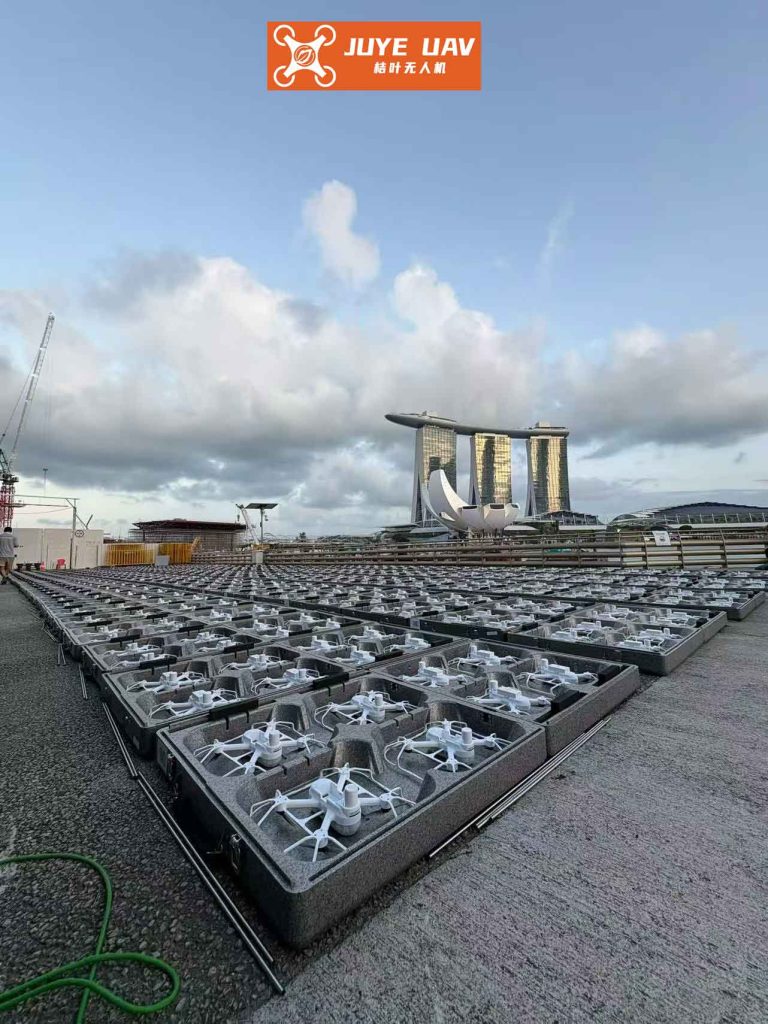
The core challenge for a formation drone light show is managing proximity. Drones must fly very close to each other to create solid-looking shapes from the audience’s perspective, often coming within meters of one another. They must also navigate their entire flight path within a defined geo-fenced volume. Unlike a single drone’s flight, a show involves a dense, dynamic swarm where the state of each agent—its position, velocity, and intended trajectory—is interdependent on the states of its neighbors. Therefore, the collision avoidance system cannot be an afterthought; it must be an integral, real-time component of the formation control logic. Effective solutions must be decentralized, scalable, and computationally efficient to run on each drone’s onboard processor.
One highly influential framework for robotic navigation and swarm control is the Artificial Potential Field (APF) method. Conceptually, it imagines the drone’s environment as a field of virtual forces. The goal position or desired formation slot generates an attractive force, pulling the drone toward it. Obstacles and other drones generate repulsive forces, pushing the drone away. The drone then moves according to the resultant force vector. For a formation drone light show, each drone’s desired position in the animation frame provides the attraction, while all other drones and the boundaries of the performance zone provide repulsion. The net force \( \vec{F}_{total,i} \) on drone \( i \) can be conceptually expressed as:
$$\vec{F}_{total,i} = \vec{F}_{att,i} + \sum_{j \neq i} \vec{F}_{rep,ij} + \sum_{o} \vec{F}_{rep,io}$$
where \( \vec{F}_{att,i} \) is the attractive force to its target, \( \vec{F}_{rep,ij} \) is the repulsive force from neighbor drone \( j \), and \( \vec{F}_{rep,io} \) is the repulsive force from static or dynamic obstacle \( o \). The velocity command for the drone is derived from this force vector.
However, a naive application of APF for a formation drone light show has significant limitations. It traditionally assumes every drone is aware of every other drone’s precise location, which is impractical from a communication bandwidth and robustness standpoint. Furthermore, it treats all inter-drone relationships as equal, lacking a mechanism to prioritize avoidance maneuvers. This is where modern consensus theory from multi-agent systems provides a crucial upgrade. We can define a communication topology—a network graph specifying which drones talk to which others. Drone \( i \) only needs information from its “neighbors” in this graph, denoted by the set \( N_i \). This reflects the realistic local communication mesh networks used in shows. We can also assign a communication weight \( a_{ij} \) to the link from drone \( j \) to drone \( i \), signifying the priority or strength of that connection.
This leads to an improved, consensus-aware APF formulation. The total potential field function \( J_i(\vec{\rho}_i) \) for drone \( i \) is not a sum over all drones, but only over its communicating neighbors, weighted accordingly:
$$J_i(\vec{\rho}_i) = \sum_{j \in N_i} a_{ij} J_{ij}(||\vec{\rho}_{ij}||)$$
Here, \( \vec{\rho}_i \) is the position vector of drone \( i \), and \( \vec{\rho}_{ij} = \vec{\rho}_i – \vec{\rho}_j \) is the relative position vector. The function \( J_{ij} \) is a pairwise potential function dependent on the distance \( ||\vec{\rho}_{ij}|| \). This approach is highly scalable and fault-tolerant for a large-scale formation drone light show.
The design of the pairwise potential function \( J_{ij} \) is paramount. It must create a strong repulsive field at very short ranges to prevent collisions, a stable equilibrium at the desired formation separation distance, and a mild attractive field at longer ranges to help maintain formation cohesion. A function inspired by the generalized Morse potential is often effective. It combines an attractive term and a repulsive term:
$$J_{ij}(||\vec{\rho}_{ij}||) = J_{ij}^{att}(||\vec{\rho}_{ij}||) + J_{ij}^{rep}(||\vec{\rho}_{ij}||)$$
For distances within the effective range \( D = (d_{min}, d_{max}] \), we can define:
$$
J_{ij}^{att} = \frac{1}{2} k_{ij} ||\vec{\rho}_{ij}||^2, \quad J_{ij}^{rep} = \frac{b}{e^{\frac{||\vec{\rho}_{ij}||}{c}} – e^{\frac{d_{min}}{c}}}
$$
where \( d_{min} \) is the absolute minimum safety distance, \( d_{max} \) is the maximum range of inter-drone influence, and \( k_{ij}, b, c \) are positive tuning constants. The repulsive term dominates when \( ||\vec{\rho}_{ij}|| \) is close to \( d_{min} \), ensuring a strong push away. The attractive quadratic term dominates at the desired separation \( d_{desired} \), creating a stable equilibrium point where the total potential is minimized. For a formation drone light show, \( d_{desired} \) corresponds to the spacing defined in the choreography.
| Parameter | Symbol | Role in Formation Drone Light Show |
|---|---|---|
| Minimum Safety Distance | \( d_{min} \) | The hard limit; drones must never be closer. Sets the “no-fly” zone around each drone. |
| Desired Formation Distance | \( d_{desired} \) | The ideal spacing between drones in a static formation shape (e.g., 1.5-3 meters). |
| Communication Weight | \( a_{ij} \) | Prioritizes avoidance. A drone may give more “right of way” to a key drone in a critical animation path. |
| Attractive Gain | \( k_{ij} \) | Controls how strongly a drone seeks its target position in the formation. Higher gain leads to tighter tracking but may cause overshoot. |
| Repulsive Magnitude | \( b \) | Controls the strength of the repulsive push. Must be high enough to prevent collisions but not so high as to cause violent jerks. |
The velocity field command for drone \( i \), derived from the negative gradient of the total potential ( \( \vec{V}_i = -\nabla_{\vec{\rho}_i} J_i \) ), incorporating the consensus weights, becomes:
$$\vec{V}_i^{form} = \sum_{j \in N_i} a_{ij} \left( -k_{ij}||\vec{\rho}_{ij}|| + \frac{b}{c} \frac{e^{\frac{||\vec{\rho}_{ij}||}{c}}}{(e^{\frac{||\vec{\rho}_{ij}||}{c}} – e^{\frac{d_{min}}{c}})^2} \right) \frac{\vec{\rho}_{ij}}{||\vec{\rho}_{ij}||}$$
This velocity vector dictates how drone \( i \) should move relative to its neighbors to maintain both formation shape and safe separation. It is a continuous, reactive control law.
In a formation drone light show, obstacles are primarily the boundaries of the performance box and, in rare cases, unexpected objects like birds. The obstacle avoidance potential must be highly reliable. A standard repulsive field similar to the inter-drone one can be used, but with a key enhancement: incorporating relative velocity. This makes the system more efficient and anticipatory. If an obstacle (like another drone system’s lost vehicle) is moving towards the swarm, the repulsion should be stronger and activate earlier. We define the obstacle potential \( J_{io}^{rep} \) for obstacle \( o \):
$$J_{io}^{rep}(||\vec{\rho}_{io}||) = \left(1 + \kappa(V_o)\right) \cdot \frac{b_o}{e^{\frac{||\vec{\rho}_{io}||}{c_o}} – e^{\frac{d_{min,o}}{c_o}}}$$
where \( \vec{\rho}_{io} = \vec{\rho}_i – \vec{\rho}_o \), and \( V_o \) is the closing speed (the component of the relative velocity along the line connecting drone and obstacle). The function \( \kappa(V_o) \) is zero when the obstacle is stationary or moving away, and increases with positive closing speed:
$$\kappa(V_o) = e^{-1/V_o} \quad \text{for} \quad V_o > 0$$
This means a fast-approaching object generates a significantly larger repulsive potential, prompting a more urgent evasive maneuver from the drones in the formation drone light show.
The complete desired velocity command for drone \( i \), combining formation-keeping and obstacle avoidance, is then:
$$\vec{V}_i^{des} = \vec{V}_i^{form} + \vec{V}_i^{obs} + \vec{V}_i^{nominal}$$
Here, \( \vec{V}_i^{obs} \) is the velocity contribution from the obstacle gradient, and \( \vec{V}_i^{nominal} \) is the drone’s pre-planned trajectory velocity for the animation. This summed vector \( \vec{V}_i^{des} = [V_{x,i}^{des}, V_{y,i}^{des}, V_{z,i}^{des}]^T \) is the output of the high-level collision avoidance algorithm. It provides the instantaneous kinematic goal.
However, a velocity command is just an instruction. The drones must execute it precisely. This requires a dedicated flight controller—a lower-level control system that takes the desired velocity vector (or its conversion into desired speed, pitch, and yaw angles) and commands the drone’s motors and control surfaces to achieve it. For multi-rotor drones used in light shows, this typically involves a cascaded control structure. The high-level collision avoidance module outputs a desired velocity \( \vec{V}_i^{des} \). This is compared to the actual velocity \( \vec{V}_i \) to generate a desired acceleration or thrust vector via a Proportional-Integral-Derivative (PID) controller. This thrust vector is then decomposed by the drone’s attitude controller into individual motor speeds to achieve the required lift and tilt.
The mathematical representation of this tracking control for a simplified linearized model can be expressed as follows. Let the drone’s longitudinal state vector be \( \mathbf{x}_i = [V_i, \theta_i, q_i]^T \) (speed, pitch angle, pitch rate) and its control input be \( \mathbf{u}_i = [\delta_{thrust,i}, \delta_{tilt,i}]^T \). A state-space model approximates the dynamics:
$$\dot{\mathbf{x}}_i = \mathbf{A} \mathbf{x}_i + \mathbf{B} \mathbf{u}_i$$
The flight controller’s job is to compute \( \mathbf{u}_i \) so that the drone’s actual velocity tracks \( \vec{V}_i^{des} \). A PID control law for the velocity error \( \mathbf{e}_v = \vec{V}_i^{des} – \vec{V}_i \) would be:
$$\mathbf{u}_i(t) = \mathbf{K}_P \mathbf{e}_v(t) + \mathbf{K}_I \int_0^t \mathbf{e}_v(\tau) d\tau + \mathbf{K}_D \frac{d\mathbf{e}_v(t)}{dt}$$
The matrices \( \mathbf{K}_P, \mathbf{K}_I, \mathbf{K}_D \) are tuned for stable and responsive performance. This inner loop runs at a very high frequency (e.g., hundreds of Hertz), ensuring the drone faithfully follows the commands from the slower-running (tens of Hertz) collision avoidance algorithm.
The integration of the improved APF-based collision avoidance with the flight controller creates a robust, hierarchical control system for a formation drone light show. The following table summarizes the information flow and the role of each component in this integrated system.
| System Layer | Function | Key Inputs | Key Outputs | Frequency |
|---|---|---|---|---|
| Collision Avoidance Algorithm | Computes safe desired velocity based on neighbor positions, obstacle data, and formation target. | Neighbor states (from network), Own GPS/IMU, Pre-planned path, Obstacle map. | Desired velocity vector \( \vec{V}_i^{des} \) (or converted to desired speed, pitch, yaw). | Medium (10-50 Hz) |
| Flight Controller (Inner Loop) | Stabilizes drone and tracks the desired velocity/attitude commands. | Desired commands from CA layer, Actual state from onboard sensors (gyro, accelerometer). | Motor PWM signals (individual motor speeds). | High (100-500 Hz) |
| Communication Mesh | Distributes state information (position, velocity) among neighboring drones according to the topology. | Own state. | Broadcasts state to neighbors; receives neighbor states. | Synchronized with CA layer |
To conceptually illustrate the effectiveness of such a system, consider a critical transition in a formation drone light show, such as switching from a tight globe to a rapidly expanding ring. Drones start in close proximity (near \( d_{min} \)) and must move outward quickly without colliding. The consensus-aware APF ensures that each drone calculates its repulsion based on its immediate neighbors in the communication graph, not the entire swarm. The repulsive forces naturally orchestrate an orderly expansion. Drones with higher priority weights (e.g., those on critical leading edges of the animation) might experience less “push” from others, ensuring the overall shape deforms correctly. The inclusion of the velocity-dependent term in obstacle avoidance would be critical if a drone were to malfunction and stop mid-air; others approaching it would sense a high closing speed and initiate a strong, early evasion, potentially rerouting around the stalled unit to preserve the overall show integrity.
The performance of this methodology can be evaluated through key metrics essential for a commercial formation drone light show:
| Performance Metric | Description | How the Improved APF System Addresses It |
|---|---|---|
| Safety (Zero Collisions) | The ultimate requirement. No physical contact between drones or with obstacles. | The repulsive potential \( J^{rep} \) approaches infinity as \( ||\vec{\rho}|| \rightarrow d_{min} \), creating a virtually impassable force field at the minimum distance. |
| Formation Accuracy | Precision in achieving the intended choreographed shapes and smooth transitions. | The attractive potential \( J^{att} \) and the equilibrium at \( d_{desired} \) provide steady-state accuracy. Consensus weights help preserve key shape features. |
| Smoothness of Motion | Audience-perceived fluidity of animations, free from jerky corrections. | The continuous, gradient-based velocity field produces smooth trajectories. Proper tuning of parameters \( b, c, k \) prevents oscillatory behavior. |
| Scalability | Ability to maintain performance as the number of drones increases from hundreds to thousands. | Local communication topology (neighbor sets \( N_i \)) ensures each drone’s computation is independent of total swarm size, enabling scalability. |
| Robustness to Failures | Resilience against loss of a drone or a communication link. | Decentralized control means the loss of one drone doesn’t crash the system. The mesh network can often reroute information. |
In conclusion, the magic of a modern formation drone light show is fundamentally an engineering marvel in distributed real-time control. By adapting and enhancing principles from artificial potential fields and multi-agent consensus theory, developers have created robust systems that seamlessly blend artistry with safety. The improved artificial potential field method, incorporating local communication topologies and weighted interactions, provides a mathematically elegant and practically effective framework for decentralized collision avoidance. When tightly integrated with responsive flight control loops, it allows hundreds of autonomous agents to dance in perilously close proximity, weaving complex, collision-free paths across the night sky. This technology not only ensures the flawless execution of today’s breathtaking formation drone light show but also paves the way for future applications in dense urban air mobility, where safe and efficient navigation in crowded airspace is paramount. The continuous evolution of these algorithms will enable ever more ambitious and intricate aerial symphonies, pushing the boundaries of what is possible in coordinated robotic flight.