
As an expert deeply engaged in the field of unmanned aerial vehicle (UAV) security, I have observed how the rapid advancement of drone technology has transformed both civilian and military operations. While drones bring immense benefits—from aerial photography to agricultural monitoring—they also pose unprecedented risks to national security, public safety, and individual privacy. The phenomenon of “black flights” (unauthorized drone operations) interfering with manned aviation, invading restricted zones, and facilitating criminal activities has become a pressing concern. In this comprehensive analysis, I will examine the key characteristics of modern drones, the critical countermeasure technologies, the persistent challenges we face in the countermeasure domain, and the strategic solutions required to address these issues, all while emphasizing the indispensable role of drone regulation. Effective drone regulation is not merely a legal framework; it is the backbone that ensures the safe integration of drones into our airspace. Without robust drone regulation, the risks associated with drone misuse will continue to escalate.
Overview of Drone Characteristics
To develop effective countermeasures, we must first understand the inherent features of modern drones that make them both useful and dangerous. The following table summarizes the key characteristics of typical consumer-grade and industrial-grade drones, highlighting parameters that directly impact countermeasure strategies.
| Characteristic | Consumer-Grade (e.g., DJI Mavic) | Industrial-Grade (e.g., agricultural sprayers) | Implication for Countermeasures |
|---|---|---|---|
| Maximum Speed | 15–20 m/s | 10–15 m/s | Requires rapid detection and response |
| Operating Altitude | 0–500 m | 0–1000 m | Low-altitude detection is challenging |
| Payload Capacity | 0.5–2 kg | 10–50 kg | Can carry harmful substances or explosives |
| Endurance | 20–30 min | 30–60 min | Short window for interception |
| Communication | 2.4/5.8 GHz, Wi-Fi | 4G/5G, proprietary links | Vulnerable to jamming but adaptable |
| Navigation | GPS/GLONASS/BDS | Multi-constellation RTK | Spoofing possible with low signal strength |
One of the most critical features is the low-altitude, slow-speed, small-size (often abbreviated as “low-slow-small” or LSS) profile of many consumer drones. This profile makes them difficult to detect by traditional radar systems, which are optimized for fast-moving, high-altitude targets. Moreover, the cost and operational threshold for these drones have dropped dramatically. A hobbyist can purchase a capable quadcopter for a few hundred dollars online, and even assemble one from readily available components. This low barrier to entry directly undermines traditional drone regulation efforts, as enforcement becomes nearly impossible when millions of devices are in circulation. Additionally, modern drones incorporate advanced flight controllers with features such as automatic return-to-home, geofencing, and obstacle avoidance. While these enhance safety in normal use, they also complicate countermeasure efforts because a jammed drone may autonomously return to its launch point rather than crash, requiring careful planning during interdiction.
The technological sophistication of drones continues to evolve. For instance, the integration of 5G networks enables low-latency command and control, allowing operators to fly beyond visual line of sight (BVLOS) with greater reliability. This capability, while beneficial for legitimate operations like pipeline inspection, also enables malicious actors to launch attacks from remote locations. Consequently, the effectiveness of drone regulation must be continuously updated to keep pace with technological advances. Without a dynamic regulatory framework, countermeasure technologies will always be one step behind.
Key Technologies for Drone Countermeasures
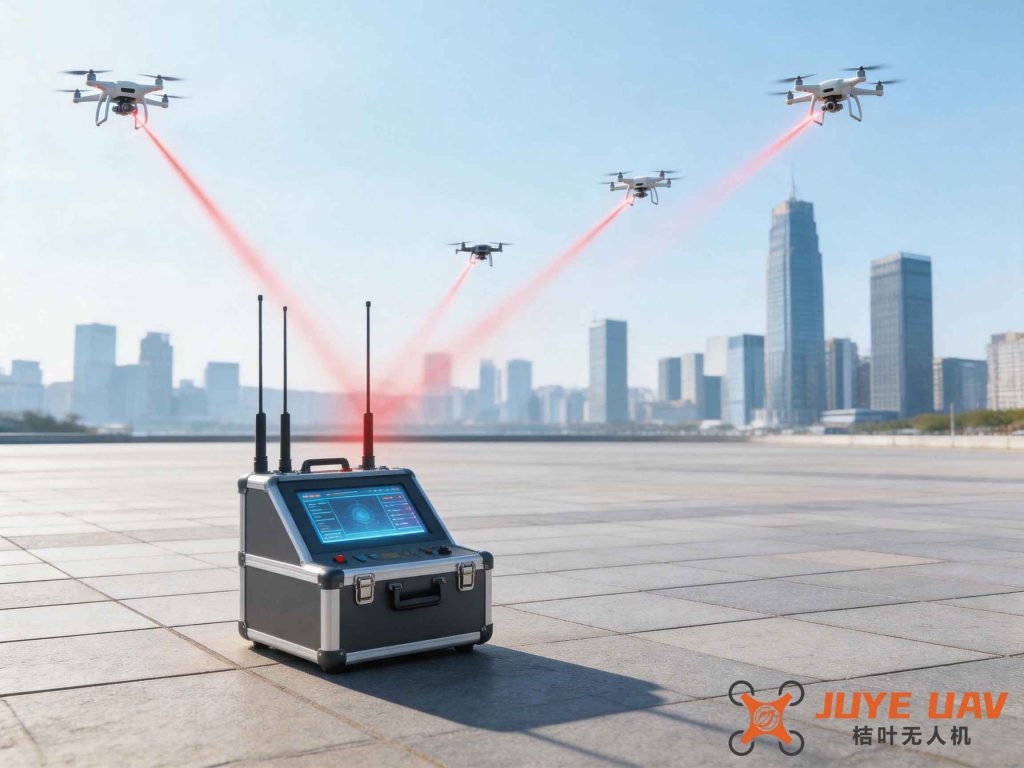
Drone countermeasure technologies can be broadly categorized into four groups: interference and blocking, direct destruction, interception and capture, and deception and control. Each has its own advantages and limitations, and the choice of technology depends on the operational environment, legal constraints, and desired outcomes. A strong drone regulation policy should guide the selection and deployment of these technologies to minimize collateral damage.
Interference and Blocking Technologies
Electromagnetic Interference (EMI): EMI disrupts the communication link between the drone and its remote controller, effectively severing command, telemetry, and video signals. The required jamming power can be estimated using the standard link budget equation:
$$P_{jam} = \frac{P_t G_t G_r \lambda^2}{(4\pi R)^2 L} \cdot \frac{1}{\text{SNR}_{\text{req}}}$$
where \(P_t\) is the transmitter power, \(G_t\) and \(G_r\) are antenna gains, \(\lambda\) is the wavelength, \(R\) is the range, \(L\) accounts for system losses, and \(\text{SNR}_{\text{req}}\) is the required signal-to-noise ratio for successful jamming. For typical consumer drones operating at 2.4 GHz, a jamming power of 10–20 W is often sufficient to disrupt links within 1–2 km. However, high-power jammers can interfere with other legitimate communications in the area, including aircraft navigation systems and mobile networks. Therefore, drone regulation must specify when and where such jammers can be activated, especially near airports or urban centers.
Navigation Signal Jamming: Civilian drones rely on Global Navigation Satellite Systems (GNSS) such as GPS, BeiDou, or GLONASS for positioning. Because GNSS signals are extremely weak (typically below -130 dBm), they are vulnerable to jamming. A simple jamming source can generate wideband noise over the L1 frequency (1575.42 MHz) to deny the drone its position fix. The effective jamming distance is given by:
$$R_{\text{jam}} = \sqrt{\frac{P_j G_j G_{\text{rec}} \lambda^2}{(4\pi)^2 \cdot \text{SNR}_{\text{min}} \cdot kTB}}$$
where \(P_j\) is jamming power, \(G_j\) is jamming antenna gain, \(G_{\text{rec}}\) is the receiver antenna gain, \(k\) is Boltzmann’s constant, \(T\) is system temperature, and \(B\) is the receiver bandwidth. While effective, this technique can also disrupt nearby GNSS receivers used by aircraft, ships, and even cellular base stations for timing synchronization. Responsible drone regulation mandates that navigation jammers be used only in emergency scenarios after assessing the risk to critical infrastructure.
Acoustic Interference: Some drones use MEMS gyroscopes for attitude stabilization. Acoustic resonance at the gyroscope’s natural frequency can cause the sensor to output erroneous data, leading to loss of control. The resonant frequency \(f_0\) of a typical MEMS gyroscope is around 10–20 kHz. By emitting a high-intensity acoustic wave tuned to this frequency, we can induce mechanical failure. However, the effective range is limited (typically < 50 m) and the cost of acoustic arrays is high, making it unsuitable for large-scale deployment. Drone regulation currently does not address acoustic countermeasures, but as the technology matures, regulatory guidelines will be necessary.
Direct Destruction Technologies
Kinetic solutions such as missiles, anti-drone guns, and lasers can physically destroy a drone. For example, a high-energy laser can melt or ablate the drone’s structure. The required laser power depends on the target’s reflectivity and flight speed:
$$P_{\text{laser}} = \frac{E_{\text{threshold}}}{\tau} \cdot \frac{1}{\eta}$$
where \(E_{\text{threshold}}\) is the energy needed to cause critical damage, \(\tau\) is the dwell time, and \(\eta\) is the coupling efficiency. While effective, these methods are expensive, produce falling debris, and may cause collateral damage in populated areas. Furthermore, using lethal force against a drone may raise legal and ethical questions. Comprehensive drone regulation must clearly define the circumstances under which kinetic destruction is permissible, requiring strict authorization from relevant authorities.
Interception and Capture Technologies
Net-based capture using larger drones, shotguns with net rounds, or trained raptors (e.g., eagles) offer non-destructive alternatives. However, these methods are limited by range, operator skill, and the drone’s agility. The probability of successful capture \(P_{\text{capture}}\) can be modeled as:
$$P_{\text{capture}} = \frac{1}{1 + e^{-\alpha (d – d_0)}}$$
where \(d\) is the distance from the interceptor, \(d_0\) is the effective range parameter, and \(\alpha\) is a coefficient related to the drone’s speed and maneuverability. With modern obstacle avoidance systems, drones can actively evade net-based traps, reducing capture success rates. Drone regulation should encourage the development of automated capture systems that integrate with air traffic management to avoid secondary accidents.
Deception and Control Technologies
Navigation Spoofing: By generating fake GNSS signals, we can manipulate the drone’s perceived position, forcing it to fly to a predetermined landing zone or return to a false home point. The spoofing signal must be synchronized with the authentic signal and slightly more powerful. The required signal power ratio is often less than 1 dB. This is a “soft kill” approach that avoids debris. However, it requires precise knowledge of the drone’s receiver architecture. Drone regulation can mandate that all commercially sold drones include authentication mechanisms (e.g., Galileo’s Public Regulated Service) to resist spoofing, thereby closing a vulnerability that current regulations often overlook.
Radio Signal Hijacking: Some drones use unencrypted or weakly encrypted communication protocols. By recording and replaying control packets, or by brute-forcing the protocol, an interceptor can take over the drone. The difficulty of hijacking increases with stronger encryption. For instance, DJI’s newer models use AES-256 encryption, which is computationally infeasible to break in real time. Drone regulation could require manufacturers to implement standard encryption and provide backdoor access only to law enforcement under strict judicial oversight—a contentious but potentially effective measure.
Hacktivism (Cyber Attacks): Drones that rely on Wi-Fi or cellular connections are susceptible to common cyber exploitation techniques. While this approach can be powerful, it demands significant expertise and often requires access to the drone’s internal network. The legal framework for cyber countermeasures is still murky. Drone regulation must evolve to include provisions for cyber interdiction, balancing operational needs against privacy and data security rights.
Current Challenges in the Drone Countermeasure Domain
Despite the availability of various countermeasure technologies, several systemic challenges hinder their effective deployment. These challenges are intimately linked to the inadequacy of existing drone regulation frameworks.
Technological Lag: Countermeasure Systems vs. Drone Evolution
Drone technology evolves at a breakneck pace. In the past decade, we have seen the emergence of autonomous swarms, anti-jamming antennas, and stealth-like designs. Meanwhile, many countermeasure systems are based on decade-old assumptions. For example, early drone jammers were designed to block 2.4 GHz only, but modern drones use frequency-hopping spread spectrum (FHSS) and adaptive channel selection. The following table compares typical drone capabilities across generations:
| Feature | 2015 Generation | 2020 Generation | 2025 Generation (Expected) |
|---|---|---|---|
| Communication Band | 2.4 GHz fixed | 2.4/5.8 GHz FHSS | 2.4/5.8/60 GHz + 4G/5G |
| Anti-jamming | None | Basic spread spectrum | Adaptive frequency hopping + beamforming |
| Navigation | GPS only | GPS+GLONASS | Multi-constellation + IMU fusion |
| Autonomy | Manual control | Waypoint + return-to-home | Full autonomous swarming |
| Radar Signature | Large RCS | Reduced RCS via shaping | Stealth coatings and low-probability-of-intercept |
As the table shows, each new generation outpaces the countermeasures designed for the previous one. The gap is exacerbated by the fact that many countermeasure systems are developed by military contractors for defense applications, where cost and size are secondary. Civilian applications demand low-cost, portable, and non-lethal solutions, but the market has not yet delivered. Drone regulation can stimulate innovation by creating certification standards for countermeasure equipment and by funding research through public-private partnerships.
Inadequate Public Awareness and Regulatory Enforcement
One of the most profound challenges is the public’s limited understanding of drone risks. Most drone operators are unaware of the legal restrictions regarding altitude, no-fly zones, and privacy. Even when regulations exist, enforcement is spotty. For example, many countries require drone registration, but the sheer number of devices makes enforcement nearly impossible. The following equation illustrates the compliance challenge:
$$C_{\text{compliance}} = \frac{N_{\text{registered}}}{N_{\text{total}}} \times 100\%$$
In many regions, the registration rate is estimated to be below 20% for recreational drones. Without a digital identification system (e.g., Remote ID) embedded in every drone, authorities cannot reliably identify, track, or pursue violators. Drone regulation must mandate Remote ID on all drones above a certain weight, and ensure that the data is accessible to law enforcement in real time. Furthermore, public education campaigns should highlight the dangers of “black flights” and the legal consequences. Only when society internalizes the risks can voluntary compliance improve.
Indiscriminate Countermeasures and Secondary Hazards
Many existing countermeasure devices are designed with a “one-size-fits-all” approach, often causing collateral damage. High-power jammers can disrupt nearby hospitals, airport radars, and emergency services. Kinetic interception in urban areas may lead to drone crashes onto roads or buildings, causing injuries or fires. The risk of secondary damage can be quantified using a simplified risk equation:
$$R_{\text{secondary}} = P_{\text{failure}} \cdot C_{\text{consequence}}$$
where \(P_{\text{failure}}\) is the probability that the countermeasure causes the drone to land in an unsafe location, and \(C_{\text{consequence}}\) is the expected damage cost. For example, a jammed drone that loses GPS may drift into a crowd. Without proper risk assessment, the cure can be worse than the disease. Drone regulation should require an operational risk analysis before deploying any countermeasure, and establish graduated response protocols: first use non-destructive methods (jamming, spoofing), then escalate to capture, and only in extreme cases resort to destruction. Moreover, all countermeasure operators must be certified and trained to minimize unintended consequences.
Strategic Solutions to Enhance Drone Countermeasure Effectiveness
To address the above challenges, we need a multi-faceted strategy that combines technological innovation, regulatory modernization, and public engagement. The following subsections detail the key measures.
Innovate Countermeasure Technologies and Integrate Cloud Intelligence
We must accelerate the development of adaptive countermeasure systems that can keep pace with drone evolution. One promising approach is the use of cloud-based artificial intelligence (AI) to classify drones and select optimal countermeasures. For instance, a distributed sensor network (RF, radar, optical) can feed data to a central AI that identifies the drone’s model, communication protocol, and flight path. The AI then recommends the most effective jamming or spoofing technique with minimal interference to other radio services. The decision can be based on a multi-objective optimization:
$$\min \left( w_1 \cdot \text{Interference Level} + w_2 \cdot \text{Collateral Risk} \right)$$
subject to a minimum probability of neutralization \(P_{\text{neutralization}} \geq 0.95\). Such a system would greatly enhance the precision and safety of countermeasures. Drone regulation must establish standards for cloud-based drone identification and data sharing among agencies, ensuring privacy while enabling rapid response.
Another technological pathway is the development of directed energy weapons that can disable drones without producing debris. High-power microwaves (HPM) can overwhelm a drone’s electronics, causing it to lose control and land safely. The required power density is on the order of 10–100 kW/m² at the target. Drone regulation should create test ranges and safety guidelines for HPM devices, accelerating their transition from military to civilian use.
Enhance Public Awareness and Community-Based Oversight
No amount of technology can replace a vigilant public. We need to launch nationwide campaigns to educate citizens about drone safety and the importance of drone regulation. Social media, public service announcements, and school programs can disseminate information about prohibited areas, registration requirements, and reporting suspicious drone activity. Pilot communities (e.g., residential areas near airports) can be trained to report “black flights” via a mobile app, which feeds into a centralized monitoring system. The reporting rate can be modeled as:
$$P_{\text{report}} = \frac{N_{\text{aware}} \cdot f_{\text{convenience}}}{1 + e^{-\beta (t – t_0)}}$$
where \(f_{\text{convenience}}\) is a factor reflecting the ease of reporting, and \(t\) is time since campaign launch. By simplifying the reporting process (e.g., one-click report with geotagging), we can dramatically increase community participation. Drone regulation should also incentivize manufacturers to incorporate “no-fly zone” constraints directly into their firmware, leveraging geofencing as a first line of defense.
Deploy Countermeasures Judiciously to Minimize Collateral Damage
We must adopt a tiered countermeasure deployment strategy based on location and threat level. The following table summarizes recommended approaches for different scenarios:
| Location Type | Examples | Preferred Countermeasure | Avoided Methods |
|---|---|---|---|
| Dense Urban | City centers, stadiums | Navigation spoofing, radio hijacking | Kinetic destruction, high-power jamming |
| Critical Infrastructure | Power plants, military bases | Net capture, high-power microwave | Explosive or projectile-based |
| Remote Areas | Rural farms, deserts | Kinetic destruction, laser | Collateral risk minimal |
| Airliner Flight Paths | Near airports | GPS spoofing to redirect away | Any method causing drone to fall |
In addition, we should develop counter-drone drones that can physically intercept and escort rogue drones away from sensitive areas. These interceptors can be equipped with non-lethal payloads such as sticky nets or electronic disruptors. Drone regulation must authorize and license such interceptors, ensuring they have right-of-way over other drones. Furthermore, international coordination on drone regulation is essential because drones do not respect borders. A drone launched from one country can easily cross into another, necessitating harmonized rules on countermeasure use and data sharing.
Conclusion
In summary, the rapid proliferation of drones has created a challenging landscape for security professionals. The key characteristics of modern drones—low cost, high performance, and ease of operation—make them both valuable tools and potential threats. While a variety of countermeasure technologies exist, from jamming to kinetic destruction, each has limitations and carries risks of collateral damage. The most pressing issues we face include the technological gap between countermeasure systems and drone evolution, inadequate public awareness and enforcement of regulations, and the potential for secondary harm from indiscriminate countermeasures. To overcome these problems, we must pursue a holistic approach that combines technological innovation (cloud AI, adaptive jamming, directed energy) with robust drone regulation that mandates Remote ID, geofencing, and graduated response protocols. Public education campaigns and community-based reporting systems should supplement formal enforcement. Finally, the deployment of countermeasures must be tailored to the operational environment, prioritizing soft-kill methods in urban areas and reserving kinetic options for remote or high-threat scenarios. Only by integrating technology, regulation, and societal vigilance can we stay ahead of the evolving drone threat and ensure that the benefits of drone technology are not overshadowed by the risks. The path forward demands continuous research, investment, and international collaboration on drone regulation to create a safe and secure airspace for all.