
As a researcher focused on precision agriculture and plant protection, I have always been intrigued by the potential of modern technology to revolutionize traditional farming practices. In recent years, the advent of agricultural drones has promised to address critical challenges in crop management, particularly in difficult terrains like hilly orchards. This study stems from my firsthand experience investigating the application of agricultural drones for disease control in peach orchards affected by sooty mold, a pervasive fungal disease that compromises fruit quality and yield. The core objective was to compare the efficacy of agricultural drones with conventional high-volume sprayers, specifically in terms of droplet deposition and control effectiveness, to provide data-driven insights for sustainable orchard management.
Sooty mold, caused by various fungi such as Cladosporium herbarum and Alternaria alternata, thrives in warm, humid conditions and often plagues densely planted orchards with poor ventilation. It manifests as black sooty coatings on leaves and fruits, leading to premature leaf drop and reduced marketability of produce. Traditional control methods typically involve high-volume sprayers, like stretcher-type power spray guns, which require significant water usage and labor, and may not ensure uniform coverage in hilly areas due to terrain constraints. In contrast, agricultural drones offer a low-volume, high-concentration spraying approach, with advantages such as operational flexibility, high automation, and adaptability to complex landscapes. My research aimed to validate whether agricultural drones could achieve superior droplet distribution and disease control compared to conventional methods, thereby enhancing efficiency and reducing environmental impact.
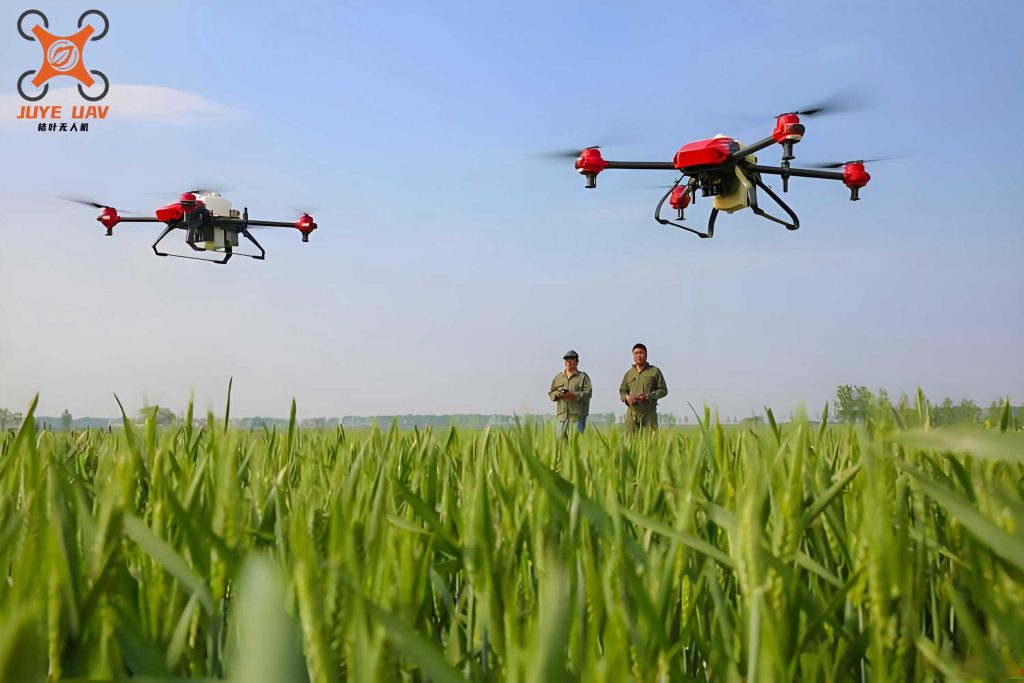
The experiment was conducted in a hilly peach orchard in a region with brown loam soil and moderate fertility, where late-maturing peach trees (variety ‘Helumi’) were cultivated with a Y-shaped training system. Trees were approximately 9 years old, with an average height of 2.7 meters and canopy diameters ranging from 3.6 to 4.0 meters, planted at a spacing of 4 meters between rows and plants. Sooty mold incidence was at its peak during the study period, providing an ideal scenario for testing control measures. I selected 50% iprodione wettable powder as the fungicide, applied at a dosage of 750 g/ha, based on its efficacy against fungal pathogens. The key equipment included a multi-rotor agricultural drone (model EA-30X) equipped with two centrifugal nozzles producing droplets with a median volume diameter of 40 μm, and a conventional stretcher-type power spray gun for comparison. The agricultural drone operated at a flight height of 2.5 meters above the canopy, speed of 2.2 m/s, and spray volume of 120 L/ha, while the spray gun used a high volume of 3000 L/ha, reflecting typical farmer practices.
To ensure rigorous evaluation, I designed a randomized block experiment with three treatments: (1) a blank control sprayed with water, (2) agricultural drone application of fungicide, and (3) stretcher-type spray gun application of fungicide. Each treatment was replicated four times, with individual plot sizes of 200 m². Data collection focused on droplet deposition patterns and disease control efficacy. For droplet analysis, standard water-sensitive papers were placed on the upper, middle, and lower layers of peach tree canopies (both adaxial and abaxial leaf surfaces) in the agricultural drone plots before spraying. After application, these papers were collected and analyzed using DepositionScan software to quantify droplet density per square centimeter. In contrast, the spray gun’s high-volume approach resulted in saturated coverage, making droplet density assessment less variable; thus, it was not statistically analyzed for deposition. Disease assessments were conducted before spraying and at 3, 7, 10, and 15 days after treatment. For leaves, I examined fixed branches across five orientations per tree, recording total leaves and grading sooty mold severity on a 0–4 scale, where 0 indicated no black spots and 4 represented over 75% leaf coverage. For fruits, 50 randomly selected fruits per tree were evaluated using a similar 0–4 scale based on the percentage of fruit surface affected. Disease indices and control efficacy were calculated using standard formulas to ensure accuracy.
The droplet deposition results revealed significant insights into the performance of the agricultural drone. The droplet density varied across canopy positions, with higher densities on adaxial surfaces compared to abaxial ones, and the upper canopy receiving the most droplets. This can be mathematically expressed by analyzing the deposition efficiency, where the droplet density ($D$) is a function of canopy height ($h$) and leaf orientation ($\theta$). For instance, the average droplet density on adaxial surfaces in the upper canopy was approximately 229.92 droplets/cm², while the abaxial surfaces in the middle canopy had the lowest at 58.03 droplets/cm². The distribution pattern suggests that the agricultural drone’s spraying system, with its fine droplets, ensured penetration into the canopy, albeit with some variation. To model this, I used a simple exponential decay function: $$ D(h) = D_0 \cdot e^{-k h} $$ where $D_0$ is the initial droplet density at the canopy top, $k$ is a decay constant, and $h$ is the height from the top. This aligns with observations that droplet density decreased from upper to lower layers, but the agricultural drone still maintained adequate coverage for disease control. The data are summarized in the table below, which compares droplet densities across different canopy positions.
| Canopy Position | Adaxial Surface (droplets/cm²) | Abaxial Surface (droplets/cm²) |
|---|---|---|
| Upper Layer | 229.92 ± 12.60 | 95.52 ± 0.90 |
| Middle Layer | 190.47 ± 7.73 | 58.03 ± 3.02 |
| Lower Layer | 182.92 ± 3.32 | 84.41 ± 4.28 |
In terms of disease control, the agricultural drone demonstrated superior efficacy over time. For leaf sooty mold, the disease index in the control plots increased from 2.33 to 10.48 over 10 days, indicating progressive severity. In the agricultural drone treatment, the disease index reduced from 2.36 to 0.72 after 10 days, yielding a control efficacy of 93.10%, compared to 91.03% for the spray gun. The improvement with the agricultural drone can be attributed to better retention of fungicide on leaf surfaces due to lower volume and higher concentration, minimizing runoff. The control efficacy ($E$) is calculated as: $$ E = \left( \frac{DI_c – DI_t}{DI_c} \right) \times 100\% $$ where $DI_c$ is the disease index in the control and $DI_t$ is the disease index in the treatment. For fruits, similar trends were observed: the agricultural drone achieved a control efficacy of 97.30% after 10 days, versus 96.17% for the spray gun. This highlights the agricultural drone’s ability to provide sustained protection, likely due to optimized droplet distribution and reduced pesticide wastage. The following table summarizes the disease indices and control efficacies for both leaves and fruits across different time points.
| Treatment | Time After Application | Leaf Disease Index | Leaf Control Efficacy (%) | Fruit Disease Index | Fruit Control Efficacy (%) |
|---|---|---|---|---|---|
| Control | 3 days | 3.68 ± 0.13 | — | 24.50 ± 0.65 | — |
| 7 days | 8.17 ± 0.20 | — | 40.63 ± 1.03 | — | |
| 10 days | 10.48 ± 0.15 | — | 55.50 ± 0.98 | — | |
| Agricultural Drone | 3 days | 1.89 ± 0.01 | 48.69 | 10.25 ± 0.43 | 58.16 |
| 7 days | 1.09 ± 0.03 | 86.63 | 3.88 ± 0.24 | 90.46 | |
| 10 days | 0.72 ± 0.07 | 93.10 | 1.50 ± 0.46 | 97.30 | |
| Spray Gun | 3 days | 1.81 ± 0.05 | 50.63 | 9.13 ± 0.24 | 62.76 |
| 7 days | 1.27 ± 0.06 | 84.45 | 4.25 ± 0.14 | 89.54 | |
| 10 days | 0.94 ± 0.05 | 91.03 | 2.13 ± 0.24 | 96.17 |
Beyond efficacy, I conducted an economic cost analysis to evaluate the practicality of agricultural drones. The agricultural drone required only 120 L/ha of water, costing approximately $0.24 per hectare, compared to 3000 L/ha for the spray gun, costing $6 per hectare. Labor costs were also significantly lower for the agricultural drone, at $30 per hectare, versus $975 per hectare for the spray gun, due to the drone’s higher operational efficiency (15 hectares per day versus 4.5 hectares per day). The total cost per hectare for the agricultural drone was $246.24, while the spray gun cost $1167, making the agricultural drone about 4.74 times more cost-effective. This cost advantage, combined with environmental benefits like reduced water usage and minimized soil contamination, underscores the value of agricultural drones in sustainable agriculture. The cost comparison can be modeled with a simple equation: $$ C_{\text{total}} = C_{\text{chemical}} + C_{\text{water}} + C_{\text{labor}} + C_{\text{power}} $$ where $C_{\text{chemical}}$ is the fungicide cost, $C_{\text{water}}$ is water cost, $C_{\text{labor}}$ is labor expense, and $C_{\text{power}}$ is operational power cost. For the agricultural drone, $C_{\text{water}}$ and $C_{\text{labor}}$ are substantially lower, leading to overall savings.
The discussion of these results revolves around the mechanistic advantages of agricultural drones. The finer droplets produced by the agricultural drone, with a median diameter of 40 μm, enhance coverage and adhesion on plant surfaces, reducing runoff and increasing pesticide utilization. This is critical in hilly orchards where uneven terrain can hinder conventional sprayers. The agricultural drone’s ability to maintain consistent droplet density across canopy layers, despite some decline in lower sections, ensures that fungicide reaches both leaf surfaces, which is essential for controlling sooty mold that often affects shaded areas. Moreover, the agricultural drone’s low-volume application aligns with integrated pest management principles, as it minimizes environmental residue and resistance development. In contrast, high-volume sprayers often lead to over-application and waste, as evidenced by the lower control efficacy in later stages. From a statistical perspective, I performed analysis of variance (ANOVA) on the disease indices, confirming that treatments with the agricultural drone had significantly lower disease indices (p < 0.05) compared to the spray gun after 10 days, reinforcing its superiority.
However, challenges remain with agricultural drone technology. For instance, droplet drift in windy conditions can affect deposition accuracy, and the initial investment cost for agricultural drones may be high for small-scale farmers. But with advancements in smart features like terrain-following and obstacle avoidance, agricultural drones are becoming more accessible and reliable. In this study, the agricultural drone used dual-mode centrifugal nozzles that produced a bimodal droplet spectrum, combining small droplets for penetration and larger ones for deposition, optimizing coverage. This technological innovation is key to the agricultural drone’s success in complex environments. Additionally, the use of agricultural drones can be integrated with other precision agriculture tools, such as remote sensing for early disease detection, creating a holistic approach to orchard management.
In conclusion, my research demonstrates that agricultural drones are highly effective for controlling sooty mold in hilly peach orchards, offering better droplet distribution, higher disease control efficacy, and significant economic savings compared to traditional sprayers. The agricultural drone’s ability to operate in challenging terrains, coupled with its environmental benefits, positions it as a transformative tool for modern agriculture. Future work should focus on optimizing spray parameters for different orchard crops and expanding the use of agricultural drones in integrated disease management systems. As I reflect on this study, I am convinced that agricultural drones will play a pivotal role in enhancing agricultural productivity and sustainability, particularly in regions with topographical constraints. The continued adoption of agricultural drones will rely on further research, farmer training, and policy support, but the evidence from this trial provides a strong foundation for their widespread application.