
The increasing integration of Unmanned Aerial Vehicles (UAVs), or drones, into law enforcement operations represents a significant technological shift. From crime scene investigation and traffic accident reconstruction to patrols, surveillance, and counter-terrorism, drones are becoming indispensable tools. This expansion creates an urgent and growing demand for proficient drone pilots and tactical operators within police forces. Consequently, the development of a standardized, scientific, and effective drone training curriculum within public security academies is paramount. This article, based on my research and experience, explores the construction and optimization of such a curriculum, emphasizing a multi-modal pedagogical approach tailored to produce operationally ready personnel.
The core objective of any police drone training program must be to serve practical law enforcement needs. This translates into three primary training goals: developing advanced piloting skills for complex missions, imparting knowledge of UAV regulations for both operational and administrative duties, and fostering the ability to innovate and adapt drone technology to specific policing scenarios. The curriculum must therefore be comprehensive, moving from foundational theory to hands-on flight practice and culminating in realistic tactical application exercises.
To systematically address these needs, I propose a curriculum structured around three core modules: Theory, Simulation & Flight Training, and Tactical Application. Each module requires a distinct teaching mode and operational procedure.
| Curriculum Module | Primary Teaching Mode | Core Content & Skills | Key Objective |
|---|---|---|---|
| Theory Module | Receptive Learning | Aviation regulations, Aerodynamics, Airspace Management, Data Protection Laws, “Counter-UAV” legal frameworks. | Build foundational knowledge of the legal and technical environment. |
| Simulation & Flight Training Module | Self-Learning & Tutoring | Basic & Advanced Piloting (Manual, GPS, FPV), Emergency Procedures, Payload Operation (Camera, LiDAR, Speaker). | Achieve muscle memory, proficiency, and safety in drone control. |
| Tactical Application Module | Case-Based & Inquiry-Based Learning | Mission Planning, Multi-Drone Swarm Tactics, Data Acquisition & Analysis, Scenario-Based Drills (Search & Rescue, Crowd Monitoring, Crime Scene). | Translate piloting skill into effective, real-world law enforcement solutions. |
The Theory Module is best served by a receptive learning model. The teaching procedure follows a structured path: review previous knowledge, stimulate learning motivation through real-case introductions, deliver new content, conduct consolidation exercises, evaluate understanding, and schedule spaced reviews. This efficient transmission of information is crucial for topics like aviation law. For instance, understanding the legal framework for authorizing flights in controlled airspace, governed by specific regulations, can be seen as a function of mission parameters and location, conceptually represented as:
$$ \text{Flight Clearance} = f(\text{Airspace Class}, \text{Mission Type}, \text{Operational Risk}) $$
Similarly, the technical principles of flight, such as the thrust required for a quadcopter to hover, can be introduced with basic physics:
$$ T = \frac{m \cdot g}{n \cdot \cos(\phi)} $$
where \(T\) is thrust per motor, \(m\) is mass, \(g\) is gravity, \(n\) is the number of motors, and \(\phi\) is the tilt angle. This module forms the critical knowledge base for all subsequent practical drone training.
The Simulation & Flight Training Module shifts to a self-learning and tutoring paradigm. The procedure here is Self-Study → Discussion → Instructor Guidance → Summary → Practice & Consolidation. Trainees first use flight simulators to learn controls and basic maneuvers autonomously. This phase is vital for building initial competency and safety before live flight. The core of piloting skill development lies in repeated, deliberate practice. A simplified model for skill progression in drone training could be:
$$ P(t) = P_{\text{max}} \cdot (1 – e^{-k \cdot t}) $$
where \(P(t)\) is proficiency at time \(t\), \(P_{\text{max}}\) is maximum achievable proficiency, and \(k\) is a learning rate constant dependent on training quality and individual aptitude. Following simulation, instructors provide targeted, one-on-one tutoring during actual flight sessions, correcting techniques and introducing advanced maneuvers like orbital flying, waypoint navigation, and failsafe procedure execution.
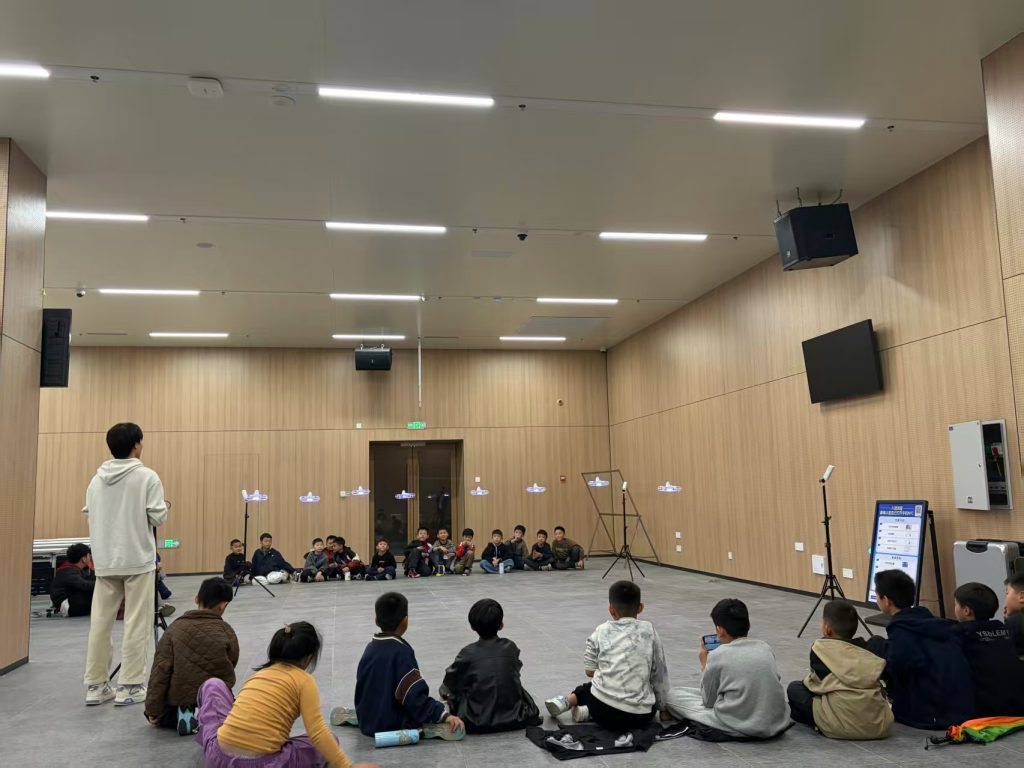
The transition to the Tactical Application Module employs case-based and inquiry-based learning. The teaching procedure follows: Present Real-World Policing Problem → Hypothesis Formulation → Tactical Reasoning → Validation via Simulation/Exercise → Summary & Improvement. Trainees analyze past operations, such as using drones for thermal imaging in a nighttime search, and brainstorm optimal flight patterns and sensor settings. They then test these hypotheses in simulated or field exercises. A key advanced concept is data processing from drone-mounted sensors. For example, the effectiveness of an aerial surveillance mission can be modeled by the amount of actionable intelligence \(I\) extracted, which is a function of sensor resolution \(R\), flight pattern coverage \(C\), and data processing algorithms \(A\):
$$ I = \int_{T} \int_{S} A(R(x,y,t), C(x,y,t)) \, dS \, dt $$
where \(S\) is the area and \(T\) is the mission time. Training in this module also covers multi-drone swarm tactics, where coordination is key. The efficiency of a search pattern with \(n\) drones can be compared to a single drone:
$$ \text{Search Efficiency Gain} = \frac{\text{Area}_{n\text{ drones}}(t)}{\text{Area}_{1\text{ drone}}(t)} \approx n^{\alpha} $$
where \(\alpha\) is a factor (\(0 < \alpha \leq 1\)) accounting for coordination overhead and communication delays. This hands-on, problem-solving approach ensures the drone training is deeply aligned with operational realities.
The successful implementation of this multi-modal drone training curriculum depends on several enabling conditions. Firstly, a hybrid instructor model is essential. While core law enforcement tactics must be taught by experienced officers, specialized flight instruction and technical theory can be delivered by certified civilian UAV instructors or engineers brought in through partnerships. Secondly, training infrastructure must be versatile. This includes computer labs with high-fidelity flight simulators, dedicated outdoor flying fields that meet regulatory standards, and access to virtual reality (VR) systems for immersive tactical scenario training. Thirdly, innovative teaching methods should be leveraged. Competitive flying events (“drone rodeos”) focused on policing tasks can motivate trainees and push skill boundaries. Furthermore, collaboration with university engineering departments or drone clubs can spur innovation in areas like automated threat detection algorithms, a critical next frontier in advanced drone training.
Evaluating the effectiveness of a drone training program requires a multi-dimensional assessment strategy, moving beyond simple written tests. The evaluation should be a weighted composite of formative (ongoing) and summative (final) assessments across all three modules.
| Assessment Component | Weight | Format & Examples | Purpose |
|---|---|---|---|
| Theory Knowledge | 20% | Written exams on regulations, aerodynamics, and mission law. | Ensure foundational knowledge and regulatory compliance understanding. |
| Flight Proficiency | 40% | Practical flight tests: Basic maneuvers, precision flying, emergency procedure execution, payload operation. | Objectively measure piloting skill, safety, and hardware mastery. |
| Tactical Application | 40% | Scenario-based field exercises, mission planning reports, after-action reviews, and innovation projects (e.g., developing a new flight pattern for evidence search). | Assess the ability to apply knowledge and skill to solve authentic policing problems. |
This assessment model acknowledges that a brilliant pilot who cannot apply their skill tactically is as ineffective as a strategic thinker who cannot safely operate a drone. Furthermore, for exceptionally innovative trainees who develop new tactics or technical modifications, a portfolio-based assessment by a panel of experts should be available, recognizing that advancement in drone training often comes from creative, applied thinking.
In conclusion, the path to professionalizing police drone operations lies in the deliberate design and continuous optimization of specialized drone training curricula. By adopting a structured, multi-modal approach that segments learning into Theory, Simulation & Flight, and Tactical Application, and by supporting it with appropriate teaching methods, infrastructure, and holistic assessment, public security academies can systematically produce competent drone operators. These operators will not merely be pilots, but integrated law enforcement professionals capable of leveraging aerial technology to enhance public safety, gather crucial intelligence, and perform their duties with greater efficiency and lower risk. The evolution of this drone training must remain dynamic, constantly incorporating lessons from the field and advancements in technology to meet the ever-changing demands of modern policing.