
The proliferation of unmanned aerial vehicles (UAVs) represents one of the most disruptive and pervasive challenges to modern military operations and security frameworks. From my perspective as a researcher embedded within the broader defense technology community, the shift is not merely incremental; it is paradigmatic. The skies, once dominated by expensive, crewed platforms with predictable signatures, are now increasingly contested by vast numbers of low-cost, intelligent, and agile drones. This democratization of aerial capability necessitates a fundamental rethinking of defensive doctrines and technologies, placing the development and deployment of robust anti-UAV systems at the forefront of military modernization efforts worldwide.
The core of the challenge lies in the asymmetric nature of the threat. Modern military-grade UAVs, while formidable, operate within known acquisition and engagement paradigms. The greater concern stems from the commercial and hobbyist sectors. The numbers are staggering. Consider the following breakdown of the threat landscape, categorized by typical characteristics and the primary anti-UAV challenges they present:
| UAV Threat Level | Common Designation | Typical Weight/Span | Primary Missions | Key anti-UAV Detection Challenges | Key anti-UAV Engagement Challenges |
|---|---|---|---|---|---|
| Group I | Micro / Nano | < 2 kg / < 50 cm | Close-range ISR, payload delivery | Minimal radar cross-section (RCS), low infrared/audio signature, terrain masking. | Cost-exchange ratio, high maneuverability, difficulty with kinetic intercept. |
| Group II | Small (Tactical) | 2-25 kg / 1-3 m | Tactical reconnaissance, light attack | Low, slow flight profile blending with ground clutter; intermittent communications. | Swarming potential, use of commercial parts making tracking difficult. |
| Group III | Medium (Tactical) | 25-600 kg / 3-8 m | Persistent ISR, precision strike | Better detectable but can employ countermeasures; operating in complex airspace. | Requires dedicated air defense assets; potential for saturation attacks. |
| Group IV/V | Large / HALE | > 600 kg / > 20 m | Strategic ISR, communications relay | High-altitude, long-endurance flights; sophisticated sensor suites. | Engagement ranges exceeding traditional SHORAD; high asset value. |
This categorization underscores a critical point: there is no monolithic “drone threat.” Instead, we face a spectrum of challenges requiring a layered, integrated approach to anti-UAV defense. The most acute problem today involves Groups I and II. Their low cost, high availability, and small physical and electromagnetic signatures render traditional air defense systems, designed for larger, faster, hotter targets, largely ineffective or economically unfeasible to employ. Shooting a million-dollar missile at a thousand-dollar drone is not a sustainable strategy.
The mathematical reality of detection underscores this difficulty. The probability of detection ($P_d$) for a radar system is fundamentally governed by the radar range equation, which for a simple, single-pulse case can be expressed as:
$$P_d = f\left( \frac{P_t G_t G_r \lambda^2 \sigma}{(4\pi)^3 R^4 k T_s B F L} \right)$$
Where:
$P_t$ = Transmitter power
$G_t, G_r$ = Transmit and receive antenna gain
$\lambda$ = Wavelength
$\sigma$ = Target’s Radar Cross-Section (RCS)
$R$ = Range to target
$k$ = Boltzmann’s constant
$T_s$ = System noise temperature
$B$ = Bandwidth
$F$ = Noise figure
$L$ = System losses
For a Group I micro-UAV, the RCS ($\sigma$) can be as low as $0.001 \text{ m}^2$ or less. Plugging this into the equation reveals the stark challenge: the received signal power drops precipitously with range ($R^4$), meaning these tiny drones must be extraordinarily close to be detected by conventional surveillance radars tuned for larger targets. They effectively disappear into the noise floor. This necessitates the development of new sensing paradigms specifically for the anti-UAV mission, often combining radar, electro-optical/infrared (EO/IR), and acoustic sensors in a fused network.
Beyond detection, the problem of identification and intent assessment is paramount. Is a detected UAV a friendly asset, a civilian hobbyist’s device, or a hostile platform? The “observe, orient, decide, act” (OODA) loop in anti-UAV operations is critically bottlenecked at the “orient” and “decide” stages. Rapid classification requires rich signature libraries and often real-time intelligence. The decision to engage carries significant political and collateral damage risks. This is where electronic support (ES) systems come into play, analyzing the UAV’s communication links (e.g., GPS L1, Wi-Fi, proprietary RF protocols) to fingerprint its type and potentially its controller’s location. The signal-to-noise ratio (SNR) for such electronic detection is also a key metric:
$$SNR_{ES} = \frac{P_{UAV} G_{UAV} G_{ES} \lambda^2}{(4\pi R)^2 k T_{ES} B_{ES}}$$
Where $P_{UAV}$ and $G_{UAV}$ are the transmit power and antenna gain of the UAV’s command or navigation link. Jamming these links, a form of electronic attack (EA), is a primary anti-UAV soft-kill method. The effectiveness of a jamming system depends on achieving a sufficient jamming-to-signal ratio (J/S) at the UAV’s receiver:
$$\frac{J}{S} = \frac{P_j G_j G_{UAV}(R) \lambda^2 B_{UAV}}{P_c G_c G_{UAV}(J) \lambda^2 B_j 4\pi R_j^2 L_j} \approx \frac{P_j G_j R_c^2 B_{UAV}}{P_c G_c R_j^2 B_j}$$
for a simplistic barrage jamming case, where $P_j, G_j$ are jammer power and gain, $R_j$ is range from jammer to UAV, $P_c, G_c$ are the legitimate controller’s power and gain, $R_c$ is the range from controller to UAV, and $B$ terms are bandwidths. The goal is to raise the noise floor at the UAV’s receiver high enough to disrupt its command or navigation signals, forcing it to land, return home, or crash.
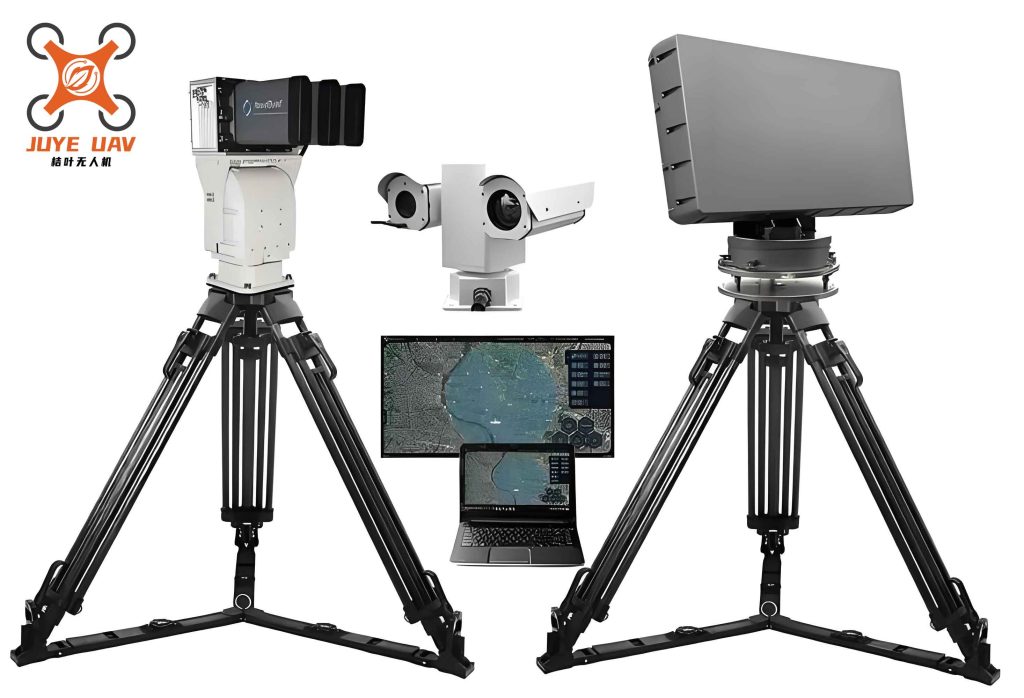
The kinetic and directed-energy “hard-kill” side of anti-UAV technology is equally dynamic. While missiles and guns are viable for larger drones, countering swarms of small UAVs requires high-density, low-cost-per-engagement solutions. This has spurred massive investment in two key areas: high-energy lasers (HEL) and high-power microwaves (HPM).
High-energy laser systems offer the promise of “infinite magazines” and precision engagement at the speed of light. The core physics is governed by the power required at the target to achieve a desired effect (e.g., burn-through, structural failure). A simplified model for the irradiance ($I$, power per unit area) on target is:
$$I = \frac{P_T \cdot \eta_{sys} \cdot \eta_{atm}}{ \pi \left( \frac{\theta_{div} \cdot R}{2} \right)^2 } = \frac{4 P_T \eta_{sys} \eta_{atm}}{\pi (\theta_{div} R)^2}$$
Where:
$P_T$ = Transmitted laser power
$\eta_{sys}$ = System optical efficiency
$\eta_{atm}$ = Atmospheric transmission factor (a critical challenge, modeled by Beer-Lambert law: $\eta_{atm} \approx e^{-\beta R}$, where $\beta$ is the attenuation coefficient)
$\theta_{div}$ = Laser beam divergence angle (in radians)
$R$ = Range to target
The required fluence (energy per unit area, $F = I \cdot t_{ dwell}$) to defeat a target depends on its material properties. For a thin-skinned UAV, the time-to-puncture can be estimated. Meanwhile, High-Power Microwave systems operate differently, emitting a broad beam of electromagnetic energy to disrupt or fry the electronic components inside a UAV. The electric field strength ($E$) at range is crucial:
$$E = \frac{\sqrt{30 \cdot P_j \cdot G_j}}{R}$$
Where $P_j$ is the peak radiated power and $G_j$ is the antenna gain. The power absorbed by a UAV’s electronics is related to the square of this field strength and the effective receiving area of its wiring and circuits. HPM is particularly promising for area defense against swarms.
Given this array of technologies—kinetic, electronic, laser, microwave—how does one architect a coherent anti-UAV system? The answer is a layered, networked “system-of-systems” approach. No single sensor or effector is sufficient. The following table outlines a notional integrated anti-UAV architecture:
| Defense Layer | Range Band | Primary Sensors | Primary Effectors | Key Function |
|---|---|---|---|---|
| Long-Range / Strategic | > 20 km | Air Surveillance Radars, ELINT/SIGINT platforms | Long-range SAMs, Counter-UAV aircraft | Early warning, track initiation, engagement of high-altitude/large UAVs. |
| Medium-Range / Tactical | 5 – 20 km | 3D Air Search Radars (C/X-band), EO/IR telescopes | Medium-range SAMs, HEL systems, Electronic Warfare suites | Core engagement zone for tactical UAVs; discrimination and identification. |
| Short-Range / Point Defense | 1 – 5 km | X/Ku-band FCRs, Distributed acoustic/EO arrays, RF detectors | SHORAD missiles, Guns, HEL, HPM, RF jammers, net cannons | Final protective fire; hard and soft kill against penetrating drones and swarms. |
| Very-Short-Range / Last Ditch | < 1 km | Visual, handheld RF detectors, rifle-scope EO/IR | Small-arms fire, handheld jammers, directed sonic devices | Immediate defense of dismounted troops and critical points. |
The glue that binds these layers is the command, control, and battle management (C2BM) system. This is the brain of the anti-UAV network. It must fuse data from disparate sensors into a single, coherent air picture, perform rapid threat evaluation (prioritizing which of dozens of tracks represents the greatest danger), and assign the optimal effector—considering range, probability of kill, collateral damage, and cost. This is a massive data processing and AI/ML challenge. Algorithms must manage uncertainty, learn new UAV signatures, and adapt to novel swarm tactics in real-time. The overall system effectiveness ($E_{sys}$) can be conceptualized as a function of its subcomponents:
$$E_{sys} = f(P_{detect}, P_{ident}, P_{track}, P_{assign}, P_{kill} | \text{Threat Type, Environment})$$
Where each $P$ represents the probability associated with a step in the kill chain. A weakness in any one (e.g., low $P_{ident}$ for micro-UAVs) degrades the entire system.
Looking forward, the anti-UAV battle is an arms race driven by accelerating technologies. On the threat side, we anticipate increased autonomy using AI, reducing reliance on vulnerable communication links. Swarm intelligence will enable complex, coordinated behaviors—true “smart swarms” rather than simple saturation attacks. Advances in battery technology and materials science will extend range and payload capabilities. On the defense side, the integration of AI into C2BM for predictive threat analysis and automated response will be critical. The development of more powerful, compact, and efficient directed energy weapons is a clear priority. Furthermore, “non-kinetic” strategies are gaining traction, such as cyber-takeover of drones and targeting the manufacturing/supply chains behind adversarial drone programs.
The economic and tactical calculus remains central. An effective anti-UAV system must be affordable enough to be deployed widely and must have a favorable cost-exchange ratio. This often pushes solutions towards electronic attack and directed energy. Furthermore, training and doctrine are as important as the hardware. Soldiers at all levels must be educated on UAV threats and trained on countermeasure equipment, from handheld jammers to operating procedures for large-scale defensive systems.
In conclusion, the field of anti-UAV defense is one of the most dynamic and critical in modern military science. It sits at the intersection of radar engineering, electromagnetics, optics, artificial intelligence, and systems integration. The threat is evolving with frightening speed, leveraging global commercial innovation. The defense, therefore, cannot be static. It requires continuous research, agile development, and a holistic view that combines cutting-edge technology with sound tactical concepts and comprehensive training. The goal is not to build an impenetrable shield—an impossible task—but to raise the cost and complexity for an adversary to use UAVs effectively, thereby deterring their use and protecting our forces and assets in an increasingly crowded and contested sky. The development of resilient, adaptive, and scalable anti-UAV systems is not just a technical pursuit; it is a strategic imperative for maintaining operational freedom and security in the 21st century.