
As an enthusiast and researcher in the field of aerial robotics, I have always been fascinated by the mesmerizing spectacle of drone light shows. These displays, where hundreds or even thousands of drones fly in synchrony to create dazzling patterns in the night sky, represent a convergence of technology, art, and engineering. In this article, I will delve into the intricacies of drone light shows, from their fundamental principles to advanced applications, using mathematical models and data summaries to enhance understanding. The keyword ‘drone light show’ will be central to our discussion, as we explore how these performances are orchestrated and their impact on modern entertainment and beyond.
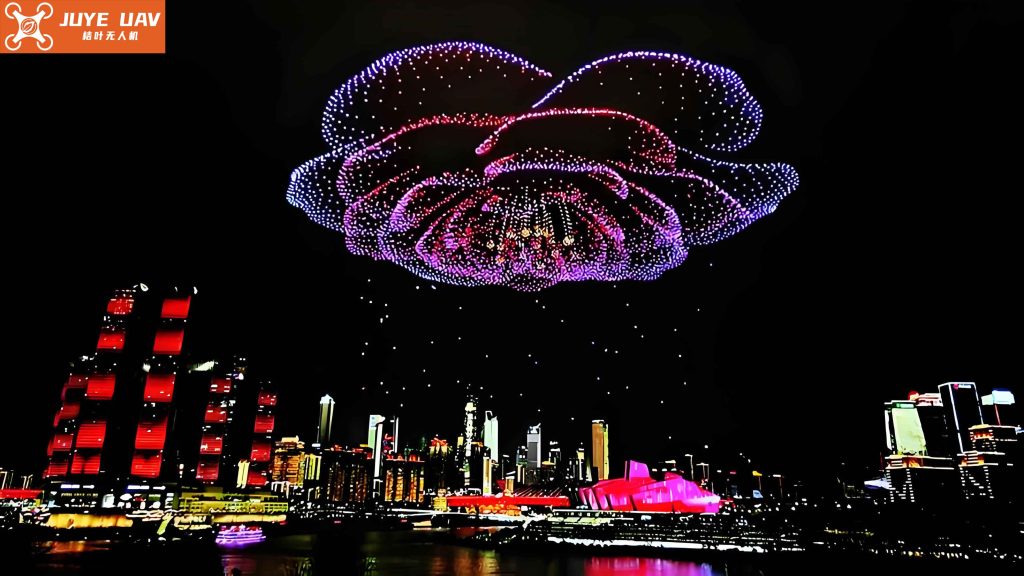
The concept of a drone light show revolves around coordinating multiple unmanned aerial vehicles (UAVs) equipped with LED lights to form dynamic images and animations. Each drone acts as a pixel in a three-dimensional canvas, with its position and color controlled in real-time. This requires sophisticated algorithms for trajectory planning, collision avoidance, and communication synchronization. Over the years, drone light shows have evolved from simple formations to complex narratives, often used in major events like Olympics ceremonies, corporate launches, and public festivals. The allure of a drone light show lies not only in its visual appeal but also in the technological prowess behind it, making it a compelling subject for analysis.
To understand the mechanics of a drone light show, we must first consider the hardware involved. Typical drones used in these displays are lightweight, often quadcopters, with high-precision GPS modules, inertial measurement units (IMUs), and programmable RGB LEDs. The fleet is managed by a ground control station (GCS) that sends commands via wireless networks, ensuring each drone follows a pre-defined path. The coordination is critical; even a minor error can disrupt the entire drone light show. Therefore, robust communication protocols are essential, similar to those in secure UAV networks, but tailored for low-latency and high-reliability demands.
In designing a drone light show, one of the key challenges is path planning. Each drone must move from an initial position to a target position within a specific time frame, while avoiding collisions with other drones and environmental obstacles. This can be formulated as an optimization problem. Let the position of drone \(i\) at time \(t\) be denoted by \(\mathbf{p}_i(t) = [x_i(t), y_i(t), z_i(t)] \in \mathbb{R}^3\). The objective is to minimize the total energy consumption or maximize the smoothness of trajectories, subject to constraints such as velocity and acceleration limits. For a drone light show with \(N\) drones, the problem can be expressed as:
$$ \min_{\mathbf{p}_i(t)} \sum_{i=1}^{N} \int_{0}^{T} \left\| \frac{d^2 \mathbf{p}_i(t)}{dt^2} \right\|^2 dt $$
subject to:
$$ \left\| \frac{d \mathbf{p}_i(t)}{dt} \right\| \leq v_{\text{max}}, \quad \left\| \frac{d^2 \mathbf{p}_i(t)}{dt^2} \right\| \leq a_{\text{max}}, \quad \text{for all } i, t $$
and collision avoidance constraints:
$$ \| \mathbf{p}_i(t) – \mathbf{p}_j(t) \| \geq d_{\text{safe}}, \quad \text{for all } i \neq j, t $$
where \(v_{\text{max}}\) and \(a_{\text{max}}\) are the maximum velocity and acceleration, respectively, and \(d_{\text{safe}}\) is the minimum safe distance between drones. This optimization ensures that the drone light show operates smoothly and safely. Advanced techniques, such as deep reinforcement learning, can be employed to solve these problems in real-time, adapting to dynamic conditions.
The synchronization of lights is another crucial aspect. Each drone’s LED color and intensity must change according to the overall design. This is often managed through a centralized controller that broadcasts timing signals. The color output can be modeled using RGB values, where for drone \(i\) at time \(t\), the color \(\mathbf{c}_i(t) = [r_i(t), g_i(t), b_i(t)]\) is determined by a master script. The overall visual effect of the drone light show depends on the precise alignment of these color changes with the drones’ positions. For instance, to create a fading effect, the intensity might follow an exponential decay:
$$ I_i(t) = I_0 \cdot e^{-\lambda t} $$
where \(I_i(t)\) is the intensity, \(I_0\) is the initial intensity, and \(\lambda\) is the decay rate. Such mathematical models help in programming captivating sequences for a drone light show.
Communication security is also vital, especially for large-scale drone light shows where interference or hacking could cause failures. While the focus is not on eavesdropping as in secure UAV communication, ensuring that control signals are authenticated and encrypted is important. Techniques like frequency hopping spread spectrum (FHSS) or digital signatures can be used to protect the integrity of the drone light show commands. This parallels the security considerations in other UAV applications, but with an emphasis on reliability rather than secrecy.
To illustrate the technical parameters involved in a typical drone light show, I have compiled data from various performances into the following table. This table summarizes key aspects such as the number of drones, flight duration, and communication methods.
| Aspect | Typical Range | Description |
|---|---|---|
| Number of Drones | 100 to 3000+ | Larger fleets enable more complex patterns in a drone light show. |
| Flight Time | 10 to 30 minutes | Limited by battery life; often uses swappable batteries for longer shows. |
| Communication Protocol | Wi-Fi, RF, or proprietary systems | Ensures low-latency control for synchronized movements in the drone light show. |
| GPS Accuracy | ±1 cm to ±10 cm | High precision is required for tight formations in a drone light show. |
| LED Brightness | 1000 to 5000 lumens | Bright lights ensure visibility even in urban environments for a drone light show. |
| Collision Avoidance | Onboard sensors or centralized algorithms | Critical for safety during a drone light show, especially in windy conditions. |
Another important consideration is the environmental impact of a drone light show. Unlike fireworks, drones are reusable and produce no smoke or debris, making them an eco-friendly alternative. However, they do consume electricity and require careful logistics. The energy consumption for a fleet of drones can be estimated using the power model for quadcopters. The power required for hover is given by:
$$ P = \frac{(mg)^{3/2}}{\sqrt{2 \rho A}} $$
where \(m\) is the mass of the drone, \(g\) is gravitational acceleration, \(\rho\) is air density, and \(A\) is the rotor disk area. For a drone light show with \(N\) drones, the total power consumption over time \(T\) is:
$$ E_{\text{total}} = \sum_{i=1}^{N} \int_{0}^{T} P_i(t) dt $$
This energy usage can be optimized by planning efficient trajectories, as mentioned earlier. Moreover, the noise generated by drones can be a concern for public events; thus, quieter propellers are often used in drone light shows.
The artistic design of a drone light show involves converting visual concepts into flight paths and light sequences. Designers use software tools to simulate the show in 3D before actual deployment. These tools allow for testing different configurations and ensuring that the drone light show will be visually appealing from various angles. The process typically includes storyboarding, path generation, and synchronization with music. For example, to create a swirling pattern, the trajectory of each drone might follow a spiral path parameterized by:
$$ x_i(t) = R \cos(\omega t + \phi_i), \quad y_i(t) = R \sin(\omega t + \phi_i), \quad z_i(t) = z_0 + \alpha t $$
where \(R\) is the radius, \(\omega\) is the angular velocity, \(\phi_i\) is the phase offset for drone \(i\), \(z_0\) is the initial height, and \(\alpha\) is the vertical speed. Such parametric equations enable the creation of complex animations in a drone light show.
In terms of applications, drone light shows have expanded beyond entertainment. They are used in advertising, where brands leverage the novelty to capture attention. For instance, a company might sponsor a drone light show to launch a new product, with drones forming the product’s logo in the sky. Additionally, drone light shows are employed in education and research, demonstrating swarm robotics and coordination algorithms. They also have potential in disaster response, where drones could form visible signals for rescue operations, though this is less common. The versatility of a drone light show makes it a valuable tool across sectors.
Looking ahead, the future of drone light shows is promising. Advances in battery technology will allow longer performances, while improvements in AI will enable more adaptive and interactive shows. For example, drones could respond to audience movements or weather conditions in real-time. Furthermore, the integration of augmented reality (AR) could blend physical drones with virtual elements, creating immersive experiences. The keyword ‘drone light show’ will likely become synonymous with cutting-edge technology in public spectacles. As the industry grows, standardization of safety protocols and communication systems will be essential to ensure the reliability of every drone light show.
To further analyze the performance metrics, let’s consider a scenario where we want to maximize the visual impact of a drone light show. This can be quantified by a metric such as the overall brightness contrast or the complexity of patterns. Suppose we define a utility function \(U\) that depends on the positions and colors of all drones. The optimization problem becomes:
$$ \max_{\mathbf{p}_i(t), \mathbf{c}_i(t)} U(\{\mathbf{p}_i(t), \mathbf{c}_i(t)\}) $$
subject to the same physical constraints as before. This is a high-dimensional control problem that can be tackled using machine learning techniques. For instance, deep reinforcement learning algorithms, like the Deep Deterministic Policy Gradient (DDPG), can learn optimal policies for coordinating drones in a drone light show. The agent (controller) observes the state of the drones and selects actions (velocity and color changes) to maximize cumulative reward, which might be based on audience feedback or artistic goals.
Another interesting aspect is the scalability of drone light shows. As the number of drones increases, the communication and computation requirements grow. This can be addressed through decentralized control, where drones make local decisions based on neighbor information. Such swarm intelligence approaches mimic natural systems like bird flocks, enabling robust and scalable performances. The dynamics of a drone swarm can be modeled using differential equations, such as the Reynolds flocking model:
$$ \frac{d\mathbf{v}_i}{dt} = \alpha \sum_{j \in \mathcal{N}_i} (\mathbf{v}_j – \mathbf{v}_i) + \beta \sum_{j \in \mathcal{N}_i} (\mathbf{p}_j – \mathbf{p}_i) + \gamma \mathbf{g}_i $$
where \(\mathbf{v}_i\) is the velocity of drone \(i\), \(\mathcal{N}_i\) is its set of neighbors, \(\alpha, \beta, \gamma\) are coefficients, and \(\mathbf{g}_i\) is a goal-directed term. This model ensures cohesion and alignment in the swarm, which is essential for a harmonious drone light show.
In conclusion, drone light shows represent a fascinating intersection of technology and art. From precise path planning to synchronized lighting, every element requires careful engineering. The keyword ‘drone light show’ encapsulates not just the spectacle but also the innovation behind it. As I reflect on my experiences, I am excited by the potential for future developments, such as autonomous shows that adapt to environments or integrate with other technologies. The mathematical models and tables presented here provide a glimpse into the complexity involved, but the true magic of a drone light show lies in its ability to inspire wonder and push the boundaries of what is possible with unmanned aerial vehicles.
To summarize key technical formulas used in drone light show design, here is another table:
| Formula | Purpose | Application in Drone Light Show |
|---|---|---|
| $$ \mathbf{p}_i(t) = [x_i(t), y_i(t), z_i(t)] $$ | Position tracking | Defines the 3D location of each drone over time. |
| $$ \| \mathbf{p}_i(t) – \mathbf{p}_j(t) \| \geq d_{\text{safe}} $$ | Collision avoidance | Ensures safety during the drone light show. |
| $$ I_i(t) = I_0 \cdot e^{-\lambda t} $$ | Light intensity control | Creates fading effects in the drone light show. |
| $$ P = \frac{(mg)^{3/2}}{\sqrt{2 \rho A}} $$ | Power consumption | Estimates energy usage for fleet management. |
| $$ \frac{d\mathbf{v}_i}{dt} = \alpha \sum_{j \in \mathcal{N}_i} (\mathbf{v}_j – \mathbf{v}_i) + \cdots $$ | Swarm dynamics | Models collective behavior for scalable drone light shows. |
Ultimately, the success of a drone light show depends on a blend of artistic vision and technical execution. As the field evolves, we can expect more immersive and interactive experiences, solidifying the drone light show as a staple of modern entertainment and beyond. Whether for celebration, education, or innovation, the drone light show continues to captivate audiences worldwide, showcasing the incredible potential of coordinated aerial systems.