
As a key operator in the telecommunications sector, we recognize that the low altitude economy is rapidly emerging as a pivotal force for sustainable and high-quality economic growth. The integration of low-altitude intelligent networks (LAIN) is transforming traditional aviation sectors, unlocking new opportunities across various industries. In this article, we explore the pathways to foster the development of the low altitude economy through advanced networking solutions, focusing on infrastructure, technological innovation, and ecosystem collaboration. By analyzing the产业链逻辑, demand drivers, and operational challenges, we aim to provide insights into how operators can leverage their expertise to propel the low altitude economy forward, ensuring it becomes a robust engine for future economic expansion.
The low altitude economy encompasses a wide range of activities, including unmanned aerial vehicles (UAVs), electric vertical take-off and landing (eVTOL) aircraft, and other aerial platforms operating in altitudes typically below 1,000 meters. This sector is not just an extension of general aviation but a transformative domain that integrates digital connectivity, sensing technologies, and intelligent management systems. Key to this evolution is the low altitude economy’s reliance on seamless communication, precise navigation, and real-time data processing, which operators are uniquely positioned to provide. We will delve into the core issues, policy frameworks, and business models that define the low altitude economy, emphasizing the role of low-altitude intelligent networking in overcoming existing barriers.
Critical Issues in Low Altitude Economy Development
The development of the low altitude economy is intertwined with general aviation, yet it introduces distinct challenges and opportunities. Historically, general aviation has focused on manned flights for purposes like tourism, agriculture, and emergency services, but the low altitude economy expands this to include automated and connected systems. One major issue is the integration of low-altitude airspace management with existing aviation frameworks. In many regions, airspace below 1,000 meters remains underutilized due to regulatory hurdles and safety concerns. For instance, the classification of airspace often leads to conflicts between different users, such as commercial drones and traditional aircraft. To address this, we propose a holistic approach that includes dynamic airspace allocation using real-time data analytics. The relationship between low-altitude activities and general aviation can be summarized by the following equation, which highlights the synergy: $$ E_{low} = \int (A_{ga} + I_{tech}) \, dt $$ where \( E_{low} \) represents the economic output of the low altitude economy, \( A_{ga} \) denotes general aviation contributions, and \( I_{tech} \) symbolizes technological integration factors.
Another critical aspect is the management of low-altitude airspace. Over the past decades, reforms have shifted from strict control to more flexible试点, but challenges like overlapping jurisdictions and safety responsibilities persist. For example, in many countries, multiple agencies oversee low-altitude flights, leading to bureaucratic delays. We advocate for a unified management system that leverages digital twins and AI-based simulation to optimize airspace usage. This can be modeled as: $$ U_{air} = \frac{C_{max} \times E_{eff}}{R_{risk}} $$ where \( U_{air} \) is airspace utilization efficiency, \( C_{max} \) is maximum capacity, \( E_{eff} \) is operational efficiency, and \( R_{risk} \) is risk factor. By reducing \( R_{risk} \) through better sensing and communication, the low altitude economy can achieve higher utilization rates.
Furthermore, the diversity of low-altitude飞行载体, such as UAVs, eVTOLs, and light fixed-wing aircraft, introduces variability in performance requirements. For instance, eVTOLs are ideal for urban mobility due to their vertical take-off capabilities, but they face limitations in battery life and payload. We have analyzed that the energy density of batteries is a key constraint; current technologies offer around 285 Wh/kg, whereas urban air mobility demands at least 400 Wh/kg. This gap can be addressed through innovations in materials and propulsion systems, which operators can support by providing testing environments and data analytics services.
Policy Evolution and Its Impact
Policy frameworks have played a crucial role in shaping the low altitude economy. Initially, regulations were restrictive, focusing on safety and security, but recent years have seen a shift towards encouragement and standardization. For example, many governments have introduced policies that classify low-altitude activities and streamline approval processes. This evolution has释放积极信号 for investors and innovators, leading to increased adoption of low-altitude technologies. Below is a table summarizing key policy milestones and their effects on the low altitude economy:
| Year | Policy Initiative | Impact on Low Altitude Economy |
|---|---|---|
| 2010 | Initial airspace management reforms | Opened up low-altitude zones for experimental use, boosting UAV testing |
| 2020 | Inclusion in national development plans | Accelerated investment in infrastructure and R&D for low-altitude applications |
| 2023 | Standardization of drone regulations | Enhanced safety and interoperability, fostering commercial scalability |
| 2024 | Integration with digital economy strategies | Promoted cross-sector collaborations, such as with logistics and agriculture |
These policies have not only facilitated the growth of the low altitude economy but also highlighted the need for adaptive regulations that keep pace with technological advancements. As operators, we engage with policymakers to advocate for frameworks that support innovation while ensuring public safety. For instance, we participate in standards development organizations to define communication protocols for low-altitude networks, which can be expressed as: $$ P_{com} = \sum_{i=1}^{n} (B_i \times L_i) $$ where \( P_{com} \) represents communication protocol efficiency, \( B_i \) is bandwidth allocation, and \( L_i \) is latency requirements for different low-altitude scenarios.
Industry Chain Analysis and Demand Drivers
The low altitude economy features a complex industry chain spanning upstream, midstream, and downstream segments. Upstream involves raw materials and components, such as batteries, sensors, and communication chips; midstream covers manufacturing and infrastructure, including UAV production and ground support systems; downstream focuses on services like logistics, surveillance, and passenger transport. We break down this chain to identify opportunities for operator involvement. The following table outlines the key components and their interconnections:
| Segment | Components | Operator Role |
|---|---|---|
| Upstream | Materials, chips, batteries | Provide R&D support for communication modules and integrate sensing technologies |
| Midstream | UAV manufacturing, network infrastructure | Deploy 5G/6G base stations and satellite links for seamless coverage |
| Downstream | Logistics, emergency response, data services | Offer platform-based solutions for flight management and data analytics |
Demand for the low altitude economy is driven by multiple factors, including economic growth, technological progress, industrial competition, and evolving service needs. For example, the rise of e-commerce has fueled demand for drone-based delivery services, while advancements in AI have enabled autonomous flight operations. We model the demand growth using a logistic function: $$ D(t) = \frac{K}{1 + e^{-r(t – t_0)}} $$ where \( D(t) \) is demand at time \( t \), \( K \) is the carrying capacity of the market, \( r \) is the growth rate, and \( t_0 \) is the inflection point. Based on our analysis, the low altitude economy is currently in the exponential growth phase, with \( r \) values increasing due to policy support and technological breakthroughs.
Specifically, economic drivers include consumer demand for faster logistics and personalized services, such as aerial tourism. Technological drivers involve improvements in battery efficiency and communication latency, which we enhance through network slicing and edge computing. Industrial competition pushes operators to form alliances with manufacturers and service providers, creating integrated offerings. Service demand is shaped by the need for reliable and scalable solutions, which we address by developing customized packages for different industries.
Business Scenarios and Operational Requirements
In the short to medium term, the low altitude economy will prioritize applications in公共服务, logistics, and specialized operations. For instance, UAVs are already used in agriculture for crop monitoring and spraying, while eVTOLs are being tested for urban air mobility. We anticipate that scenarios like emergency response and infrastructure inspection will gain traction due to their high social value. To illustrate, the following table compares key business scenarios based on factors like technical maturity and market potential:
| Scenario | Technical Maturity | Market Growth Potential | Key Requirements |
|---|---|---|---|
| Agriculture Monitoring | High | Moderate | High-resolution imaging, real-time data transmission |
| Urban Logistics | Medium | High | Low-latency communication, precision navigation |
| Disaster Response | Low | High | Robust connectivity, rapid deployment capabilities |
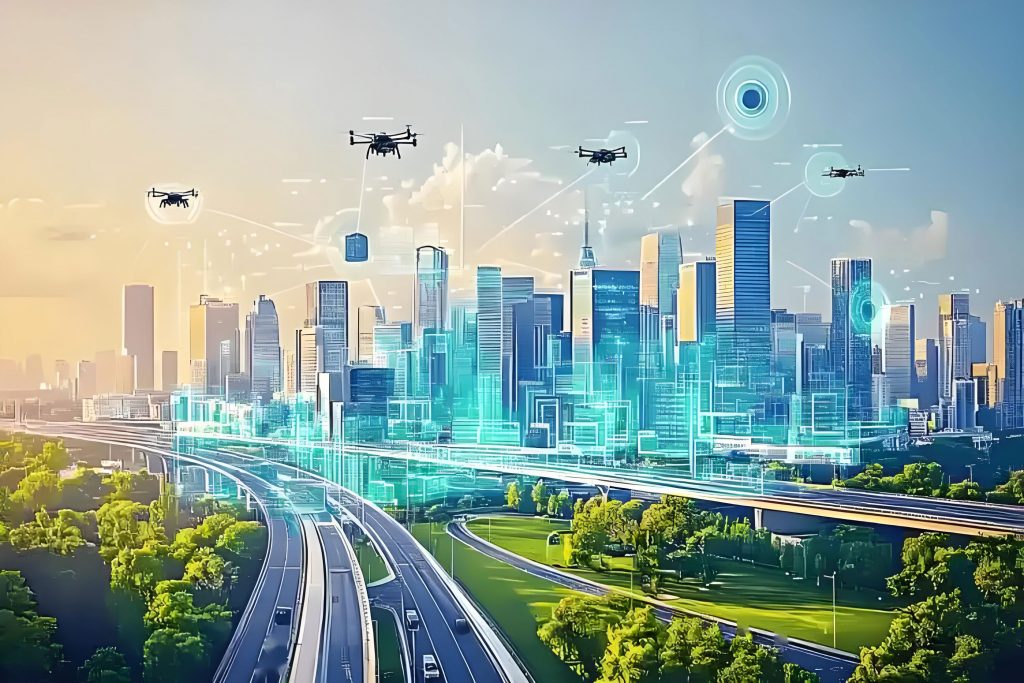
Operational requirements for these scenarios center on communication, sensing, and control capabilities. Communication needs include high-bandwidth links for video streaming and low-latency channels for command and control. We address this by optimizing our network infrastructure using beamforming and massive MIMO technologies, which can be represented as: $$ C_{opt} = \max \sum (B \times \log_2(1 + \frac{S}{N})) $$ where \( C_{opt} \) is the optimal capacity, \( B \) is bandwidth, \( S \) is signal power, and \( N \) is noise. Sensing requirements involve trajectory tracking and obstacle detection, which we enable through integrated radar and LiDAR systems. Control demands range from direct manual operations to fully autonomous networks, requiring reliable data links and fail-safe mechanisms.
Moreover, the low altitude economy necessitates advanced data processing for functions like route planning and intrusion detection. We employ machine learning algorithms to analyze flight data and predict potential conflicts, enhancing safety and efficiency. For example, the probability of a successful mission can be modeled as: $$ P_{success} = 1 – \prod_{i=1}^{n} (1 – p_i) $$ where \( p_i \) represents the reliability of each subsystem, such as communication, navigation, and power. By improving each \( p_i \) through redundant designs and real-time monitoring, we boost overall system performance.
Operator Strategies for Low Altitude Intelligent Networking
As operators, we face several commercial challenges in the low altitude economy, including infrastructure gaps, technological dependencies, and regulatory uncertainties. For instance, the limited coverage of communication networks in rural areas hinders drone operations, while reliance on imported components for critical parts like chips affects supply chain stability. To overcome these, we focus on building a comprehensive low-altitude intelligent network that integrates communication, navigation, and sensing functionalities. Our approach includes deploying dedicated 5G networks for low-altitude use, leveraging satellite backhaul for remote areas, and developing AI-driven platforms for air traffic management.
In terms of service capabilities, we explore areas such as network slicing for customized connectivity, data analytics for predictive maintenance, and security services to prevent cyber threats. For example, we offer tiered subscription plans for different user needs, from basic data packages for small UAVs to premium plans with guaranteed latency for critical applications. The revenue potential can be calculated using: $$ R = \sum (S_i \times P_i) + A_{value} $$ where \( R \) is total revenue, \( S_i \) is the number of subscriptions for service tier \( i \), \( P_i \) is the price per tier, and \( A_{value} \) represents value-added services like insurance or financial products.
We also engage in ecosystem building by partnering with hardware manufacturers, software developers, and government agencies. These collaborations allow us to co-create solutions that address specific industry pain points, such as reducing operational costs for logistics companies or improving response times for emergency services. The table below summarizes potential revenue streams for operators in the low altitude economy:
| Revenue Stream | Description | Example |
|---|---|---|
| Network Services | Connectivity packages based on data usage and performance | 5G plans for UAV operators with SLA guarantees |
| Data Services | Analytics and insights derived from flight data | Predictive maintenance reports for fleet managers |
| Platform Services | Access to management platforms and APIs | Subscription fees for flight control software |
| Value-Added Services | Insurance, financing, and consulting | Revenue sharing with partners on insured drone deliveries |
To illustrate the economic impact, we can use a growth model for the low altitude economy: $$ G_{economy} = \alpha \cdot I_{tech} + \beta \cdot I_{infra} + \gamma \cdot I_{policy} $$ where \( G_{economy} \) is the growth rate, \( \alpha \), \( \beta \), and \( \gamma \) are coefficients representing the contributions of technology, infrastructure, and policy investments, respectively. By aligning our strategies with these factors, we aim to maximize our role in fostering a vibrant low altitude economy.
Conclusion
In summary, the low altitude economy represents a transformative opportunity that requires coordinated efforts in networking, regulation, and innovation. As telecommunications operators, we are committed to advancing low-altitude intelligent networks that enable secure, efficient, and scalable operations. By addressing infrastructure limitations, enhancing technological capabilities, and fostering collaborative ecosystems, we can unlock the full potential of the low altitude economy. Looking ahead, we envision a future where low-altitude activities become integral to daily life, driven by continuous improvements in connectivity and intelligence. Through persistent investment and partnership, the low altitude economy will not only contribute to economic growth but also pave the way for sustainable development in the aerial domain.