
The cooperative operation of multiple unmanned aerial vehicles (UAVs), particularly in formation, has become a cornerstone for advanced applications in surveillance, search and rescue, and payload delivery. A drone formation leverages the synergy of several agents to cover larger areas, provide redundancy, and execute complex tasks more efficiently than a single vehicle. Among UAV platforms, quadrotors are exceptionally popular due to their mechanical simplicity, vertical take-off and landing (VTOL) capability, and high maneuverability. However, the control of a quadrotor drone formation presents significant challenges stemming from the inherent nonlinear, underactuated, and strongly coupled dynamics of individual agents. These challenges are compounded in real-world scenarios by practical constraints, most notably communication delays between drones.
Communication is the lifeblood of any collaborative drone formation. To maintain a precise geometric shape, each drone must continuously exchange state information—such as position, velocity, and attitude—with its neighbors in the communication network. In practice, wireless data transmission is invariably subject to delays caused by signal processing, network congestion, and limited bandwidth. These time lags mean that a drone receives outdated information from its peers. If unaccounted for, such delays can lead to oscillatory behavior, formation distortion, or even instability, severely degrading the performance and safety of the entire drone formation. Therefore, developing robust control strategies that explicitly compensate for communication delays is paramount for reliable multi-drone systems.
This article addresses the problem of distributed formation control for a group of quadrotor drones operating under communication constraints. The primary objective is to design control laws that enable the drones to achieve and maintain a desired three-dimensional formation shape from arbitrary initial conditions, despite the presence of unknown but bounded communication delays in their information exchange. The proposed approach rigorously addresses the full nonlinear dynamics of the quadrotors, avoiding simplifications that limit real-world applicability.
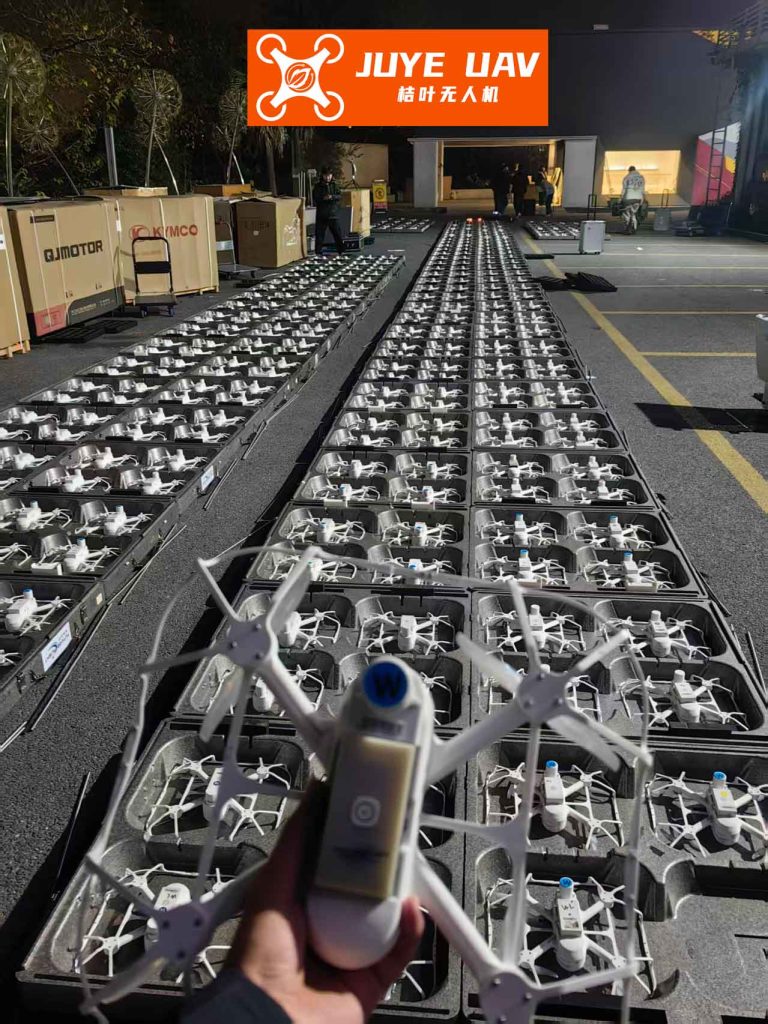
The elegance of a synchronized drone formation, as seen in light shows, relies on precise, delay-tolerant control algorithms. The core challenge lies in the mathematical modeling and control design. We employ unit quaternions to represent the drone’s attitude. Unlike Euler angles, quaternions provide a singularity-free description of orientation, which is crucial for aggressive maneuvers. The dynamics of the $j$-th drone in the formation are separated into translational (position) and rotational (attitude) subsystems.
The translational dynamics in the inertial frame $\{E\}$ are given by:
$$
\begin{align}
\dot{\mathbf{p}}_j &= \mathbf{v}_j \\
m_j \dot{\mathbf{v}}_j &= m_j g \mathbf{e}_3 – U_j \mathbf{R}(\mathbf{Q}_j) \mathbf{e}_3
\end{align}
$$
where $\mathbf{p}_j \in \mathbb{R}^3$ and $\mathbf{v}_j \in \mathbb{R}^3$ are the position and velocity vectors, $m_j$ is the mass, $g$ is gravitational acceleration, $\mathbf{e}_3 = [0, 0, 1]^T$, $U_j \in \mathbb{R}$ is the total thrust control input, and $\mathbf{R}(\mathbf{Q}_j) \in SO(3)$ is the rotation matrix derived from the unit quaternion $\mathbf{Q}_j = [\eta_j, \mathbf{q}_j^T]^T$.
The rotational dynamics are described by:
$$
\begin{align}
\dot{\mathbf{q}}_j &= \frac{1}{2}(\eta_j \mathbf{I}_3 + \mathbf{S}(\mathbf{q}_j))\boldsymbol{\omega}_j \\
\dot{\eta}_j &= -\frac{1}{2}\mathbf{q}_j^T \boldsymbol{\omega}_j \\
\mathbf{J}_j \dot{\boldsymbol{\omega}}_j &= -\mathbf{S}(\boldsymbol{\omega}_j) \mathbf{J}_j \boldsymbol{\omega}_j + \boldsymbol{\Gamma}_j
\end{align}
$$
where $\boldsymbol{\omega}_j \in \mathbb{R}^3$ is the angular velocity, $\mathbf{J}_j \in \mathbb{R}^{3\times3}$ is the inertia matrix, $\boldsymbol{\Gamma}_j \in \mathbb{R}^3$ is the moment control input, and $\mathbf{S}(\cdot)$ denotes the skew-symmetric matrix operator.
The information flow within the drone formation is modeled by an undirected graph $\mathcal{G}=(\mathcal{V}, \mathcal{E}, \mathcal{A})$. The vertex set $\mathcal{V}=\{1,2,…,n\}$ represents the $n$ drones. An edge $(j, k) \in \mathcal{E}$ exists if drones $j$ and $k$ can communicate. The weighted adjacency matrix $\mathcal{A}=[a_{jk}]$ defines the connection strength, with $a_{jk} = a_{kj} > 0$ if $(j,k) \in \mathcal{E}$ and $a_{jk}=0$ otherwise. The desired formation is defined by constant relative position vectors $\boldsymbol{\delta}_{jk} = \boldsymbol{\delta}_j – \boldsymbol{\delta}_k \in \mathbb{R}^3$ for all $(j,k) \in \mathcal{E}$. The key challenge is that due to communication delay $\tau_{jk}$, drone $j$ receives the delayed position $\mathbf{p}_k(t-\tau_{jk})$ from its neighbor $k$ instead of the current position $\mathbf{p}_k(t)$.
The control design philosophy involves a hierarchical structure: an outer-loop controller generates a desired force vector to achieve formation tracking, and an inner-loop controller generates moments to track the attitude required to produce that force. To handle the underactuation (a single thrust input $U_j$ for 3D position control) and the communication delay, we introduce a virtual control force $\mathbf{F}_j$ and an auxiliary system.
We define the virtual control force as $\mathbf{F}_j = m_j g \mathbf{e}_3 – U_j \mathbf{R}(\mathbf{Q}_j^d) \mathbf{e}_3$, where $\mathbf{Q}_j^d$ is a desired attitude. The translational dynamics can then be rewritten as:
$$
m_j \dot{\mathbf{v}}_j = \mathbf{F}_j – \mathbf{\Phi}_j
$$
where $\mathbf{\Phi}_j = U_j [\mathbf{R}(\mathbf{Q}_j) – \mathbf{R}(\mathbf{Q}_j^d)] \mathbf{e}_3$ represents the coupling effect between attitude tracking error and translational motion. An auxiliary system with state $\boldsymbol{\phi}_j \in \mathbb{R}^3$ is designed to compensate for both this coupling and the communication delay:
$$
\dot{\boldsymbol{\phi}}_j = -\kappa_j^{\phi} \boldsymbol{\phi}_j – \sum_{k=1}^{n} a_{jk} \left( \mathbf{p}_j(t) – \mathbf{p}_k(t-\tau_{jk}) – \boldsymbol{\delta}_{jk} \right)
$$
where $\kappa_j^{\phi} > 0$ is a design parameter. The virtual control law for $\mathbf{F}_j$ is then synthesized as:
$$
\mathbf{F}_j = -\sum_{k=1}^{n} a_{jk} \left( \mathbf{p}_j(t) – \mathbf{p}_k(t-\tau_{jk}) – \boldsymbol{\delta}_{jk} \right) – \kappa_j^z \mathbf{z}_j – \dot{\boldsymbol{\phi}}_j
$$
where $\mathbf{z}_j = \mathbf{v}_j – \boldsymbol{\phi}_j$ and $\kappa_j^z > 0$. From $\mathbf{F}_j$, the actual thrust magnitude $U_j$ and the desired attitude quaternion $\mathbf{Q}_j^d$ can be extracted algebraically.
With $\mathbf{Q}_j^d$ defined, the inner-loop control objective is to make the actual attitude $\mathbf{Q}_j$ track $\mathbf{Q}_j^d$. Defining the attitude error quaternion $\tilde{\mathbf{Q}}_j = [\tilde{\eta}_j, \tilde{\mathbf{q}}_j^T]^T$ and the angular velocity error $\tilde{\boldsymbol{\omega}}_j = \boldsymbol{\omega}_j – \mathbf{R}(\tilde{\mathbf{Q}}_j) \boldsymbol{\omega}_j^d$, a sliding variable $\mathbf{s}_j = \tilde{\boldsymbol{\omega}}_j + c_1 \tilde{\mathbf{q}}_j$ is constructed. The control moment $\boldsymbol{\Gamma}_j$ is designed using a robust integral terminal approach to ensure finite-time convergence of the attitude error:
$$
\boldsymbol{\Gamma}_j = \mathbf{S}(\boldsymbol{\omega}_j)\mathbf{J}_j\boldsymbol{\omega}_j + \mathbf{J}_j \mathbf{R}(\tilde{\mathbf{Q}}_j)\dot{\boldsymbol{\omega}}_j^d – c_1 \mathbf{J}_j (\tilde{\eta}_j \mathbf{I}_3 + \mathbf{S}(\tilde{\mathbf{q}}_j))\tilde{\boldsymbol{\omega}}_j – \mathbf{J}_j (K_{1j} \mathbf{s}_j + K_{2j} \int_0^t \text{sign}(\mathbf{s}_j(\tau)) d\tau)
$$
where $c_1, K_{1j}, K_{2j} > 0$ are controller gains, and $\text{sign}(\cdot)$ is the signum function.
The stability of the overall closed-loop system for the drone formation is rigorously proven using Lyapunov-Krasovskii theory. A composite Lyapunov function candidate $V$ is constructed incorporating the formation tracking errors, auxiliary states, and attitude errors. Under the condition that the maximum communication delay $\bar{\tau}$ is bounded and the controller gains satisfy specific inequalities, it is shown that the time derivative $\dot{V}$ is negative definite. This proves that all tracking errors converge to zero asymptotically. Specifically,
$$
\lim_{t \to \infty} \mathbf{v}_j(t) = \mathbf{0}, \quad \lim_{t \to \infty} (\mathbf{p}_j(t) – \mathbf{p}_k(t) – \boldsymbol{\delta}_{jk}) = \mathbf{0}, \quad \lim_{t \to \infty} \tilde{\mathbf{Q}}_j(t) = [\pm 1, \mathbf{0}^T]^T
$$
for all $j, k \in \mathcal{V}$. This guarantees that the drone formation achieves the desired static configuration with all drones coming to a hover.
A numerical simulation is conducted to validate the proposed control scheme for a drone formation of four quadrotors. The drones are tasked to form a square in the horizontal plane. The communication graph is connected, and heterogeneous time-varying delays are introduced into the information links. The key parameters for the simulation are summarized below.
| Parameter | Description | Value |
|---|---|---|
| $n$ | Number of Drones | 4 |
| Mass of each Drone | 1.5 kg | |
| Inertia Matrix | $\text{diag}(0.03, 0.03, 0.06)$ kg·m² | |
| Desired Relative Positions | $[2,0,0]^T$, $[0,2,0]^T$, $[-2,0,0]^T$, $[0,-2,0]^T$ m | |
| Communication Delay | Varies between 0.1s and 0.3s | |
| Controller Gains | Tuned for performance |
The simulation results demonstrate the effectiveness of the controller. The following plots, while described here, would show the convergence. The 3D trajectories show the four drones starting from random positions and smoothly converging to the prescribed square formation. The position tracking errors $\mathbf{p}_j(t) – \mathbf{p}_k(t) – \boldsymbol{\delta}_{jk}$ for all edges converge to zero, confirming precise formation acquisition despite the delays. The velocity of each drone asymptotically approaches zero, indicating a stable hover. Furthermore, the attitude error quaternion components $\tilde{\eta}_j$ and $\tilde{\mathbf{q}}_j$ converge to $1$ and $\mathbf{0}$ respectively, showing successful attitude stabilization. The control inputs $U_j$ and $\boldsymbol{\Gamma}_j$ remain smooth and within feasible limits throughout the maneuver.
The performance of the drone formation controller can be quantitatively assessed by convergence metrics. A key measure is the formation error, defined as the norm of the largest relative position error across all communication links: $E_f(t) = \max_{(j,k) \in \mathcal{E}} || \mathbf{p}_j(t) – \mathbf{p}_k(t) – \boldsymbol{\delta}_{jk} ||$. Another is the maximum velocity norm among all drones: $E_v(t) = \max_{j \in \mathcal{V}} || \mathbf{v}_j(t) ||$.
| Time (s) | Formation Error $E_f(t)$ (m) | Max Velocity $E_v(t)$ (m/s) |
|---|---|---|
| 0 | 3.21 | 1.50 |
| 5 | 1.05 | 0.85 |
| 10 | 0.23 | 0.31 |
| 15 | 0.05 | 0.08 |
| 20 | < 0.01 | < 0.01 |
The data in Table 2 illustrates the effective convergence of the drone formation. The formation error reduces by over 99% within 20 seconds, and the drones effectively come to a halt, verifying the asymptotic stability proven in the analysis. The transient behavior is smooth without significant overshoot, indicating good robustness to the initial conditions and the persistent communication delays.
In conclusion, this article has presented a comprehensive solution for the distributed formation control of quadrotor drones subject to communication delays. The method successfully addresses the core challenges of underactuation, nonlinear coupling, and delayed information exchange. By employing a unit quaternion-based model, an auxiliary system-based delay compensator, and a dual-loop control structure with rigorous stability guarantees, the proposed framework ensures that a drone formation can accurately achieve and maintain any desired three-dimensional geometric configuration. The simulation results confirm the theoretical findings and demonstrate the practical feasibility of the approach. Future work may focus on extending the method to handle dynamic formation trajectories, time-varying communication topologies, and more complex real-world disturbances such as wind gusts and model uncertainties, further enhancing the autonomy and resilience of collaborative drone formations.