
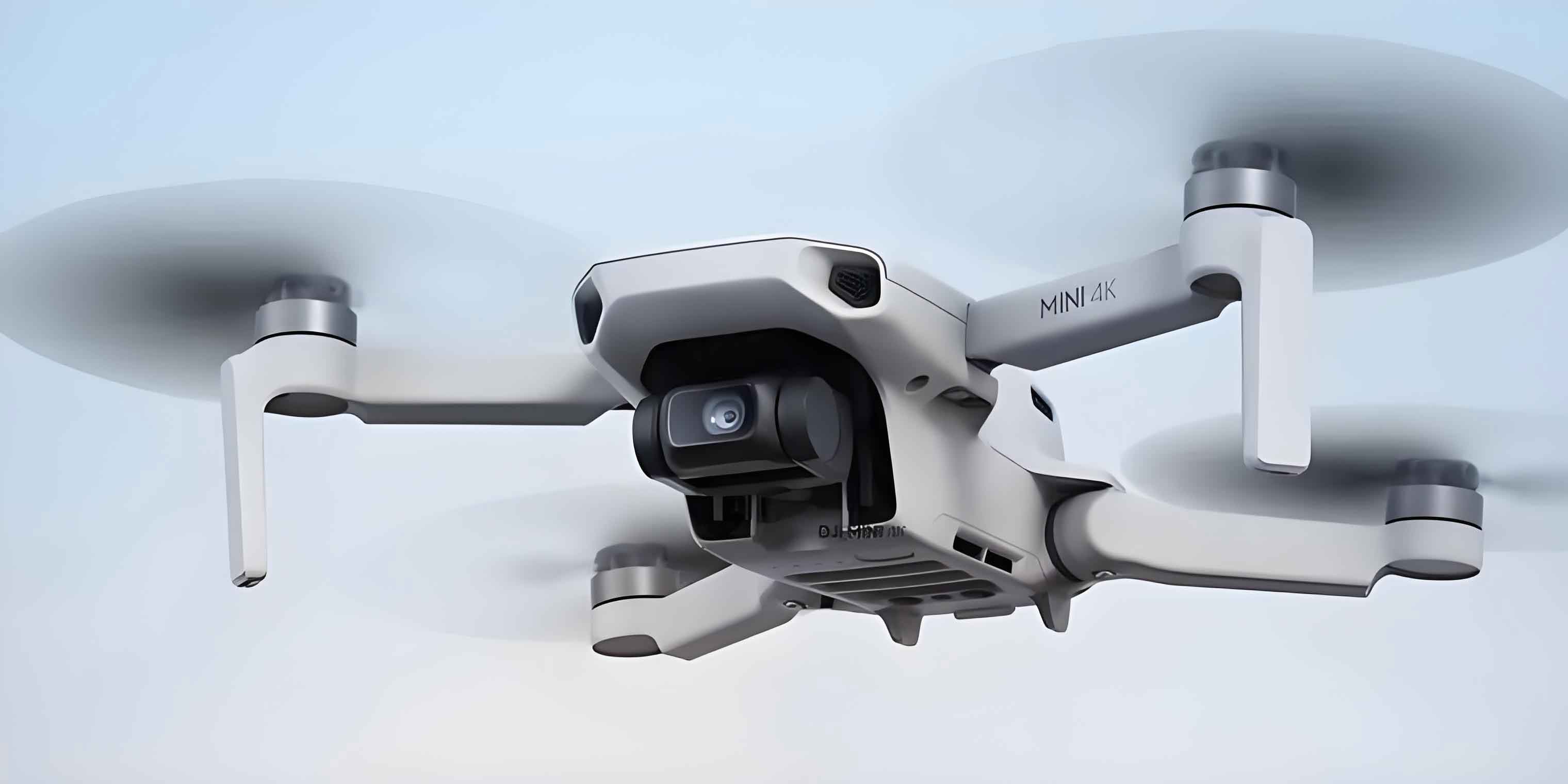
In my research, I investigate the formation control problem for UAV drones operating in complex adversarial environments. The central idea of my work is to treat each UAV drone as a rational decision-maker inside a continuous-time differential game, so that formation error minimization, energy consumption reduction, anti-attack robustness, wake disturbance rejection, and communication efficiency can be integrated into a unified control framework. By combining differential game theory, Q-learning, control barrier functions, switching topology design, memory event-triggered mechanisms, and sliding mode disturbance observers, I develop layered control architectures that allow multiple UAV drones to achieve safe, stable, and efficient cooperative flight. The following image provides a visual context for the type of UAV drones considered in my study.
1. Introduction and Problem Statement
The rapid development of autonomous aerial vehicles, embedded computation, and multi-agent coordination has made formation control of UAV drones an important research topic. Compared with a single UAV drone, a formation of multiple UAV drones can cover larger areas, perform distributed sensing, improve mission redundancy, and complete tasks that are difficult for one vehicle. Typical applications include cooperative reconnaissance, search and rescue, environmental monitoring, agricultural inspection, and adversarial confrontation. In these missions, each UAV drone must maintain a prescribed geometric relationship with its neighbors while respecting its own dynamic constraints, communication constraints, safety constraints, and energy limitations.
However, practical formation control of UAV drones is affected by severe uncertainties. Malicious attacks such as denial-of-service attacks and false data injection attacks can corrupt communication channels. Wake-induced aerodynamic disturbances can create nonlinear coupled forces between UAV drones flying in close formation. Communication bandwidth is limited, and frequent data exchange increases energy consumption. In addition, safety constraints require that UAV drones never collide with each other or with external obstacles. These issues make traditional centralized or purely reactive formation controllers insufficient for many realistic scenarios.
I formulate the formation control problem of UAV drones as a differential game. In this formulation, each UAV drone is a player. The state of the entire formation evolves according to coupled differential equations, and each UAV drone selects a control strategy to minimize its own performance index. The performance index can include terminal formation error, velocity mismatch, control effort, safety penalty, and disturbance rejection cost. The solution concept I use is the Nash equilibrium, at which no single UAV drone can improve its own cost by unilaterally changing its strategy. This perspective is natural for distributed formation control because each UAV drone usually has access only to local information from itself and its neighbors.
1.1 Main Contributions
My work makes several contributions to differential game-based formation control for UAV drones. First, I establish a general connection between differential games, formation coordination, safety constraints, and distributed Nash equilibrium seeking. Second, I design a secure formation control framework for UAV drones under mixed attacks by integrating Q-learning, control barrier functions, and generalized algebraic Riccati equations. Third, I develop a memory event-triggered differential game control strategy for UAV drones subject to wake disturbances and communication constraints, where switching topology, sliding mode disturbance observers, and Nash equilibrium strategies are combined. Finally, I verify the proposed methods through simulation studies that examine formation convergence, safety distance maintenance, attack rejection, communication reduction, and disturbance compensation.
| Symbol | Meaning | Role in My Formulation |
|---|---|---|
| \(N\) | Number of UAV drones | Number of players in the differential game |
| \(x_i(t)\) | State of UAV drone \(i\) | Position, velocity, and internal state variables |
| \(u_i(t)\) | Control input of UAV drone \(i\) | Decision variable of player \(i\) |
| \(J_i\) | Performance index of UAV drone \(i\) | Cost minimized by each UAV drone |
| \(u_i^*\) | Nash equilibrium strategy | Best response of UAV drone \(i\) |
| \(h_{ij}\) | Control barrier function | Safety constraint between UAV drones \(i\) and \(j\) |
| \(t_k^i\) | Event-triggered instant | Communication update time of UAV drone \(i\) |
| \(\hat{\omega}_i\) | Estimated disturbance | Wake disturbance compensation signal |
2. Mathematical Preliminaries
Before presenting my control designs, I summarize the mathematical foundations used throughout my study. These foundations include differential game theory, Nash equilibrium, zero-sum games, control barrier functions, graph theory, memory event-triggered mechanisms, and sliding mode disturbance observers. These tools are not independent; I combine them so that UAV drones can make distributed decisions, avoid collisions, reject disturbances, and reduce communication burden.
2.1 Differential Games and Nash Equilibrium
I consider a continuous-time differential game with \(N\) players, where each player corresponds to one UAV drone. The state equation of the game is
$$
\dot{x}(t)=f\left(x(t),u_1(t),u_2(t),\ldots,u_N(t),t\right),
$$
where \(x(t)\) is the global state of all UAV drones and \(u_i(t)\) is the control strategy of UAV drone \(i\). The performance index of UAV drone \(i\) is
$$
J_i\left(u_1,\ldots,u_N\right)
=
\phi_i\left(x(T)\right)
+
\int_{t_0}^{T}
L_i\left(x(t),u_1(t),\ldots,u_N(t),t\right)\,dt.
$$
Here, \(\phi_i\) is the terminal cost, such as terminal formation error, and \(L_i\) is the running cost, such as velocity mismatch and control effort. A strategy tuple \(\left(u_1^*,u_2^*,\ldots,u_N^*\right)\) is a Nash equilibrium if for every UAV drone \(i\),
$$
J_i\left(u_i^*,u_{-i}^*\right)
\le
J_i\left(u_i,u_{-i}^*\right),
$$
for all admissible strategies \(u_i\). In my formation control framework, this inequality means that no UAV drone can reduce its own formation cost by deviating alone. The Nash equilibrium therefore provides a distributed stability notion for UAV drones.
For a two-player zero-sum differential game, the cost relationship is
$$
J_1(u_1,u_2)+J_2(u_1,u_2)=0.
$$
The saddle-point equilibrium satisfies
$$
J_1\left(u_1^*,u_2\right)
\le
J_1\left(u_1^*,u_2^*\right)
\le
J_1\left(u_1,u_2^*\right).
$$
I use this structure to model the interaction between a formation controller and an intelligent attacker. The controller seeks to minimize the formation cost, while the attacker seeks to maximize it.
2.2 Control Barrier Functions
For safe formation control of UAV drones, I introduce a control barrier function \(h_{ij}\) for each pair of neighboring UAV drones. The distance between UAV drone \(i\) and UAV drone \(j\) is
$$
d_{ij}
=
\sqrt{
\left(x_i-x_j\right)^2
+
\left(y_i-y_j\right)^2
+
\left(z_i-z_j\right)^2
}.
$$
I define the safety function as
$$
h_{ij}=d_{ij}^2-d_{\mathrm{safe}}^2,
$$
where \(d_{\mathrm{safe}}\) is the minimum safe separation. The safe set is
$$
\mathcal{C}
=
\left\{
x \in \mathbb{R}^n
\mid
h_{ij}(x)\ge 0
\text{ for all neighboring pairs}
\right\}.
$$
To enforce forward invariance of the safe set, I require the barrier condition
$$
\dot{h}_{ij}+\lambda h_{ij}\ge 0,
\qquad \lambda>0.
$$
For a control-affine system \(\dot{x}=f(x)+g(x)u\), this condition becomes a linear inequality in the control input. I embed this inequality into a quadratic program so that each UAV drone can modify its nominal differential game control only when necessary. This is particularly important when UAV drones fly in dense formation under attacks or disturbances.
2.3 Graph Theory for Communication Topology
I model the communication network among UAV drones as an undirected graph \(\mathcal{G}=(\mathcal{V},\mathcal{E})\), where \(\mathcal{V}=\{1,2,\ldots,N\}\) is the node set and \(\mathcal{E}\) is the edge set. Each node represents one UAV drone. An edge \((i,j)\) means that UAV drone \(i\) and UAV drone \(j\) can exchange information. The adjacency matrix \(A=[a_{ij}]\) is defined by
$$
a_{ij}=
\begin{cases}
1, & (i,j)\in\mathcal{E},\ i\ne j,\\
0, & \text{otherwise}.
\end{cases}
$$
The Laplacian matrix \(L=[l_{ij}]\) is
$$
l_{ij}=
\begin{cases}
-a_{ij}, & i\ne j,\\
\sum_{q=1,q\ne i}^{N}a_{iq}, & i=j.
\end{cases}
$$
I assume that the communication graph of the UAV drones is connected. This assumption ensures that local information can propagate through the formation and that distributed Nash equilibrium strategies can be implemented without a central coordinator.
2.4 Memory Event-Triggered Mechanism
To reduce communication load among UAV drones, I use a memory event-triggered mechanism. Let \(t_k^i\) be the \(k\)-th triggering instant of UAV drone \(i\). The next triggering instant is
$$
t_{k+1}^i
=
\inf
\left\{
mh>t_k^i
\mid
\sum_{s=1}^{S}\mu_s e_{is}^T(t)\Omega e_{is}(t)
+
e_i^{uT}(t)\varepsilon e_i^u(t)
>
\vartheta_i(t) z_i^T(t)\Omega z_i(t)
\right\}.
$$
Here, \(S\) is the number of historical samples, \(\mu_s\) are memory weights, \(e_{is}\) and \(e_i^u\) are state and input trigger errors, \(\Omega\) is a positive definite weighting matrix, \(\varepsilon>0\), and \(\vartheta_i(t)\) is an adaptive threshold. The memory term allows UAV drones to use historical information rather than only the current error. This reduces unnecessary transmissions and improves robustness against short-term fluctuations.
2.5 Sliding Mode Disturbance Observer
Wake disturbances acting on UAV drones are difficult to model exactly because they depend on relative position, velocity, wingtip vortices, and atmospheric conditions. I therefore treat wake effects as bounded integrated uncertainties and estimate them with six independent sliding mode disturbance observers. For the \(x\)-channel of UAV drone \(i\), I design
$$
\begin{cases}
\dot{\hat{x}}_i = v_i + \lambda_{i1}\operatorname{sign}\left(x_i-\hat{x}_i\right),\\
\dot{v}_i = \cos\gamma_i\cos\chi_i + \hat{\omega}_{ix},\\
\dot{\hat{\omega}}_{ix} = -\lambda_{i2}\operatorname{sign}\left(\hat{\omega}_{ix}-\omega_{ix}\right).
\end{cases}
$$
Similar observers are designed for the \(y\), \(z\), \(V\), \(\gamma\), and \(\chi\) channels. The estimated disturbances are injected into the controller to cancel the wake effect. This observer-based compensation improves the robustness of formation control for UAV drones without requiring exact aerodynamic models.
3. Differential Game Formulation for UAV Drones
In my formulation, each UAV drone minimizes a performance index that balances formation accuracy, velocity matching, and control effort. The point-mass model of UAV drone \(i\) is
$$
\begin{aligned}
\dot{x}_i &= V_i\cos\gamma_i\cos\chi_i+\omega_{ix},\\
\dot{y}_i &= V_i\cos\gamma_i\sin\chi_i+\omega_{iy},\\
\dot{h}_i &= V_i\sin\gamma_i+\omega_{ih},\\
\dot{V}_i &= \frac{T_i-D_i}{m_i}-g\sin\gamma_i+\omega_{iV},\\
\dot{\gamma}_i &= \frac{L_i\cos\phi_i-m_i g\cos\gamma_i}{m_iV_i}+\omega_{i\gamma},\\
\dot{\chi}_i &= \frac{L_i\sin\phi_i}{m_iV_i\cos\gamma_i}+\omega_{i\chi}.
\end{aligned}
$$
Here, \(x_i\), \(y_i\), and \(h_i\) are position coordinates, \(V_i\) is speed, \(\gamma_i\) is flight path angle, \(\chi_i\) is heading angle, \(T_i\) is thrust, \(D_i\) is drag, \(L_i\) is lift, \(\phi_i\) is bank angle, and \(\omega_{i\bullet}\) represents wake or external disturbance. Through feedback linearization, I obtain a triple-integrator-like model in the position channels:
$$
\ddot{p}_i=u_i,
\qquad
p_i=
\begin{bmatrix}
x_i & y_i & h_i
\end{bmatrix}^{T}.
$$
Let
$$
z_i=
\begin{bmatrix}
p_i\\
v_i
\end{bmatrix},
\qquad
v_i=\dot{p}_i.
$$
Then the state-space model of UAV drone \(i\) is
$$
\dot{z}_i=A z_i+B u_i,
$$
with
$$
A=
\begin{bmatrix}
0 & I_3\\
0 & 0
\end{bmatrix},
\qquad
B=
\begin{bmatrix}
0\\
I_3
\end{bmatrix}.
$$
The performance index I assign to UAV drone \(i\) is
$$
J_i
=
\sum_{j\in\mathcal{N}_i}
\frac{l_{ij}}{2}
\left\|
p_i(t_f)-p_j(t_f)-d_{ij}
\right\|^2
+
\frac{r_i}{2}
\int_{0}^{t_f}
\left\|
u_i(t)
\right\|^2 dt.
$$
This index captures terminal formation error and control effort. Because each UAV drone has its own cost, the formation problem is a non-cooperative differential game. I seek a Nash equilibrium so that each UAV drone has no incentive to deviate from the agreed formation strategy.
| Formation Objective | Mathematical Representation | Control Implication |
|---|---|---|
| Formation accuracy | \(\|p_i(t_f)-p_j(t_f)-d_{ij}\|^2\) | Reduce terminal position error |
| Velocity synchronization | \(\|v_i(t_f)-v_j(t_f)\|^2\) | Maintain coordinated motion |
| Energy saving | \(\int \|u_i(t)\|^2 dt\) | Penalize excessive control effort |
| Safety | \(h_{ij}\ge 0\) | Avoid collisions among UAV drones |
| Communication efficiency | Event-triggered updates | Reduce data exchange frequency |
4. Secure Formation Control of UAV Drones under Mixed Attacks
In adversarial environments, UAV drones may suffer from both denial-of-service attacks and false data injection attacks. A denial-of-service attack blocks control packets, while a false data injection attack inserts malicious signals into the control channel. I model the mixed attack as
$$
\tilde{u}_i(k)
=
a(k)u_i(k)
+
b(k)\psi_i(k),
$$
where \(a(k)\) and \(b(k)\) are Bernoulli indicators. When \(a(k)=0\), the control input is blocked by a denial-of-service attack. When \(b(k)=1\), a false data injection attack is active, and \(\psi_i(k)\) is the malicious signal. The probabilities are
$$
\Pr\left(a(k)=1\right)=\alpha,
\qquad
\Pr\left(b(k)=1\right)=\beta.
$$
I formulate the interaction between the formation controller and the attacker as a zero-sum differential game. The controller minimizes a cost that penalizes formation error and control effort, while the attacker maximizes the same cost by injecting false data. The value function is
$$
J_i(x(k))
=
\mathbb{E}
\left[
\sum_{i=k}^{\infty}
\gamma^{i-k}
\left(
x^T(i)Qx(i)
+
a(i)u^T(i)R_1u(i)
–
b(i)\psi^T(i)R_2\psi(i)
\right)
\right].
$$
The Bellman equation is
$$
J(x(k))
=
x^T(k)Qx(k)
+
u^T(k)R_1u(k)
–
\psi^T(k)R_2\psi(k)
+
\gamma J(x(k+1)).
$$
Assuming a quadratic value function
$$
J(x(k))=x^T(k)Px(k),
$$
I derive the generalized algebraic Riccati equation. The optimal control and worst-case attack are obtained from the saddle point of the Hamiltonian. This yields a robust formation controller for UAV drones under mixed attacks.
4.1 Q-Learning for Anti-Attack Strategies
Because the exact attack probabilities and the system model may be unknown, I use Q-learning to learn the anti-attack strategy. The Q-function is
$$
Q(x(k),u(k),\psi(k))
=
x^T(k)Qx(k)
+
u^T(k)R_1u(k)
–
\psi^T(k)R_2\psi(k)
+
\gamma x^T(k+1)Px(k+1).
$$
I approximate the Q-function as a quadratic form in the augmented vector
$$
z(k)=
\begin{bmatrix}
x^T(k) & u^T(k) & \psi^T(k)
\end{bmatrix}^{T}.
$$
Then
$$
Q(z(k))
=
z^T(k)M z(k).
$$
Using least-squares policy evaluation, I update \(M\) iteratively. The control policy and attack policy are then improved according to
$$
u(k)
=
-\left(M_{22}\right)^{-1}
\left(
M_{21}x(k)+M_{23}\psi(k)
\right),
$$
$$
\psi(k)
=
\left(
M_{33}-M_{32}M_{22}^{-1}M_{23}
\right)^{-1}
\left(
M_{32}M_{22}^{-1}M_{21}-M_{31}
\right)x(k).
$$
This Q-learning procedure allows UAV drones to learn resilient formation policies without requiring full knowledge of the attack model. I summarize the algorithm below.
| Step | Operation | Purpose |
|---|---|---|
| 1 | Initialize \(P\), \(M\), \(K\), and \(L\) | Start with zero or conservative values |
| 2 | Collect data along system trajectories | Obtain state, control, and attack samples |
| 3 | Evaluate \(M\) by least squares | Estimate the quadratic Q-function |
| 4 | Improve \(u\) and \(\psi\) | Update controller and worst-case attack |
| 5 | Repeat until convergence | Reach a stable anti-attack policy |
4.2 Safety-Constrained Formation Control
After obtaining the differential game controller, I add a safety filter based on control barrier functions. The nominal control \(u_i^{\mathrm{nom}}\) is first computed from the Nash equilibrium. Then I solve the quadratic program
$$
u_i^{\mathrm{new}}
=
\arg\min_{u_i}
\left\|
u_i-u_i^{\mathrm{nom}}
\right\|^2,
$$
subject to
$$
\dot{h}_{ij}+\lambda h_{ij}\ge 0,
\qquad
j\in\mathcal{N}_i.
$$
This safety filter modifies the control input only when the safety constraint is about to be violated. Therefore, formation accuracy and energy efficiency are preserved during normal flight, while collisions are avoided in emergency situations. In my simulation, the distance between every pair of UAV drones remains above the safe threshold even when denial-of-service and false data injection attacks occur.
| Attack Type | Effect on UAV Drones | Countermeasure in My Framework |
|---|---|---|
| Denial-of-service | Control packets are blocked | Q-learning robust policy and game-theoretic compensation |
| False data injection | Malicious signals corrupt control input | Zero-sum differential game and saddle-point control |
| Mixed attack | Both blocking and injection occur randomly | Hierarchical Q-learning plus CBF safety filter |
| Collision risk | UAV drones may approach unsafe separation | Control barrier function and quadratic programming |
5. Memory Event-Triggered Differential Game Control with Wake Disturbance Compensation
In the second part of my research, I address wake disturbances, communication limitations, and robustness issues in formation flight of UAV drones. I propose a cooperative control strategy that integrates topology optimization, disturbance compensation, and differential game theory. The architecture has three layers: a topology control layer, a disturbance observer layer, and a differential game control layer.
5.1 Switching Topology Design
To reduce communication power consumption, I design a switching topology control layer based on graph theory. The maximum transmission range of each UAV drone is modeled as a sphere. I divide the sphere into equal-volume partitions. From each partition, the UAV drone selects the nearest neighbor. This produces a set of links that are evenly distributed in space. Then, within each partition, I construct a minimum spanning tree and select one link from it. The resulting topology has fewer redundant links while maintaining connectivity.
Let \(P\) be the set of neighbor positions. For each neighbor position \(p\), I compute the distance from the UAV drone position \(p_0\):
$$
d=\|p-p_0\|.
$$
I select the partition vector \(s^*\) that maximizes the inner product with \(d\). The selected link is the nearest neighbor in that partition. This procedure is executed independently by each UAV drone, but it produces a globally consistent and efficient communication topology.
| Topology Feature | Conventional Fixed Topology | My Switching Topology |
|---|---|---|
| Link redundancy | High | Reduced |
| Connectivity | May be fragile | Maintained by partition and MST |
| Transmission power | Often excessive | Lower due to nearest-neighbor selection |
| Adaptability | Limited | Dynamic switching according to relative motion |
| Suitability for UAV drones | Moderate | High |
5.2 Sliding Mode Disturbance Observer for Wake Effects
Wake disturbances are generated by the vortices and airflow of neighboring UAV drones. These disturbances are uncertain and nonlinear. I design six independent sliding mode disturbance observers for each UAV drone, corresponding to the \(x\), \(y\), \(z\), \(V\), \(\gamma\), and \(\chi\) channels. The estimated disturbance is then used in the controller to cancel the actual disturbance. The observer for the \(x\)-channel is
$$
\begin{cases}
\dot{\hat{x}}_i = v_i+\lambda_{i1}\operatorname{sign}\left(x_i-\hat{x}_i\right),\\
\dot{v}_i = \cos\gamma_i\cos\chi_i+\hat{\omega}_{ix},\\
\dot{\hat{\omega}}_{ix} = -\lambda_{i2}\operatorname{sign}\left(\hat{\omega}_{ix}-\omega_{ix}\right).
\end{cases}
$$
The observer gains \(\lambda_{i1}\) and \(\lambda_{i2}\) are chosen to ensure fast convergence and chattering suppression. In my simulations, the observer accurately tracks the wake disturbance in the \(x\)-direction and effectively reduces the formation error caused by aerodynamic coupling.
5.3 Memory Event-Triggered Sliding Mode Controller
After disturbance estimation, I design a memory event-triggered sliding mode controller. The sliding surface for UAV drone \(i\) is
$$
s_i(t)
=
C z_i(t)
+
\int_{t_0}^{t}
CBK
\left(
z_i(\tau)-z_i^d(\tau)
\right)d\tau,
$$
where \(z_i^d\) is the desired state and \(K\) is the controller gain. The event-triggered condition determines when the state and control information of UAV drone \(i\) should be transmitted to its neighbors. When the trigger condition is satisfied, the neighbor receives the updated information. Otherwise, the previous value is used. This reduces the communication frequency while preserving the closed-loop stability.
The sliding mode controller is
$$
u_i(t)
=
-\left(CB\right)^{-1}
\left[
CAz_i(t)+CBKz_i(t)
+
CBK e_i(t)
+
CB e_i^u(t)
+
\varsigma \operatorname{sign}\left(s_i(t)\right)
\right],
$$
where \(\varsigma>0\) is the switching gain. The reaching condition is
$$
s_i^T(t)\dot{s}_i(t)
\le
-\varsigma
\left\|
s_i(t)
\right\|_1
\le 0.
$$
Therefore, the system reaches the sliding surface in finite time. The equivalent control yields the closed-loop sliding mode dynamics
$$
\dot{z}(t)
=
\left(
I\otimes A
\right)z(t)
+
\left(
I\otimes BK
\right)z(t)
+
\text{perturbation terms}.
$$
I derive a linear matrix inequality condition to guarantee exponential stability of the closed-loop system. The condition depends on the smallest and largest eigenvalues of the Laplacian matrix and the event-triggered parameters.
| Parameter | Description | Influence on Control Performance |
|---|---|---|
| \(\Omega\) | Event-triggered weighting matrix | Balances state and input errors |
| \(\mu_s\) | Memory weights | Controls influence of historical data |
| \(\varepsilon\) | Input error weight | Adjusts sensitivity to control input mismatch |
| \(\vartheta_i(t)\) | Adaptive threshold | Reduces unnecessary transmissions |
| \(\varsigma\) | Sliding mode gain | Improves disturbance rejection |
5.4 Distributed Nash Equilibrium for formation of UAV Drones
To achieve formation control of UAV drones with only local information, I use a distributed terminal state estimation method. Each UAV drone estimates its own terminal position and terminal velocity and exchanges these estimates with its neighbors. The estimation law is
$$
\begin{bmatrix}
\dot{\xi}_i^p\\
\dot{\xi}_i^v
\end{bmatrix}
=
\begin{bmatrix}
w_{pp} & w_{pv}\\
w_{vp} & w_{vv}
\end{bmatrix}
\begin{bmatrix}
\xi_i^p\\
\xi_i^v
\end{bmatrix}
+
k_i
\sum_{j\in\mathcal{N}_i}
\left(
\xi_j-\xi_i-\varpi_{ij}
\right),
$$
where \(\xi_i^p\) and \(\xi_i^v\) are estimates of terminal position and velocity, \(k_i>0\) is a gain, and \(\varpi_{ij}\) is the desired formation displacement. Under a connected communication graph, these estimates converge to the true terminal states. Then the distributed Nash equilibrium control is
$$
u_i^*
=
-\left(CB\right)^{-1}
\left[
CAz_i(t)+CBKz_i(t)
+
CBK e_i(t)
+
CB e_i^u(t)
\right]
–
B_i^T
\sum_{j\in\mathcal{N}_i}
l_{ij}
\left(
\xi_j-\xi_i-\varpi_{ij}
\right).
$$
This control law allows each UAV drone to implement the differential game strategy without a central coordinator. The formation error converges to a small neighborhood of zero, and the Nash equilibrium is achieved in a distributed manner.
6. Simulation Studies and Performance Evaluation
I verify my control frameworks through multiple simulation scenarios. The first scenario considers five UAV drones under mixed denial-of-service and false data injection attacks. The second scenario considers one leader UAV drone and four follower UAV drones subject to wake disturbances and communication constraints. In both scenarios, I evaluate formation convergence, safety distance, control effort, attack rejection, disturbance estimation, event-triggered communication reduction, and Nash equilibrium convergence.
6.1 Secure Formation under Mixed Attacks
For the secure formation scenario, I set the number of UAV drones to five, the simulation time to 60 seconds, the step size to 0.05 seconds, and the formation formation time to 30 seconds. The attack probabilities are \(\alpha=0.2\) and \(\beta=0.2\). The discount factor is \(\gamma=0.99\). The safe distance is 30 meters. The controller cost matrix is \(R_1=0.5\). The position weight matrix \(Q\) emphasizes formation accuracy. After 30 seconds, I switch from the finite-time Nash equilibrium controller to a proportional-derivative controller to maintain the formation and reduce energy consumption.
| Simulation Parameter | Value | Purpose |
|---|---|---|
| Number of UAV drones | 5 | Formation coordination |
| Mass of each UAV drone | 20 kg | Point-mass dynamics |
| Gravity acceleration | \(9.81\ \mathrm{m/s^2}\) | Vertical dynamics |
| Total time | 60 s | Full mission duration |
| Step size | 0.05 s | Numerical integration |
| Formation time | 30 s | Transition to steady formation |
| Attack probabilities | \(\alpha=0.2,\ \beta=0.2\) | Mixed attack randomness |
| Safe distance | 30 m | Collision avoidance threshold |
The simulation results show that the five UAV drones form the prescribed formation smoothly even when denial-of-service and false data injection attacks occur. The separation distance between every pair of UAV drones remains above the safety threshold. The control barrier function filter successfully modifies the control input when a UAV drone approaches the safety boundary. The Riccati matrix sequence and the controller and attacker gains converge quickly, which confirms the stability of the differential game solution.
6.2 Memory Event-Triggered Formation with Wake Disturbance
For the second scenario, I set the simulation time to 40 seconds, the time step to 0.01 seconds, and the topology update interval to 0.2 seconds. The formation consists of one leader UAV drone and four follower UAV drones. The maximum transmission range is 50 meters, and the minimum transmission power is 0.1 W. The sliding mode observer gains are \(\lambda_1=5.0\) and \(\lambda_2=3.0\). The communication topology is divided into eight spherical partitions.
| Parameter | Value | Role |
|---|---|---|
| Simulation time | 40 s | Formation and tracking |
| Time step | 0.01 s | Discrete integration |
| Topology update | 0.2 s | Switching topology |
| Leader UAV drones | 1 | Reference trajectory |
| Follower UAV drones | 4 | Formation members |
| Maximum transmission range | 50 m | Neighbor selection |
| Minimum transmission power | 0.1 W | Energy saving |
| Observer gains | \(\lambda_1=5.0,\ \lambda_2=3.0\) | Disturbance estimation |
The switching topology reduces the average number of communication links from ten to about four and a half for five UAV drones. The event-triggered mechanism reduces the communication load by approximately 40 to 54 percent. The sliding mode disturbance observer accurately estimates the wake disturbance in the \(x\)-direction. The formation error converges to a small value, and the three-dimensional trajectories of the UAV drones are smooth and continuous. The Nash equilibrium convergence curve decays quickly, which verifies the convergence of the distributed differential game strategy.
| Performance Metric | Observed Result | Interpretation |
|---|---|---|
| Formation convergence | Fast and smooth | UAV drones reach the desired formation |
| Safety distance | Always above threshold | Collisions are avoided |
| Attack rejection | Stable under mixed attacks | Q-learning and game control are effective |
| Communication reduction | 40 to 54 percent | Memory event-triggered mechanism saves bandwidth |
| Disturbance estimation | Accurate tracking | Sliding mode observers compensate wake effects |
| Nash equilibrium | Rapid convergence | Distributed game solution is stable |
7. Discussion
My research shows that differential game theory provides a natural and powerful framework for formation control of UAV drones. By treating each UAV drone as a player, I can incorporate formation error, velocity synchronization, energy consumption, safety, and communication cost into a unified decision-making structure. The Nash equilibrium gives a distributed stability notion, and the resulting control laws can be implemented with local information. This is important because centralized formation control of UAV drones is often impractical in large-scale or adversarial missions.
The integration of control barrier functions with differential games is particularly useful for safety-critical formation control. The nominal game-theoretic controller optimizes formation performance, while the safety filter prevents collisions. The quadratic program formulation is computationally efficient and can be solved online by each UAV drone. This layered design maintains the benefits of both optimal control and safety verification.
The memory event-triggered mechanism significantly reduces communication among UAV drones. Traditional event-triggered control uses only the current error, which can cause unnecessary triggering under short-term disturbances. My memory-based trigger uses historical samples and control input errors, so it is more selective and robust. The sliding mode disturbance observer further improves robustness by estimating and compensating wake effects. Together, these components allow UAV drones to maintain formation under aerodynamic coupling and limited communication.
There are still several limitations in my current study. First, my attack model uses probabilistic denial-of-service and false data injection attacks, but real adversaries may adapt their strategies over time. Second, my wake disturbance model treats aerodynamic coupling as a bounded uncertainty, which may not capture all vortex interactions in very dense formations. Third, my simulation studies focus on a small number of UAV drones, and scalability to large swarms requires further investigation. Fourth, communication delays and packet losses are only partially addressed through event-triggered control, and a more detailed network model may be needed for real-world deployment.
8. Conclusion and Future Work
In my research, I developed differential game-based formation control methods for UAV drones operating under complex conditions. I first established the mathematical foundations of differential games, Nash equilibrium, control barrier functions, graph theory, memory event-triggered mechanisms, and sliding mode disturbance observers. I then formulated formation control of UAV drones as a differential game in which each UAV drone minimizes its own formation cost. I designed a secure formation control framework that combines Q-learning, zero-sum differential games, and control barrier functions to handle mixed denial-of-service and false data injection attacks. I also designed a memory event-triggered differential game controller with switching topology and sliding mode disturbance observers to handle wake disturbances, communication constraints, and robustness requirements.
The simulation results confirm that my methods allow UAV drones to form and maintain the desired formation, avoid collisions, reject attacks, compensate wake disturbances, reduce communication load, and converge to Nash equilibrium. The proposed frameworks are distributed, safety-aware, communication-efficient, and robust to adversarial disturbances. These properties make them suitable for cooperative missions involving multiple UAV drones.
For future work, I plan to extend my framework in several directions. First, I will consider adaptive and intelligent attackers that change their strategies in real time. Second, I will include more detailed aerodynamic models for wake interactions among UAV drones. Third, I will study large-scale formations and heterogeneous teams consisting of fixed-wing UAV drones, rotary-wing UAV drones, unmanned ground vehicles, and unmanned surface vehicles. Fourth, I will integrate advanced reinforcement learning and evolutionary optimization to improve the learning efficiency and generalization of anti-attack strategies. Fifth, I will consider communication delays, packet losses, sensor noise, and dynamic obstacles in a unified safety-critical differential game framework. These extensions will further enhance the practical applicability of differential game-based formation control for UAV drones.
| Research Aspect | My Contribution | Future Direction |
|---|---|---|
| Differential game model | Formation control of UAV drones as a Nash equilibrium problem | Adaptive and stochastic game models |
| Safety | Control barrier function and quadratic programming filter | Dynamic obstacles and uncertain safety sets |
| Attacks | Q-learning and zero-sum game for mixed attacks | Intelligent and evolving attackers |
| Communication | Memory event-triggered mechanism and switching topology | Delay, packet loss, and large-scale networks |
| Disturbance | Sliding mode disturbance observers for wake effects | High-fidelity aerodynamic coupling models |
| Scalability | Distributed terminal state estimation and Nash control | Heterogeneous and large-scale swarms |
Overall, my study demonstrates that differential games offer a rigorous and flexible foundation for formation control of UAV drones. By combining game-theoretic decision-making with safety constraints, disturbance estimation, and event-triggered communication, I provide a unified pathway toward resilient, efficient, and safe cooperative flight of multiple UAV drones in challenging environments.