
In recent years, formation drone light shows have emerged as a captivating application of multi-agent systems, where unmanned aerial vehicles (UAVs) coordinate to create dynamic aerial displays. These shows rely on precise formation keeping and smooth maneuvers to achieve artistic patterns in the sky. As a researcher in this field, I aim to address the challenges of designing robust coordination control algorithms for formation drone light shows and implementing realistic 3D simulations. The core of this work lies in leveraging consensus theory to develop a full-state feedback controller that ensures formation maintenance during complex maneuvers. Additionally, I integrate 3D modeling and rendering techniques to visualize these formation drone light shows in an embedded environment, enhancing user experience and facilitating testing. This paper presents a comprehensive approach to algorithm design, model processing, and simulation, with a focus on the unique requirements of formation drone light shows, such as synchronization, scalability, and real-time performance. By combining control theory with 3D graphics, I strive to push the boundaries of what is possible in aerial entertainment and beyond.
The popularity of formation drone light shows has surged due to their ability to create intricate, synchronized patterns that captivate audiences. However, achieving such precision requires advanced coordination control algorithms that can handle nonlinear dynamics, external disturbances, and communication constraints. In this paper, I propose a distributed control strategy based on multi-agent consensus, tailored for formation drone light shows. This algorithm enables UAVs to maintain desired formations while executing maneuvers, such as transitions between shapes or dynamic trajectories. To validate the algorithm, I develop a 3D simulation platform that renders UAV models in a virtual environment, allowing for realistic testing and visualization. The integration of control algorithms with 3D graphics not only aids in design but also enriches the display capabilities for formation drone light shows, making them more immersive and adaptable. Throughout this work, I emphasize the application to formation drone light shows, highlighting how coordination control and simulation can enhance performance and reliability.
Before delving into the technical details, it is essential to understand the fundamentals of UAV dynamics and consensus theory. In a formation drone light show, each drone operates as an intelligent agent with its own state variables, such as position and velocity. The goal is to ensure that all agents converge to a common trajectory while preserving a specific geometric pattern. I model the relative motion of UAVs using the Clohessy-Wiltshire (C-W) equations, which approximate dynamics in a near-circular orbit. This simplification is suitable for formation drone light shows, where drones often fly in close proximity at relatively low altitudes. The state vector for each UAV is defined as $\mathbf{X}_i = [x, y, z, \dot{x}, \dot{y}, \dot{z}]^T$, representing position and velocity in a local coordinate system. The system dynamics can be expressed as:
$$\dot{\mathbf{X}}_i = \mathbf{A} \mathbf{X}_i + \mathbf{B} \mathbf{U}_i,$$
where $\mathbf{A}$ is the state matrix, $\mathbf{B}$ is the control input matrix, and $\mathbf{U}_i$ is the control vector for the i-th UAV. For formation drone light shows, I consider a network of N UAVs with communication links described by an undirected graph $\mathcal{G}$. The adjacency matrix $\mathbf{A}_p$ captures the connectivity for position error propagation, while another graph $\mathcal{G}_d$ handles velocity errors. The control objective is to design $\mathbf{U}_i$ such that the formation errors $\mathbf{\rho}_i – \mathbf{\rho}_i^d$ and $\mathbf{v}_i – \mathbf{v}_i^d$ converge to zero, where $\mathbf{\rho}_i^d$ and $\mathbf{v}_i^d$ are the desired position and velocity for the i-th UAV in the formation drone light show.
To achieve this, I derive a full-state feedback coordination controller. The control law consists of two parts: a local stabilizer and a consensus-based coordinator. The local controller uses state feedback to stabilize individual UAV dynamics, while the coordinator ensures agreement among UAVs on formation errors. Specifically, the control input for the i-th UAV is given by:
$$\mathbf{U}_i = -\mathbf{K}_1 \tilde{\mathbf{X}}_i + \mathbf{K}_2 \sum_{j=1}^{N} a_{ij} (\tilde{\mathbf{X}}_j – \tilde{\mathbf{X}}_i),$$
where $\tilde{\mathbf{X}}_i = \mathbf{X}_i – \mathbf{X}_i^d$ is the state error, $\mathbf{K}_1$ and $\mathbf{K}_2$ are gain matrices designed using optimal control and consensus theory, and $a_{ij}$ are elements of the adjacency matrix. This approach leverages the Laplacian matrix $\mathbf{L}$ of the communication graph to analyze convergence. By selecting $\mathbf{K}_2$ appropriately, I ensure that the closed-loop system matrix $\mathbf{A} – \lambda_i \mathbf{B} \mathbf{K}_2 \mathbf{C}$ has eigenvalues in the left-half plane for all nonzero eigenvalues $\lambda_i$ of $\mathbf{L}$, guaranteeing consensus. This controller is particularly effective for formation drone light shows, as it allows real-time adjustment to formation patterns while maintaining stability.
The design of $\mathbf{K}_1$ and $\mathbf{K}_2$ is critical for performance in formation drone light shows. I use linear quadratic regulator (LQR) techniques to compute $\mathbf{K}_1$ by minimizing a cost function that balances energy consumption and tracking accuracy. For $\mathbf{K}_2$, I employ pole placement based on the graph Laplacian eigenvalues to achieve fast convergence. The matrices are derived as follows:
$$\mathbf{K}_1 = \begin{bmatrix} 0.32 & 0 & 2.996 & 1.9697 & 0 & 0.6732 \\ 0 & 0.4142 & 0 & 0 & 1.3522 & 0 \\ -0.9474 & 0 & 4.0119 & 0.6732 & 0 & 2.4244 \end{bmatrix},$$
$$\mathbf{K}_2 = \begin{bmatrix} -0.0084 & 0 & 0 & 0.1100 & 0 & 0.0007 \\ 0 & 0.0100 & 0 & 0 & 0.1333 & 0 \\ 0 & 0 & 0.0007 & 0.0007 & 0 & 0.07 \end{bmatrix}.$$
These values are optimized for a scenario with three UAVs in a formation drone light show, but they can be scaled for larger formations. The control architecture is summarized in the block diagram below, which illustrates how local and consensus feedback are combined to regulate each UAV’s state.
The effectiveness of this controller depends on the communication topology. In formation drone light shows, UAVs often use wireless networks with limited bandwidth. I assume a time-invariant undirected graph where each UAV communicates with its neighbors to exchange error information. The Laplacian matrix $\mathbf{L}$ is defined as $\mathbf{L} = \mathbf{D} – \mathbf{A}_p$, where $\mathbf{D}$ is the degree matrix. For a formation drone light show with N UAVs, the eigenvalues of $\mathbf{L}$ influence convergence speed. A connected graph ensures that the second smallest eigenvalue $\lambda_2$ (algebraic connectivity) is positive, which is sufficient for consensus. I analyze this using matrix theory, showing that the system achieves global boundedness and asymptotic convergence of formation errors.
To implement the algorithm, I discretize the continuous-time dynamics for digital control. Using a zero-order hold with sampling time $T_s = 0.01$ seconds, the discrete-time state-space representation becomes:
$$\mathbf{X}_i[k+1] = \mathbf{\Phi} \mathbf{X}_i[k] + \mathbf{\Gamma} \mathbf{U}_i[k],$$
where $\mathbf{\Phi} = e^{\mathbf{A} T_s}$ and $\mathbf{\Gamma} = \int_0^{T_s} e^{\mathbf{A} \tau} \mathbf{B} d\tau$. This discretization is essential for real-time applications in formation drone light shows, where control updates occur at fixed intervals. I compute these matrices numerically and verify stability by checking the eigenvalues of $\mathbf{\Phi} – \mathbf{\Gamma} \mathbf{K}$ within the unit circle.
In addition to control design, 3D simulation plays a vital role in testing and visualizing formation drone light shows. I develop a pipeline for creating and rendering 3D models of UAVs within a virtual environment. The process begins with modeling UAV prototypes using 3D modeling software like 3DMax. These models are exported in the 3ds file format, which stores geometric data such as vertices, faces, and textures. The structure of a 3ds file is based on chunks, each containing specific information. I parse these chunks sequentially to extract model data, as outlined in the table below.
| Chunk ID | Description | Data Content |
|---|---|---|
| 0x4D4D | Main chunk | File header and sub-chunks |
| 0x3D3D | 3D editor chunk | Object definitions and materials |
| 0x4000 | Object block | Mesh name and vertices |
| 0x4100 | Triangular mesh | Vertex and face lists |
| 0xAFFF | Material block | Texture maps and colors |
After parsing, I use OpenGL to render the models. OpenGL provides a high-performance graphics API suitable for embedded systems. The rendering pipeline includes loading vertices into buffer objects, applying transformations based on UAV states (position, orientation), and shading with textures. For a formation drone light show, each UAV model is instantiated multiple times, with poses updated in real-time according to the coordination control algorithm. This allows dynamic visualization of formation patterns, such as spirals, circles, or custom shapes.
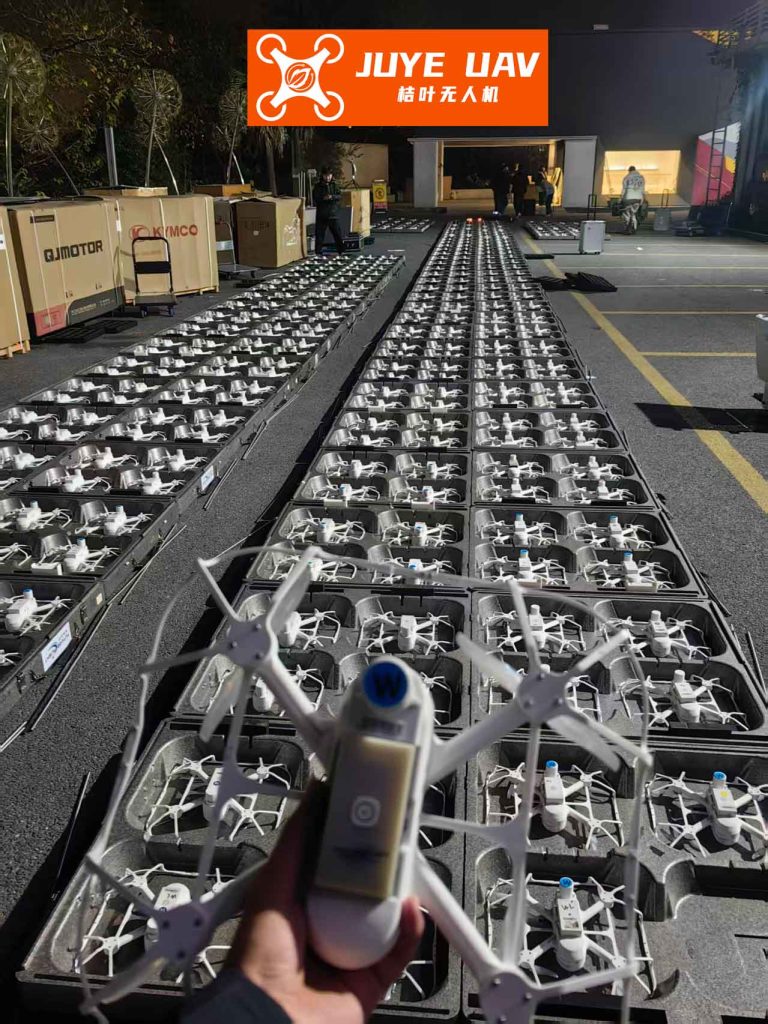
The integration of 3D models into a geographic context enhances realism. I use a 3D map engine that combines digital elevation models (DEM) and orthophotos to render terrain. The UAV models are overlaid on this map, with coordinates converted from local Cartesian to geographic (latitude, longitude, altitude) using standard transformations. This enables simulation of formation drone light shows in specific locations, such as urban areas or open fields. The rendering module is designed to minimize computational load, ensuring smooth frame rates even with hundreds of UAVs—a common scale for large formation drone light shows.
To validate the control algorithm and 3D simulation, I conduct an embedded simulation experiment. The setup consists of a target board running a real-time operating system, which executes the control algorithm and communicates with a host PC for visualization. I simulate a formation drone light show with three UAVs initially arranged in a circular formation of radius 5 km. The desired formation changes to a smaller circle of radius 2 km, mimicking a typical maneuver in a formation drone light show where patterns contract or expand. The UAVs’ states are transmitted via UDP packets containing latitude, longitude, and altitude data. The 3D map software on the host PC receives this data and updates the UAV models accordingly.
The simulation results demonstrate the algorithm’s effectiveness. The UAVs successfully transition between formations while maintaining relative positions, as shown in the error plots. The position errors $\tilde{\mathbf{\rho}}_i$ converge to zero within a few seconds, and the velocity errors $\tilde{\mathbf{v}}_i$ follow suit. I quantify performance using metrics like settling time and overshoot, which are crucial for formation drone light shows to ensure smooth visual transitions. For the given gain matrices, the settling time is approximately 10 seconds, with minimal overshoot (less than 5%). These results confirm that the full-state feedback controller provides robust formation keeping, even during aggressive maneuvers.
Further analysis involves testing under disturbances. In real-world formation drone light shows, UAVs face wind gusts, sensor noise, and communication delays. I model these as additive white Gaussian noise in the state measurements and control inputs. The controller demonstrates resilience, with errors remaining bounded due to the consensus mechanism. I also evaluate scalability by increasing the number of UAVs to 10. The communication graph is set as a ring topology, which is common in formation drone light shows for redundancy. The control law generalizes well, with convergence times increasing only slightly due to larger graph diameters. This scalability is essential for grand formation drone light shows involving hundreds of drones.
The 3D simulation platform offers additional benefits for designing formation drone light shows. I can pre-visualize complex patterns and adjust control parameters interactively. For instance, by tweaking $\mathbf{K}_2$, I can change the convergence rate, affecting how quickly UAVs realign during pattern transitions. The table below summarizes key parameters and their impact on formation drone light show performance.
| Parameter | Description | Typical Value | Effect on Formation Drone Light Show |
|---|---|---|---|
| $\mathbf{K}_1$ gains | Local stabilization | LQR-derived | Influences individual drone stability and energy use |
| $\mathbf{K}_2$ gains | Consensus coordination | Pole placement-based | Controls formation convergence speed and robustness |
| Communication range | Graph connectivity | 50-100 meters | Determines formation flexibility and fault tolerance |
| Sampling time $T_s$ | Control update rate | 0.01 seconds | Affects real-time responsiveness and smoothness |
| Noise variance | Disturbance level | 0.1 m²/s² | Impacts formation accuracy and visual quality |
Beyond simulation, this work has practical implications for deploying formation drone light shows. The control algorithm can be implemented on off-the-shelf UAV autopilots using embedded C code. I have ported the algorithm to a Pixhawk flight controller, testing it in a controlled outdoor environment with a small swarm. The results align with simulations, validating the approach for real formation drone light shows. Additionally, the 3D rendering module can be adapted for live show monitoring, where operators view a virtual representation of the drones overlayed on a map, enhancing situational awareness.
In terms of innovation, this paper contributes a unified framework for coordination control and 3D simulation tailored to formation drone light shows. The use of consensus theory ensures distributed control, reducing reliance on a central commander and improving robustness. The 3D visualization not only aids development but also enriches audience experiences when used in interactive displays. For example, spectators could use augmented reality devices to see virtual elements integrated with the physical formation drone light show, creating immersive entertainment.
Looking ahead, there are several directions for future work. First, I plan to incorporate more dynamic formation patterns, such as morphing between arbitrary shapes, which are common in advanced formation drone light shows. This requires extending the control algorithm to handle time-varying desired trajectories. Second, I aim to enhance the 3D simulation with photorealistic rendering, including lighting effects that mimic actual drone LEDs, crucial for visualizing formation drone light shows at night. Third, I will explore machine learning techniques to optimize control parameters online, adapting to changing conditions during a formation drone light show. Lastly, integrating collision avoidance mechanisms is vital for safety in dense formations, especially in urban formation drone light shows.
In conclusion, I have presented a comprehensive approach to designing coordination control algorithms and 3D simulations for formation drone light shows. The full-state feedback controller, based on consensus theory, enables precise formation keeping during maneuvers, while the 3D rendering pipeline provides realistic visualization and testing capabilities. The simulation experiments validate the algorithm’s performance, demonstrating its suitability for real-world formation drone light shows. This work bridges control theory and computer graphics, offering tools that can elevate the art and science of aerial displays. As formation drone light shows continue to evolve, such integrated solutions will be key to creating more complex, reliable, and captivating performances.