
The modern battlespace is undergoing a profound transformation, one that I have observed with increasing focus. The proliferation of unmanned aerial vehicles (UAVs), ranging from sophisticated military-grade systems to commercially available quadcopters repurposed for combat, has fundamentally altered the tactical calculus. This shift, starkly illustrated in recent conflicts, compels a critical examination of our defensive posture. The core challenge we face is no longer merely confronting traditional airpower but developing resilient, cost-effective, and scalable anti-UAV architectures. This article synthesizes current observations and future projections on the systems and strategies required to neutralize this pervasive threat.
The threat spectrum is remarkably broad. It encompasses medium-altitude long-endurance (MALE) drones for reconnaissance and strike, down to small and micro-UAVs that provide tactical intelligence or act as loitering munitions. The accessibility of commercial-off-the-shelf (COTS) technology is a key driver. A commercially available drone, costing a few hundred dollars, can now perform tasks once reserved for expensive military hardware: surveillance, artillery correction, and even direct attacks by dropping munitions or functioning as a kamikaze vehicle. The operational impact is staggering, with tens of thousands of sorties logged in recent years, creating an unprecedented scale of drone warfare.
The most pressing tactical development, in my view, is the evolution toward autonomy and swarming. Future conflicts will not merely feature individual drones but coordinated anti-UAV swarms capable of saturating defenses. These swarms could execute complex, multi-domain missions where individual units perform specialized roles—reconnaissance, electronic warfare, communications relay, and kinetic strike—all orchestrated by AI-driven “lead” drones. This represents a qualitative leap beyond remote-piloted systems. The mathematical challenge of defeating a swarm is non-trivial. If a defensive system can engage a target every \( t_{engage} \) seconds, and an attacking swarm of \( N \) drones arrives simultaneously, the system is overwhelmed if:
$$ N > \frac{T_{total}}{t_{engage}} $$
where \( T_{total} \) is the total time available for engagement before the swarm reaches its target. This simple formula underscores the need for area-effect weapons and multi-layered defenses.
| UAV Category | Typical Size/Role | Primary Threat | Key anti-UAV Challenge |
|---|---|---|---|
| Group 1 (Micro/Small) | < 20 kg, COTS quadcopters, FPV drones | Tactical ISTAR, loitering munitions against personnel/light vehicles | Detection difficulty, cost asymmetry, swarm saturation |
| Group 2 (Tactical) | 20-150 kg, e.g., TB-2 | Precision strike against vehicles, persistent surveillance | Extended range, integrated defense suites, cost-effective engagement |
| Group 3/4/5 (MALE/HALE) | Large, fixed-wing (e.g., Shahed-136) | Strategic strikes on infrastructure, long-range ISR | Defeating GNSS/INS guidance, layered intercept (kinetic/electronic) |
| Swarming Systems | Multiple Group 1/2 UAVs | Saturation attacks, coordinated multi-role missions | Simultaneous engagement, defeating decentralized AI control |
Current anti-UAV methodologies can be broadly categorized into kinetic and non-kinetic effects. The traditional kinetic approach—using missiles or gun systems—faces a severe cost-effectiveness dilemma. Engaging a $500 drone with a $400,000 missile is financially and logistically unsustainable, especially against swarms. However, advancements are being made in smart, programmable munitions. Airburst munitions from autocannons, guided by advanced fusing and targeting algorithms, show promise for countering drone clusters. The probability of kill \( P_k \) for such a system against a swarm can be modeled as a function of the munition’s effective radius \( r_{eff} \), drone density \( \rho \), and system reaction time:
$$ P_k \approx 1 – e^{ -\rho \cdot \pi r_{eff}^2 } $$
for a given engagement cycle.
Non-kinetic effects, primarily Electronic Warfare (EW), currently form the first line of defense. Jamming, which disrupts the command-and-control (C2) link or GNSS guidance, is widespread and effective against many COTS and older military systems. The effectiveness \( E_{jamming} \) can be conceptualized as a function of jamming power \( P_j \), range \( R \), and the target’s signal processing gain \( G_{target} \):
$$ E_{jamming} \propto \frac{P_j \cdot G_{jam}}{R^2 \cdot G_{target}} $$
Where \( G_{jam} \) is the jamming antenna gain. However, the trend toward autonomous drones with inertial navigation systems (INS), alternative navigation (terrain, visual), and AI-based target recognition is reducing the susceptibility to pure RF jamming. Furthermore, powerful jammers can be geolocated and destroyed, creating a counter-battery dynamic.
This brings us to the most promising and heavily researched frontiers of anti-UAV technology: Directed Energy Weapons (DEWs). These systems aim to provide the “deep magazine” and low cost-per-shot needed to counter swarm threats.
High-Energy Lasers (HEL) function by delivering concentrated photon energy to a spot on the target, causing thermal damage. The time \( t_{kill} \) required to disable a target is inversely proportional to the laser’s power on target \( P_{tot} \) and the target’s susceptibility \( \alpha \):
$$ t_{kill} \propto \frac{1}{P_{tot} \cdot \alpha} $$
Current mobile HEL prototypes in the 50-300 kW range are effective against Group 1 and 2 UAVs. However, challenges remain. Atmospheric attenuation (scattering, absorption due to haze, rain, smoke) and thermal blooming degrade beam integrity over range. The required dwell time on a fast-moving or maneuvering target also makes single lasers vulnerable to saturation by swarms. For Counter-Rocket, Artillery, and Mortar (C-RAM) missions, the dwell time challenge is even greater, requiring rapid burn-through of a shell casing.
High-Power Microwaves (HPM) represent a paradigm shift for anti-UAV swarm defense. Instead of a focused beam, HPM systems emit a wide-area pulse of electromagnetic energy designed to couple into and fry the sensitive electronics of drones. The key advantage is the ability to engage multiple targets in a single shot. The effective radius \( R_{HPM} \) for a given pulse energy \( E_{pulse} \) and frequency \( f \) against a drone with a susceptibility threshold \( S_{min} \) can be approximated by:
$$ R_{HPM} \leq \sqrt{ \frac{E_{pulse} \cdot G_{HPM}}{4\pi \cdot S_{min}} } $$
where \( G_{HPM} \) is the antenna gain. Systems are being developed for both fixed-site defense and mobile applications, with some prototypes demonstrating success against entire drone swarms in testing. HPM may also have utility against the guidance systems of some precision-guided munitions.
| Technology | Principle | Key Advantages | Primary Limitations | Suitability vs. Swarms |
|---|---|---|---|---|
| Kinetic (Missiles/Guns) | Physical destruction via projectile | High cost-per-kill, limited magazine depth, saturation risk | Low (Cost-prohibitive) | |
| Electronic Warfare (Jamming) | Disrupts C2 & Navigation links | Reduced effect vs. autonomous drones, emitter location risk | Medium-High (Dependent on drone autonomy) | |
| High-Energy Laser (HEL) | Low-Medium (Sequential engagement) | |||
| High-Power Microwave (HPM) | Very High (Simultaneous engagement) | |||
| Interceptor Drones | Medium (Depends on interceptor capabilities) |
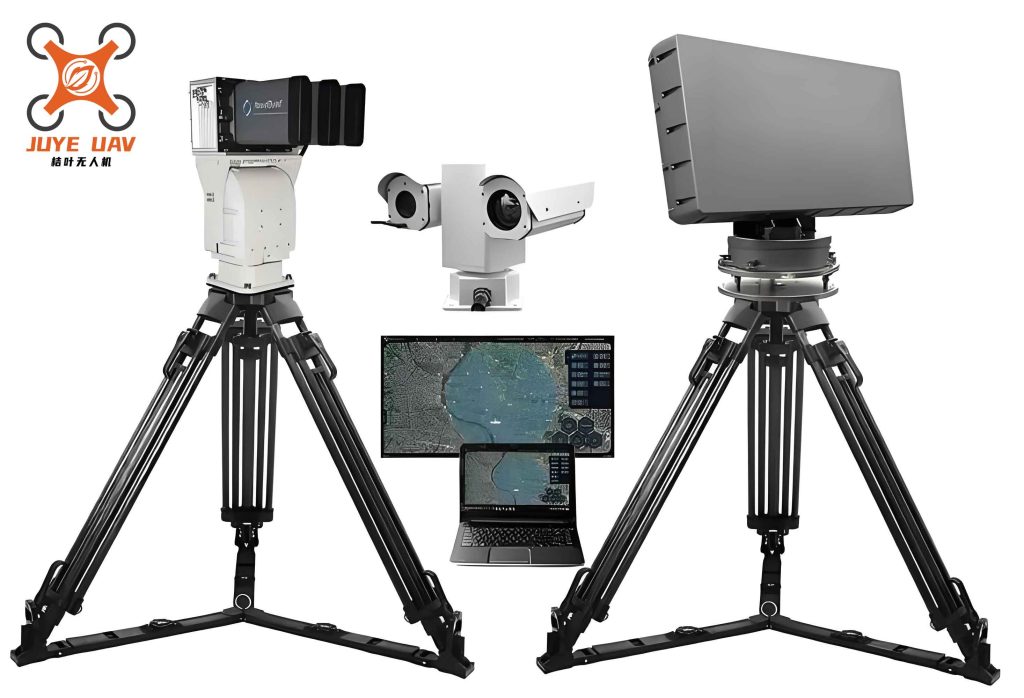
A critical insight from ongoing developments is that no single “silver bullet” exists. The future of effective anti-UAV defense lies in integrated, layered “systems of systems.” This architecture must seamlessly blend sensors, command and control (C2), and a diverse mix of effectors. Sensors need to be networked, combining ground-based radars (like advanced AESA types), electro-optical/infrared (EO/IR) trackers, and even acoustic detection to provide a comprehensive air picture and low-probability-of-intercept (LPI) tracking of small, low-flying drones.
The effector layer must be a hybrid. Wide-area HPM and advanced EW systems form the outer layer to degrade and defeat swarms and less resilient individuals. HELs and autocannons with smart munitions provide precision point defense for high-value assets and handle leakers. Interceptor drones could offer a forward-deployed, persistent layer. The C2 system is the brain, using AI and battle management algorithms to optimally assign threats to effectors based on priority, capability, and resource state (e.g., laser power level, missile inventory). The overall system resilience \( R_{system} \) against a diverse threat set \( \{T\} \) can be thought of as:
$$ R_{system} = 1 – \prod_{T_i \in \{T\}} (1 – P_{defeat}(T_i)) $$
where \( P_{defeat}(T_i) \) is the probability the integrated system defeats threat \( T_i \).
Furthermore, the line between anti-UAV and C-RAM is blurring. Many of the same technologies—particularly HEL and HPM—are being pursued for both missions. However, C-RAM presents a more daunting physics problem due to the higher speed and structural robustness of artillery shells. A future integrated air and missile defense network will likely have nodes capable of engaging both UAVs and certain RAM projectiles, but specialized systems will remain for the highest-velocity threats.
| Operational Parameter | Kinetic Systems | Directed Energy (HEL/HPM) | Electronic Warfare |
|---|---|---|---|
| Cost per Engagement | Very High ($10k – $1M+) | Very Low (Cost of electrical power) | Low (Cost of system operation) |
| Magazine Depth | Limited (Physical inventory) | Very High (Limited by power supply) | Effectively Unlimited |
| Engagement Speed | Fast (Once launched) | HEL: Slower (Dwell time) HPM: Instant (Pulse) |
Near-instant (Speed of light) |
| Collateral Damage Risk | High (Falling debris/shrapnel) | HEL: Low (Precision) HPM: Medium (Area effect) |
Low (Non-kinetic) |
| All-Weather Capability | High | HEL: Reduced in bad weather HPM: Generally High |
High |
In conclusion, the trajectory is clear. The anti-UAV mission is a top priority that will define defensive operations for decades. The adversary’s drone technology will continue to evolve, emphasizing autonomy, resilience, and swarming. Our response cannot be monolithic. It must be an agile, adaptive network of complementary technologies—where high-power microwaves counter the swarm, lasers and smart projectiles handle the outliers, and electronic warfare constantly contests the spectrum. The integration of AI for sensor fusion, target identification, and weapon assignment will be as crucial as the hardware itself. The goal is to create a dynamic, multi-layered shield so dense that the probability of a drone finding a path through it approaches zero. The era of the drone is here, and the era of the sophisticated, networked anti-UAV system has just begun.