
The pursuit of advanced unmanned aerial vehicles (UAVs) has increasingly turned to nature for inspiration. Among natural flyers, the butterfly presents a unique and complex flight paradigm characterized by large, low-aspect-ratio wings, low flapping frequencies, and significant body oscillations. This article presents the design rationale and aerodynamic principles behind a novel bio-inspired flying butterfly drone, engineered to emulate the high-lift mechanisms observed in Lepidoptera. The core of this design lies in translating three critical aerodynamic phenomena—the formation of a large-scale vortex ring, the strategic positioning of the leading-edge vortex, and the augmentation of lift during the downstroke—into a functional mechanical system. This flying butterfly drone aims to achieve vertical take-off and landing (VTOL) and stable hovering by intelligently modulating wing kinematics and center of mass.
The flight of insects, operating at low Reynolds numbers (typically $$10 < Re < 10^4$$), cannot be adequately explained by steady-state aerodynamics. The lift generated under such conditions is insufficient to support the insect’s weight. Therefore, flying insects, including butterflies, leverage unsteady aerodynamic mechanisms. For a flying butterfly drone to be viable, it must successfully replicate these mechanisms. The governing equations for viscous, incompressible flow, the Navier-Stokes equations, are central to understanding this phenomenon:
$$
\frac{\partial \mathbf{u}}{\partial t} + (\mathbf{u} \cdot \nabla) \mathbf{u} = -\frac{1}{\rho} \nabla p + \nu \nabla^2 \mathbf{u}
$$
$$
\nabla \cdot \mathbf{u} = 0
$$
where $$\mathbf{u}$$ is the flow velocity, $$p$$ is the pressure, $$\rho$$ is the fluid density, and $$\nu$$ is the kinematic viscosity. Solving these equations for a flapping wing reveals complex vortex structures that are key to high lift generation. The primary challenge in designing an effective flying butterfly drone is to mechanically induce and control these vortex structures.
High-Lift Mechanisms in Butterflies and Implementation Strategy
Butterfly flight is distinct due to its low wingbeat frequency, lack of wing flip during the upstroke, and pronounced body pitching. Computational and experimental studies have shown that a coherent, large-scale vortex ring (VR) is formed around the wings during each stroke cycle. This VR, encompassing the leading edge, trailing edge, and wingtips, creates a region of low pressure inside the ring, resulting in a significant pressure difference and, consequently, high lift. The design of the flying butterfly drone must first and foremost facilitate the consistent generation of this strong vortex ring.
Furthermore, research indicates that the body’s pitch oscillation (denoted as *P*) moves the formation point of the Leading-Edge Vortex (LEV) closer to the wing surface and the vehicle’s center of mass. This proximity enhances the effective leverage of the lift force, improving stability and control. Simultaneously, the body’s vertical heaving motion (denoted as *O*) strengthens the intensity of the vortex ring. A successful flying butterfly drone must, therefore, incorporate a means to induce beneficial body pitch motion.
Analysis of flapping kinematics across insects reveals that the instantaneous lift force peaks during both the downstroke and upstroke. However, the total impulse (integral of force over time) during the downstroke, $$F_d = \int_{t_{down}} L(t) \, dt$$, is critical for net vertical force. The goal for the flying butterfly drone is to maximize this integral, particularly during the downstroke, by modulating the wing’s effective area.
The following table summarizes the three key aerodynamic conditions and their corresponding design imperatives for the flying butterfly drone:
| Aerodynamic Condition | Design Imperative for the Flying Butterfly Drone |
|---|---|
| 1. Formation of a Large-Scale Vortex Ring (VR) | Biomimetic wing shape and flapping motion to generate and shed strong vortices. |
| 2. Maximized Lift Impulse during Downstroke | Mechanical mechanism to increase the effective wing area specifically during the downstroke phase. |
| 3. Body Pitch to Position LEV Advantageously | Adjustable center of mass to induce a periodic pitch oscillation synchronized with the wingbeat. |
Mechanical Design of the Bio-Inspired Flying Butterfly Drone
The proposed design for the flying butterfly drone directly addresses the three imperatives outlined above. The overall structure maintains the iconic shape of a butterfly, which is aerodynamically crucial for generating the desired flow patterns.
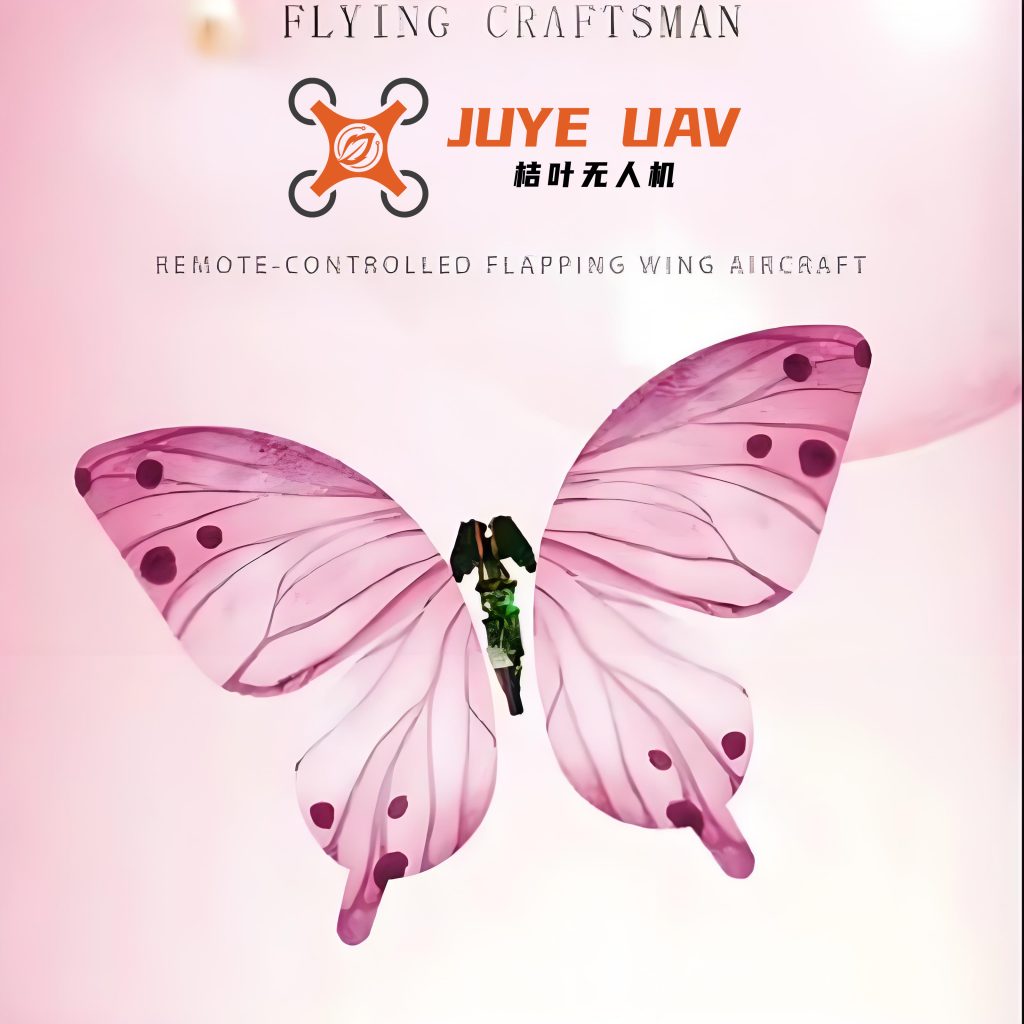
1. Core Flapping Mechanism: The primary flapping motion is achieved through a crank-slider mechanism. An electric motor drives a rotating disk (crank). A connecting rod links this crank to a slider confined within a vertical guide channel. The reciprocating motion of the slider is transferred via symmetric linkages to the forewing spars, which are hinged at the body. This converts the motor’s rotary motion into the oscillatory flapping of the forewings. The frequency ($$f$$) and amplitude of the flapping can be controlled by the motor’s rotational speed, which is fundamental for the flying butterfly drone to generate the necessary unsteady flow for vortex ring formation (Condition 1).
2. Innovative Movable Hindwing System: This is the key feature for addressing Condition 2. The hindwings are not fixed; they are mounted on a rail system allowing for fore-aft translation. A pin attached to the hindwing mechanism engages with a specially designed triangular cam groove. The interaction between the pin and this groove orchestrates the hindwing’s motion throughout the stroke cycle:
- Early Downstroke: The pin moves along one edge of the triangular groove, causing the hindwings to translate backwards and downwards, increasing the total wing area and creating a large, continuous lifting surface.
- Stroke Reversal (Bottom): At the end of the downstroke, an elastic band (or a compliant element in a refined model) pulls the pin along the second edge of the groove, rapidly sliding the hindwings forward. This reduces the total wing area by overlapping the hindwings with the forewings, minimizing negative lift or drag during the subsequent upstroke reversal.
- Upstroke: The pin travels along the third edge, moving the hindwings back to their starting position, gradually increasing area again to contribute positively to lift if the wing kinematics allow.
This mechanism ensures that the effective area $$S_{eff}(t)$$ is a function of stroke phase, $$S_{eff}(\phi)$$, with its maximum aligned with the mid-downstroke, thereby boosting the downstroke lift integral $$F_d$$.
3. Center of Mass Modulation for Body Pitch: The fore-aft translation of the relatively massive hindwing assembly during each stroke cycle causes the overall center of mass (CoM) of the flying butterfly drone to oscillate periodically. This oscillation naturally induces a body pitching motion ($$P$$). By tuning the mass distribution and the stroke-synchronized movement, this pitch can be calibrated to ensure the Leading-Edge Vortex forms optimally close to the wing, enhancing lift efficiency as per Condition 3. The pitch dynamics can be approximated by:
$$
I \ddot{\theta} + C \dot{\theta} + K \theta = \tau_{aero} + \tau_{CoM}(t)
$$
where $$I$$ is the moment of inertia, $$C$$ is a damping coefficient, $$K$$ is a stiffness, $$\tau_{aero}$$ is the aerodynamic torque, and $$\tau_{CoM}(t)$$ is the periodic torque induced by the moving CoM.
Theoretical Scaling and Parameter Estimation
Based on allometric scaling laws derived from biological insects, key parameters for a functional flying butterfly drone can be estimated. These laws relate physical parameters to body mass ($$m$$) via power-law relationships. For a target mass of $$m = 0.07 \, \text{kg}$$, the following calculations provide a baseline:
| Parameter | Scaling Law | Calculated Value | Design Implication for Flying Butterfly Drone |
|---|---|---|---|
| Wingspan (b) | $$b = 1.24 \, m^{0.37}$$ | $$b \approx 0.46 \, \text{m}$$ | Proposed design uses ~0.53 m for greater lift area. |
| Wing Area (S) | $$S = 0.16 \, m^{0.67}$$ | $$S \approx 0.027 \, \text{m}^2$$ | Design target ~0.07 m² to compensate for lower efficiency. |
| Aspect Ratio (AR) | $$AR = 9.34 \, m^{0.07}$$ | $$AR \approx 7.77$$ | Design AR = b²/S ≈ 4.0, favoring maneuverability over endurance. |
| Flapping Frequency (f) | $$f = 3.99 \, m^{-0.2}$$ | $$f \approx 6.8 \, \text{Hz}$$ | Target operational frequency for the motor mechanism. |
| Min. Power Speed ($$V_{mp}$$) | $$V_{mp} = 8.7 \, m^{0.16}$$ | $$V_{mp} \approx 5.7 \, \text{m/s}$$ | Reference for forward flight efficiency. |
| Max. Power Output ($$P_{max}$$) | $$P_{max} = 84.39 \, m^{0.73}$$ | $$P_{max} \approx 12.1 \, \text{W}$$ | Required peak power for the motor and drive system. |
The lift force $$L$$ generated by the flying butterfly drone can be modeled using a modified version of the quasi-steady equation, accounting for the variable area:
$$
L(t) = \frac{1}{2} \rho \, C_L(\alpha, Re, \dot{\phi}) \, S_{eff}(\phi) \, U(t)^2
$$
where $$C_L$$ is the instantaneous lift coefficient (a function of angle of attack $$\alpha$$, Reynolds number $$Re$$, and flapping rate $$\dot{\phi}$$), $$\rho$$ is air density, and $$U(t)$$ is the instantaneous wing speed. The function $$S_{eff}(\phi)$$ is directly controlled by the movable hindwing mechanism.
Aerodynamic Vortex Dynamics and Performance
The successful operation of the flying butterfly drone hinges on its ability to generate and manage specific vortex structures. During the powerful downstroke, the wings’ motion sheds vorticity from the leading edge, trailing edge, and tips. These vortices connect to form the aforementioned vortex ring. The strength (circulation, $$\Gamma$$) of this ring is proportional to the lift. According to the Kutta-Joukowski theorem related to unsteady flow, the lift per unit span is $$L’ = \rho U \Gamma$$. For the entire flying butterfly drone wing, the total circulation shed per stroke contributes to the ring’s strength.
The movable hindwing mechanism directly influences this process. By maximizing area during the downstroke, it increases the rate of vorticity generation $$\frac{d\Gamma}{dt}$$, leading to a stronger vortex ring and higher peak lift. The subsequent retraction of the hindwings at the stroke reversal helps in cleanly terminating the downstroke vortex and preparing for the next cycle, reducing detrimental wake interactions.
The induced body pitch further optimizes the Leading-Edge Vortex (LEV) stability. At low $$Re$$, the LEV can prematurely detach. The pitching motion of the flying butterfly drone’s body effectively changes the effective angle of attack distribution along the stroke, helping to stabilize the LEV and keep it attached closer to the wing root, which improves aerodynamic efficiency. The relationship between body pitch angle $$\theta_b(t)$$ and effective angle of attack $$\alpha_{eff}$$ is:
$$
\alpha_{eff}(t) = \alpha_{wing}(t) + \theta_b(t)
$$
where $$\alpha_{wing}(t)$$ is the geometric angle of attack of the wing relative to the body.
Conclusion and Future Development Pathways
This design outlines a comprehensive mechanical strategy to embody the high-lift mechanics of butterflies into a functional flying butterfly drone. By integrating a biomimetic shape, a stroke-phase-dependent variable-area wing system, and a mass-induced pitching mechanism, the design targets the three critical conditions for generating sufficient unsteady lift for VTOL and hovering. The flying butterfly drone concept demonstrates that intelligent mechanical synchronization can substitute for biological muscular control to achieve complex aerodynamic goals.
The realization of a practical flying butterfly drone based on this design will depend on advancements in several supporting technologies. The elastic band in the cam-follower system would be replaced by sophisticated compliant mechanisms or shape memory alloy (SMA) actuators for precise control. Lightweight, high-strength materials like carbon-fiber-reinforced polymers and polyimide films would be essential for the airframe and flexible joints. The power system, currently conceptualized as a DC motor, could evolve to include piezoelectric actuators or artificial muscles for more efficient and silent operation. Finally, closed-loop control algorithms using micro-electro-mechanical systems (MEMS) sensors will be crucial for stabilizing the inherently unstable flapping-wing platform, making the autonomous flying butterfly drone a reality. This bio-inspired approach promises a new class of agile, efficient, and aesthetically unique micro aerial vehicles.