
As urbanization accelerates, the proliferation of high-rise buildings, large complexes, and underground spaces has intensified the complexity and severity of fire hazards. In this context, timely, efficient, and safe disaster reconnaissance and fire suppression have become paramount demands for firefighting forces. The introduction of intelligent fire drone clusters, leveraging their mobility, flexibility, and collaborative capabilities, offers a transformative approach to enhancing rescue efficiency. However, the application of fire drone clusters in fire rescue remains in its nascent stage, facing challenges in coordinated control, adaptation to complex environments, and intelligent decision support. In this article, I will analyze the value of fire drone clusters in fire rescue, focus on key dilemmas, and explore innovative strategies to optimize their application, aiming to provide references for scaling up their use in the firefighting domain.
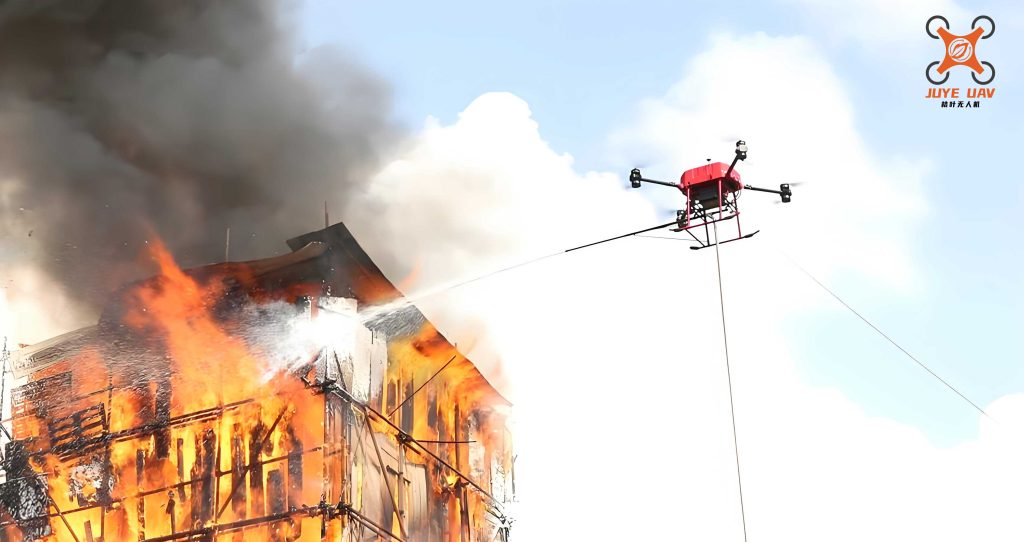
The integration of fire drone clusters into fire rescue operations represents a significant technological leap. These intelligent systems can revolutionize traditional methods by providing real-time data, reducing risks, and extending operational capabilities. In the following sections, I will delve into the importance, current limitations, and future strategies for deploying fire drone clusters, emphasizing the keyword ‘fire drone’ throughout to highlight their central role. The use of tables and formulas will help summarize key concepts and technical aspects, facilitating a deeper understanding of this emerging field.
Significance of Intelligent Fire Drone Clusters in Fire Rescue
Fire rescue operations often occur in high-risk environments such as densely populated areas, complex traffic zones, and tall structures. The ability to gather accurate and comprehensive situational awareness is crucial for effective response. Traditional methods relying on human observation are limited by visibility, efficiency, and safety concerns. Fire drone clusters address these issues by offering enhanced reconnaissance, risk reduction, and expanded rescue capabilities.
Enhancing Disaster Reconnaissance and Situational Awareness
Fire drone clusters enable rapid deployment to fire scenes, equipped with multi-source sensors like electro-optical, infrared, and radar systems. These drones can capture real-time images, thermal distributions, and other critical data, significantly improving reconnaissance speed and breadth. Compared to single drones, clusters provide panoramic coverage through coordinated efforts, transmitting information via network systems to expand firefighters’ perceptual fields. This not only supports accurate decision-making but also shifts reconnaissance tasks away from human operators, mitigating risks. For instance, fire drone clusters can continuously monitor blind spots or key areas, offering reliable insights for commanders. The collaborative nature of these fire drone systems acts as a technological backbone for situational awareness.
To illustrate the advantages, consider the following table comparing traditional reconnaissance with fire drone cluster-based approaches:
| Aspect | Traditional Reconnaissance | Fire Drone Cluster Reconnaissance |
|---|---|---|
| Speed | Slow, limited by human mobility | Fast, drones can fly directly to the scene |
| Coverage | Limited to ground-level or accessible areas | Comprehensive, including aerial and multi-angle views |
| Risk to Personnel | High, due to exposure to hazards | Low, as drones operate remotely |
| Data Realism | Often fragmented and subjective | Real-time, multi-source, and objective |
| Cost Efficiency | High labor costs and resource intensity | Scalable with reduced human intervention |
The efficiency gain from using fire drone clusters can be modeled mathematically. Let the reconnaissance efficiency \( E \) be defined as the ratio of area covered per unit time to the risk involved. For traditional methods, \( E_t = \frac{A_t}{t_t \cdot R_t} \), where \( A_t \) is area covered, \( t_t \) is time, and \( R_t \) is risk factor. For fire drone clusters, \( E_d = \frac{A_d}{t_d \cdot R_d} \). Given that \( A_d > A_t \), \( t_d < t_t \), and \( R_d < R_t \), it follows that \( E_d > E_t \), demonstrating the superiority of fire drone systems. This formula underscores how fire drone clusters enhance operational effectiveness.
Reducing Risks for Fire Rescue Personnel
Firefighting is inherently dangerous, with personnel exposed to high temperatures, smoke, toxic gases, and structural collapses. Fire drone clusters serve as a protective barrier by substituting human involvement in hazardous zones. These drones can enter core fire areas for reconnaissance and assessment, avoiding unnecessary human entry. Equipped with灭火装备 like fire-extinguishing balls or dry powder, fire drone clusters can perform unmanned灭火 tasks, responding quickly and withdrawing if threats arise. Even if individual fire drones are damaged, the cluster can maintain mission continuity through redundancy. In scenarios like high-rise buildings or large oil tanks, where ground-based equipment may be ineffective, fire drone clusters offer vertical灭火 capabilities, extending the spatial range of fire suppression. Thus, fire drone clusters are a vital means to lower casualties and ensure safety.
The risk reduction can be quantified using a probability model. Let \( P_h \) be the probability of human injury in traditional rescue, and \( P_d \) be the probability when using fire drone clusters. Assuming a cluster of \( n \) drones, each with a failure rate \( \lambda \), the overall system reliability \( R_s \) can be expressed as \( R_s = 1 – (1 – e^{-\lambda t})^n \), where \( t \) is mission time. Since \( P_d \) is proportional to \( 1 – R_s \), and \( P_h \) is typically higher due to direct exposure, we have \( P_d < P_h \). This highlights how fire drone clusters mitigate risks through technological redundancy.
Extending Rescue Capabilities in Complex Environments
Fire incidents often involve challenging conditions such as high heat, smoke, confined spaces, and hazardous materials. Fire drone clusters excel in these environments by enabling立体覆盖 and sustained operations. For example, in large petrochemical plants, fire drone clusters can deploy swarm robots for close-range侦察 or set up temporary communication relays to guide trapped individuals. They can also carry hazardous material detectors to assess leaks and control火势 through aerial spraying. The “one-to-many” operational mode of fire drone clusters allows for efficient coverage of vast areas, complementing human efforts where physical limitations exist. This strategic expansion of rescue capabilities makes fire drone clusters indispensable for modern firefighting.
A table summarizing the extended capabilities of fire drone clusters in various complex environments is provided below:
| Environment Type | Challenge | Fire Drone Cluster Solution |
|---|---|---|
| High-Rise Buildings | Limited access for ground equipment | Vertical deployment and灭火 from air |
| Petrochemical Fires | Explosive and toxic atmospheres | Remote sensing and chemical agent dispersal |
| Confined Spaces | Poor visibility and mobility | Small drones or swarm robots for internal侦察 |
| Wildland Fires | Rapid spread and large area coverage | Clusters for aerial monitoring and firebreak creation |
| Urban Congestion | Traffic and obstruction issues | Rapid aerial response bypassing ground barriers |
The operational efficiency in complex environments can be described by a协同 performance metric. Let \( C \) represent the协同 efficiency of a fire drone cluster, defined as \( C = \frac{\sum_{i=1}^{n} u_i}{n \cdot \tau} \), where \( u_i \) is the utility of drone \( i \), \( n \) is the number of drones, and \( \tau \) is the time to complete a task. In complex settings, fire drone clusters optimize \( C \) through adaptive formation and task allocation, outperforming single drones or human teams.
Current Dilemmas in Applying Fire Drone Clusters to Fire Rescue
Despite their potential, fire drone clusters face several practical challenges that hinder widespread adoption. These include immature协同 control technologies, limited environmental adaptability, and inadequate data processing systems. Addressing these issues is crucial for realizing the full benefits of fire drone systems.
Im成熟 of Cluster Coordinated Control Technologies
The协同 operation of fire drone clusters requires advanced algorithms for communication networking, swarm scheduling, and task allocation. Current systems often rely on simplified models that struggle in dynamic fire rescue environments. Challenges include maintaining formation shapes, avoiding collisions, and ensuring robust communication under interference. For instance, in dense smoke or strong winds, fire drone clusters may experience signal loss or formation breakdown, compromising mission success. Moreover, the autonomy of fire drones is limited, with most adjustments依赖地面站 control, leading to slow responses. This undermines the agility needed in fast-evolving fire scenarios.
The control challenge can be formulated using a dynamic system model. Consider a cluster of \( m \) fire drones with positions \( \mathbf{x}_i(t) \) and velocities \( \mathbf{v}_i(t) \). The协同 control law aims to minimize a cost function \( J = \int_{0}^{T} \left( \sum_{i=1}^{m} \| \mathbf{v}_i – \mathbf{v}_d \|^2 + \sum_{i \neq j} f(\|\mathbf{x}_i – \mathbf{x}_j\|) \right) dt \), where \( \mathbf{v}_d \) is the desired velocity and \( f \) is a collision avoidance term. In practice, uncertainties from environmental disturbances \( \xi(t) \) (e.g., wind gusts) make this optimization non-trivial, as \( \dot{\mathbf{x}}_i = \mathbf{v}_i + \xi(t) \). Current algorithms often fail to account for such \( \xi(t) \) in real-time, highlighting the need for more robust fire drone control strategies.
Limited Environmental Adaptability and Operational Efficiency
Fire scenes present harsh conditions like浓烟, high temperatures, strong winds, and electromagnetic interference. Fire drone clusters must overcome these to perform effectively. However,感知 limitations arise when optical sensors are obstructed by smoke or impaired by heat.规划 and control issues include difficulty in generating safe flight paths in confined spaces or maintaining stability during定点悬停. For example, strong winds can destabilize fire drones, affecting precise operations like payload delivery. Additionally, the机动性 of fire drone clusters across different fire venues—such as urban versus industrial settings—needs improvement to ensure consistent efficiency.
To quantify adaptability, we can define an environmental adaptability index \( A_e \) for a fire drone cluster: \( A_e = \alpha \cdot S_p + \beta \cdot R_t + \gamma \cdot M_a \), where \( S_p \) is sensor performance under干扰 (e.g., signal-to-noise ratio), \( R_t \) is thermal resilience (e.g., operating temperature range), and \( M_a \) is maneuverability (e.g., agility score). Weights \( \alpha, \beta, \gamma \) reflect environmental priorities. Current fire drone systems often have low \( A_e \) values due to technological gaps, as shown in the table below:
| Environmental Factor | Impact on Fire Drone Clusters | Current Mitigation Level | Target Improvement |
|---|---|---|---|
| High Temperature | Sensor and battery degradation | Moderate (limited cooling systems) | High (advanced materials and thermal management) |
| 浓烟 Obscuration | Reduced visual and IR perception | Low (reliance on clear视野) | High (multi-sensor fusion and穿透 algorithms) |
| Strong Winds | Flight instability and trajectory deviation | Moderate (basic stabilization controls) | High (adaptive control and predictive modeling) |
| Electromagnetic Interference | Communication and navigation failures | Low (susceptible to noise) | High (shielded systems and frequency hopping) |
The operational efficiency \( \eta \) in such environments can be expressed as \( \eta = \frac{Q_{output}}{Q_{input}} \), where \( Q_{output} \) is the任务完成量 (e.g., area scouted or火势 controlled) and \( Q_{input} \) is resource consumption (e.g., energy or time). For fire drone clusters, \( \eta \) often drops in complex settings due to increased \( Q_{input} \) from compensation efforts, emphasizing the need for better adaptability.
Inadequate Data Processing and Decision Support Systems
Fire drone clusters generate vast amounts of heterogeneous data—from imagery to telemetry—but leveraging this for decision-making remains a hurdle. Issues include communication bottlenecks in transmitting large datasets, limited real-time processing capabilities, and lack of intelligent fusion algorithms. Without effective data compression or edge computing, valuable information may be lost or delayed. Furthermore, visualization tools are often rudimentary, presenting data as scattered points rather than intuitive situational maps. This hampers commanders’ ability to quickly interpret火场 dynamics and make informed choices.
A data processing pipeline for fire drone clusters can be modeled as a series of transformations: raw data \( D_r \) → preprocessed data \( D_p \) → fused information \( D_f \) →决策 support \( D_s \). The efficiency of this pipeline is governed by metrics like latency \( L = t_{end} – t_{start} \) and accuracy \( Acc = \frac{TP + TN}{TP + TN + FP + FN} \), where TP, TN, FP, FN are classification outcomes for fire-related features. Current systems suffer from high \( L \) and low \( Acc \) due to inadequate algorithms, as summarized by the formula \( Utility_{data} = \frac{Acc}{L} \). Improving this requires advancements in fire drone onboard processing and cloud-edge协同.
Innovative Strategies for Optimizing Fire Drone Cluster Applications
To overcome these dilemmas, I propose several strategies centered on building intelligent协同 networks, enhancing environmental adaptability, and deepening data integration. These approaches aim to propel fire drone clusters from experimental stages to reliable field deployment.
Constructing Intelligent Collaborative Networks for Stronger Cluster Linkages
Developing robust协同控制 technologies is foundational. This involves researching advanced formation control algorithms that account for dynamic fire environments. For example, using multi-sensor fusion for environmental modeling can improve navigation accuracy.避障 algorithms should be optimized to ensure safe航迹 planning in cluttered spaces. Additionally, fostering autonomy in fire drone clusters through task-driven结构调整 is key. By enabling drones to self-organize based on mission needs—such as reassigning roles during a rescue—responsiveness can be enhanced. Human-drone interaction should also be streamlined via natural interfaces like voice commands, reducing cognitive load on operators.
A proposed协同 network architecture can be represented as a graph \( G = (V, E) \), where vertices \( V \) represent fire drones and edges \( E \) represent communication links. The goal is to maximize connectivity while minimizing latency. The协同 performance can be optimized using a公式 like \( \max \sum_{i,j \in V} w_{ij} \cdot \log(1 + SNR_{ij}) – \lambda \cdot \sum_{i \in V} E_i \), where \( w_{ij} \) is the importance of link \( (i,j) \), \( SNR_{ij} \) is the signal-to-noise ratio, \( E_i \) is energy consumption, and \( \lambda \) is a trade-off parameter. This encourages efficient and reliable fire drone cluster networking.
Optimizing Resilience Technologies for Broader Environmental Adaptation
Enhancing the抗干扰能力 of fire drone clusters involves both hardware and software improvements. On the hardware front, using lightweight, heat-resistant composites and electromagnetic兼容 designs can boost durability. Aerodynamic refinements can stabilize flight in windy conditions. On the software side, advancing感知 technologies through multi-sensor fusion—such as combining lidar with thermal imaging—can penetrate smoke and provide accurate mappings. Moreover, developing adaptive control algorithms for狭小空间 navigation and wind compensation will expand operational scope. For specific scenarios like high-rise fires, research should focus on vertical作业 techniques and cluster density optimization to balance coverage and communication.
The improvement in environmental adaptability can be captured by a resilience metric \( R \), defined as \( R = \prod_{k=1}^{K} (1 – p_k) \), where \( p_k \) is the probability of failure due to environmental factor \( k \) (e.g., overheating, signal loss). By enhancing technologies, we aim to reduce each \( p_k \), thereby increasing \( R \) for fire drone clusters. The table below outlines strategic interventions:
| Technology Area | Current State | Innovation Strategy | Expected Impact on Fire Drone Performance |
|---|---|---|---|
| Thermal Protection | Basic insulation and cooling | Active cooling systems and phase-change materials | Extended operation in high-temperature zones |
| Sensor Fusion | Limited integration of data sources | AI-driven fusion of optical, IR, and radar data | Improved perception in obscured environments |
| Flight Control | Conventional PID controllers | Model predictive control (MPC) for wind adaptation | Stable hovering and precise maneuvers in gusts |
| Communication | Vulnerable to interference | 5G-based mesh networking and error correction | Reliable data transmission in electromagnetically noisy areas |
Furthermore, the efficiency gain from these optimizations can be expressed as \( \Delta \eta = \eta_{new} – \eta_{old} \), where \( \eta_{new} \) incorporates resilience technologies. For instance, if a fire drone cluster’s operational time in high heat increases from \( t_1 \) to \( t_2 \), then \( \eta_{new} \propto t_2 \) and \( \Delta \eta > 0 \), demonstrating value.
Establishing Decision Support Systems through Deep Data Intelligence Fusion
Creating integrated decision support systems is crucial for translating fire drone data into actionable insights. This involves deploying edge computing for real-time data preprocessing and feature extraction, reducing transmission loads. Intelligent fusion algorithms should be developed to combine heterogeneous data into coherent situational assessments—for example, using machine learning models to automatically identify fire spread patterns or trapped individuals. Visualization tools must evolve to offer immersive experiences via AR/VR, presenting火场态势 in 360-degree全景 or 3D maps. Additionally, natural human-system interaction through语音识别 or gesture control can speed up信息获取 and command issuance.
A framework for such a system can be described using a hierarchical model: at the云 level, big data analytics optimize调度; at the边 level, edge nodes handle local processing; at the端 level, fire drones execute commands. The overall intelligence \( I \) can be quantified as \( I = \sum_{l \in \{云,边,端\}} \omega_l \cdot H(D_l) \), where \( H(D_l) \) is the information entropy processed at level \( l \), and \( \omega_l \) are weights reflecting importance. By maximizing \( I \), fire drone clusters become more effective in supporting rescue decisions.
The data-to-decision pipeline can also be formalized with a公式 like \( Decision = f(\theta_1 \cdot D_{sensor} + \theta_2 \cdot D_{context} + \epsilon) \), where \( \theta_1, \theta_2 \) are learned parameters, \( D_{sensor} \) is sensor data, \( D_{context} \) is environmental context, and \( \epsilon \) is noise. Through continuous learning, fire drone systems can refine \( f \) for better accuracy.
Conclusion
The规模化 application of intelligent fire drone clusters in fire rescue represents a forward-looking innovation in smart emergency response. While current challenges in协同 control, environmental adaptation, and data processing persist, concerted efforts from industry, academia, and practitioners can drive progress. By constructing robust协同 networks, optimizing resilience technologies, and establishing intelligent decision support systems, fire drone clusters will increasingly become indispensable tools. I believe that through collaboration and pilot testing, these fire drone systems will transition from labs to real火场, enhancing public safety and ushering in a new era of human-machine协同 in fire rescue. Let us work together to harness this “智慧力量” for a safer future.
In summary, fire drone clusters offer transformative potential, and by addressing key dilemmas with innovative strategies, we can unlock their full capabilities. The repeated emphasis on ‘fire drone’ throughout this article underscores their centrality in modern firefighting. As technology evolves, fire drone clusters will undoubtedly play a pivotal role in saving lives and protecting property, making our communities more resilient against fire hazards.