
My research focuses on developing novel photoanode structures for dye-sensitized solar cells (DSSCs) by mimicking the intricate microstructures found in nature. The concept of the ‘butterfly drone’ has inspired me to explore how biological nanostructures can be replicated and combined with plasmonic effects to enhance photovoltaic performance. In this study, I successfully fabricated TiO₂ bionic butterfly wings using the Papilio bianor butterfly as a template and further modified them with gold nanoparticles to leverage the localized surface plasmon resonance (LSPR) effect. The results demonstrate significant improvements in power conversion efficiency, opening new pathways for bio-inspired photovoltaic devices.
Energy is the cornerstone of human societal development. From the early utilization of wood, wind, and water power to the widespread adoption of fossil fuels during the industrial revolution, each energy transition has propelled civilization forward. However, the environmental challenges associated with fossil fuel consumption, including pollution and climate change, have accelerated the search for clean and renewable energy sources. Among these, solar energy stands out as one of the most abundant and accessible forms of renewable energy. The direct conversion of sunlight into electricity through photovoltaic technologies represents a pivotal solution for sustainable energy generation.
The evolution of solar cell technology spans three generations. First-generation solar cells, primarily based on crystalline silicon, dominate the commercial market due to their mature technology and stable efficiency. However, their high production costs and complex manufacturing processes limit further expansion. Second-generation thin-film solar cells, made from compound semiconductors such as gallium arsenide and cadmium telluride, offer improved light absorption but face challenges related to material scarcity and toxicity. Third-generation solar cells, including dye-sensitized solar cells (DSSCs), organic photovoltaics, and perovskite solar cells, promise low-cost fabrication and environmental friendliness.
DSSCs, first reported by Grätzel and his team in 1991, have attracted considerable attention due to their simple fabrication process, low cost, and theoretical high efficiency. The typical structure of a DSSC resembles a sandwich configuration, comprising a transparent conducting substrate (FTO), a semiconductor oxide film, dye sensitizer molecules, an electrolyte containing redox couples, and a counter electrode. When light illuminates the DSSC, dye molecules absorb photons and become excited, injecting electrons into the conduction band of the semiconductor. These electrons then diffuse through the semiconductor film to the conducting substrate and flow through the external circuit to the counter electrode. Meanwhile, the oxidized dye molecules are regenerated by the electrolyte, which accepts electrons from the counter electrode, completing the electrical circuit.
The photoanode plays a critical role in determining the overall performance of DSSCs. Titanium dioxide (TiO₂) remains the most widely used photoanode material due to its excellent chemical stability, non-toxicity, and favorable energy band alignment. TiO₂ exists in three crystalline phases: anatase, rutile, and brookite. Among these, anatase TiO₂ exhibits superior photoelectrochemical properties with a bandgap of approximately 3.2 eV, making it the preferred choice for DSSC applications. However, the wide bandgap limits light absorption to the ultraviolet region, and the random nanoparticle morphology often leads to charge recombination losses.
To overcome these limitations, researchers have explored various strategies to modify TiO₂ photoanodes. One-dimensional nanostructures such as nanowires, nanotubes, and nanorods have been developed to provide direct electron transport pathways and reduce charge recombination. Hierarchical structures with high specific surface areas have been designed to enhance dye loading and light harvesting efficiency. Elemental doping with metals or non-metals has been employed to narrow the bandgap and extend light absorption into the visible region. Despite these advances, the efficiency improvement remains incremental, motivating the search for novel approaches.
Nature offers a wealth of inspiration for designing efficient light-harvesting structures. Butterfly wings, in particular, exhibit remarkable optical properties arising from their hierarchical microstructures. The wings of butterflies are covered with thousands of tiny scales, each measuring approximately 100 μm in length and 50 μm in width. These scales are arranged in an overlapping pattern similar to roof tiles, providing structural integrity and water repellency. The scales themselves contain intricate substructures including ridges, ribs, and pores that interact with light through diffraction, interference, and scattering mechanisms.
The structural colors observed in butterfly wings originate from photonic crystal-like arrangements of chitin and air layers. These periodic structures create photonic bandgaps that reflect specific wavelengths of light, producing vivid colors without pigments. In the case of black or dark-colored butterflies, the wing scales are optimized for maximum light absorption, acting as efficient light traps. The quasi-honeycomb structures found in some Papilio species have been shown to capture light effectively through multiple reflections within the microscale cavities.
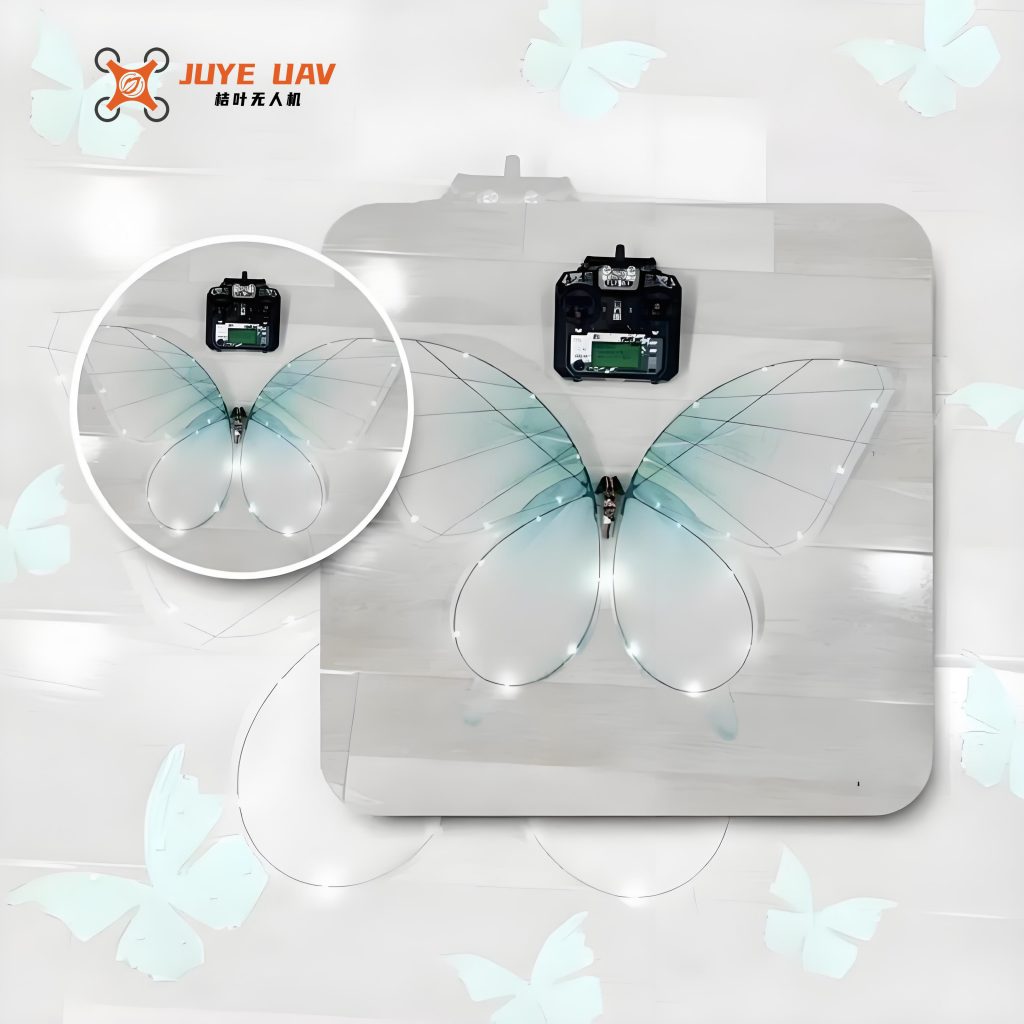
The concept of the ‘butterfly drone’ has emerged as a fascinating application of biomimetic butterfly wing structures in micro-aerial vehicles and autonomous systems. These drones, inspired by the flight mechanics and structural coloration of butterflies, could potentially benefit from the light-harvesting capabilities of butterfly wing-mimetic solar cells. The integration of DSSCs with ‘butterfly drone’ technology would enable self-powered operation, extending flight endurance and operational range. My research aims to contribute to this vision by developing efficient bio-inspired photoanodes for DSSCs that could ultimately power such ‘butterfly drone’ systems.
In my experimental work, I selected the Papilio bianor butterfly as the template for replicating wing microstructures. The Papilio bianor, commonly known as the emerald swallowtail, displays vibrant green and blue structural colors on its wings. Scanning electron microscopy (SEM) characterization revealed that the wing scales of Papilio bianor exhibit a highly organized hierarchical architecture. The scales are approximately 100 μm long and 50 μm wide, with longitudinal ridges running along their length. These ridges are interconnected by horizontal rib structures, creating a network of pores with diameters around 0.8 μm. The cross-sectional view shows that the ridges have a base width of 0.5 μm and a height of about 1.2 μm, with a spacing of 1.8 μm between adjacent ridges.
To replicate this intricate structure in TiO₂, I employed a TiCl₄ secondary hydrolysis method combined with template-assisted sol-gel processing. The fabrication procedure involved several steps. First, the butterfly wings were cleaned in ethanol to remove loose scales. The cleaned wings were then immersed in a TiCl₄ ethanol solution at varying concentrations (0.2, 0.1, 0.08, and 0.06 mol/L) and heated at 70°C for 1.5 hours. Subsequently, deionized water was added and the treatment continued for an additional 3.5 hours to promote hydrolysis. The treated wings were placed between two FTO glass substrates and calcined at 500°C for 2 hours with a controlled heating rate of 1°C/min. During calcination, the organic butterfly wing template was completely removed, leaving behind TiO₂ replicas with preserved microstructural features.
Through systematic optimization, I found that the concentration of the TiCl₄ precursor solution significantly affected the replication fidelity. At high concentrations (0.2 mol/L), the pores of the wing structure were filled and blocked by excess TiO₂, resulting in a loss of fine details. At low concentrations (0.06 mol/L), the replicated structure appeared fragmented and incomplete, indicating insufficient TiO₂ deposition. The optimal concentration was determined to be 0.08 mol/L, which produced the most faithful replication of the butterfly wing microstructure with well-preserved pore networks and ridge structures. The resulting TiO₂-BW samples exhibited a shrinkage of approximately 40% compared to the original butterfly wings, which is typical for sol-gel templating processes.
The crystalline phase of the as-prepared TiO₂-BW was analyzed using X-ray diffraction (XRD) and Raman spectroscopy. The XRD pattern showed diffraction peaks at 25.36°, 37.8°, and 48.09°, corresponding to the (101), (004), and (200) planes of anatase TiO₂ (JCPDS No.84-1286). No peaks corresponding to rutile or brookite phases were detected, confirming the formation of pure anatase phase. The Raman spectrum exhibited characteristic peaks at 148, 400, 520, and 643 cm⁻¹, which are attributed to the Eg, B1g, and A1g vibrational modes of anatase TiO₂. Notably, the Raman peak intensity of TiO₂-BW was significantly higher than that of commercial P25 nanoparticles, suggesting enhanced light scattering and trapping effects arising from the hierarchical microstructure.
The light absorption properties of the photoanodes were evaluated using UV-vis spectroscopy. When N719 dye was adsorbed onto the photoanodes, the TiO₂-BW-based photoanode exhibited substantially higher absorption across the visible spectrum compared to the standard P25 photoanode. This enhanced light harvesting capability can be attributed to two factors. First, the unique hierarchical structure of the TiO₂-BW provides a larger specific surface area, enabling greater dye loading. Second, the photonic crystal-like arrangement of the microstructures increases the optical path length through multiple scattering and diffraction events, allowing more efficient utilization of incident photons.
To quantify the dye loading capacity, I performed dye desorption experiments. The photoanodes were immersed in NaOH solution to detach the adsorbed N719 dye molecules, and the absorption spectra of the resulting solutions were measured. The results clearly showed that the TiO₂-BW photoanode adsorbed significantly more dye than the P25 photoanode, confirming the beneficial effect of the increased surface area provided by the hierarchical microstructure. The enhanced dye loading directly contributes to higher photocurrent generation.
I fabricated DSSCs using the TiO₂-BW photoanodes and compared their photovoltaic performance with cells based on standard P25 photoanodes. The current density-voltage (J-V) characteristics were measured under simulated AM 1.5G illumination at 100 mW/cm². The results are summarized in the following table:
| Photoanode | JSC (mA/cm²) | VOC (V) | FF (%) | PCE (%) |
|---|---|---|---|---|
| P25 | 11.08 | 0.80 | 62.8 | 5.58 |
| TiO₂-BW | 14.27 | 0.77 | 54.9 | 6.02 |
The TiO₂-BW-based DSSC achieved a power conversion efficiency (PCE) of 6.02%, compared to 5.58% for the P25-based cell. The improvement was primarily driven by a significant increase in short-circuit current density (JSC) from 11.08 to 14.27 mA/cm², representing a 28.8% enhancement. This substantial JSC improvement is consistent with the enhanced light absorption and dye loading observed in the TiO₂-BW photoanode. However, the open-circuit voltage (VOC) decreased from 0.80 V to 0.77 V, and the fill factor (FF) dropped from 62.8% to 54.9%. The reduction in VOC may be attributed to increased charge recombination at the additional surface defects introduced by the hierarchical microstructure. The decreased FF suggests higher internal resistance, possibly due to less efficient charge transport through the complex pore network.
Incident photon-to-electron conversion efficiency (IPCE) measurements further confirmed the benefits of the TiO₂-BW structure. The IPCE spectrum of the TiO₂-BW-based cell showed higher values across the entire visible wavelength range compared to the P25-based cell. This broad enhancement indicates that the hierarchical microstructure effectively improves light harvesting efficiency at all wavelengths, not just at specific resonance conditions. The integrated IPCE values were consistent with the JSC measurements, validating the reliability of the performance evaluation.
To further enhance the performance, I turned to the localized surface plasmon resonance (LSPR) effect. LSPR is a phenomenon occurring in metal nanoparticles where conduction electrons collectively oscillate when excited by incident light at a specific resonant frequency. This oscillation generates a strongly enhanced electromagnetic field in the vicinity of the nanoparticles, which can significantly amplify the light absorption of nearby dye molecules. The LSPR characteristics depend on the size, shape, composition of the nanoparticles, and the dielectric properties of the surrounding medium.
I prepared gold and silver colloids using the sodium citrate reduction method. The gold colloid exhibited a wine-red color with an average particle size of 30.24 nm and a surface plasmon resonance absorption peak at 520 nm. The silver colloid appeared pale yellow with an average particle size of 35.86 nm and a resonance peak at 440 nm. Considering the stronger absorption peak, better stability, and closer match with the absorption spectrum of N719 dye, I selected gold nanoparticles for further study.
The LSPR effect of gold nanoparticles was validated through finite-difference time-domain (FDTD) simulations using FDTD Solutions software. I constructed a simulation model consisting of a 30 nm diameter gold nanoparticle placed on a butterfly wing substrate. The simulation results revealed a significant enhancement of the electromagnetic field intensity at the nanoparticle surface, with the strongest field concentration occurring at the particle-substrate interface. The field enhancement factor reached several orders of magnitude, confirming the potential of gold nanoparticles to amplify light absorption in the surrounding dye molecules. The simulation also showed that the field enhancement is highly localized, decaying rapidly with distance from the nanoparticle surface.
To incorporate gold nanoparticles into the TiO₂-BW structure, I modified the fabrication process by introducing gold colloid during the hydrolysis step. Specifically, after the initial TiCl₄ treatment, I added 50 mL of 0.4 mmol/L gold colloid instead of pure deionized water and continued the treatment for 3.5 hours. This allowed the gold nanoparticles to be adsorbed onto the hydrolyzed titanium species within the wing template. Subsequent calcination at 500°C removed the organic template and crystallized the TiO₂ while preserving the gold nanoparticles in their metallic state. The resulting composite material was designated as Au/TiO₂-BW.
SEM characterization of the Au/TiO₂-BW samples showed that the butterfly wing microstructure was well-preserved, with the ridges, ribs, and pore networks clearly visible. No obvious aggregation of gold nanoparticles was observed, indicating uniform dispersion throughout the TiO₂ matrix. The energy-dispersive X-ray spectroscopy (EDX) analysis confirmed the presence of gold with a mass content of 5.32% in the final product.
XRD analysis of Au/TiO₂-BW revealed the characteristic peaks of anatase TiO₂, along with a weak peak at 44.5° corresponding to the (200) plane of metallic gold (Au). This confirms that gold exists as elemental nanoparticles within the TiO₂ matrix. Raman spectroscopy showed enhanced peak intensities for Au/TiO₂-BW compared to TiO₂-BW, attributed to the surface-enhanced Raman scattering (SERS) effect induced by the LSPR of gold nanoparticles. The SERS enhancement provides indirect evidence for the strong local electromagnetic fields generated by the gold nanoparticles.
Transmission electron microscopy (TEM) imaging provided detailed structural information about the Au/TiO₂-BW composite. The TEM images showed TiO₂ nanoparticles with lattice fringes corresponding to the (101) plane of anatase (d = 0.35 nm) and gold nanoparticles with lattice fringes corresponding to the (200) plane (d = 0.20 nm). The selected area electron diffraction (SAED) pattern exhibited diffraction rings characteristic of anatase TiO₂, with a weak ring indexed to the (200) plane of gold. Elemental mapping confirmed the uniform distribution of gold, titanium, and oxygen throughout the sample.
X-ray photoelectron spectroscopy (XPS) was employed to investigate the chemical states of elements in Au/TiO₂-BW. The survey spectrum confirmed the presence of Au, Ti, O, and C elements. The high-resolution Au 4f spectrum showed peaks at 83.43 eV and 87.08 eV, corresponding to Au 4f7/2 and Au 4f5/2, respectively. The binding energy of Au 4f7/2 was shifted by 0.57 eV compared to standard metallic gold (84.0 eV), indicating electron transfer from gold to TiO₂. This electron transfer is beneficial for charge separation and transport in DSSCs. The Ti 2p spectrum exhibited peaks at 458.63 eV and 464.33 eV, corresponding to Ti 2p3/2 and Ti 2p1/2 of Ti⁴⁺ in TiO₂, confirming that the gold modification did not alter the chemical state of titanium.
UV-vis absorption spectroscopy of the N719-sensitized photoanodes revealed that Au/TiO₂-BW exhibited significantly higher light absorption than both TiO₂-BW and P25 photoanodes. The enhanced absorption can be attributed to the synergistic effect of the hierarchical butterfly wing microstructure and the LSPR effect of gold nanoparticles. The microstructure provides multiple light scattering sites that increase the optical path length, while the LSPR generates strong local electromagnetic fields that amplify dye absorption. The dye desorption experiments showed that Au/TiO₂-BW had slightly higher dye loading than TiO₂-BW, but the difference was not sufficient to explain the substantial enhancement in light absorption. Therefore, the LSPR effect plays a dominant role in the improved optical performance.
To understand the energy band structure, I calculated the optical bandgap of the photoanode materials using the Tauc plot method:
$$(\alpha h\nu)^{1/n} = A(h\nu – E_g)$$
$$h\nu = \frac{hc}{\lambda}$$
where α is the absorption coefficient, h is Planck’s constant, c is the speed of light, λ is the wavelength, A is a constant, n = 1/2 for direct bandgap semiconductors, and Eg is the bandgap energy. The calculated bandgap values were 3.12 eV for P25, 3.02 eV for TiO₂-BW, and 3.07 eV for Au/TiO₂-BW. The reduction in bandgap for TiO₂-BW compared to P25 can be attributed to the enhanced light absorption from the hierarchical structure. The slight increase in bandgap for Au/TiO₂-BW compared to TiO₂-BW may result from the Schottky barrier formed at the Au-TiO₂ interface, which has a minor effect on the band structure.
The photovoltaic performance of DSSCs based on Au/TiO₂-BW photoanodes was evaluated and compared with P25 and TiO₂-BW cells. The J-V characteristics are summarized in the following table:
| Photoanode | JSC (mA/cm²) | VOC (V) | FF (%) | PCE (%) |
|---|---|---|---|---|
| P25 | 8.24 | 0.78 | 61.47 | 3.98 |
| TiO₂-BW | 9.86 | 0.78 | 56.46 | 4.36 |
| Au/TiO₂-BW | 10.96 | 0.80 | 52.85 | 4.66 |
The Au/TiO₂-BW-based DSSC achieved the highest PCE of 4.66%, representing a 17.1% improvement over the P25-based cell (3.98%) and a 6.9% improvement over the TiO₂-BW-based cell (4.36%). The enhancement was primarily driven by the increase in JSC, which reached 10.96 mA/cm² for Au/TiO₂-BW compared to 8.24 mA/cm² for P25 and 9.86 mA/cm² for TiO₂-BW. The improved JSC can be attributed to the combined effects of enhanced light absorption from the butterfly wing microstructure and the LSPR-induced field enhancement from gold nanoparticles.
Interestingly, the VOC of Au/TiO₂-BW (0.80 V) was higher than that of TiO₂-BW (0.78 V) and comparable to P25 (0.78 V). The increase in VOC suggests that the incorporation of gold nanoparticles effectively suppresses charge recombination. This is consistent with the XPS observation of electron transfer from gold to TiO₂, which creates a Schottky barrier at the Au-TiO₂ interface. This barrier facilitates charge separation by directing electrons toward TiO₂ and preventing their back-transfer to the electrolyte or dye molecules. The enhanced charge separation efficiency contributes to higher VOC and improved overall device performance.
However, the fill factor (FF) decreased progressively from P25 (61.47%) to TiO₂-BW (56.46%) to Au/TiO₂-BW (52.85%). The reduction in FF can be attributed to increased internal resistance associated with the complex hierarchical structure. The pore networks in the butterfly wing microstructure may create tortuous pathways for ion transport in the electrolyte, increasing series resistance. Additionally, the non-uniform distribution of gold nanoparticles could generate local hot spots due to plasmonic heating, affecting the electrolyte properties and charge collection efficiency. Despite the FF reduction, the substantial improvement in JSC and slight enhancement in VOC resulted in a net gain in PCE.
The IPCE spectra of the DSSCs showed that Au/TiO₂-BW exhibited the highest photon-to-electron conversion efficiency across the entire visible spectrum from 400 to 700 nm. The enhancement was particularly pronounced in the wavelength range of 500-600 nm, which corresponds to the LSPR absorption band of gold nanoparticles. This spectral overlap confirms that the LSPR effect of gold nanoparticles contributes to the enhanced photocurrent generation. The integrated IPCE values were in good agreement with the JSC measurements from the J-V characterization, validating the consistency of the performance evaluation.
Electrochemical impedance spectroscopy (EIS) was performed to investigate the charge transport and recombination dynamics in the DSSCs. The measurements were conducted in the dark at a bias voltage of -0.75 V with a frequency range from 0.1 Hz to 100 kHz. The Nyquist plots exhibited two semicircles: the high-frequency semicircle corresponding to charge transfer at the counter electrode/electrolyte interface (R₁), and the mid-frequency semicircle corresponding to charge transfer at the photoanode/dye/electrolyte interface (R₂). The equivalent circuit model used for fitting included series resistance (RS), R₁, and R₂.
| Photoanode | RS (Ω) | R₁ (Ω) | R₂ (Ω) |
|---|---|---|---|
| P25 | 126.6 | 29.11 | 278.4 |
| TiO₂-BW | 118.1 | 20.74 | 368.2 |
| Au/TiO₂-BW | 72.58 | 17.91 | 517.3 |
The EIS results revealed that Au/TiO₂-BW exhibited the smallest series resistance (RS = 72.58 Ω) and charge transfer resistance at the counter electrode (R₁ = 17.91 Ω), indicating improved conductivity and electrocatalytic activity. More importantly, the charge recombination resistance at the photoanode interface (R₂) increased from 278.4 Ω for P25 to 368.2 Ω for TiO₂-BW and further to 517.3 Ω for Au/TiO₂-BW. The significant increase in R₂ demonstrates that the hierarchical butterfly wing structure and gold nanoparticles effectively suppress charge recombination at the photoanode/dye/electrolyte interface. This suppression of recombination is consistent with the higher VOC observed for Au/TiO₂-BW and confirms the beneficial role of the Schottky barrier formed at the Au-TiO₂ interface.
The comprehensive characterization and performance evaluation demonstrate that the combination of hierarchical butterfly wing microstructures and LSPR-active gold nanoparticles provides a synergistic approach to enhancing DSSC performance. The butterfly wing microstructure contributes to increased dye loading, enhanced light scattering, and extended optical path length. The gold nanoparticles generate strong local electromagnetic fields through LSPR, amplifying light absorption in adjacent dye molecules. Additionally, the Schottky barrier at the Au-TiO₂ interface promotes charge separation and suppresses recombination, improving the overall photovoltaic efficiency.
The concept of integrating bio-inspired structures with plasmonic effects opens new possibilities for developing high-performance DSSCs. The ‘butterfly drone’ concept, which envisions autonomous micro-aerial vehicles powered by efficient solar cells, could particularly benefit from this approach. The lightweight, flexible, and efficient photoanodes developed in this study could be integrated into ‘butterfly drone’ wings, enabling self-powered flight and extended operational capabilities. The hierarchical microstructure of the photoanode not only enhances light harvesting but also provides mechanical flexibility, making it suitable for curved wing surfaces.
Future research directions could explore several avenues to further optimize the performance. First, the synthesis conditions could be refined to achieve more precise replication of the butterfly wing microstructure. Factors such as reaction time, temperature, solvent composition, and template pretreatment could be systematically optimized. Second, the size, shape, and loading of gold nanoparticles could be tuned to maximize the LSPR enhancement. Previous studies have shown that nanoparticles with specific shapes (e.g., nanorods, nanostars) exhibit stronger and more tunable LSPR effects. Third, alternative plasmonic materials such as silver, copper, or bimetallic alloys could be investigated to achieve broader spectral coverage and higher field enhancement.
The application of bio-inspired photoanodes in ‘butterfly drone’ technology represents an exciting frontier. The ‘butterfly drone’ concept requires lightweight, efficient, and durable power sources that can operate under varying light conditions. DSSCs based on butterfly wing-mimetic photoanodes offer unique advantages for this application. Their flexibility allows integration into curved wing surfaces, their light weight reduces payload requirements, and their efficient low-light performance enables operation during dawn, dusk, and cloudy conditions. Moreover, the aesthetic appeal of structural colors derived from butterfly wings could make ‘butterfly drone’ systems both functional and visually appealing.
In conclusion, my research has successfully demonstrated a novel approach to enhancing DSSC performance by combining bio-inspired butterfly wing microstructures with LSPR-active gold nanoparticles. The TiO₂-BW photoanode replicated from Papilio bianor butterfly wings exhibited significantly improved light absorption and dye loading compared to conventional P25 photoanodes, leading to a PCE improvement from 3.98% to 4.36%. The incorporation of gold nanoparticles further enhanced the performance to 4.66%, representing a 17.1% improvement over the standard P25 cell. The synergistic effect of the hierarchical microstructure and LSPR effect resulted in enhanced JSC, improved VOC, and suppressed charge recombination. This work provides a promising strategy for developing high-performance DSSCs and contributes to the vision of ‘butterfly drone’ systems powered by efficient, bio-inspired solar cells. The integration of biomimetic structures with plasmonic nanomaterials opens new pathways for next-generation photovoltaic devices that are both efficient and environmentally sustainable.