
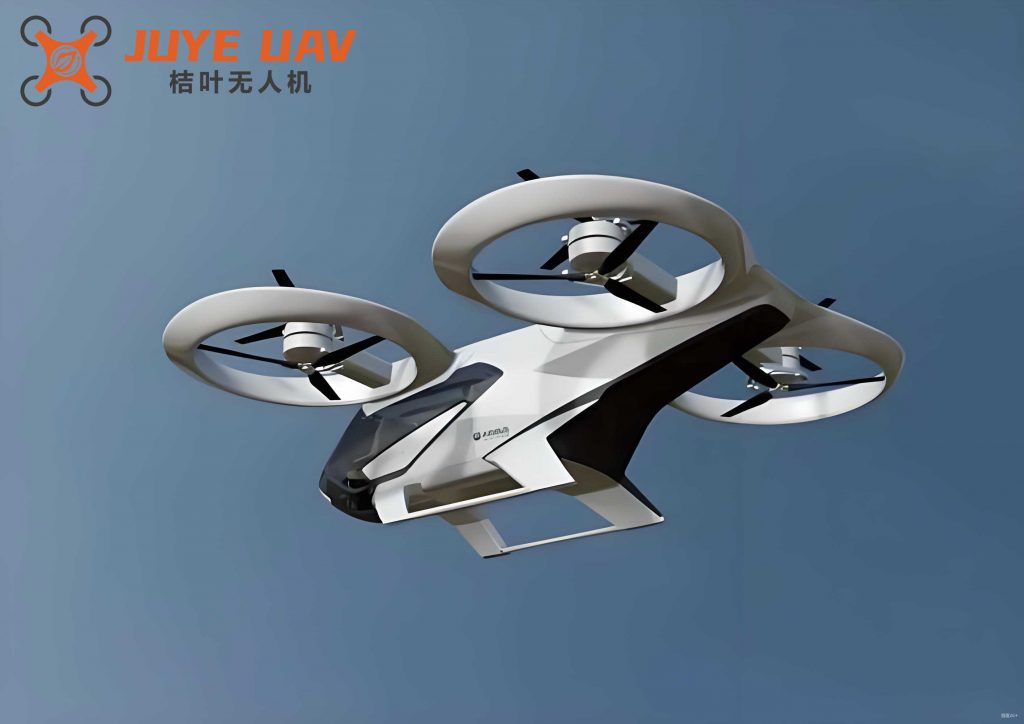
In the realm of unmanned aerial vehicles, the quadrotor drone has garnered significant attention due to its high maneuverability, vertical take-off and landing capabilities, and precise hovering. However, as a typical nonlinear, strongly coupled, and underactuated system, the quadrotor drone faces numerous challenges in control system design, particularly when subjected to model uncertainties and external disturbances. Attitude control is paramount for maintaining stable flight, and traditional methods like PID control often fall short in handling these complexities. This paper delves into the development of an enhanced active disturbance rejection control (ADRC) scheme tailored for quadrotor drone attitude regulation. By integrating fuzzy logic with classical ADRC and refining key components, we aim to achieve superior robustness and faster response times, ensuring reliable operation in dynamic environments.
The quadrotor drone’s dynamics are inherently complex, involving multiple degrees of freedom and intricate couplings between rotational and translational motions. To formulate a control-oriented model, we define two coordinate systems: the world frame \(X_wY_wZ_w\) and the body frame \(X_bY_bZ_b\). The transformation between these frames is governed by a rotation matrix \(R \in SO(3)\), derived through sequential rotations about the x, y, and z axes. Using the Newton-Euler equations, the dynamics of the quadrotor drone can be expressed as follows:
$$ \begin{aligned} \ddot{x} &= (\cos\psi\sin\theta\cos\phi + \sin\psi\sin\phi)\frac{U_1}{m}, \\ \ddot{y} &= (\sin\psi\sin\phi\cos\phi – \cos\psi\sin\phi)\frac{U_1}{m}, \\ \ddot{z} &= (\cos\theta\cos\phi)\frac{U_1}{m} – g, \\ \ddot{\phi} &= \frac{lU_2 + \dot{\theta}\dot{\psi}(I_z – I_x)}{I_x}, \\ \ddot{\theta} &= \frac{lU_3 + \dot{\phi}\dot{\psi}(I_y – I_z)}{I_y}, \\ \ddot{\psi} &= \frac{U_4 + \dot{\phi}\dot{\theta}(I_x – I_y)}{I_z}, \end{aligned} $$
where \(x, y, z\) denote positions, \(\phi, \theta, \psi\) represent roll, pitch, and yaw angles, \(m\) is the mass, \(g\) is gravitational acceleration, \(l\) is the arm length, \(I_x, I_y, I_z\) are moments of inertia, and \(U_1, U_2, U_3, U_4\) are control inputs derived from rotor thrusts. The control inputs are related to rotor speeds \(\omega_i\) via:
$$ \begin{bmatrix} U_1 \\ U_2 \\ U_3 \\ U_4 \end{bmatrix} = \begin{bmatrix} K_F(\omega_1^2 + \omega_2^2 + \omega_3^2 + \omega_4^2) \\ K_F(\omega_1^2 + \omega_4^2 – \omega_2^2 – \omega_3^2) \\ K_F(\omega_3^2 + \omega_4^2 – \omega_1^2 – \omega_2^2) \\ K_M(\omega_2^2 + \omega_4^2 – \omega_3^2 – \omega_1^2) \end{bmatrix}, $$
with \(K_F\) and \(K_M\) as lift and torque coefficients. This model highlights the nonlinearities and couplings that complicate control design for the quadrotor drone. To simplify, we treat coupling terms as internal disturbances and decouple the system into four independent channels, approximating it as a set of single-input single-output linear systems for controller synthesis.
Active disturbance rejection control offers a model-independent approach by estimating and compensating for total disturbances, which encompass both internal uncertainties and external perturbations. The conventional ADRC structure comprises a tracking differentiator (TD), a nonlinear state error feedback (NLSEF), and an extended state observer (ESO). However, limitations exist, such as the non-smoothness of the fal function in the ESO and difficulties in parameter tuning. To address these, we propose a fuzzy-enhanced ADRC with an improved ESO and optimized parameters using a modified beetle antennae search algorithm. This hybrid strategy elevates the performance of the quadrotor drone attitude control system.
The core of our improvement lies in the redesign of the ESO. Traditionally, the ESO employs a fal function defined as:
$$ \text{fal}(e, \alpha, \delta) = \begin{cases} \frac{e}{\delta^{\alpha-1}}, & |e| \le \delta, \\ |e|^\alpha \text{sgn}(e), & |e| > \delta, \end{cases} $$
where \(e\) is the error, \(\alpha\) is a nonlinear factor, and \(\delta\) is a threshold. While this function embodies the “small error, large gain; large error, small gain” principle, it suffers from discontinuities at \(|e| = \delta\) and excessive gain for large errors. We introduce a novel yfal function to replace fal:
$$ \text{yfal}(e, \alpha, \beta, \delta) = \begin{cases} k_1 e + k_2 \ln(1 + e), & |e| \le \delta, \\ e^\alpha \text{sgn}(e), & \delta < |e| < 1, \\ e^{\alpha\beta} \text{sgn}(e), & |e| \ge 1, \end{cases} $$
with \(k_1 = \alpha\delta^{\alpha-1} – \frac{(1-\alpha)\delta^\alpha}{(1+\delta)\ln(1+\delta) – \delta}\) and \(k_2 = \frac{(1+\delta)(1-\alpha)\delta^\alpha}{(1+\delta)\ln(1+\delta) – \delta}\), where \(\beta\) is a constraint release factor. This yfal function ensures smooth transitions and better gain characteristics, enhancing the ESO’s estimation accuracy for the quadrotor drone. The improved ESO dynamics are given by:
$$ \begin{aligned} e_1 &= z_1 – y, \\ e_2 &= z_2 – x_2, \\ \dot{z}_1 &= z_2 – \beta_1 e, \\ \dot{z}_2 &= z_3 – \beta_2 \, \text{yfal}(e, \alpha_1, \delta) + b u, \\ \dot{z}_3 &= -\beta_3 \, \text{yfal}(e, \alpha_2, \delta), \end{aligned} $$
where \(z_1, z_2, z_3\) are estimated states, \(\beta_1, \beta_2, \beta_3\) are observer gains, and \(b\) is a compensation factor. Convergence of this observer is guaranteed under the condition \(\beta_1\beta_2 – \beta_3 > 0\), as proven via Lyapunov stability analysis. This ensures that the estimated disturbances converge to actual values, enabling effective compensation for the quadrotor drone.
To further adapt the controller to varying operating conditions, we incorporate fuzzy logic into the NLSEF. The fuzzy module adjusts the feedback gains \(k_P\) and \(k_D\) in real-time based on error \(e_1\) and error derivative \(e_2\), leveraging expert knowledge. The fuzzy sets are defined as {NB, NM, NS, ZO, PS, PM, PB} for both inputs and outputs, with 49 rules summarized in Table 1. The adjusted gains are computed as:
$$ k_1 = k’_1 + \Delta k_1, \quad k_2 = k’_2 + \Delta k_2, $$
where \(\Delta k_1\) and \(\Delta k_2\) are fuzzy outputs. This fuzzy adaptation enhances the quadrotor drone’s ability to handle nonlinearities and transient disturbances.
| \(e_1 / e_2\) | NB | NM | NS | ZO | PS | PM | PB |
|---|---|---|---|---|---|---|---|
| NB | PB/PB | PB/PB | PM/PM | PM/PM | PS/NS | PS/NM | ZO/NB |
| NM | PM/PB | PM/PB | PS/PM | PS/PS | PS/ZO | ZO/NS | NS/NM |
| NS | PS/PB | PS/PB | PS/PM | PS/PM | PS/PS | NS/NS | NM/NB |
| ZO | PB/PB | PM/PM | PS/PS | ZO/PS | PS/PS | PM/PM | PB/PB |
| PS | NM/NB | NS/NS | PS/PS | PS/PM | PS/PM | PS/PB | PS/PB |
| PM | NS/NM | ZO/NS | PS/ZO | PS/PS | PS/PM | PM/PB | PM/PB |
| PB | ZO/NB | PS/NM | PS/NS | PM/PM | PM/PM | PB/PB | PB/PB |
Parameter tuning is critical for ADRC performance, and manual adjustment can be tedious. We employ a modified beetle antennae search (BAS) algorithm to optimize parameters like \(\beta_1, \beta_2, \beta_3, k_P, k_D\) for the quadrotor drone. The BAS algorithm mimics beetle foraging behavior, but we enhance it by introducing dynamic step size adjustment based on fitness evaluation. The optimization process minimizes an objective function, such as integral absolute error, ensuring rapid convergence to optimal parameters. The pseudo-code is as follows:
1. Initialize parameters: initial position \(x_0\), direction \(dir\), step size \(step\), antennae distance \(d_0\), and regulation factor \(C\).
2. Normalize direction: \(b = dir / \|dir\|\).
3. Update antennae distance: \(d_0 = d_0 \cdot C\).
4. Compute left and right antennae positions: \(x_l = x + d_0 \cdot dir / 2\), \(x_r = x – d_0 \cdot dir / 2\).
5. Evaluate fitness \(f(x_l)\) and \(f(x_r)\) via simulation of the quadrotor drone model.
6. Adjust \(C\): if fitness improves, decrease \(C\); otherwise, increase \(C\).
7. Update position: \(x(t+1) = x_t + step \cdot b \cdot C \cdot \text{sgn}[f(x_r) – f(x_l)]\).
8. Repeat until convergence.
This automated tuning significantly improves the efficiency of setting up the ADRC for the quadrotor drone, leading to better control outcomes.
To validate our proposed controller, we conduct simulations in MATLAB/Simulink using a quadrotor drone model based on the DJI 450 parameters. We compare our improved fuzzy ADRC with conventional PID, fuzzy PID, and standard ADRC. The quadrotor drone parameters are listed in Table 2, and controller parameters are optimized as shown in Table 3. The simulations include step tracking, disturbance rejection under step and sinusoidal disturbances, and performance metrics such as settling time and overshoot.
| Parameter | Symbol | Value | Unit |
|---|---|---|---|
| Mass | \(m\) | 1.5 | kg |
| Arm Length | \(l\) | 0.225 | m |
| Lift Coefficient | \(K_F\) | 1.105 × 10⁻⁵ | N·min²/r² |
| Torque Coefficient | \(K_M\) | 1.489 × 10⁻⁷ | N·m·min²/r² |
| Gravity Acceleration | \(g\) | 9.8 | m/s² |
| x-axis Inertia | \(I_x\) | 1.737 × 10⁻² | kg·m² |
| y-axis Inertia | \(I_y\) | 1.737 × 10⁻² | kg·m² |
| z-axis Inertia | \(I_z\) | 3.175 × 10⁻² | kg·m² |
| Time Constant | \(T_m\) | 0.0136 | s |
| Controller | Parameter | Yaw | Pitch/Roll |
|---|---|---|---|
| PID | \(K_P\) | 20 | 25 |
| \(K_I\) | 0.1 | 0.35 | |
| \(K_D\) | 10 | 10 | |
| Improved ADRC | \(K_p\) | 16.33 | 30.96 |
| \(K_d\) | 640.29 | 1942.30 | |
| \(\beta_1\) | 27.16 | 54.27 | |
| \(\beta_2\) | 779.30 | 1960.06 | |
| \(\beta_3\) | 11.67 | 11.06 | |
| \(b\) | 18 | 35 |
The simulation results demonstrate the efficacy of our approach for the quadrotor drone. In square-wave tracking tests, the improved ADRC achieves settling times of 0.298 s and 0.35 s for two segments, outperforming PID (1.765 s, 1.857 s), fuzzy PID (1.287 s, 1.525 s), and standard ADRC (0.378 s, 0.42 s). Under step disturbances, the improved ADRC recovers in 0.168 s, compared to 1.653 s for PID and 0.237 s for standard ADRC. For sinusoidal disturbances, the overshoot is reduced to 2.26%, lower than other methods. These metrics are summarized in Table 4, highlighting the superior performance of our controller in stabilizing the quadrotor drone.
| Controller | Square-wave Settling Time (s) | Step Disturbance Recovery Time (s) | Sinusoidal Disturbance Overshoot (%) |
|---|---|---|---|
| PID | 1.765 / 1.857 | 1.653 | 3.24 |
| Fuzzy PID | 1.287 / 1.525 | 1.574 | 3.06 |
| Standard ADRC | 0.378 / 0.42 | 0.237 | 2.40 |
| Improved ADRC | 0.298 / 0.35 | 0.168 | 2.26 |
The yfal function’s advantages are evident in smoother error responses and better gain modulation. As shown in Figure 3 (simulated curves), yfal with varying constraint release factors \(\beta\) offers continuous transitions and adaptive gain, unlike the fal function which exhibits discontinuities. This directly translates to reduced chattering and improved disturbance rejection for the quadrotor drone. Furthermore, the fuzzy adaptation allows dynamic adjustment of feedback gains, ensuring robust performance across different flight conditions. The integration of BAS optimization streamlines parameter selection, making the controller practical for real-world applications.
In conclusion, this paper presents a comprehensive enhancement of active disturbance rejection control for quadrotor drone attitude stabilization. By replacing the fal function with yfal, incorporating fuzzy logic for gain adaptation, and utilizing an improved beetle antennae search algorithm for parameter tuning, we achieve a controller that excels in response speed, disturbance rejection, and robustness. The quadrotor drone benefits from these improvements through more stable and precise flight operations, even in the presence of model uncertainties and external perturbations. Future work will focus on hardware implementation and real-flight testing to further validate the controller’s performance in diverse environments for quadrotor drone applications.
The mathematical rigor behind our design ensures stability, as proven via Lyapunov analysis for the improved ESO. The convergence condition \(\beta_1\beta_2 – \beta_3 > 0\) guarantees that observer errors asymptotically approach zero, enabling accurate disturbance estimation. This theoretical foundation, combined with empirical simulations, underscores the reliability of our approach for the quadrotor drone. Additionally, the modular nature of the controller allows for easy integration with other systems, such as path planning or swarm coordination, extending its utility beyond single-agent control.
Throughout this paper, we have emphasized the importance of the quadrotor drone as a platform for advanced control strategies. The quadrotor drone’s versatility makes it an ideal testbed for nonlinear control methods, and our improved ADRC contributes to the growing body of research aimed at enhancing autonomous flight capabilities. By addressing key limitations in traditional ADRC, we pave the way for more resilient and adaptive control systems for the quadrotor drone, ultimately supporting its deployment in missions ranging from surveillance to delivery.
In summary, the quadrotor drone attitude control problem is effectively tackled through a synergistic blend of fuzzy logic, optimized observer design, and intelligent parameter tuning. The results affirm that our improved ADRC offers a significant step forward in achieving high-performance control for the quadrotor drone, ensuring it can operate reliably in challenging scenarios. As the demand for autonomous drones grows, such advancements will be crucial for unlocking their full potential in both civilian and military domains.