
This research focuses on the critical challenge of achieving robust and precise airspeed-attitude control for fixed-wing drones operating under significant sensor measurement noise. Fixed-wing drone systems possess complex nonlinear dynamic characteristics and strict actuator constraints. The quality of flight control is highly susceptible to sensor measurement noise, which can degrade performance and compromise stability. To address these issues, we propose a novel control framework that integrates the strengths of Nonlinear Model Predictive Control (NMPC) with an Unscented Kalman Filter (UKF) for state estimation.
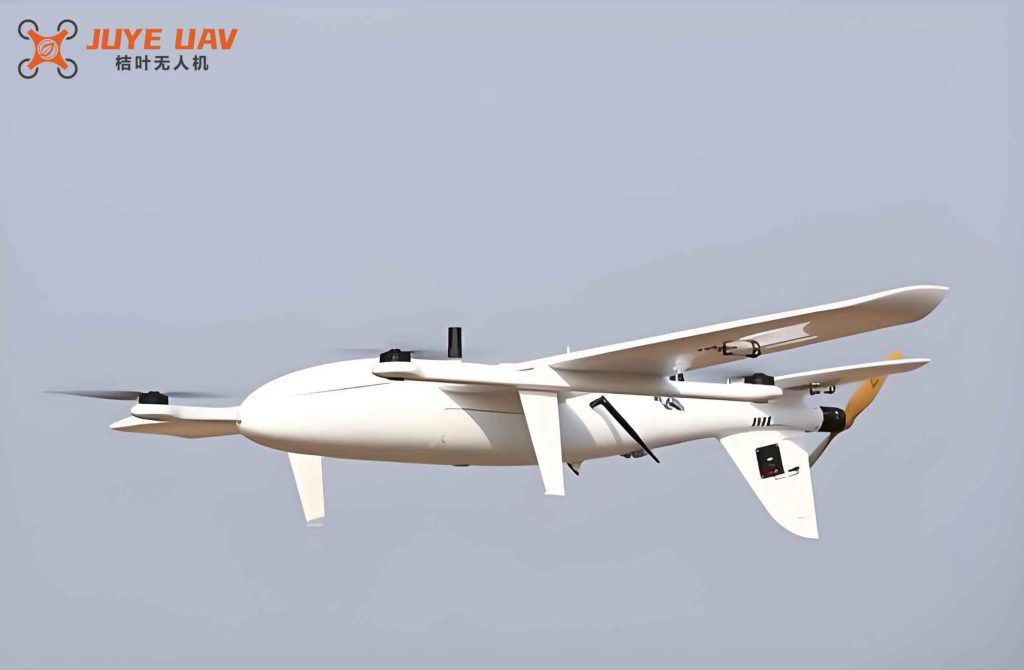
Our approach was designed to mitigate the adverse effects of noise, particularly on critical local states such as the angle of attack, sideslip angle, and body angular rates. These states are directly measured by sensors and are prone to significant disturbances. In our proposed framework, we first developed a state estimator based on the UKF to accurately estimate these local states, effectively filtering out noise and providing a clean signal for the controller. Subsequently, we implemented an NMPC-based controller that leverages the filtered state estimates to compute optimal control inputs, explicitly handling the system’s physical constraints and nonlinearities. The performance of this integrated UKF-NMPC scheme was validated through comprehensive simulation experiments and benchmarked against a comparable framework that integrated NMPC with an Extended Kalman Filter (EKF). The results from our study provide quantitative evidence of the superior performance of our method.
Fixed-Wing Drone Dynamic Model
Our work is built upon a detailed and well-established nonlinear model of a fixed-wing drone. We assume a flat Earth, negligible mass changes, and a plane-symmetric configuration. The system dynamics can be expressed in velocity and body frames. The state vector and control input vector for the full six-degree-of-freedom system are defined as:
$$
x = [V_T, \alpha, \beta, \phi, \theta, \psi, p, q, r]^T \quad \text{and} \quad u = [\delta_T, \delta_{al}, \delta_{ar}, \delta_{el}, \delta_{er}, \delta_r]^T
$$
In this representation, $V_T$, $\alpha$, and $\beta$ denote the airspeed, angle of attack, and sideslip angle, respectively. The variables $\phi$, $\theta$, and $\psi$ represent the roll, pitch, and yaw attitude angles. The angular rates are $p$, $q$, and $r$, corresponding to the roll, pitch, and yaw axes. The control inputs include throttle ($\delta_T$) and deflections for the left aileron ($\delta_{al}$), right aileron ($\delta_{ar}$), left elevator ($\delta_{el}$), right elevator ($\delta_{er}$), and rudder ($\delta_r$).
The general nonlinear system and observation models for the fixed-wing drone are:
$$
\dot{x} = f(x, u, t), \quad y = h(x, t)
$$
Here, both $f(x, u, t)$ and $h(x, t)$ are nonlinear functions. Our experimental drone features a conventional layout with five independently controlled control surfaces, providing high maneuverability and control flexibility. Key parameters for this specific fixed-wing drone model are sourced from well-known literature in the field.
UKF-Based Local State Estimation for Fixed-Wing Drones
To counteract the significant impact of sensor noise, we designed a specialized state estimator focused on the most critical flight states. These states are the ones most affected by sensor noise, including the angle of attack, sideslip angle, and the body angular rates. The state vector for this local estimator $x_s$ and its corresponding measurement vector $y_s$, along with the shared control input $u$, are defined as:
$$
x_s = [\alpha, \beta, p, q, r]^T, \quad y_s = [\alpha, \beta, p, q, r]^T
$$
The process for this local estimation relies on the powerful UKF algorithm, which is particularly effective for nonlinear systems. The key steps of our state estimation procedure for the fixed-wing drone are summarized below.
| Step | Description | Core Formula |
|---|---|---|
| 1. Sigma Point Generation | Generate a set of sigma points to approximate the distribution of the state variable at time step k, based on the estimated state $\hat{x}_{k|k}$ and its covariance $P_{k|k}$. | $$\hat{x}^{(0)}_{k|k} = \hat{x}_{k|k}$$ $$\hat{x}^{(i)}_{k|k} = \hat{x}_{k|k} + (\alpha^2 (n+\kappa) P_{k|k})^{1/2}_i$$ $$\hat{x}^{(i)}_{k|k} = \hat{x}_{k|k} – (\alpha^2 (n+\kappa) P_{k|k})^{1/2}_i$$ |
| 2. Time Update (Prediction) | Propagate each sigma point through the nonlinear process model $F_s$ to obtain a set of predicted sigma points $\hat{x}^{(i)}_{k+1|k}$. Then, compute the predicted state $\hat{x}_{k+1|k}$ and covariance $P_{k+1|k}$ as weighted sums. | $$\hat{x}^{(i)}_{k+1|k} = F_s(\hat{x}^{(i)}_{k|k}, u(k))$$ $$\hat{x}_{k+1|k} = \sum_{i=0}^{2n} w^{(i)}_m \hat{x}^{(i)}_{k+1|k}$$ $$P_{k+1|k} = \sum_{i=0}^{2n} w^{(i)}_c (\hat{x}^{(i)}_{k+1|k} – \hat{x}_{k+1|k}) (\cdot)^T + Q_k$$ |
| 3. Measurement Update | Generate a new set of sigma points from the predicted state. Propagate these through the measurement model to compute predicted measurements. Then, compute the innovation covariance, cross-covariance, and the Kalman gain $K_{k+1}$. Finally, update the state estimate $\hat{x}_{k+1|k+1}$ and covariance $P_{k+1|k+1}$. | $$K_{k+1} = P_{xy} P^{-1}_{y}$$ $$\hat{x}_{k+1|k+1} = \hat{x}_{k+1|k} + K(y_{k+1} – \hat{y}_{k+1})$$ $$P_{k+1|k+1} = P_{k+1|k} – K_{k+1}P_yK^T_{k+1}$$ |
In these formulas, $n$ is the number of state variables, and $Q_k$ and $R_k$ are the process and measurement noise covariance matrices, respectively. The weighting coefficients $w^{(i)}_m$ and $w^{(i)}_c$ are determined by parameters $\alpha$, $\kappa$, and $\beta$. By avoiding the linearization step required by the EKF, the UKF offers superior estimation accuracy and stability, a quality that is crucial for the robust control of fixed-wing drones in noisy environments.
NMPC-Based Airspeed-Attitude Control Design
For the core control task, we implemented an NMPC strategy designed to track desired states for the fixed-wing drone, specifically $x_{ref} = [V_T, \phi, \theta, \beta]^T$. The controller operates by solving an online optimization problem at each sampling instant. The system is first discretized using a sampling time $T_s$, yielding the discrete system:
$$
x(k+1) = F(x(k), u(k)), \quad y(k) = H(x(k))
$$
The core objective of the NMPC is to minimize a cost function over a finite prediction horizon, leading to the following optimization problem:
$$
\min_{U} J = \min_{U} \left( \sum_{i=0}^{N_p-1} \left( || x_e(k+i|k) ||^2_Q + || u(k+i) ||^2_R \right) + || x(k+N_p|k) ||^2_P \right)
$$
Here, $x_e = x – x_{ref}$ is the tracking error. The matrices $Q$, $R$, and $P$ are the state, control input, and terminal state weight matrices, respectively. The variable $N_p$ is the prediction horizon. The optimization is subject to several important constraints that are crucial for the safe and practical operation of a fixed-wing drone.
| Constraint Type | Description | Mathematical Formulation |
|---|---|---|
| System Dynamics | The predicted states must follow the fixed-wing drone’s dynamic model. | $$x(k+1+i|k) = F(x(k+i|k), u(k))$$ |
| Input Magnitude | Control surface deflections and throttle are limited by physical actuators. | $$u_{min} \leq u(k) \leq u_{max}$$ |
| Input Rate | The rate of change of control inputs is limited to prevent excessive servo loads. | $$\Delta u_{min} \leq \Delta u(k) \leq \Delta u_{max}$$ |
| State Constraints | States like angle of attack are bounded to prevent stall and maintain structural integrity. | $$x_{min} \leq x(k) \leq x_{max}$$ |
| Terminal Set | The final predicted state must belong to a terminal set $\Omega$ to guarantee stability. | $$x(k+N_p|k) \in \Omega$$ |
This nonlinear programming problem is solved at each time step. The optimal control sequence $U^*(k) = [u^*(k), u^*(k+1), …, u^*(k+N_p-1)]$ is computed. We then apply only the first element of this sequence, $u^*(k)$, to the fixed-wing drone. The state is updated, and the entire process repeats in a receding horizon fashion. The stability of this closed-loop fixed-wing drone system was proven through a Lyapunov analysis, establishing that under nominal conditions, the controller ensures asymptotic stability.
Simulation Results and Comparative Analysis
We validated our proposed UKF-NMPC framework through extensive simulations of a fixed-wing drone model in a Matlab/Simulink environment. The actuator dynamics were modeled as second-order systems with a natural frequency of 100 rad/s and a damping ratio of 0.75, with deflection limits of $\pm 25^\circ$ and rate limits of $\pm 120^\circ$/s. To simulate a strong noise environment, we added Gaussian white noise to the sensor signals for angle of attack ($\sigma_{\alpha,\beta} = 2^\circ$/s) and angular rates ($\sigma_{p,q,r} = 5^\circ$/s). The performance of the UKF was directly compared against the EKF.
Local State Estimation Performance: Our first set of experiments focused on comparing the estimation accuracy of the two filters. The results show that both filters can track the true values, but the UKF consistently outperforms the EKF, especially during periods of rapid state change. The quantitative comparison is presented in the table below.
| Estimated State | UKF RMSE | EKF RMSE | Error Reduction with UKF (%) |
|---|---|---|---|
| Angle of Attack ($\alpha$) | 0.5493 $^\circ$ | 2.1785 $^\circ$ | 74.49 % |
| Sideslip Angle ($\beta$) | 0.0335 $^\circ$ | 0.2530 $^\circ$ | 86.86 % |
| Roll Rate ($p$) | 1.0901 $^\circ$/s | 1.9202 $^\circ$/s | 43.23 % |
| Pitch Rate ($q$) | 1.4182 $^\circ$/s | 3.8164 $^\circ$/s | 62.84 % |
| Yaw Rate ($r$) | 0.7311 $^\circ$/s | 1.7608 $^\circ$/s | 58.49 % |
These results confirm our hypothesis that the UKF is superior for state estimation in the strongly nonlinear fixed-wing drone system. The avoidance of linearization errors in the UKF process leads to significantly more accurate and stable estimates, laying a robust foundation for the subsequent NMPC controller.
Closed-Loop Attitude Control Performance: The ultimate goal of our research is to improve the control of the fixed-wing drone. We compared the closed-loop attitude tracking performance under three scenarios: using raw noisy measurements (No Filter), using the EKF for estimation, and using our proposed UKF method. The maximum tracking errors for the three attitude angles are summarized below.
| Control Configuration | Roll Angle Tracking Error ($\phi$, $^\circ$) | Pitch Angle Tracking Error ($\theta$, $^\circ$) | Yaw Angle Tracking Error ($\psi$, $^\circ$) |
|---|---|---|---|
| No Filter (Direct Measurement) | 4.30 | 0.91 | 7.72 |
| With EKF in the Loop | 0.94 | 0.31 | 3.01 |
| With UKF in the Loop | 0.24 | 0.28 | 0.60 |
The results are very clear. Without any filtering, the NMPC controller struggles to maintain stable flight, with large oscillations and significant tracking errors. While the introduction of the EKF considerably improves the situation, the tracking of the roll and yaw angles still shows noticeable fluctuations, with maximum errors of 0.94$^\circ$ and 3.01$^\circ$, respectively. In stark contrast, when our UKF-based estimator is integrated into the control loop, the fixed-wing drone’s attitude tracking becomes remarkably smooth. The maximum errors for roll, pitch, and yaw are reduced to just 0.24$^\circ$, 0.28$^\circ$, and 0.60$^\circ$, respectively. This represents a substantial improvement in tracking accuracy and noise rejection compared to the EKF-based system. Our experiments demonstrate that the fusion of UKF and NMPC provides a highly effective and robust solution for the airspeed-attitude control of fixed-wing drones operating under strong noise conditions.
Conclusions
Through our research, we have demonstrated that the NMPC framework is highly effective for multi-constrained attitude control of fixed-wing drones. However, its performance is severely degraded by sensor noise, leading to significant tracking errors and oscillations. Introducing an EKF into the control loop can mitigate noise but is not entirely successful, with persistent, albeit smaller, fluctuations in the controlled states. The primary contribution of our work is the successful fusion of a UKF-based local state estimator with an NMPC controller. The UKF, by avoiding the linearization errors inherent in the EKF, provides superior estimates of critical states like angle of attack and angular rates. This enhanced state information directly translates into a dramatic improvement in the closed-loop control performance of the fixed-wing drone. The simulation results provide strong quantitative evidence that our UKF-NMPC framework yields a substantial reduction in both state estimation errors and attitude tracking errors when compared to the EKF-NMPC benchmark. We conclude that the proposed framework is a highly effective and robust solution for precise and stable control of fixed-wing drones in noisy environments, significantly enhancing their operational reliability and safety.