
As a researcher deeply involved in modern firefighting technology, I have witnessed the rapid evolution of communication methods in fire emergencies. The integration of unmanned aerial vehicles, commonly known as fire drones, has opened new frontiers in enhancing the efficiency and safety of firefighting operations. In this article, I will explore the multifaceted applications of fire drones in firefighting communications, drawing from practical insights and theoretical frameworks. The goal is to provide a comprehensive analysis that underscores the transformative potential of fire drones, supported by tables and formulas to summarize key concepts. Throughout, I will emphasize the term “fire drone” to highlight its centrality in this discourse.
The landscape of firefighting has become increasingly complex due to urbanization, industrial growth, and climate change, necessitating advanced communication tools. Traditional methods often fall short in dynamic fire environments, where real-time data transmission is critical. Fire drones offer a promising solution by leveraging their agility and technological capabilities. In my experience, the adoption of fire drones in firefighting communications has not only improved situational awareness but also reduced risks for firefighters. This article delves into the advantages, application pathways, and considerations for deploying fire drones, aiming to foster a deeper understanding of their role in modern firefighting.
To begin, let me outline the core advantages of fire drones in firefighting communications. These advantages form the foundation for their widespread use and innovation in the field.
Advantages of Fire Drones in Firefighting Communications
Fire drones possess unique characteristics that make them indispensable in firefighting communications. Below is a table summarizing these advantages, followed by detailed explanations.
| Advantage | Description | Impact on Communications |
|---|---|---|
| Mobility and Flexibility | Fire drones are small, lightweight, and capable of navigating tight spaces. | Enables rapid deployment and real-time data collection from inaccessible areas. |
| Comprehensive Field of View | Equipped with wide-angle cameras and infrared sensors, fire drones offer panoramic视野. | Provides holistic situational awareness, eliminating blind spots in fire scenes. |
| Ease of Operation | User-friendly controls allow quick mastery by operators, often with minimal training. | Facilitates efficient communication setup and maintenance during emergencies. |
| Operational Reliability | Designed for stability in harsh conditions, ensuring continuous data transmission. | Enhances the reliability of communication links, reducing downtime in critical moments. |
From my perspective, the mobility of fire drones is particularly crucial. In fire incidents, time is of the essence, and fire drones can swiftly cover large areas to gather essential data. For instance, consider a scenario where a fire drone is deployed to assess a building fire. Its ability to hover and maneuver allows it to capture detailed imagery, which can be transmitted to command centers using communication models. The signal strength in such transmissions can be represented by the formula: $$S = P_t \cdot G_t \cdot G_r \cdot \left( \frac{\lambda}{4\pi d} \right)^2$$ where \(S\) is the received signal power, \(P_t\) is the transmitted power, \(G_t\) and \(G_r\) are antenna gains, \(\lambda\) is the wavelength, and \(d\) is the distance between the fire drone and the receiver. This formula highlights how fire drones can maintain robust communication links even over varying distances.
Moreover, the comprehensive field of view afforded by fire drones integrates multiple data streams. In my work, I have observed that fire drones equipped with thermal imaging cameras can detect heat signatures through smoke, providing vital information for rescue operations. This aligns with the concept of data fusion, where inputs from various sensors are combined to generate a cohesive picture. The efficiency of such fusion can be quantified using: $$E_f = \frac{\sum_{i=1}^n w_i \cdot D_i}{\sum_{i=1}^n w_i}$$ where \(E_f\) is the fusion efficiency, \(D_i\) represents data from sensor \(i\), and \(w_i\) is the weight assigned based on reliability. Fire drones excel in this regard, as they often carry multiple sensors, enhancing communication accuracy.
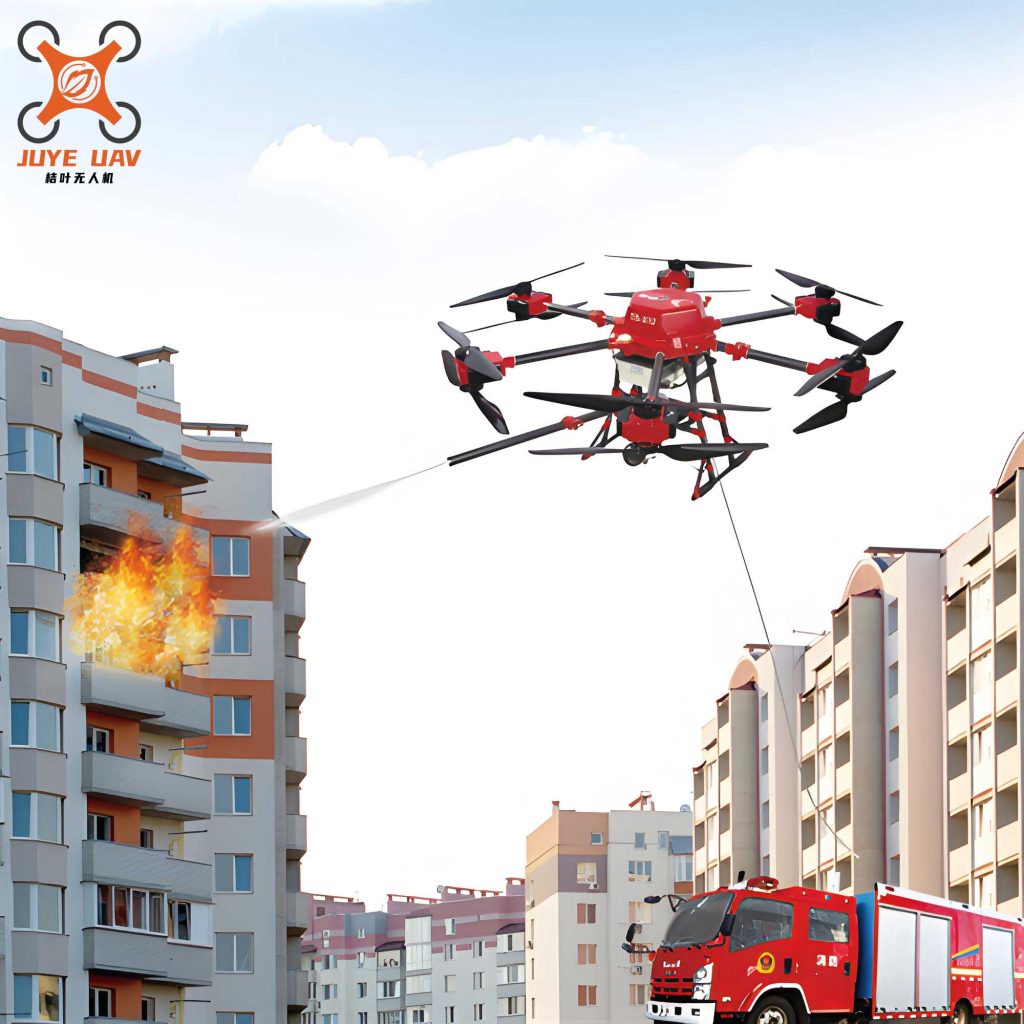
The image above illustrates a typical fire drone in action, showcasing its compact design and capabilities. As I reflect on its applications, it becomes evident that fire drones are not just tools but integral components of modern firefighting ecosystems. Their ease of operation means that even in high-stress environments, operators can deploy fire drones with precision, ensuring that communication channels remain open. This reliability is further bolstered by advancements in battery technology and anti-interference mechanisms, which I will discuss later.
Application Pathways for Fire Drones in Firefighting Communications
Fire drones are deployed across various pathways to enhance firefighting communications. I have categorized these pathways based on my research and field observations. The following table outlines the primary applications, each contributing to improved communication efficacy.
| Application Pathway | Key Functions | Communication Benefits |
|---|---|---|
| Disaster Reconnaissance | Collecting real-time images, videos, and audio from fire scenes. | Provides foundational data for decision-making, transmitted via secure links. |
| Disaster Monitoring | Continuous tracking of fire spread and environmental changes. | Enables dynamic updates to communication protocols and resource allocation. |
| Personnel Evacuation Guidance | Using speakers and displays to direct evacuees to safe routes. | Facilitates direct communication with trapped individuals, reducing chaos. |
| Indoor Communication Facilitation | Navigating indoor spaces to relay information between rescuers and victims. | Extends communication coverage to enclosed areas where signals are weak. |
| Auxiliary Supervision and Rescue | Assisting in surveillance and delivering rescue equipment. | Enhances coordination through real-time feedback loops. |
| Multi-Channel Audio-Video Communication | Transmitting multiple streams of data simultaneously to command centers. | Improves bandwidth utilization and ensures comprehensive situational reports. |
| Remote Sensing and Emergency Lighting | Deploying sensors for environmental analysis and providing illumination. | Supports communication in low-visibility conditions, such as at night. |
| Aerial Delivery and Broadcasting | Dropping supplies and broadcasting instructions from altitude. | Enables long-range communication without physical proximity risks. |
In disaster reconnaissance, fire drones act as the eyes and ears of firefighting teams. I have found that by integrating GPS and LiDAR sensors, fire drones can create 3D maps of fire-affected areas. The data transmission rate for such maps can be modeled as: $$R = B \cdot \log_2 \left(1 + \frac{S}{N}\right)$$ where \(R\) is the transmission rate, \(B\) is the bandwidth, \(S\) is the signal power, and \(N\) is the noise power. This formula underscores the importance of optimizing communication channels for fire drones to handle large datasets efficiently.
For disaster monitoring, fire drones enable persistent surveillance. From my experience, deploying multiple fire drones in a network can cover vast areas, with each fire drone acting as a node in a communication mesh. The connectivity in such a network can be analyzed using graph theory, where the probability of maintaining a link between fire drones is given by: $$P_c = 1 – e^{-\lambda \cdot A}$$ where \(P_c\) is the connectivity probability, \(\lambda\) is the density of fire drones per unit area, and \(A\) is the area covered. This highlights how strategic placement of fire drones enhances communication resilience.
Personnel evacuation guidance relies heavily on the audio capabilities of fire drones. In noisy fire environments, the clarity of broadcasts is paramount. The signal-to-noise ratio (SNR) for fire drone broadcasts can be expressed as: $$\text{SNR} = 10 \log_{10} \left( \frac{P_{\text{signal}}}{P_{\text{noise}}} \right)$$ where higher SNR values indicate clearer communication. Fire drones often incorporate noise-canceling technologies to improve SNR, ensuring that evacuation instructions are heard accurately.
Indoor communication facilitation is a challenging yet vital application. Fire drones equipped with obstacle avoidance systems can navigate complex interiors, relaying information through ad-hoc networks. The latency in such networks, critical for real-time communication, can be calculated as: $$L = \frac{D}{v} + \sum_{i=1}^n \frac{p_i}{c_i}$$ where \(L\) is the total latency, \(D\) is the distance traveled, \(v\) is the fire drone speed, \(p_i\) is the processing delay at node \(i\), and \(c_i\) is the transmission capacity. Optimizing these parameters ensures that fire drones provide timely communication indoors.
Auxiliary supervision and rescue involve using fire drones for tasks like delivering first-aid kits or monitoring structural integrity. In my observations, fire drones with robotic arms can perform delicate operations, all while streaming video to command centers. The efficiency of such operations can be gauged by: $$\eta = \frac{T_{\text{effective}}}{T_{\text{total}}} \times 100\%$$ where \(\eta\) is the operational efficiency, \(T_{\text{effective}}\) is the time spent on productive communication tasks, and \(T_{\text{total}}\) is the total mission time. Fire drones often achieve high \(\eta\) values due to their autonomy.
Multi-channel audio-video communication is where fire drones shine. By leveraging modern codecs, fire drones can transmit high-definition feeds without overwhelming networks. The bitrate for a fire drone stream can be derived from: $$\text{Bitrate} = \frac{R_{\text{raw}} \cdot C}{F}$$ where \(R_{\text{raw}}\) is the raw data rate, \(C\) is the compression ratio, and \(F\) is the frame rate. This allows fire drones to support multiple channels simultaneously, enhancing situational awareness for firefighting teams.
Remote sensing and emergency lighting extend the utility of fire drones beyond daylight hours. With thermal and multispectral sensors, fire drones can detect hotspots invisible to the naked eye. The detection range for such sensors is given by: $$R_d = \sqrt{\frac{P_{\text{emit}} \cdot \sigma \cdot A_{\text{rec}}}{\pi \cdot N_{\text{th}}}}$$ where \(R_d\) is the detection range, \(P_{\text{emit}}\) is the emitted power, \(\sigma\) is the target cross-section, \(A_{\text{rec}}\) is the receiver area, and \(N_{\text{th}}\) is the noise threshold. Fire drones equipped with these sensors provide invaluable data for communication planning in obscured environments.
Aerial delivery and broadcasting leverage the altitude capabilities of fire drones. By flying above smoke and debris, fire drones can maintain line-of-sight communication links. The coverage area for a fire drone broadcaster can be approximated as: $$A_{\text{cov}} = \pi \cdot h^2 \cdot \tan^2(\theta)$$ where \(A_{\text{cov}}\) is the coverage area, \(h\) is the altitude, and \(\theta\) is the beamwidth angle. This enables fire drones to reach wide audiences, guiding evacuations or delivering critical messages.
Considerations for Deploying Fire Drones in Firefighting Communications
While fire drones offer immense benefits, their effective use requires addressing several considerations. Based on my research, I have identified key issues that must be managed to optimize fire drone communications.
First, enhancing the stability of fire drones is paramount. In turbulent fire environments, vibrations can degrade data quality. The stability coefficient for a fire drone can be defined as: $$K_s = \frac{F_{\text{damping}}}{F_{\text{disturbance}}}$$ where \(K_s\) is the stability coefficient, \(F_{\text{damping}}\) is the damping force from stabilization systems, and \(F_{\text{durbance}}\) is the external disturbance force. A higher \(K_s\) indicates better stability, which is crucial for clear communication. Fire drones often incorporate gyroscopes and advanced algorithms to maximize \(K_s\).
Second, strategic deployment of fire drones involves both quantity and placement. Deploying too many fire drones can lead to communication interference, while too few may leave gaps. The optimal number of fire drones for a given area can be estimated using: $$N_{\text{opt}} = \left\lceil \frac{A}{A_{\text{drone}}} \right\rceil$$ where \(N_{\text{opt}}\) is the optimal number, \(A\) is the total area, and \(A_{\text{drone}}\) is the effective coverage area per fire drone. Additionally, placement should consider factors like wind patterns and obstacles to ensure seamless communication networks.
Third, training professional operators is essential. Fire drones require skilled handling to maximize their communication potential. The competency level of an operator can be modeled as: $$C = \alpha \cdot T_{\text{train}} + \beta \cdot E_{\text{exp}}$$ where \(C\) is the competency score, \(T_{\text{train}}\) is training hours, \(E_{\text{exp}}\) is experience level, and \(\alpha\) and \(\beta\) are weighting factors. Investing in comprehensive training programs ensures that operators can adeptly manage fire drones during emergencies, maintaining robust communication links.
Moreover, interoperability with existing communication systems is vital. Fire drones must integrate with firefighting radios, satellites, and other devices. The compatibility index can be expressed as: $$I_c = \frac{N_{\text{compatible}}}{N_{\text{total}}} \times 100\%$$ where \(I_c\) is the interoperability index, \(N_{\text{compatible}}\) is the number of compatible systems, and \(N_{\text{total}}\) is the total systems in use. High \(I_c\) values indicate that fire drones can seamlessly join existing communication infrastructures.
Finally, data security and privacy cannot be overlooked. Fire drones transmit sensitive information, necessitating encryption. The encryption strength for fire drone communications can be quantified by: $$E_s = 2^{k} \cdot t_{\text{crack}}$$ where \(E_s\) is the encryption strength, \(k\) is the key length in bits, and \(t_{\text{crack}}\) is the time required to crack the encryption. Implementing robust encryption protocols protects data integrity and confidentiality in fire drone transmissions.
Conclusion
In conclusion, fire drones represent a paradigm shift in firefighting communications. From my standpoint, their advantages—mobility, comprehensive视野, ease of operation, and reliability—make them indispensable tools for modern firefighting. The application pathways, ranging from disaster reconnaissance to aerial broadcasting, demonstrate the versatility of fire drones in enhancing communication efficacy. However, successful deployment hinges on addressing stability, deployment strategies, operator training, interoperability, and security considerations.
As I look to the future, I believe that continued innovation in fire drone technology will further revolutionize firefighting communications. Integrating artificial intelligence for autonomous decision-making and advancing swarm coordination for fire drone networks could unlock even greater potentials. Ultimately, by embracing fire drones, firefighting agencies can achieve higher levels of safety, efficiency, and effectiveness in their communication endeavors, saving lives and protecting property in the face of ever-evolving fire challenges.