
The contemporary battlefield is undergoing a paradigm shift, with unmanned aerial vehicles (UAVs) emerging as a ubiquitous and potent threat. Recent large-scale regional conflicts have vividly demonstrated that the success of aerial assault and counter-air operations significantly influences the course of war. The proliferation of UAV technology has given rise to a new mode of air assault, presenting a severe challenge to traditional air defense systems and the survivability of ground forces, particularly artillery. As the backbone of ground-based fire support crucial for decisive battlefield victory, traditional artillery systems face an existential challenge. In the face of persistent and pervasive UAV threats, these systems must urgently adapt by exploring novel methods and pathways for self-defense and area denial against drones. This analysis delves into the operational requirements and technological trajectories for empowering artillery—encompassing howitzers, assault guns, and rocket artillery—with expanded anti-UAV capabilities, forging new advantages for future warfare.
Operational Imperative: The UAV Threat Matrix
The tactical landscape has been fundamentally altered by the extensive use of UAVs. In modern conflicts, the density of drone operations can reach staggering levels, with estimates suggesting 25 to 40 drones active per 10 km of frontline, effectively creating a continuous surveillance and strike grid. The effectiveness of these systems is no longer theoretical; operational data from recent conflicts shows certain loitering munition models achieving direct attack success rates (kills and mission kills) approaching 85%. The primary operational modalities of UAV threats to artillery are multifaceted:
- Persistent Overhead Reconnaissance: Low-cost reconnaissance drones provide persistent, high-fidelity intelligence, surveillance, and reconnaissance (ISR), illuminating the battlefield and enabling rapid targeting of high-value assets like artillery positions.
- Multirole Mission Support: UAVs equipped with modular payloads (electronic warfare, target designation, strike) offer flexible and cost-effective mission support, often operating in coordinated swarms.
- Cost-Imposition and Attrition: Masses of inexpensive commercial or purpose-built drones are used to saturate and exhaust expensive, limited-capacity air defense systems, exposing their positions and depleting their costly interceptor munitions.
- Saturating Swarm Attacks: Coordinated attacks by drone swarms aim to overwhelm defense systems through sheer numbers, posing a near-insurmountable challenge to point defense and creating opportunities for follow-on strikes.
For artillery systems, the threat manifests in two direct ways: precision direct attack by loitering munitions or kamikaze drones, and indirect attack through drone-directed fire from other artillery or missile systems. The lack of organic air threat awareness and countermeasure capabilities leaves even heavily armored self-propelled howitzers critically vulnerable. The need for an organic or integrated anti-UAV capability is no longer a luxury but a survival necessity.
Global Trends in Artillery-Based Anti-UAV Development
International developments point towards a clear trend: evolving artillery platforms from purely offensive tools into multi-role, anti-UAV capable systems. The driving philosophy is “using groups to counter groups” and “defeating low-cost threats with affordable solutions,” leveraging the inherent attributes of artillery—volume of fire, relative platform affordability, and deployment flexibility.
Key International Initiatives:
- U.S. Army – 155mm Howitzer Air Defense Tests: Successful interception of a high-speed target drone (simulating a cruise missile) using a 155mm howitzer firing a hypervelocity projectile (HVP). This demonstrated the technical feasibility of large-caliber, indirect-fire systems engaging aerial targets when integrated with appropriate sensors, fire control, and munitions.
- U.S. Air Force – Multi-Domain Artillery: Exploration of a C-130-transportable 155mm truck-mounted gun system for base defense against cruise missiles and drones. The concept emphasizes integration into a broader battle management network for cueing and low-cost area defense.
- Industry Concepts – Gun-Based Air Defense (GBAD): Proposals for layered defense systems using various cannon calibers (e.g., 30mm, 35mm, 57mm) firing programmable airburst munitions to create cost-effective “walls of steel” against massed UAV and cruise missile raids.
- U.S. Marine Corps – “Attack-Defense” Rocket Artillery: Efforts to adapt the HIMARS launcher with a Multi-Mission Launcher (MML) to fire interceptors, transforming it from a pure strike asset into a platform with integrated anti-UAV and short-range air defense (SHORAD) capabilities.
- European Assault Guns – Integrated Airburst Capability: Modern infantry fighting vehicles (IFVs) like the KF41 Lynx are equipped with medium-caliber cannons (e.g., 35mm) firing Advanced Hit Efficiency And Destruction (AHEAD) or similar time-programmable munitions, granting them inherent capability against low-altitude aerial threats.
- Multirole Cased Telescoped Systems: Systems like the 40mm Cased Telescoped Weapon System (CTWS) are designed from the outset for multi-role engagement, including effective defense against UAVs using airburst ammunition that projects a dense cloud of sub-projectiles.
These trends coalesce into several overarching development vectors for artillery anti-UAV capability expansion:
| Development Vector | Core Principle | Key Enablers |
|---|---|---|
| Networked Integration & Situational Awareness | Fuse into a common operational picture; receive remote cuing. | Data links (Tactical Data Links, Link 16), Battle Management Systems, onboard sensors (radar, E/O). |
| Dual-Role (Attack & Defense) & Rapid Mode Switching | Platforms must seamlessly transition between ground fire support and point air defense roles. | Dual-mode fire control software, compatible ammunition handling, trained crews. |
| Cost-Effective Enhancement & Smart Upgrades | Minimize platform modification cost; maximize capability through software and smart munitions. | Open architecture vetronics, software-defined capabilities, modular hardware add-ons. |
| Platform Consolidation & Multi-Functionality | Reduce logistics footprint by having fewer platform types perform more functions. | Common chassis, universal fire control interfaces, multi-role ammunition. |
| Precision Engagement & Effective Kill Mechanisms | Ensure high probability of kill (Pk) against small, agile UAVs. | Guided/programmable munitions, proximity fuzes, disruptive warheads (RF, cyber). |
Technical Pathways and Recommendations for Capability Expansion
Expanding anti-UAV capabilities across the artillery fleet requires a tailored approach based on platform type, caliber, and intended primary role. The overarching goal is to enable a “self-defense & cooperative defense” posture without fundamentally altering the core artillery mission or incurring prohibitive cost. The conceptual framework involves enhancing information sharing, adapting fire control modes, and developing or integrating specialized munitions.
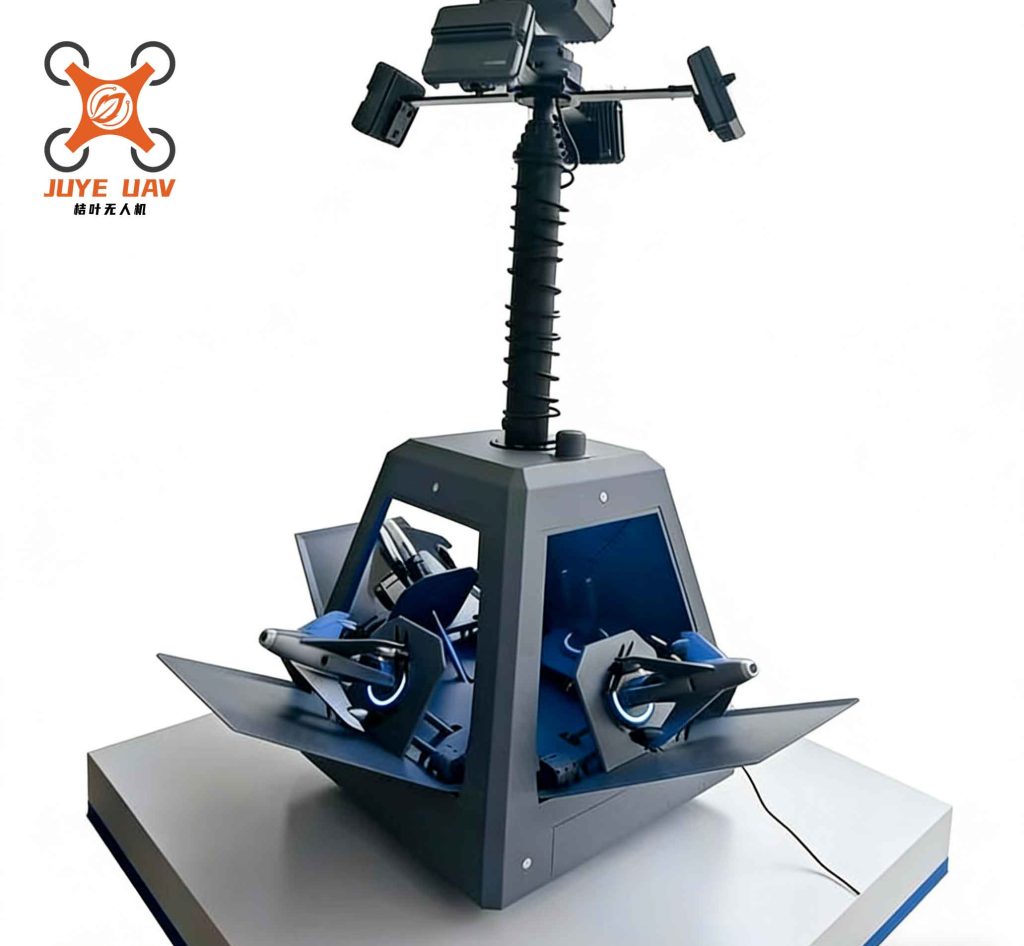
The feasibility and focus differ by platform type, as summarized below:
| Artillery Type | Recommended Development Path | Key Challenges & Focus Areas | Expected Role |
|---|---|---|---|
| Large-Caliber Howitzers (155mm) | Develop a dedicated anti-UAV/counter-cruise missile fire mode. Integrate with air defense network for cueing. Fire guided or hypervelocity projectiles (HVP). | High-accuracy fire control solution for fast-moving aerial targets; development of cost-effective guided/hypervelocity munitions; network integration. | Area defense against larger drones, loitering munitions, and cruise missiles; high single-shot Pk due to large warhead. |
| Medium/Small-Caliber Assault Guns (30-57mm) | Leverage high elevation angles and high rate-of-fire. Integrate air search/track capability (radar/E-O). Employ programmable airburst munitions (AHEAD-type). | Adding capable, compact air search sensors; developing high-accuracy ballistic solutions at high angles; ammunition cost. | Close-in self-defense (CID) for the platform and immediate vicinity; effective against small UAV swarms at short ranges. |
| Rocket Artillery | Develop and integrate guided interceptor rockets with proximity or directional warheads. Utilize the existing launch platform’s mobility and reload capability. | Developing accurate, low-cost guided rockets suitable for engaging small UAVs; fire control adaptation for aerial intercepts. | Complement to missile-based SHORAD; defense of artillery battalion areas against saturating low-altitude threats; cost-effective volume fire. |
Detailed Recommendations by Platform
1. For Large-Caliber Suppression Artillery (e.g., 155mm SPH):
The development should center on creating a dedicated anti-UAV operational mode within the fire control system (FCS). This requires:
* Hardware: Integration of a data link module to receive Air Track Warning (ATW) or similar cues from the integrated air defense network. Potentially, a lightweight, mast-mounted passive warning sensor.
* Software: New FCS algorithms to compute firing solutions for high-speed, maneuvering aerial targets. Automated ballistic solution generation and gun laying sequences.
* Munitions: Procurement or development of guided projectiles with proximity fuzes or hypervelocity kinetic energy rounds. The probability of kill (Pk) for a fragmenting 155mm shell against a UAV can be modeled as a function of miss distance and lethal radius:
$$ P_k = 1 – e^{-\frac{A_{UAV}}{A_{lethal}}} $$
where $A_{UAV}$ is the presented area of the UAV, and $A_{lethal}$ is the effective area covered by lethal fragments at a given miss distance. For a direct or near-miss with HVP, the Pk approaches 1.
* Doctrine: Clear protocols for mode switching, target prioritization, and coordination with dedicated air defense units.
2. For Small/Medium-Caliber Assault Guns (e.g., IFV Main Gun):
This platform’s evolution is closely aligned with modern air defense cannon. The upgrade path is more straightforward:
* Sensors: Integrate a capable fire-control radar or significantly enhance the existing panoramic sight with automatic air target tracking algorithms. Cuing from networked sensors remains vital.
* Fire Control: Implement an automatic anti-UAV tracking and engagement mode. The system must solve the ballistic lead for airburst munitions.
* Munitions: Standardize on programmable time-fuzed airburst ammunition. The effectiveness of such a round is given by the number of sub-projectiles (N), their velocity (vs), and the engagement geometry. The expected number of hits on a target flying through the cloud is:
$$ E(Hits) = \rho_{s} \cdot A_{UAV} \cdot v_{rel} \cdot \Delta t $$
where $\rho_{s}$ is the spatial density of sub-projectiles, $A_{UAV}$ is the target’s cross-sectional area, $v_{rel}$ is the relative velocity, and $\Delta t$ is the time the target spends in the lethal cloud.
* Mobility: Maintain the capability for “shoot-on-the-move” against aerial targets, a key advantage over static systems.
3. For Rocket Artillery:
The rocket system’s value lies in launching multiple interceptors rapidly to address swarm threats.
* Launcher Adaptation: The core platform needs minimal modification—primarily software updates to the launch control system to accept aerial fire missions and compute intercept trajectories.
* Interceptor Rocket: This is the critical technological hurdle. A low-cost, precision-guided rocket with a suitable warhead (fragmentation, rod, or directed energy) must be developed. Guidance could be via GPS/INS with terminal update or semi-active laser. The salvo size required to achieve a desired defeat probability against a swarm of size $N_{swarm}$ can be approximated if the single-shot kill probability $P_{ssk}$ is known:
$$ N_{salvo} \approx \frac{N_{swarm}}{P_{ssk}} $$
This highlights the need for high $P_{ssk}$ or a very low-cost interceptor to make salvo fires economical.
* Role: It would serve as a low-tier, high-volume layer within a layered anti-UAV defense, protecting fixed or semi-fixed positions like artillery parks or forward operating bases.
Conclusion
The transformation of the battlefield by unmanned systems is irreversible. While dedicated air defense and new physical principle weapons (laser, microwave) are essential components of the solution, they cannot be ubiquitous due to cost and complexity. Therefore, empowering the extensive existing fleet of artillery systems with organic anti-UAV capabilities presents a force-multiplying opportunity. By following a path of networked integration, smart software upgrades, and tailored munition development—as outlined in the platform-specific recommendations—artillery can transition from being a vulnerable high-value target to a resilient, multi-role combat node. This evolution, embracing “offense-defense integration” and “multi-domain capability,” is not merely a technical upgrade but a necessary strategic adaptation to ensure artillery’s survivability and continued dominance in the future, drone-saturated battlespace. The key to success lies in implementing these enhancements in a cost-controlled, scalable manner, truly embodying the principle of using affordable, distributed systems to counter affordable, distributed threats.