
Wheat Fusarium head blight (FHB) is a climate-dependent epidemic disease that causes seedling blight, stem base rot, stalk rot, and head blight in wheat, leading to significant economic losses annually. This disease not only reduces yield but also produces mycotoxins that severely compromise grain quality. Traditional control methods, such as large-scale mechanical spraying, remain prevalent but often cause physical damage to crops during application, potentially affecting final yield. In recent years, agricultural UAVs (unmanned aerial vehicles) have emerged as a promising alternative, offering advantages like high operational efficiency, safety, water and pesticide savings, and environmental friendliness. In this study, we conducted a field experiment to compare the efficacy of an agricultural UAV with a conventional self-propelled sprayer in managing wheat FHB. The focus was on evaluating control effectiveness, operational parameters, and yield impacts, emphasizing the role of agricultural UAV technology in modern precision agriculture.
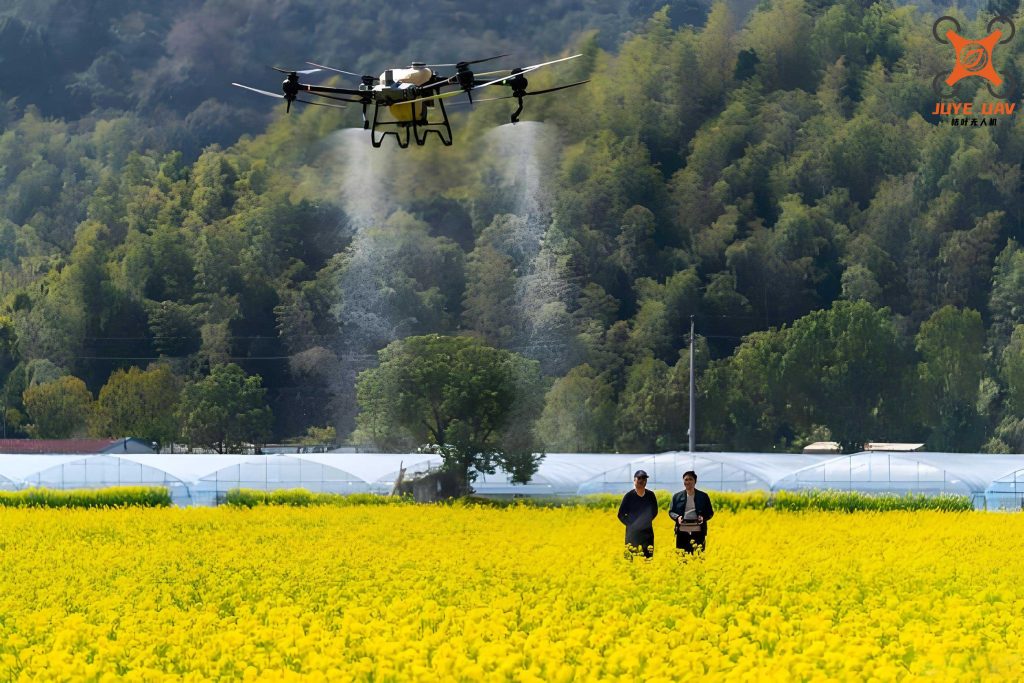
The experiment was carried out in a typical wheat-rice double-cropping system. The soil was sandy loam with a pH of 8.2, organic matter content of 18.5 g/kg, available phosphorus of 21.4 mg/kg, and rapidly available potassium of 139 mg/kg. The wheat variety used was Yangmai 25, sown on November 3, with uniform growth and good health. We employed two sprayer types: an agricultural UAV (specifically, the Quanfeng Free Eagle 1S model) and a 25-meter boom self-propelled sprayer as the conventional control. The pesticides applied included 40% prothioconazole·tebuconazole SC, 25% phenamacril SE, 43% tebuconazole SC, and 45% chlorpyrifos EC. These were chosen based on standard recommendations for FHB management.
The trial design consisted of three treatments: (1) spraying with the agricultural UAV, (2) spraying with the self-propelled sprayer, and (3) an untreated blank control. Applications were timed during the early flowering stage of wheat. The first spray was on April 24, using a mixture of 40% prothioconazole·tebuconazole at 750 mL/ha and 45% chlorpyrifos at 600 mL/ha. The second spray was on April 30, with 25% phenamacril at 1500 mL/ha and 43% tebuconazole at 300 mL/ha. To ensure fair comparison, water volumes were adjusted: the self-propelled sprayer used 450 L/ha, while the agricultural UAV used only 22.5 L/ha, reflecting its high-concentration, low-volume capability. Additional insecticides were applied across all treated plots to control aphids, spider mites, and armyworms, preventing interference from other pests.
We collected detailed operational data for the agricultural UAV, including flight height, speed, spray width, payload per flight, area covered, actual spray volume, and time efficiency. These parameters were compared against those of the self-propelled sprayer. The performance metrics can be summarized using formulas for efficiency ratios. For instance, the theoretical operational time for a given area \(A\) (in hectares) is calculated as:
$$ \text{Theoretical Time} = \frac{A \times 10,000}{\text{Spray Width} \times \text{Speed}} $$
where spray width is in meters and speed in meters per second for the agricultural UAV, or meters per minute for the self-propelled sprayer. The actual time includes loading and battery changes for the agricultural UAV, leading to an effective operation ratio:
$$ \text{Effective Operation Ratio (\%)} = \frac{\text{Theoretical Time}}{\text{Actual Time}} \times 100 $$
Table 1 presents the key flight parameters and operational data for the agricultural UAV. This highlights how the agricultural UAV optimizes spray applications through precise navigation and adjustable settings.
| Flight Parameter | Value |
|---|---|
| Load per Flight (L) | 8 |
| Flight Height (m) | 2 |
| Flight Speed (m/s) | 4.7 |
| Spray Width (m) | 4 |
| Operational Efficiency (m²/s) | 18.8 |
| Area Covered (ha) | 4.67 |
| Actual Spray Volume (L) | 86 |
| Actual Application Rate (L/ha) | 18.45 |
| Mapping Time (s) | 660 |
| Total Operation Time (s) | 6900 |
| Theoretical Spray Time (s) | 2484 |
| Effective Operation Ratio (%) | 36.0 |
For disease assessment, we surveyed wheat heads during the stable period of FHB development (May 28). In each plot, three random points were selected, with 500 spikes examined per point. Diseased spikes were counted and classified according to a standard grading scale (0 to 4, where 0 = healthy and 4 = severely diseased). The disease spike rate, disease index, and control efficacy were computed using the following formulas:
$$ \text{Disease Spike Rate (\%)} = \frac{\text{Number of Diseased Spikes}}{\text{Total Number of Spikes Surveyed}} \times 100 $$
$$ \text{Disease Index} = \frac{\sum (\text{Number of Spikes at Each Grade} \times \text{Grade Value})}{\text{Total Number of Spikes Surveyed} \times 4} \times 100 $$
$$ \text{Control Efficacy (\%)} = \frac{\text{Disease Spike Rate (or Disease Index) in Control} – \text{Disease Spike Rate (or Disease Index) in Treatment}}{\text{Disease Spike Rate (or Disease Index) in Control}} \times 100 $$
Additionally, we measured the 1000-grain weight (adjusted to 12.5% moisture content) from each treatment to evaluate yield protection. The results are summarized in Table 2, which compares the agricultural UAV and self-propelled sprayer in terms of FHB control and grain weight.
| Treatment | Disease Spike Rate (‰) | Disease Index | Control Efficacy for Spike Rate (%) | Control Efficacy for Disease Index (%) | 1000-Grain Weight (g, 12.5% moisture) |
|---|---|---|---|---|---|
| Agricultural UAV | 6.6 | 0.25 | 82.3 | 83.9 | 48.2 |
| Self-Propelled Sprayer | 5.6 | 0.175 | 85.0 | 88.7 | 48.1 |
| Blank Control | 37.3 | 1.55 | 0 | 0 | 45.6 |
The data indicate that the agricultural UAV achieved a disease spike rate control efficacy of 82.3% and a disease index control efficacy of 83.9%, which are comparable to the 85.0% and 88.7% efficacy of the self-propelled sprayer. Moreover, the 1000-grain weights from both treated plots were similar (48.2 g for the agricultural UAV and 48.1 g for the sprayer), while the untreated control showed a lower weight of 45.6 g. This demonstrates that the agricultural UAV effectively mitigated FHB damage and preserved yield, matching conventional methods.
To further analyze the efficiency of the agricultural UAV, we can model its operational dynamics. The spray deposition uniformity is critical for efficacy. Assuming a Gaussian distribution of droplet density across the spray swath, the coverage \(C(x)\) at a distance \(x\) from the centerline can be expressed as:
$$ C(x) = C_0 \exp\left(-\frac{x^2}{2\sigma^2}\right) $$
where \(C_0\) is the maximum deposition at the center and \(\sigma\) is the standard deviation related to spray dispersion. For the agricultural UAV, with a spray width of 4 m, the effective coverage area \(A_{\text{eff}}\) per pass is:
$$ A_{\text{eff}} = \int_{-W/2}^{W/2} C(x) \, dx \approx C_0 \sigma \sqrt{2\pi} \, \text{erf}\left(\frac{W}{2\sqrt{2}\sigma}\right) $$
where \(W\) is the spray width and erf is the error function. This mathematical approach helps optimize flight paths and spray parameters for maximum target coverage.
Weather conditions during the trial were recorded. Prior to the first application, there were three consecutive rainy days with 26.8 mm of precipitation, creating favorable conditions for FHB infection. Between the two sprays, four rainy days occurred with 28.1 mm of rainfall. After the second spray, eight rainy days with a total of 54.3 mm were observed by the end of May. These conditions simulated a moderate disease pressure environment, allowing for a robust evaluation of the agricultural UAV’s performance under realistic scenarios.
The adoption of agricultural UAV technology addresses several limitations of traditional sprayers. For instance, self-propelled sprayers often require large turning spaces, cause soil compaction, and may miss field edges, leading to uneven application. In contrast, the agricultural UAV operates autonomously with GPS guidance, ensuring precise spray delivery even in irregular-shaped fields. Its low-volume application reduces chemical runoff and environmental impact. However, we noted that the effective operation ratio for the agricultural UAV was 36.0%, lower than the 53.36% for the self-propelled sprayer, primarily due to time spent on refilling pesticides and swapping batteries. This highlights an area for improvement in operational logistics, such as using larger tanks or faster charging systems.
From an economic perspective, the use of an agricultural UAV can reduce labor costs and increase field throughput. The operational efficiency \(E\) in hectares per hour can be calculated as:
$$ E = \frac{3600 \times \text{Effective Operation Ratio}}{\text{Actual Time per Hectare in Seconds}} $$
For our trial, the agricultural UAV covered 4.67 hectares in 6900 seconds, yielding an approximate efficiency of 2.44 hectares per hour. Comparatively, the self-propelled sprayer covered the same area in 2100 seconds (35 minutes), resulting in an efficiency of 8.0 hectares per hour. However, when factoring in setup time and crop damage avoidance, the agricultural UAV offers net benefits in sensitive growth stages.
To generalize the findings, we can derive a predictive model for FHB control efficacy based on spray parameters. Let \(D\) represent the disease severity in the control, \(R\) the application rate of pesticide, and \(V\) the spray volume. The efficacy \(E\) might follow a logistic growth function:
$$ E = E_{\text{max}} \left(1 – \exp\left(-k \cdot R \cdot V \cdot \eta\right)\right) $$
where \(E_{\text{max}}\) is the maximum achievable efficacy, \(k\) is a constant related to pesticide potency, and \(\eta\) is the deposition efficiency factor specific to the sprayer type. For agricultural UAVs, \(\eta\) may be higher due to better canopy penetration, as demonstrated in this study.
Future research should explore the performance of agricultural UAVs in high-disease-pressure years, as our trial occurred under relatively light FHB incidence. Additionally, integrating remote sensing data from UAVs could enable real-time disease monitoring and targeted spraying, further enhancing precision agriculture. The scalability of agricultural UAV technology makes it suitable for large-scale farm operations, and ongoing advancements in battery life and payload capacity will likely improve its competitiveness.
In conclusion, this experiment confirms that agricultural UAVs are a viable tool for wheat FHB management. The agricultural UAV provided control efficacy and yield protection equivalent to conventional self-propelled sprayers, while offering advantages in precision, reduced crop damage, and environmental sustainability. As agricultural UAV technology evolves, it holds great potential to revolutionize crop protection strategies, ensuring food security and sustainable farming practices. We recommend further trials across diverse climatic conditions to validate these results and optimize application protocols for broader adoption.