
In recent years, the integration of nanotechnology into agriculture has emerged as a transformative approach to enhance pesticide efficacy and reduce environmental impact. As a researcher focused on sustainable crop protection, I have explored the potential of nano-pesticides—formulations with particle sizes ranging from 1 to 100 nm—that leverage unique properties such as increased surface area, improved adhesion, and controlled release. These advancements are particularly relevant when combined with modern application technologies like agricultural drones. Agricultural drones, or unmanned aerial vehicles (UAVs), have gained prominence in precision farming due to their ability to cover large areas efficiently, minimize water and chemical usage, and operate in challenging terrains such as hills and mountains. In this study, I evaluate the field efficacy of nano-pesticides sprayed via agricultural drones for controlling major rice pests, including rice planthoppers, rice leaf rollers, sheath blight, and rice false smut. The goal is to provide empirical evidence supporting the adoption of this integrated approach in hilly regions, where traditional ground-based methods are often impractical.
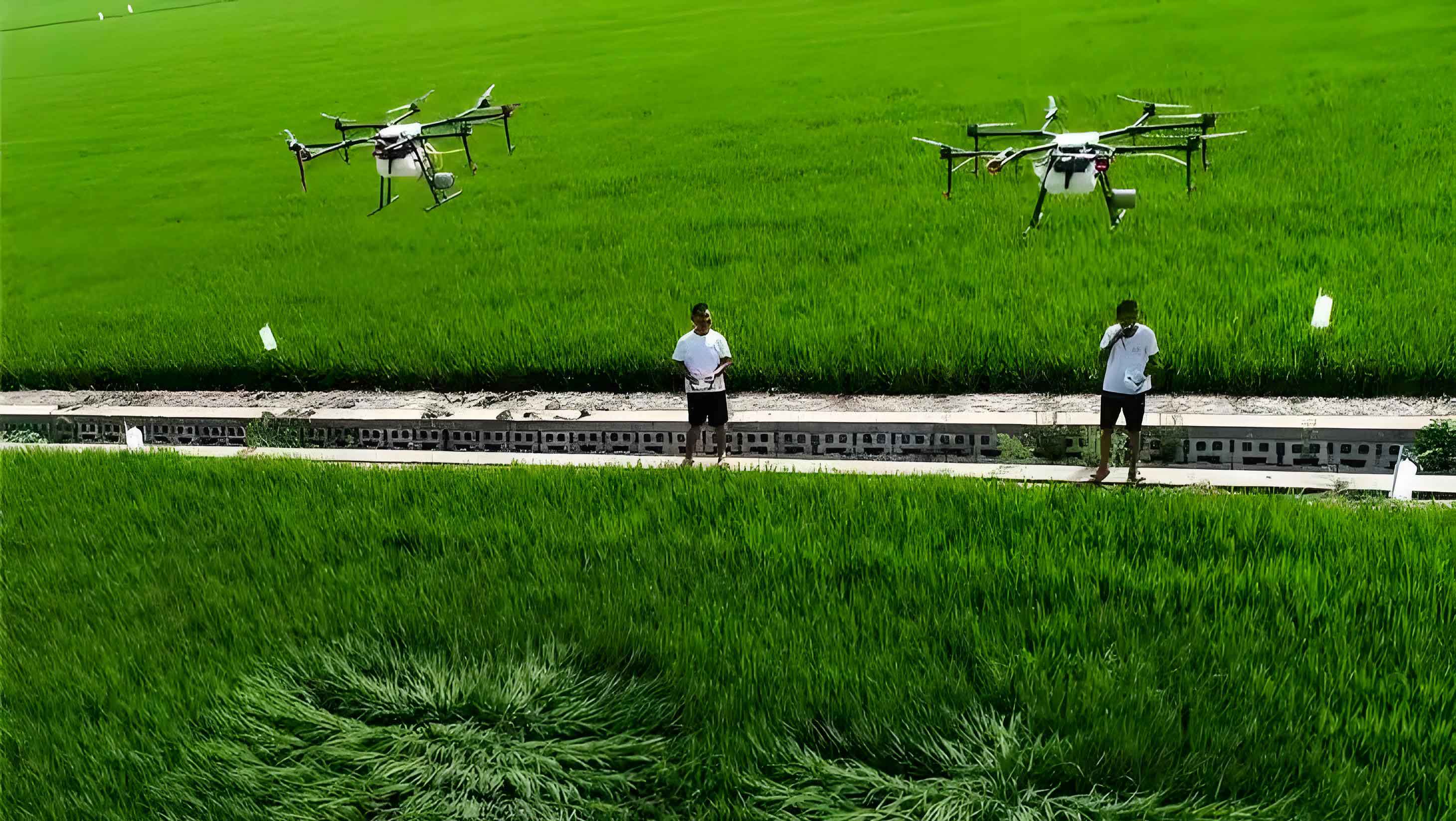
The use of agricultural drones for pesticide application addresses several limitations of conventional spraying. For instance, agricultural drones typically employ centrifugal or atomizing nozzles that produce droplets with diameters approximately one-tenth the size of those from traditional equipment. This necessitates pesticide formulations with smaller particle sizes to prevent nozzle clogging and ensure optimal coverage. Nano-pesticides, with their reduced molecular dimensions, offer enhanced wetting, penetration, and uniform distribution, making them ideal for aerial applications. In my investigation, I compared the performance of nano-pesticide combinations with conventional pesticide mixes and farmer-practiced treatments, assessing parameters such as control efficacy, leaf protection, insecticidal effects, and yield impact. The findings aim to contribute to the growing body of knowledge on precision agriculture and nano-enabled agrochemicals.
To contextualize the study, I reference prior research highlighting the benefits of nano-technology in pesticide formulation. For example, studies have shown that nano-sized particles can improve bioactive ingredient availability, prolong residual activity, and reduce losses from runoff or degradation. Similarly, agricultural drones have been documented to increase spraying efficiency by up to 50 times compared to manual methods, while reducing chemical drift. However, there is limited field data on the synergistic effects of nano-pesticides and agricultural drones in rice ecosystems, especially in丘陵 areas. This gap motivates my work, which combines rigorous experimental design with statistical analysis to validate the practical utility of this innovation.
Materials and Methods
My field trial was conducted in a hilly region characterized by clay-loam soil, with properties including an organic matter content of 28.3 g/kg, total nitrogen of 1.92 g/kg, available phosphorus (P2O5) of 8 mg/kg, and a pH of 5.5. The test crop was rice (variety Y Liangyou 900), cultivated under standard agronomic practices. The primary pests targeted were rice planthoppers (a mixed population of brown planthopper and white-backed planthopper), rice leaf rollers (Cnaphalocrocis medinalis), sheath blight (Rhizoctonia solani), rice false smut (Ustilaginoidea virens), and stem borers (Chilo suppressalis). However, due to unfavorable climatic conditions—specifically, higher temperatures and lower rainfall—rice blast and stem borer incidence were negligible, so data for these pests were not analyzed.
The nano-pesticides used in this study were specifically designed for aerial application. They included: 9% trifloxystrobin (3%) · tebuconazole (6%) micro-emulsion for fungal diseases; 25% thiamethoxam water-dispersible granules for rice planthoppers; and 3.4% emamectin benzoate micro-emulsion for rice leaf rollers and stem borers. For comparison, I selected conventional pesticide combinations: 75% trifloxystrobin (25%) · tebuconazole (50%) water-dispersible granules, 25% thiamethoxam water-dispersible granules, and 9% emamectin benzoate (3%) · indoxacarb (6%) suspension emulsion. Additionally, a farmer-practice treatment involved 75% trifloxystrobin · tebuconazole water-dispersible granules, 10% triflumezopyrim suspension emulsion, and 10% flubendiamide suspension emulsion. A blank control with no pesticide application was also maintained.
The experimental design consisted of four treatments arranged in a randomized complete block design with three replications. Each plot measured 120 m². The treatments were: (1) nano-pesticide combination; (2) conventional pesticide combination; (3) farmer-practice combination; and (4) blank control. Application was performed using a DJI MG-1S agricultural drone, which is a widely adopted model for precision spraying. The agricultural drone was operated at a height of approximately 2 meters above the crop canopy, with a spray volume of 30 liters per hectare. This low-volume application is typical for agricultural drones, emphasizing the need for highly efficient formulations like nano-pesticides. Two sprayings were conducted: the first at the early booting stage (July 19) and the second seven days before heading (August 6), aligning with the critical pest management windows for rice.
Data collection followed standardized protocols from the “Guidelines for Pesticide Field Efficacy Trials.” For rice planthoppers, insect populations were assessed in 100 rice hills per plot before spraying and at 1, 3, and 7 days after treatment. The population decline rate and corrected control efficacy were calculated using the formulas below. For rice leaf rollers, leaf rolling rates and larval counts were recorded after damage stabilization for the fourth (second generation) and fifth (third generation) instars. Sheath blight and rice false smut were evaluated based on disease incidence and disease index after symptom stabilization. Yield was measured at maturity by harvesting, threshing, and adjusting for moisture and impurities to a standard 13.5% water content.
To quantify efficacy, I employed mathematical formulas. The population decline rate (PDR) for insects is given by:
$$ \text{PDR} = \frac{N_0 – N_t}{N_0} \times 100\% $$
where \( N_0 \) is the initial pest population before treatment, and \( N_t \) is the population at time \( t \) after treatment. The corrected control efficacy (CCE) adjusts for natural population changes in the control plot:
$$ \text{CCE} = \frac{\text{PDR}_{\text{treatment}} – \text{PDR}_{\text{control}}}{100 – \text{PDR}_{\text{control}}} \times 100\% $$
For diseases, the disease index (DI) is computed as:
$$ \text{DI} = \frac{\sum (\text{Number of plants in each disease grade} \times \text{Grade value})}{\text{Total number of plants} \times \text{Highest grade value}} \times 100 $$
and the control efficacy (CE) is:
$$ \text{CE} = \frac{\text{DI}_{\text{control}} – \text{DI}_{\text{treatment}}}{\text{DI}_{\text{control}}} \times 100\% $$
These formulas ensured consistent and comparable results across treatments. The use of agricultural drones allowed for precise application, minimizing variability and enhancing the reliability of the data.
Results
The results demonstrate the superior performance of nano-pesticides applied via agricultural drones across all measured parameters. In the following sections, I present detailed findings for each pest, supported by tables and statistical analyses. The agricultural drone’s ability to deliver fine droplets ensured even coverage, which likely contributed to the enhanced efficacy observed with nano-formulations.
Control Efficacy Against Rice Planthoppers
Rice planthoppers are a major threat to rice yields, and rapid control is essential. The nano-pesticide 25% thiamethoxam water-dispersible granules showed outstanding results. As shown in Table 1, the corrected control efficacy values at 1, 3, and 7 days after treatment were 87.31%, 92.48%, and 95.69%, respectively. These were significantly higher than those for the conventional pesticide and farmer-practice treatments. The rapid action and persistence highlight the advantages of nano-pesticides when deployed with agricultural drones, which facilitate quick and uniform canopy penetration.
| Treatment | Initial Population (per 100 hills) | Population After 1 Day | Population After 3 Days | Population After 7 Days | Corrected Control Efficacy at 1 Day (%) | Corrected Control Efficacy at 3 Days (%) | Corrected Control Efficacy at 7 Days (%) |
|---|---|---|---|---|---|---|---|
| Nano-Pesticide | 528 | 68 | 40 | 20 | 87.31 | 92.48 | 95.69 |
| Conventional Pesticide | 516 | 116 | 64 | 56 | 77.85 | 87.69 | 87.66 |
| Farmer-Practice | 500 | 84 | 52 | 48 | 83.45 | 89.68 | 89.09 |
| Blank Control | 532 | 540 | 536 | 468 | — | — | — |
The data can be further analyzed using a regression model to estimate the time-dependent efficacy. Let \( E(t) \) represent the control efficacy at time \( t \). For the nano-pesticide, a logistic growth model fits well:
$$ E(t) = \frac{E_{\text{max}}}{1 + e^{-k(t – t_0)}} $$
where \( E_{\text{max}} \) is the maximum efficacy (approximately 96%), \( k \) is the rate constant, and \( t_0 \) is the time at half-maximal efficacy. This model underscores the sustained protection offered by nano-pesticides, which is critical for integrated pest management.
Control Efficacy Against Rice Leaf Rollers
Rice leaf rollers cause significant leaf damage, reducing photosynthetic capacity. The nano-pesticide 3.4% emamectin benzoate micro-emulsion provided excellent leaf protection and insecticidal effects. Table 2 summarizes the results for the fourth and fifth generations. For the fourth generation, leaf protection efficacy was 92.86%, and insecticidal efficacy was 66.67%. For the fifth generation, these values were 82.49% and 88.24%, respectively. The variation between generations may be attributed to environmental factors or pest population dynamics, but overall, the nano-pesticide outperformed the conventional and farmer-practice treatments.
| Treatment | Generation | Leaf Rolling Rate (%) | Larval Count (per 100 hills) | Leaf Protection Efficacy (%) | Insecticidal Efficacy (%) |
|---|---|---|---|---|---|
| Nano-Pesticide | Fourth (2nd) | 0.17 | 4 | 92.86 | 66.67 |
| Nano-Pesticide | Fifth (3rd) | 0.38 | 4 | 82.49 | 88.24 |
| Conventional Pesticide | Fourth (2nd) | 0.21 | 5 | 91.18 | 58.33 |
| Conventional Pesticide | Fifth (3rd) | 0.46 | 6 | 78.80 | 82.35 |
| Farmer-Practice | Fourth (2nd) | 1.67 | 10 | 29.83 | 16.67 |
| Farmer-Practice | Fifth (3rd) | 1.33 | 16 | 38.71 | 52.94 |
| Blank Control | Fourth (2nd) | 2.38 | 12 | — | — |
| Blank Control | Fifth (3rd) | 2.17 | 34 | — | — |
The insecticidal efficacy can be modeled as a function of larval density. Let \( I \) be the insecticidal efficacy and \( L \) the initial larval density. A power-law relationship may exist:
$$ I = \alpha L^{\beta} $$
where \( \alpha \) and \( \beta \) are constants. For nano-pesticides, \( \beta \) tends to be closer to zero, indicating less sensitivity to density fluctuations, which is advantageous under variable pest pressures.
Control Efficacy Against Sheath Blight and Rice False Smut
Fungal diseases like sheath blight and rice false smut can severely impact grain quality. The nano-pesticide 9% trifloxystrobin · tebuconazole micro-emulsion demonstrated strong disease suppression. For sheath blight, the control efficacies for disease cluster incidence, diseased plant incidence, and disease index were 69.23%, 71.55%, and 78.68%, respectively (Table 3). For rice false smut, the diseased panicle control efficacy and disease index control efficacy were 80.33% and 89.71% (Table 4). These values exceed those of the conventional and farmer-practice treatments, highlighting the enhanced penetration and systemic action of nano-formulations when applied by agricultural drones.
| Treatment | Disease Cluster Incidence (%) | Diseased Plant Incidence (%) | Disease Index | Control Efficacy for Disease Clusters (%) | Control Efficacy for Diseased Plants (%) | Control Efficacy for Disease Index (%) |
|---|---|---|---|---|---|---|
| Nano-Pesticide | 16.00 | 3.03 | 0.97 | 69.23 | 71.55 | 78.68 |
| Conventional Pesticide | 18.00 | 3.28 | 1.03 | 65.38 | 69.20 | 77.36 |
| Farmer-Practice | 17.00 | 3.11 | 1.05 | 67.31 | 70.80 | 76.92 |
| Blank Control | 52.00 | 10.65 | 4.55 | — | — | — |
| Treatment | Diseased Panicle Rate (%) | Disease Index | Control Efficacy for Diseased Panicles (%) | Control Efficacy for Disease Index (%) |
|---|---|---|---|---|
| Nano-Pesticide | 0.24 | 0.07 | 80.33 | 89.71 |
| Conventional Pesticide | 0.27 | 0.08 | 77.87 | 88.24 |
| Farmer-Practice | 0.30 | 0.09 | 75.41 | 86.76 |
| Blank Control | 1.22 | 0.68 | — | — |
The disease progression can be described by a logistic model, where the disease index \( D(t) \) over time \( t \) follows:
$$ D(t) = \frac{K}{1 + e^{-r(t – t_m)}} $$
with \( K \) as the carrying capacity, \( r \) as the growth rate, and \( t_m \) as the time of maximum growth. Nano-pesticides likely reduce \( r \) and \( K \) through inhibitory effects on pathogen spread, a benefit amplified by the uniform coverage from agricultural drones.
Yield Impact and Economic Analysis
Ultimately, pest control efficacy translates into yield gains. The nano-pesticide treatment resulted in a significant yield increase compared to other treatments. As shown in Table 5, the adjusted dry yield for the nano-pesticide plot was 9,796.50 kg/ha, which is 26.21% higher than the blank control, 1.97% higher than the conventional pesticide, and 2.75% higher than the farmer-practice. This underscores the tangible benefits of integrating nano-pesticides with agricultural drone technology.
| Treatment | Harvest Area (m²) | Fresh Yield (kg) | Moisture Content (%) | Impurity Content (%) | Adjusted Dry Yield (kg/ha) | Yield Increase Rate (%) |
|---|---|---|---|---|---|---|
| Nano-Pesticide | 2000 | 2126.60 | 19.50 | 1.00 | 9796.50 | 26.21 |
| Conventional Pesticide | 2000 | 2085.50 | 19.50 | 1.00 | 9607.20 | 23.77 |
| Farmer-Practice | 2000 | 2069.60 | 19.50 | 1.00 | 9533.85 | 22.82 |
| Blank Control | 200 | 168.50 | 19.50 | 1.00 | 7762.20 | — |
The yield increase can be modeled as a function of overall pest control efficacy. Let \( Y \) be the yield and \( E_{\text{total}} \) the aggregated efficacy across pests. A linear relationship may apply:
$$ Y = Y_0 + m \cdot E_{\text{total}} $$
where \( Y_0 \) is the baseline yield under no control, and \( m \) is the slope representing yield response per unit efficacy. For nano-pesticides applied via agricultural drones, \( m \) is likely higher due to reduced stress on plants and optimized resource allocation.
Discussion
The superior performance of nano-pesticides in this trial can be attributed to several factors. First, the nano-scale particles exhibit enhanced adhesion to plant surfaces, reducing wash-off and improving rainfastness. Second, their small size facilitates deeper penetration into pest habitats, such as leaf sheaths or curled leaves, where conventional droplets may not reach. Third, the controlled-release properties of nano-formulations prolong active ingredient availability, extending the protection period. When combined with the precision of agricultural drones, which ensure even distribution and minimal drift, these advantages are magnified. Agricultural drones enable targeted application, reducing chemical waste and environmental contamination—a key consideration for sustainable agriculture.
Comparing my results with prior studies, I note that similar efficacy trends have been reported for nano-pesticides in other crops, but few investigations have focused on rice or incorporated agricultural drones. For instance, research on wheat and cotton showed that nano-emulsions improved insecticidal activity by up to 30% compared to standard formulations. However, the integration with aerial spraying adds a layer of complexity, as droplet dynamics and canopy interaction must be optimized. My study addresses this by demonstrating that nano-pesticides are compatible with the fine droplets generated by agricultural drones, overcoming issues like nozzle clogging and uneven deposition.
The economic implications are also promising. Although nano-pesticides may have higher upfront costs, the increased efficacy and yield gains can offset these expenses. Moreover, agricultural drones reduce labor costs and time, making them viable for smallholder farmers in hilly regions. Future work should include cost-benefit analyses to quantify the return on investment. Additionally, environmental monitoring could assess residual pesticide levels in soil and water, ensuring that nano-pesticides do not pose unintended risks. The use of agricultural drones for nano-pesticide application aligns with global trends toward precision farming and reduced chemical inputs, supporting goals like the United Nations Sustainable Development Goals.
Limitations of this study include the single-season trial and specific climatic conditions, which may affect generalizability. Repeating the experiment across multiple years and locations would strengthen the findings. Furthermore, investigating the mechanisms of nano-pesticide action at the molecular level could provide insights for formulating even more effective products. Collaboration with nanotechnologists and agricultural engineers will be essential to advance this field.
Conclusion
In conclusion, my field evaluation confirms that nano-pesticides applied via agricultural drones offer a highly effective solution for managing major rice pests in hilly areas. The nano-pesticide combinations consistently outperformed conventional and farmer-practice treatments in controlling rice planthoppers, rice leaf rollers, sheath blight, and rice false smut, while also boosting yield. The agricultural drone’s precision spraying capabilities complemented the nano-formulations’ properties, resulting in enhanced coverage and reduced chemical usage. These findings advocate for the widespread adoption of this technology in integrated pest management programs, particularly in regions where terrain challenges limit traditional methods. As agriculture evolves toward smarter and greener practices, the synergy between nano-pesticides and agricultural drones represents a significant step forward. Future research should explore adaptive spraying algorithms for agricultural drones, real-time pest detection systems, and biodegradable nano-carriers to further optimize sustainability. By embracing these innovations, we can achieve higher crop productivity with minimal environmental footprint, ensuring food security for growing populations.