
In recent years, the adoption of direct-seeded rice cultivation has expanded significantly due to labor shortages and the promotion of modern, lightweight farming systems. However, this method faces severe weed infestations, which occur in two main periods: 5–20 days after sowing, dominated by graminaceous weeds, and 25–40 days after sowing, dominated by sedges and broadleaf weeds. Traditional weed control methods, such as backpack or stretcher-mounted sprayers, are labor-intensive, inefficient, and struggle with field accessibility. As a result, herbicide overuse has led to increased weed resistance, reduced efficacy, and environmental concerns. In this context, agricultural drones have emerged as a promising solution, offering advantages like high safety, adaptability, efficiency, and lower labor costs. They enhance pesticide utilization, reduce labor intensity, and improve work efficiency, making them widely applicable for crop pest and disease control. This study aims to evaluate the effectiveness of agricultural drones in controlling weeds in direct-seeded rice fields while reducing herbicide usage, compared to conventional electric sprayers. We focus on pre-emergence and post-emergence weed control stages, assessing efficacy, safety, and operational efficiency.
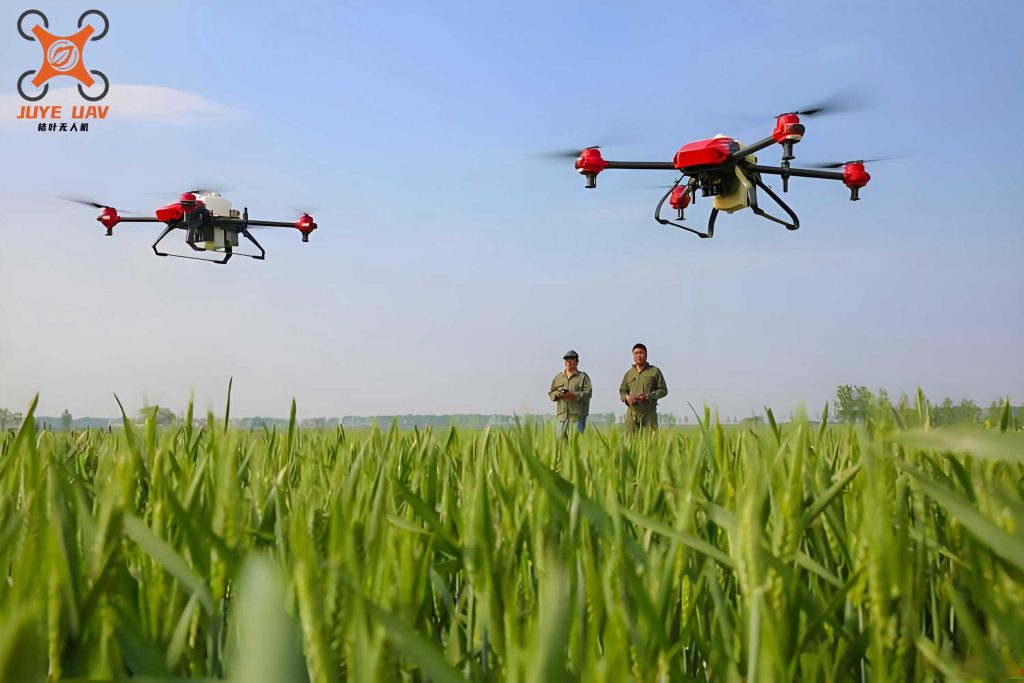
Our research was conducted in a direct-seeded rice field in a region of Zhejiang Province, China, characterized by a temperate climate typical of the Ningbo-Shaoxing Plain. The rice variety used was a local early-season type, sown on April 10, 2023, after soaking and germination. Field management practices, including fertilization, irrigation, and non-target pest control, were kept consistent across all plots to ensure comparability. We employed two types of application equipment: an agricultural drone, specifically the Qifei multi-rotor drone A22, and a 3WB-d-16A backpack electric sprayer. The agricultural drone was operated at a height of 1.5 meters, a speed of 4 meters per second, and a swath width of 3 meters, with a water volume of 4 kilograms per 667 square meters. In contrast, the electric sprayer used 35 kilograms of water per 667 square meters. Both methods included a flight adjuvant, fatty acid ethyl ester vitamin E emulsion, at 5 milliliters per 667 square meters for the agricultural drone, to enhance droplet deposition and efficacy.
The herbicides tested were selected based on common practices for direct-seeded rice weed control. They included: 40% bensulfuron-methyl · pretilachlor suspension concentrate (SC), used for pre-emergence control; 36% isoxaflutole microcapsule suspension (CS), for broad-spectrum weed management; 48% bentazon sodium salt soluble concentrate (SL), for post-emergence control of broadleaf weeds and sedges; and 75% MCPA-dimethylamine salt aqueous solution (AS), for targeted post-emergence applications. The experimental design comprised nine treatments without replication, as detailed in Table 1. Treatments involved different herbicide combinations and dosages, applied at two key timings: 6 days after sowing (pre-emergence) and 47 days after sowing (post-emergence, at the 4–5 leaf stage of rice and 3–4 leaf stage of weeds). The agricultural drone treatments included full and reduced dosages (20–30% less), while the electric sprayer served as a conventional control. Plot sizes varied from 200 to 1,200 square meters to accommodate the application equipment.
| Treatment | Application Method | First Application (6 Days After Sowing) | Second Application (47 Days After Sowing) | Plot Area (m²) |
|---|---|---|---|---|
| 1 | Agricultural drone | 40% bensulfuron-methyl · pretilachlor 100 mL | 48% bentazon sodium salt 200 mL | 1200 |
| 2 | Agricultural drone | 40% bensulfuron-methyl · pretilachlor 100 mL + 36% isoxaflutole 30 mL | 75% MCPA-dimethylamine salt 20 mL | 1200 |
| 3 | Agricultural drone | 40% bensulfuron-methyl · pretilachlor 70 mL + 36% isoxaflutole 21 mL | 75% MCPA-dimethylamine salt 16 mL | 867 |
| 4 | Agricultural drone | 40% bensulfuron-methyl · pretilachlor 70 mL | 48% bentazon sodium salt 160 mL | 867 |
| 5 | Electric sprayer | 40% bensulfulon-methyl · pretilachlor 100 mL | 48% bentazon sodium salt 200 mL | 200 |
| 6 | Electric sprayer | 40% bensulfuron-methyl · pretilachlor 100 mL + 36% isoxaflutole 30 mL | 75% MCPA-dimethylamine salt 20 mL | 200 |
| 7 | Electric sprayer | 40% bensulfuron-methyl · pretilachlor 70 mL + 36% isoxaflutole 21 mL | 75% MCPA-dimethylamine salt 16 mL | 200 |
| 8 | Electric sprayer | 40% bensulfuron-methyl · pretilachlor 70 mL | 48% bentazon sodium salt 160 mL | 200 |
| CK | Blank control | No application | No application | 400 |
Weed assessments were conducted at two critical points: 20 days after the first application (pre-emergence stage) and 12 days after the second application (post-emergence stage). In each treatment, we used a randomized “S”-shaped sampling method with six points per plot, each covering 0.11 square meters. We recorded the number of weeds by category: graminaceous (e.g., barnyard grass), broadleaf (e.g., Ammannia auriculata, Lindernia procumbens), and sedges (e.g., Cyperus difformis). At the post-emergence assessment, we also collected and weighed fresh weed biomass to calculate control efficacy. The formulas for control efficacy are as follows:
For weed density control efficacy (percentage):
$$ \text{Density Efficacy (\%)} = \left( \frac{N_c – N_t}{N_c} \right) \times 100 $$
where \( N_c \) is the weed density in the control plot and \( N_t \) is the weed density in the treatment plot.
For fresh weight control efficacy (percentage):
$$ \text{Weight Efficacy (\%)} = \left( \frac{W_c – W_t}{W_c} \right) \times 100 $$
where \( W_c \) is the fresh weed weight in the control plot and \( W_t \) is the fresh weed weight in the treatment plot.
Additionally, we monitored rice phytotoxicity at 3 and 7 days after each application, using a visual scale from 1 to 5 (1: no symptoms, 5: severe damage affecting yield). Operational efficiency was evaluated by comparing the area covered per hour for the agricultural drone and electric sprayer.
The results for pre-emergence weed control are summarized in Table 2. The blank control plot had a high weed density of 970 plants per square meter, predominantly barnyard grass, Ammannia auriculata, and Cyperus difformis. Both the agricultural drone and electric sprayer applications showed excellent control efficacy. For the agricultural drone, full dosages achieved 100% control across all weed types, while reduced dosages (30% less) maintained efficacy rates of 95.6% to 100% for individual weeds and 98.8% to 99.8% for total weeds. Similarly, the electric sprayer with full dosages achieved 95.7% to 100% control, and with reduced dosages, 91.1% to 100% control. This indicates that the agricultural drone performs comparably to conventional methods, even with herbicide reductions, highlighting its potential for sustainable weed management.
| Treatment | Application Method | Barnyard Grass Control (%) | Ammannia auriculata Control (%) | Cyperus difformis Control (%) | Total Weed Control (%) |
|---|---|---|---|---|---|
| 1 | Agricultural drone | 100.0 | 100.0 | 100.0 | 100.0 |
| 2 | Agricultural drone | 100.0 | 100.0 | 100.0 | 100.0 |
| 3 | Agricultural drone | 95.6 | 100.0 | 97.6 | 98.8 |
| 4 | Agricultural drone | 97.8 | 100.0 | 100.0 | 99.8 |
| 5 | Electric sprayer | 97.8 | 99.7 | 95.7 | 98.0 |
| 6 | Electric sprayer | 100.0 | 100.0 | 100.0 | 100.0 |
| 7 | Electric sprayer | 91.1 | 98.8 | 100.0 | 98.8 |
| 8 | Electric sprayer | 100.0 | 99.1 | 100.0 | 99.5 |
For post-emergence weed control, assessed 12 days after the second application, the efficacy data are presented in Tables 3 and 4. In terms of weed density control, the agricultural drone with full dosages achieved 96.6% to 100% control for specific weeds and 97.9% to 100% for total weeds. With a 20% dosage reduction, efficacy ranged from 93.1% to 100% for individual weeds and 95.8% to 100% for total weeds. The electric sprayer showed equally high efficacy, with full dosages at 100% control and reduced dosages also at 100% control. The fresh weight control efficacy followed a similar pattern, with the agricultural drone achieving 98.3% to 100% control at full dosages and 98.9% to 100% at reduced dosages. These results demonstrate that the agricultural drone is highly effective for post-emergence weed control, supporting herbicide reduction strategies without compromising performance.
| Treatment | Application Method | Ammannia auriculata Control (%) | Lindernia procumbens Control (%) | Cyperus difformis Control (%) | Total Weed Control (%) |
|---|---|---|---|---|---|
| 1 | Agricultural drone | 100.0 | 100.0 | 100.0 | 100.0 |
| 2 | Agricultural drone | 98.3 | 100.0 | 96.6 | 97.9 |
| 3 | Agricultural drone | 96.6 | 100.0 | 93.1 | 95.8 |
| 4 | Agricultural drone | 100.0 | 100.0 | 100.0 | 100.0 |
| 5 | Electric sprayer | 100.0 | 100.0 | 100.0 | 100.0 |
| 6 | Electric sprayer | 100.0 | 100.0 | 100.0 | 100.0 |
| 7 | Electric sprayer | 100.0 | 100.0 | 100.0 | 100.0 |
| 8 | Electric sprayer | 100.0 | 100.0 | 100.0 | 100.0 |
| Treatment | Application Method | Ammannia auriculata Control (%) | Lindernia procumbens Control (%) | Cyperus difformis Control (%) | Total Weed Control (%) |
|---|---|---|---|---|---|
| 1 | Agricultural drone | 100.0 | 100.0 | 100.0 | 100.0 |
| 2 | Agricultural drone | 99.8 | 100.0 | 99.4 | 99.7 |
| 3 | Agricultural drone | 98.3 | 100.0 | 99.0 | 98.9 |
| 4 | Agricultural drone | 100.0 | 100.0 | 100.0 | 100.0 |
| 5 | Electric sprayer | 100.0 | 100.0 | 100.0 | 100.0 |
| 6 | Electric sprayer | 100.0 | 100.0 | 100.0 | 100.0 |
| 7 | Electric sprayer | 100.0 | 100.0 | 100.0 | 100.0 |
| 8 | Electric sprayer | 100.0 | 100.0 | 100.0 | 100.0 |
Regarding crop safety, we observed mild phytotoxicity symptoms, such as leaf whitening and chlorosis, in treatments involving isoxaflutole, but these symptoms fully recovered within 20 days without affecting seedling establishment, growth, or final yield. All other treatments showed no visible phytotoxicity, indicating that both application methods are safe for rice at the tested dosages. This underscores the suitability of agricultural drones for precise herbicide delivery, minimizing crop damage while maximizing weed control.
Operational efficiency was a key focus of our study. The agricultural drone covered an average of 4 hectares per hour, whereas the electric sprayer managed only 0.13 hectares per hour. This represents a 30-fold increase in efficiency with the agricultural drone, translating to significant labor savings and faster field operations. The high efficiency of agricultural drones makes them ideal for large-scale farming, where timely interventions are crucial for weed management. We can model this efficiency gain using a simple formula for work rate:
$$ \text{Work Rate} = \frac{A}{T} $$
where \( A \) is the area covered and \( T \) is the time taken. For the agricultural drone, with \( A = 40,000 \, \text{m}^2 \) per hour (4 hectares) and \( T = 1 \, \text{hour} \), the work rate is \( 40,000 \, \text{m}^2/\text{hour} \). For the electric sprayer, \( A = 1,300 \, \text{m}^2 \) per hour (0.13 hectares), giving a work rate of \( 1,300 \, \text{m}^2/\text{hour} \). The ratio of efficiencies is:
$$ \text{Efficiency Ratio} = \frac{40,000}{1,300} \approx 30.77 $$
This quantitative analysis highlights the transformative potential of agricultural drones in modern agriculture.
In discussion, our findings align with previous research on agricultural drones for weed control. For instance, studies in other regions have shown that drone applications can enhance herbicide efficacy with reduced volumes, contributing to sustainable farming practices. The ability of agricultural drones to achieve high control rates with 20–30% less herbicide is particularly noteworthy, as it addresses growing concerns about herbicide resistance and environmental pollution. The droplet deposition pattern of agricultural drones, characterized by fine droplets and uniform coverage, likely contributes to this efficacy. We can express the deposition efficiency using a modified version of the spray deposition model:
$$ D_e = \frac{C \times V_d \times \eta}{A_s} $$
where \( D_e \) is the effective deposition (in mg/cm²), \( C \) is the herbicide concentration, \( V_d \) is the droplet volume, \( \eta \) is the deposition efficiency factor (influenced by drone parameters like height and speed), and \( A_s \) is the spray area. For agricultural drones, optimal parameters such as low flight height and adjuvant use can increase \( \eta \), leading to better weed control even with lower herbicide inputs.
Furthermore, the integration of agricultural drones into integrated weed management (IWM) strategies offers promising avenues. By combining drone-based applications with cultural practices, such as crop rotation or cover cropping, farmers can further reduce reliance on chemicals. The cost-effectiveness of agricultural drones also merits consideration; although initial investment may be high, the long-term savings in labor, herbicide, and time can justify adoption. We estimate the economic benefit using a simple cost-benefit analysis formula:
$$ \text{Net Benefit} = (S_h + S_l) – C_d $$
where \( S_h \) is savings from herbicide reduction, \( S_l \) is savings from labor reduction, and \( C_d \) is the cost of drone operation per hectare. Assuming typical values, agricultural drones can yield positive net benefits over conventional methods, especially in large-scale operations.
Limitations of our study include the lack of replication in treatments, which may affect statistical robustness, and the focus on a single geographic region. Future research should involve replicated trials across diverse environments to validate these findings. Additionally, exploring advanced drone technologies, such as AI-based weed detection and precision spraying, could enhance efficiency further. The role of agricultural drones in climate-smart agriculture, by reducing carbon footprints through lower fuel and chemical use, also warrants investigation.
In conclusion, our study demonstrates that agricultural drones are highly effective for weed control in direct-seeded rice, achieving comparable or superior efficacy to conventional electric sprayers even with 20–30% herbicide reduction. The agricultural drone applications showed excellent pre-emergence and post-emergence control, with no significant phytotoxicity and a 30-fold increase in operational efficiency. These results support the widespread adoption of agricultural drones for sustainable rice production, aligning with global goals of reducing pesticide use and promoting precision agriculture. We recommend further promotion and training for farmers to integrate agricultural drones into their weed management programs, ultimately contributing to greener and more efficient farming systems.