
As a practitioner in agricultural technology extension, I have witnessed firsthand the transformative potential of agricultural drone plant protection technology. Traditional manual plant protection methods, while foundational, are often labor-intensive, time-consuming, and inefficient, leading to suboptimal crop protection and reduced farmer income. The advent of the agricultural drone has revolutionized this field, offering a pathway to sustainable agriculture through precision, efficiency, and cost-effectiveness. In this article, I will delve into the intricacies of agricultural drone technology, analyze the challenges hindering its widespread adoption, and propose comprehensive solutions to accelerate its promotion and application. My perspective is rooted in the belief that the agricultural drone is not merely a tool but a cornerstone of modern smart farming.
The core principle of an agricultural drone in plant protection involves the autonomous or remotely piloted aerial application of pesticides, fertilizers, or other agrochemicals. Equipped with advanced navigation systems like GPS and RTK, multispectral sensors, and precision spraying mechanisms, the agricultural drone can execute pre-programmed flight paths over farmland. The operational efficiency of an agricultural drone can be modeled mathematically. For instance, the area coverage rate (A) is a function of flight speed (v), swath width (w), and operational time (T), often expressed as:
$$ A = v \times w \times T $$
However, effective application requires considering droplet deposition density (D), which depends on flow rate (Q), flight speed (v), and spray width (w):
$$ D = \frac{Q}{v \times w} $$
Optimizing these parameters is crucial for ensuring that the agricultural drone delivers agrochemicals uniformly and at the prescribed dosage, minimizing waste and environmental drift.
The advantages of using an agricultural drone over conventional methods are profound and quantifiable. To illustrate this, consider the following comparative analysis:
| Parameter | Traditional Manual/Backpack Spraying | Agricultural Drone Plant Protection |
|---|---|---|
| Work Efficiency (hectares/hour) | 0.3 – 0.5 | 2.0 – 4.0 (or higher for large models) |
| Labor Requirement (persons per 100ha) | 15 – 20 | 1 – 2 (pilot + coordinator) |
| Water Consumption (Liters/hectare) | 300 – 600 | 10 – 30 (using ultra-low volume ULV sprays) |
| Chemical Usage Reduction | Baseline (100%) | 20% – 50% reduction possible |
| Operator Safety Risk | High (direct chemical exposure) | Low (remote operation) |
| Ability to Access Difficult Terrain | Low | Very High |
This table starkly highlights the efficiency gains. The agricultural drone drastically reduces the input of labor and resources while enhancing safety and precision. The economic benefit for a farmer can be estimated using a simple cost-benefit model. Let total cost (C_total) include fixed costs like drone purchase/depreciation (C_drone) and variable costs like batteries, chemicals, and labor (C_var). The revenue or saved cost benefit (B) comes from increased yield (Y_inc) and reduced chemical/labor costs (C_saved).
$$ C_{\text{total}} = C_{\text{drone}} + C_{\text{var}} $$
$$ B = (P_{\text{crop}} \times Y_{\text{inc}}) + C_{\text{saved}} $$
$$ \text{Net Benefit (NB)} = B – C_{\text{total}} $$
Over time, for medium to large farms, NB becomes significantly positive, making the agricultural drone a sound investment.
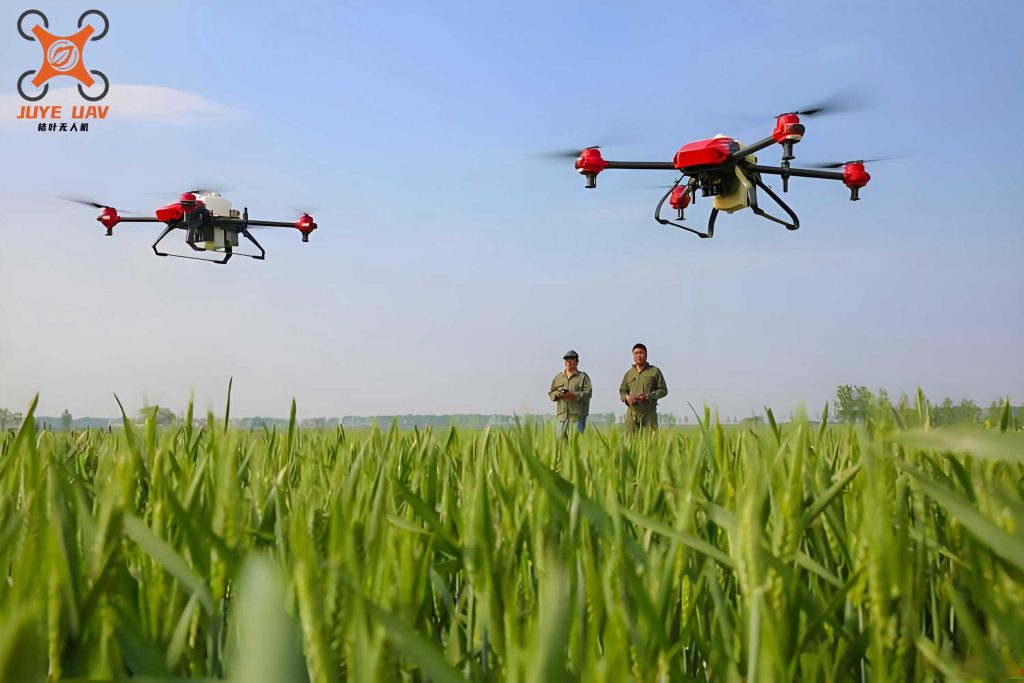
The image above captures a typical agricultural drone in action, hovering over lush green fields, symbolizing the fusion of technology and nature. It embodies the promise of this technology. However, despite its clear advantages, the journey to ubiquitous adoption of the agricultural drone is fraught with significant hurdles, which I have categorized into regulatory, technical, and socio-economic domains.
Regulatory and Management Ambiguity: One of the most pressing issues is the lack of a clear, unified regulatory framework. The operation of an agricultural drone straddles multiple jurisdictions—aviation (civil aviation authorities), agriculture (ministries of agriculture), and industrial standards (quality inspection bodies). This creates a fragmented governance landscape. There is an urgent need for standardized regulations specific to the agricultural drone concerning airspace access, pilot licensing, operational safety, and maintenance protocols. The current practice of applying general aviation rules to the agricultural drone is often mismatched due to the distinct low-altitude, low-speed, and repetitive nature of farm operations.
Technical Limitations and Core Technology Gaps: While the basic platform of the agricultural drone is mature, several core technological challenges persist. First is the limited intelligent obstacle avoidance. Most current agricultural drones rely on pre-programmed GPS waypoints and lack real-time, adaptive sensing to avoid dynamic obstacles like trees, poles, or birds. Advanced systems using LiDAR or stereo vision are costly. Second, energy density and battery life remain a bottleneck. The endurance of a typical agricultural drone is constrained by battery technology, often limiting flight times to 20-30 minutes per charge. This necessitates multiple battery swaps, reducing effective field time. The energy constraint can be modeled by the power balance equation:
$$ P_{\text{total}} = P_{\text{lift}} + P_{\text{avionics}} + P_{\text{spray}} $$
$$ E_{\text{battery}} = P_{\text{total}} \times T_{\text{flight}} $$
Where \( P_{\text{lift}} \) is the power for lift and propulsion, a major consumer. Increasing \( E_{\text{battery}} \) without drastically increasing weight is a key R&D goal for the agricultural drone industry.
Third, precision application technology needs refinement. The interaction between spray droplets, airflow from rotors, and plant canopy is complex. Drift mitigation and canopy penetration require better nozzle designs, variable rate application (VRA) systems, and understanding of droplet dynamics. The deposition efficiency \( \eta_d \) can be expressed as:
$$ \eta_d = \frac{M_{\text{deposited on target}}}{M_{\text{sprayed}}} $$
Factors affecting \( \eta_d \) include wind speed, droplet size spectrum (governed by nozzle type and pressure), and release height. Optimizing these for different crops is an ongoing research area for agricultural drone technology.
Promotion and Adoption Barriers: Beyond technology, the human and economic factors are daunting. There is a acute shortage of skilled operators who can not only pilot the agricultural drone but also perform basic maintenance, troubleshoot issues, and interpret agronomic data collected by the drones. Training programs are often inadequate or inaccessible. Furthermore, the high initial capital cost of a professional-grade agricultural drone creates a significant barrier for smallholder farmers, who constitute a large proportion of the agricultural sector globally. There is also a natural resistance to change and a lack of trust in new technology among farming communities. Demonstrating the tangible, reliable benefits of the agricultural drone requires extensive, localized trial and demonstration projects, which are resource-intensive.
To systematically address these challenges and accelerate the promotion of agricultural drone plant protection technology, a multi-pronged, coordinated strategy is essential. The following table outlines a comprehensive action plan:
| Challenge Domain | Proposed Solution | Key Actions & Stakeholders |
|---|---|---|
| Regulatory Framework | Establish a clear, integrated legal and standard system for agricultural drones. |
|
| Technical Innovation | Substantially increase R&D investment in core technologies. |
|
| Promotion & Demonstration | Implement large-scale, localized trial and demonstration networks. |
|
| Agricultural Integration | Foster deep integration of agricultural drone technology with agronomic practices (农机农艺融合). |
|
| Economic & Business Models | Develop sustainable business and service models to lower adoption barriers. |
|
The success of these measures hinges on collaboration. Governments must provide the regulatory sandbox and initial push. The private sector, including agricultural drone manufacturers and service providers, must drive innovation and affordability. Research institutions need to bridge the gap between laboratory advances and field-ready solutions. Most importantly, farmers must be engaged as co-developers and primary beneficiaries.
Looking forward, the evolution of the agricultural drone is intertwined with broader trends like the Internet of Things (IoT), big data, and artificial intelligence. Future agricultural drones will likely operate as swarms, communicating with each other and with ground sensors to perform tasks with unprecedented coordination. Predictive analytics will enable proactive plant protection, where the agricultural drone is dispatched based on disease forecasting models. The economic impact can be projected using diffusion of innovation models, such as the Bass Model, which forecasts the adoption rate of a new technology over time:
$$ \frac{dN(t)}{dt} = p \times (M – N(t)) + q \times \frac{N(t)}{M} \times (M – N(t)) $$
Here, \( N(t) \) is the cumulative number of adopters (e.g., farms using agricultural drones) by time \( t \), \( M \) is the total market potential, \( p \) is the coefficient of innovation (external influence like advertising/policy), and \( q \) is the coefficient of imitation (internal influence through word-of-mouth). Strategic promotion aims to increase both \( p \) and \( q \) for the agricultural drone.
Furthermore, the environmental benefits of widespread agricultural drone use are immense. By enabling precise application, it reduces the total chemical load on ecosystems, protecting biodiversity and water quality. The reduction in fuel consumption compared to tractor-mounted sprayers also lowers the carbon footprint of farming. This aligns the agricultural drone with global sustainable development goals.
In conclusion, the accelerated promotion and application of agricultural drone plant protection technology is not just desirable but imperative for building a resilient, productive, and sustainable agricultural future. The path involves navigating complex regulatory landscapes, breaking through technological ceilings, and winning the trust of the farming community through demonstrable results. As an advocate for this technology, I am convinced that with concerted effort from all stakeholders, the agricultural drone will soon cease to be a novelty and become as fundamental to farming as the tractor once was. The journey of every agricultural drone flying over a field is a step towards that future—a future where technology nurtures the land efficiently and responsibly.