
The continuous advancement of precision agriculture demands more efficient and effective crop protection methods. Among these, the use of agricultural drones, or unmanned aerial vehicles (UAVs), has seen exponential growth. Their ability to perform rapid, targeted spraying operations in challenging terrain offers a significant advantage over traditional ground-based machinery. However, the efficacy of these operations hinges critically on the deposition characteristics of the sprayed droplets. Factors such as the drone’s downwash, forward flight speed, environmental crosswinds, and even its changing payload during a spray mission can dramatically alter where droplets land, impacting both application efficiency and the risk of off-target drift. This study presents a comprehensive investigation into these factors for a specific class of high-capacity machinery: heavy-lift, tandem-rotor, oil-powered agricultural drones. Our primary objective was to develop and validate a Computational Fluid Dynamics (CFD) methodology using ANSYS Fluent to model and predict droplet deposition patterns, thereby providing a powerful tool for optimizing the design and operational parameters of these sophisticated agricultural drones.
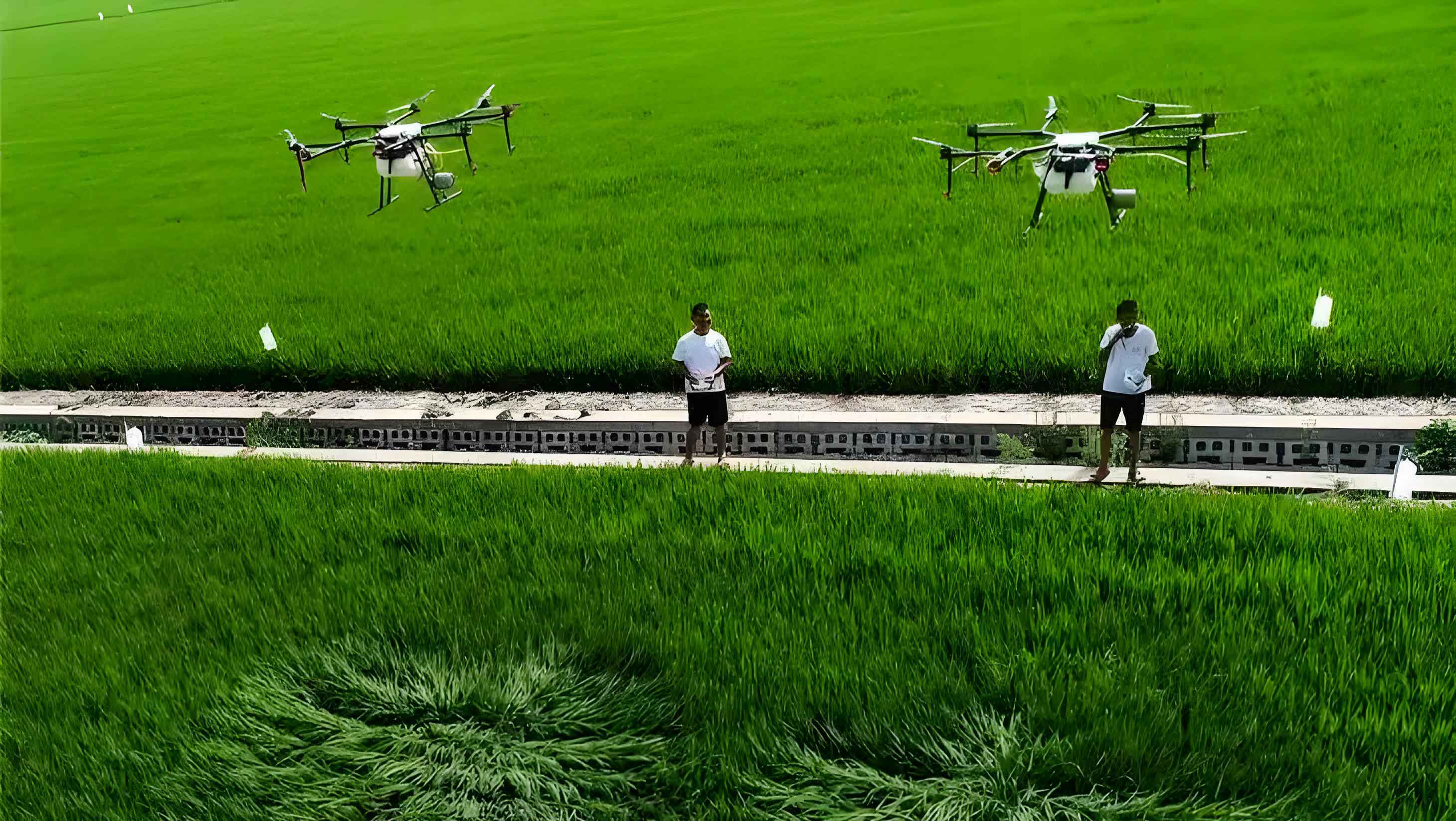
The core of our methodology rests on the synergistic combination of field measurements and high-fidelity numerical simulation. We selected a specific model, a tandem-rotor agricultural drone with a maximum payload capacity of 135 kg, as our research platform. This choice is significant; heavy-lift agricultural drones offer longer endurance and greater coverage per sortie compared to their smaller electric counterparts, making them increasingly vital for large-scale farming operations. The first phase involved rigorous field data collection. We measured the three-dimensional velocity field (X, Y, and Z components) beneath the rotors of the hovering drone using digital anemometers positioned at strategic points along the spray boom. Crucially, these measurements were taken throughout a complete spraying cycle, from a fully loaded state to a near-empty state, capturing the dynamic change in the downwash as fuel and pesticide weight diminished. This real-world data served as the critical boundary condition and validation basis for our subsequent simulations.
Computational Framework and Mathematical Modeling
To simulate the complex multiphase flow of air and pesticide droplets, we established a computational framework within ANSYS Fluent. The air (continuous phase) flow was modeled using the Reynolds-Averaged Navier-Stokes (RANS) equations with the standard k-ε turbulence model. This approach provides a computationally efficient yet accurate representation of the turbulent flow field generated by the rotors and encountered during flight. The governing transport equations for turbulent kinetic energy (k) and its dissipation rate (ε) are:
$$\frac{\partial (\rho k)}{\partial t} + \frac{\partial (\rho k u_i)}{\partial x_i} = \frac{\partial}{\partial x_j} \left[ \left( \mu + \frac{\mu_t}{\sigma_k} \right) \frac{\partial k}{\partial x_j} \right] + G_k + G_b – \rho \varepsilon – Y_M + S_k$$
$$\frac{\partial (\rho \varepsilon)}{\partial t} + \frac{\partial (\rho \varepsilon u_i)}{\partial x_i} = \frac{\partial}{\partial x_j} \left[ \left( \mu + \frac{\mu_t}{\sigma_\varepsilon} \right) \frac{\partial \varepsilon}{\partial x_j} \right] + C_{1\varepsilon} \frac{\varepsilon}{k} (G_k + C_{3\varepsilon} G_b) – C_{2\varepsilon} \rho \frac{\varepsilon^2}{k} + S_\varepsilon$$
where $\rho$ is the fluid density, $u_i$ is the velocity component, $\mu$ is the molecular viscosity, $\mu_t$ is the turbulent viscosity, $G_k$ and $G_b$ represent the generation of turbulence kinetic energy due to mean velocity gradients and buoyancy, respectively, $Y_M$ represents the contribution of fluctuating dilatation, and $C_{1\varepsilon}$, $C_{2\varepsilon}$, $C_{3\varepsilon}$, $\sigma_k$, $\sigma_\varepsilon$ are model constants.
The discrete pesticide droplets (disperse phase) were tracked using a Lagrangian particle tracking scheme, specifically the Discrete Phase Model (DPM). The trajectory of each droplet is calculated by integrating the force balance equation on the particle, which in its general form includes forces due to drag, gravity, and virtual mass. The primary equation of motion is:
$$\frac{d\mathbf{u}_p}{dt} = \mathbf{F}_D + \frac{\mathbf{g}(\rho_p – \rho)}{\rho_p} + \mathbf{F}_{\text{other}}$$
Here, $\mathbf{u}_p$ is the droplet velocity, $\rho_p$ is the droplet density, $\mathbf{g}$ is gravitational acceleration, and $\mathbf{F}_{\text{other}}$ can include additional forces like virtual mass or pressure gradient. The drag force $\mathbf{F}_D$ is the most significant for small droplets in an airstream and is given by:
$$\mathbf{F}_D = \frac{18 \mu}{\rho_p d_p^2} \frac{C_D Re}{24} (\mathbf{u} – \mathbf{u}_p)$$
where $d_p$ is the droplet diameter, $\mathbf{u}$ is the fluid velocity, $Re$ is the relative Reynolds number, and $C_D$ is the drag coefficient, typically obtained from empirical correlations.
To accurately model the potential breakup of larger droplets as they exit the nozzle and encounter high shear in the airstream, we employed the Taylor Analogy Breakup (TAB) model. This model analogizes droplet oscillation and distortion to a spring-mass system, where the restoring force is surface tension and the damping force is liquid viscosity. The governing equation for the droplet’s dimensionless distortion $y$ is:
$$\frac{d^2 y}{dt^2} = \frac{C_F \rho_g u_{rel}^2}{\rho_l r^2} – \frac{C_k \sigma}{\rho_l r^3} y – \frac{C_d \mu_l}{\rho_l r^2} \frac{dy}{dt}$$
The terms on the right-hand side represent the aerodynamic forcing, surface tension restoring force, and viscous damping force, respectively. Breakup occurs when the distortion $y$ exceeds a critical value.
Wind Field Characterization and Simulation Setup
The measured wind field data was processed to generate functional profiles for the downwash velocity. We observed that the vertical (Z-direction) velocity component was the most significant and showed a measurable, though not drastic, decrease as the payload reduced. The lateral (X and Y) components were smaller and more stochastic due to environmental interference. This processed data was implemented into the CFD model via User-Defined Functions (UDFs) to define a velocity inlet boundary condition at the top of the domain, accurately representing the rotor downwash profile. The computational domain was a large rectangular volume (5m x 5m x 8m) discretized with a high-quality structured hexahedral mesh containing over 7 million cells. The flat-fan nozzles were modeled using Fluent’s built-in atomizer model, with parameters (flow rate, spray angle, etc.) set to match the physical spray system used on the agricultural drone. The setup is summarized in the table below.
| Component | Parameter / Setting |
|---|---|
| Drone Type | Tandem-rotor, oil-powered agricultural drone |
| Max Payload | 135 kg |
| Computational Domain | 5m (L) x 5m (W) x 8m (H) |
| Mesh Type & Count | Structured Hexahedral, ~7.02 million |
| Continuous Phase Model | RANS, k-ε turbulence |
| Disperse Phase Model | Lagrangian DPM with TAB breakup |
| Nozzle Model | Flat-Fan Atomizer (8 nozzles on a boom) |
| Boundary Conditions | Velocity Inlet (top w/ UDF), Pressure Outlets (sides), Wall (ground) |
Parametric Study on Droplet Deposition
Using the validated base model (hovering, full payload), we systematically investigated the influence of three key operational parameters: forward flight speed, crosswind speed, and drone payload. Each parameter was varied independently while monitoring the resulting droplet deposition density on the ground, segmented into bins parallel and perpendicular to the flight direction.
1. Influence of Forward Flight Speed: We simulated flight speeds of 2 m/s, 5 m/s, and 10 m/s. The deposition patterns revealed that lower speeds (2-5 m/s) promoted excellent droplet penetration and uniform deposition across the swath. At 10 m/s, the deposition profile became sharply peaked, with droplets concentrating in a narrower band and showing significantly reduced penetration and increased downwind drift. This indicates that for this heavy-lift agricultural drone, optimal uniformity is achieved at moderate flight speeds.
2. Influence of Crosswind: Simulating crosswinds of 2 m/s, 5 m/s, and 10 m/s during a 2 m/s forward flight showed a dramatic effect. Crosswind was the most influential parameter on drift. Even a 2 m/s crosswind began to skew the deposition pattern. At 5 m/s and 10 m/s, the downwind displacement of the entire spray cloud became severe, drastically reducing efficacy on the target and increasing off-target risk. The table below contrasts the deposition without external flow to a scenario with crosswind, showing the strong lateral displacement.
| Distance from Nozzle (mm) | Deposition % (No External Flow) | Relative Deposition Trend (With 5 m/s Crosswind) |
|---|---|---|
| 0 – 250 | 17.93% | Severely reduced on upwind side |
| 250 – 500 | 35.04% | Peak shifts downwind |
| 500 – 750 | 26.73% | Broad, skewed distribution |
| 750 – 1000 | 14.18% | Extended downwind tail |
| 1000 – 1250 | 5.01% | Significant downwind drift |
3. Influence of Payload: Perhaps the most operationally insightful finding was related to the changing payload. Simulations comparing full, half, and empty payload conditions (with constant 2 m/s flight speed) showed remarkably stable deposition characteristics. Although the downwash velocity decreased slightly with weight, the combined effect on droplet trajectories was minimal. The penetration and drift profile remained largely consistent throughout the spraying mission. This is a highly desirable characteristic for a practical agricultural drone, as it means spray quality does not degrade from the start to the end of a sortie.
Field Validation and Synthesis of Findings
To ground-truth our simulations, we conducted controlled field trials. The agricultural drone was flown at 2 m/s over a test area with water-sensitive papers placed at different canopy heights (top, middle, lower) on tree stands. Trials were conducted both at full payload and near-empty payload. The scanned deposition results from these papers were analyzed and compared. The field data confirmed the key simulation prediction: the change in deposition pattern between full and empty load states was negligible, with a maximum variation of only 0.20% in deposition share between canopy layers. This strong agreement validates the fidelity of our CFD model and its underlying assumptions.
The integrated results from simulation and experiment allow us to draw robust conclusions. Firstly, the developed CFD methodology using Fluent is a viable and accurate tool for studying the complex deposition dynamics of agricultural drone spraying systems. It can effectively decouple and analyze the influence of individual parameters that are difficult to isolate in field tests. Secondly, for the specific heavy-lift tandem-rotor agricultural drone studied, we characterize its operational envelope: it maintains excellent and consistent spray deposition at forward speeds up to approximately 5 m/s and can tolerate crosswinds up to about 2 m/s without significant performance degradation. Crucially, its spray performance is robust to payload changes, a major practical advantage. The parameter influence hierarchy is clearly: Crosswind > Flight Speed > Payload.
Conclusion and Future Perspectives
This research successfully demonstrates a complete workflow for analyzing agricultural drone spray deposition, from field measurement to CFD simulation and experimental validation. The findings provide actionable insights for operators and manufacturers of heavy-lift agricultural drones. Operators can use these guidelines on flight speed and crosswind limits to plan more effective and environmentally responsible spraying missions. For manufacturers, the CFD model serves as a virtual testbed for optimizing future designs, such as exploring different nozzle types, boom configurations, or even rotor designs to enhance deposition efficiency and further reduce drift.
Future work will focus on increasing the model’s realism and predictive scope. The next logical step is to incorporate a porous media model or a detailed geometric model to simulate crop canopies (e.g., rice, wheat, or orchard trees). This will allow us to study canopy penetration and leaf-level deposition in silico. Furthermore, more advanced turbulence models like Large Eddy Simulation (LES) could be explored to capture transient vortical structures in the rotor wake with higher fidelity. Finally, establishing generalized “threshold” curves for a wider range of agricultural drone configurations—plotting maximum allowable crosswind against flight speed for acceptable drift—would be an invaluable tool for the precision agriculture industry. The continued refinement of such simulation-driven approaches is key to unlocking the full potential of agricultural drones as a sustainable and precise crop protection technology.