
In recent years, the explosive growth of civilian drones has revolutionized various industries, from delivery services to agricultural monitoring. However, this rapid adoption has also led to frequent incidents of unauthorized flights, often referred to as “black flights,” which have caused significant disruptions to aviation safety, including flight delays at airports and threats to passenger security. These events have raised serious concerns about privacy and public safety, sparking heated discussions on how to effectively manage civilian drones. As a researcher in this field, I believe that addressing these challenges requires an innovative approach that balances regulation with technological advancement. In this article, I propose an integrated management mode for civilian drones, based on multi-dimensional frameworks, to resolve flight conflicts and spectrum interference, enhance management efficiency, better serve consumers, and promote industrial development.
The proliferation of “black flight” incidents highlights the urgent need for robust management systems. With the increasing maturity of drone technology and the surge in consumer-grade models, negative issues such as违规违法飞行 have become rampant. These activities severely interfere with航空飞行安全, endanger lives, facilitate criminal acts, invade public privacy, and jeopardize national security. In response, authorities like the Civil Aviation Administration of China have implemented detailed regulations, and joint enforcement by multiple departments has led to a significant decline in such incidents. However, this has also created a management dilemma where strict controls stifle innovation, while lax oversight leads to chaos. The complexity of drone systems, their diverse applications, and the involvement of numerous stakeholders—from研发机构 to individual users—make执法难度大. Moreover, there is a shortage of personnel with the necessary无线电专业技术和法律素养 for effective monitoring. Cumbersome application processes further reduce consumer usage and hinder the growth of the domestic civilian drone market. Thus, traditional management methods are inadequate, failing to provide a positive user experience or support the manufacturing sector.
To overcome these challenges, I have developed an integrated management mode for civilian drones, structured around three key dimensions: lifecycle, classification and grading, and application objects. This approach aims to cover the entire lifecycle of drones, from研发 to报废, while accommodating their diverse technical configurations and wide-ranging uses. By mapping the分级分类 and application object dimensions onto the lifecycle维度, we can create a comprehensive framework that includes seven management standards:研发, 注册, 鉴定, 制造, 流通, 运行, and 报废. This allows for tailored policies that leverage standards to guide and规范新兴行业发展, fostering coordination between national, industry, group, and enterprise management standards.
The lifecycle management focuses on a chain of value-creating activities, emphasizing their interconnections and positive interactions. For classification, civilian drones are graded into micro, light, small, and large categories based on operational characteristics. From an application perspective, they are categorized into agriculture, power, security, surveying, and other uses. This multi-dimensional approach enables a more nuanced and effective management system. To illustrate, consider the following table summarizing the classification and grading system:
| Grade | Weight Range (kg) | Typical Applications | Management Level |
|---|---|---|---|
| Micro | < 0.25 | Recreation, Photography | Basic Regulation |
| Light | 0.25 – 7 | Delivery, Inspection | Standardized Control |
| Small | 7 – 25 | Agriculture, Mapping | Enhanced Oversight |
| Large | > 25 | Cargo, Surveillance | Strict Licensing |
This grading helps tailor regulations to the risk and impact of不同类别 civilian drones, ensuring that管理措施 are proportional and effective. Furthermore, the application object dimension allows for specialized standards; for example, agricultural civilian drones might have different频谱需求 compared to those used in security.
The integrated management mode的目标 is to meet consumer needs, support government监管, and drive industrial growth. Through顶层设计, it offers管理者 an高效, 全面, 合理, 智能, and轻松的管理模式, while providing consumers with a “free”飞行体验 that encourages合规操作. A key component is the establishment of a覆盖全生命周期的管理标准体系, supported by a民用无人机产业数据中心 and跨部门数据融合. These technological手段 enable administrators to gain a comprehensive understanding of the civilian drone industry, make informed decisions using大数据智能化, and facilitate multi-departmental collaboration. For instance, the U-Cloud system, approved for trial operation in 2016, represents a初步 step toward integrated management. This dynamic big data云系统 manages flight data for large numbers of civilian drones, leveraging the “互联网 +” trend to extend互联网 into low-altitude监管领域.
To quantify management efficiency, we can use a formula that incorporates key factors such as regulatory compliance and technological adoption. Let $E_m$ represent management efficiency, defined as: $$E_m = \alpha \cdot C + \beta \cdot T + \gamma \cdot I$$ where $C$ is the compliance rate of civilian drones, $T$ is the technological integration score, $I$ is the interoperability index between systems, and $\alpha$, $\beta$, $\gamma$ are weighting coefficients summing to 1. This model helps assess the effectiveness of the integrated approach over time.
In terms of technical手段,合理的无线电频谱管理 is crucial for the sustainable development of civilian drones. Due to their high data transmission requirements and bandwidth consumption, the spectrum resources available for civilian drones are becoming increasingly strained. To avoid frequency conflicts and reduce监管难度, spectrum planning should prioritize promoting drone technology while meeting无线电管理需求. This involves assessing future spectrum needs and倾斜向高频方向, particularly Ku and Ka bands for卫星固定业务, to accommodate massive data传输. A spectrum demand model can be expressed as: $$D_{total} = \sum_{i=1}^{n} N_i \cdot B_i \cdot U_i$$ where $D_{total}$ is the total spectrum demand, $N_i$ is the number of civilian drones in category $i$, $B_i$ is the average bandwidth per drone, and $U_i$ is the utilization factor. This formula underscores the need for dynamic spectrum allocation systems.
Moreover, exploring low-altitude数字化创新应用 is essential. For example, the 2016 5G drone trial by Ericsson and China Mobile demonstrated that civilian drones can coexist with mobile networks, sharing base station resources and enabling real-time data integration into cloud databases. This allows regulators to monitor civilian drones closely,结合民航政策法规 and电子围栏 for执法. It also offers services like flight plan approval, weather queries, and insurance purchases.低空数字化应用 not only enhances监管 but also promotes空域合理利用, generating significant economic value. Therefore, we should investigate the integration of civilian drones with低空移动通信网络, develop 4G+5G infrastructure, and advance网联无人机 applications to ensure和谐共存 with civil aviation.
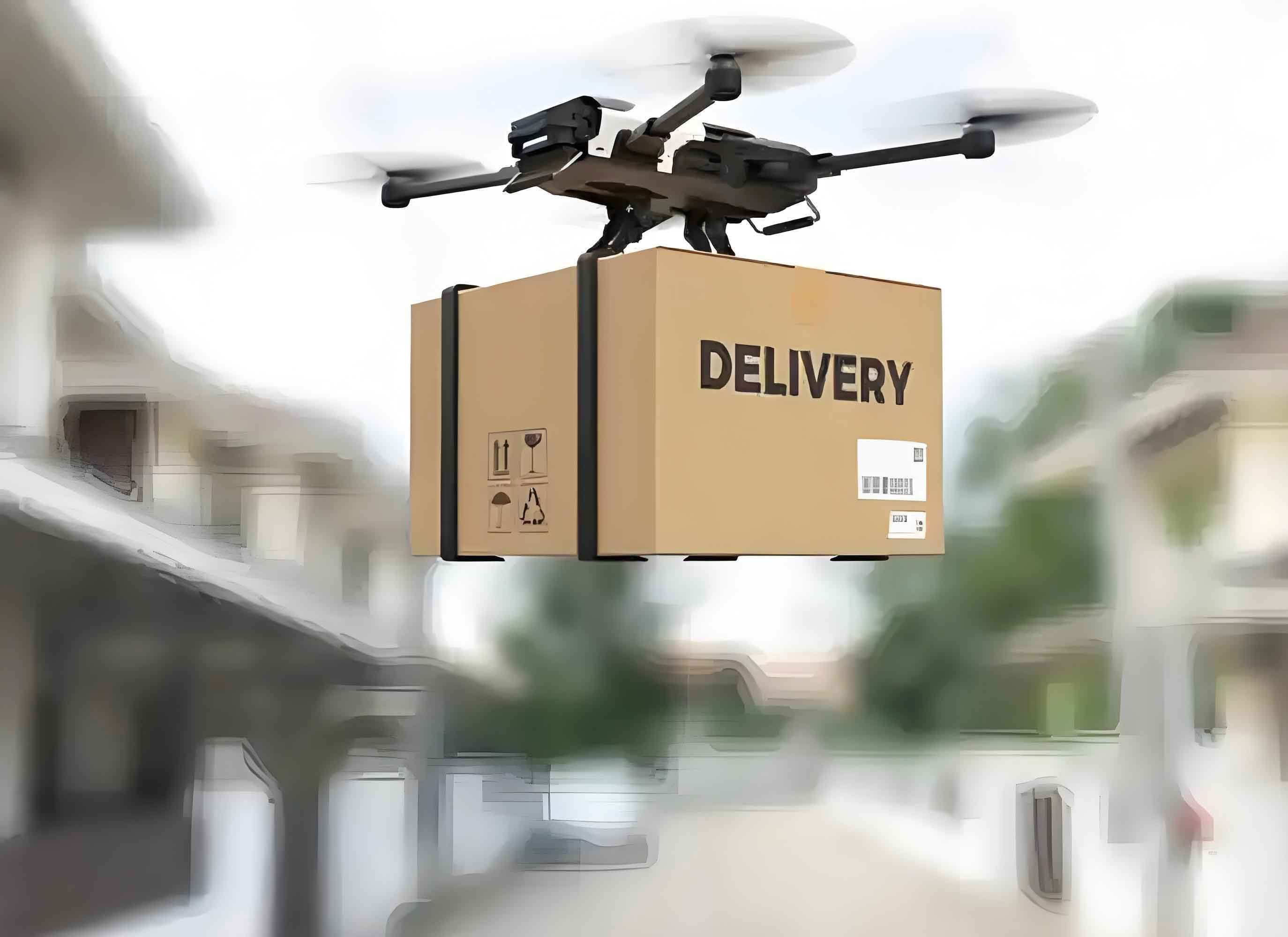
This image illustrates a delivery drone in action, showcasing how civilian drones are being utilized in logistics—a key application area that benefits from integrated management and频谱规划 to ensure safe and efficient operations.
Another critical aspect is developing更兼容的无人机空中管制方案. As military and civilian drones proliferate, they challenge the existing air traffic control格局 dominated by manned aircraft. To ensure that civilian drones can use airspace合理 without compromising safety, they must be integrated into a unified空管系统. This requires隔离运行 with some混合飞行, supported by regulations such as适航标准 for civilian drones and pilot licensing.从技术方面, investing in传感器空投 and高性能计算 can equip civilian drones with “感知与规避” capabilities. A conflict probability model in shared airspace can be described by: $$P_c = 1 – e^{-\lambda \cdot \rho \cdot t}$$ where $P_c$ is the probability of conflict, $\lambda$ is the arrival rate of civilian drones, $\rho$ is the airspace density, and $t$ is the time interval. This highlights the importance of advanced sensing technologies for collision avoidance.
The integrated management mode also involves standardized protocols across the lifecycle. The following table outlines the七类管理标准 mapped from the dimensions:
| Lifecycle Stage | Management Focus | Key Standards | Applicable to Civilian Drones Grade |
|---|---|---|---|
| 研发 (R&D) | Innovation Safety | Technical Specifications | All |
| 注册 (Registration) | Ownership Tracking | Digital ID Systems | Light, Small, Large |
| 鉴定 (Certification) | Airworthiness | Performance Tests | Small, Large |
| 制造 (Manufacturing) | Quality Control | Production Norms | All |
| 流通 (Circulation) | Market Oversight | Sales Regulations | All |
| 运行 (Operation) | Flight Safety | Operational Rules | All |
| 报废 (Disposal) | Environmental Impact | Recycling Protocols | Large |
This structured approach ensures that every phase of a civilian drone’s existence is governed by appropriate standards, reducing risks and enhancing overall system reliability. Additionally, the integration of大数据智能化 allows for real-time monitoring and adaptive policies. For instance, the U-Cloud system can analyze flight patterns of civilian drones to predict potential conflicts and automatically enforce电子围栏 restrictions.
In the realm of无线电频谱管理, we must also consider频谱共享技术 to optimize resource use. A spectrum efficiency metric for civilian drones can be defined as: $$\eta = \frac{R_{data}}{B \cdot P_{tx}}$$ where $\eta$ is the spectral efficiency in bits/sec/Hz/W, $R_{data}$ is the data rate, $B$ is the bandwidth, and $P_{tx}$ is the transmission power. Improving $\eta$ through advanced modulation schemes and dynamic spectrum access is vital for accommodating more civilian drones without interference. Furthermore, international collaboration on高频技术应用 can accelerate innovation, fostering a “产、学、研、用” ecosystem that boosts the competitiveness of civilian drone industries.
When it comes to空中管制方案, the integration of civilian drones requires sophisticated coordination mechanisms. One approach is to use geofencing based on real-time data, where无人机飞行空域 is dynamically allocated using algorithms that consider manned aircraft trajectories. A control law for autonomous navigation of civilian drones can be expressed as: $$\mathbf{u}(t) = -K \cdot (\mathbf{x}(t) – \mathbf{x}_{ref}(t)) + \mathbf{u}_{avoid}(t)$$ where $\mathbf{u}(t)$ is the control input, $K$ is a gain matrix, $\mathbf{x}(t)$ is the drone’s state vector, $\mathbf{x}_{ref}(t)$ is the reference trajectory, and $\mathbf{u}_{avoid}(t)$ is an avoidance term derived from sensor data. This ensures that civilian drones can operate safely in shared空域 while responding to obstacles.
The economic implications of effective management are profound. By streamlining processes for civilian drones, we can unlock new business models, such as drone-based delivery services that reduce costs and improve efficiency. A cost-benefit analysis for deploying civilian drones in agriculture might involve: $$CBA = \sum_{t=0}^{T} \frac{B_t – C_t}{(1 + r)^t}$$ where $CBA$ is the net present value, $B_t$ are benefits like increased crop yield, $C_t$ are costs including频谱许可 fees, $r$ is the discount rate, and $T$ is the time horizon. Positive outcomes depend on reliable management frameworks that minimize regulatory burdens.
Looking ahead, the integrated management mode for civilian drones must evolve with technological advancements. The rise of人工智能 and物联网 will enable even smarter监管 systems, where civilian drones autonomously comply with rules through machine learning algorithms. For example, predictive maintenance for civilian drones can be modeled using: $$P_{fail}(t) = 1 – \exp\left(-\int_0^t \lambda(\tau) d\tau\right)$$ where $P_{fail}(t)$ is the probability of failure by time $t$, and $\lambda(\tau)$ is the hazard function based on usage data. This proactive approach enhances safety and reduces downtime for civilian drones in critical applications like power line inspection.
In conclusion, addressing the飞行冲突及频谱干扰 caused by civilian drones demands innovative管理理念 and手段. The integrated management mode, built on lifecycle, classification, and application object dimensions, provides a robust framework. Supported by合理的无线电管理和更兼容的空中管制方案, it enables智能化产业管理, delivers a舒适的用户体验 for consumers, and promotes健康有序发展 of the civilian drone sector. By embracing these strategies, we can放飞中国“智造”梦想 and ensure that civilian drones展翅高飞 in a safe and sustainable manner. The journey toward harmonious skies filled with civilian drones is complex, but with collaborative efforts and continuous refinement of standards, we can achieve a balance between innovation and regulation, ultimately benefiting society as a whole.