
In recent years, formation drone light shows have gained immense popularity for entertainment, advertising, and artistic performances, where hundreds or thousands of drones are synchronized to create dazzling aerial displays. As the complexity of these shows increases, with intricate patterns and real-time adaptations, there is a growing need for robust simulation systems to design, test, and optimize performances before actual deployment. Traditional simulation approaches often fall short in handling the distributed and interactive nature of large-scale drone swarms, leading to challenges in coordination, communication, and visualization. To address this, I propose a distributed simulation framework based on the High Level Architecture (HLA) and Run-Time Infrastructure (RTI), which enables scalable, reusable, and interoperable simulation of formation drone light shows. This system allows for real-time monitoring, data analysis, and iterative improvement of drone performances, ensuring flawless execution in live events. By leveraging HLA/RTI, we can create a virtual environment where multiple drone simulators interact seamlessly, mimicking the behavior of actual drones in a light show. In this article, I detail the design and implementation of this framework, emphasizing its application to formation drone light show simulations, with a focus on system requirements, architectural components, and performance evaluation. Throughout, I will highlight the keyword “formation drone light show” to underscore its relevance in modern simulation technology.
The core idea behind this simulation system is to model each drone as an independent entity within a distributed network, coordinating their movements and lighting effects through HLA/RTI. This approach not only enhances realism but also reduces costs by virtualizing rehearsals and troubleshooting. The system framework integrates 3D visualization tools like Creator and Vega Prime for immersive visual feedback, while RTI serves as the communication backbone for real-time data exchange. As I explore this framework, I will incorporate tables and mathematical formulas to summarize key aspects, such as drone kinematics and communication protocols. Additionally, to illustrate the visual impact of such simulations, I include an image depicting a drone formation in action, which aligns with the theme of formation drone light shows. This image, embedded below, showcases the potential of these displays and underscores the importance of accurate simulation.
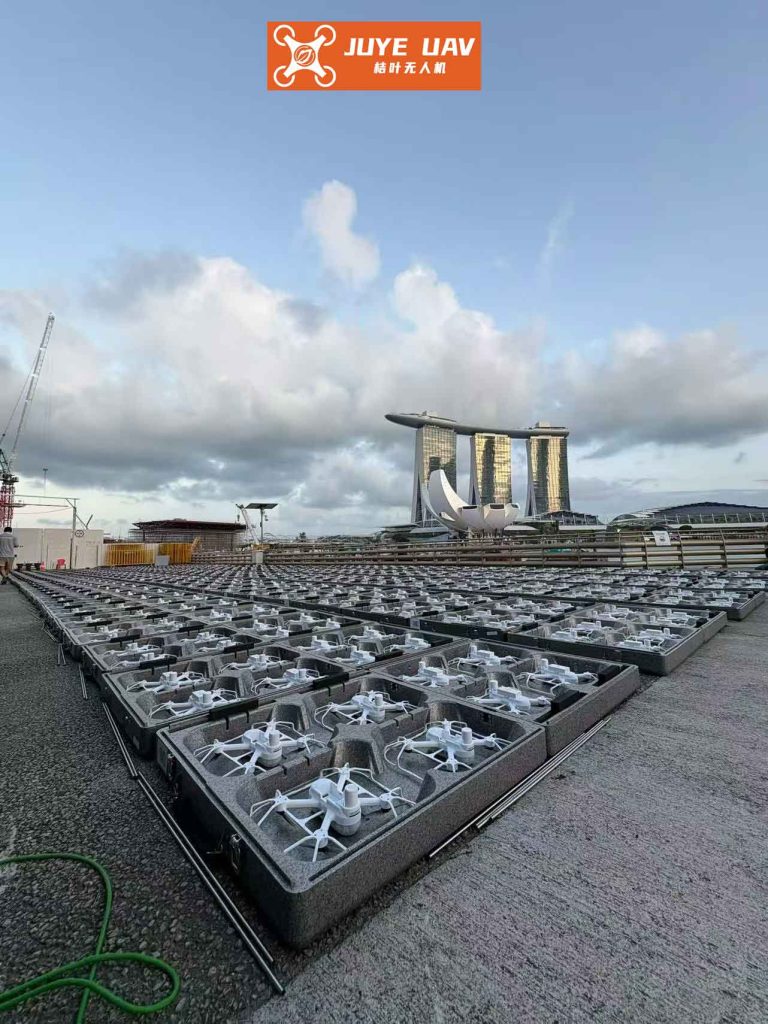
The demand for formation drone light shows has surged in events like Olympics ceremonies, concert interludes, and corporate promotions, where precise choreography is essential. These shows involve drones flying in intricate patterns while emitting colored lights, often synchronized to music or narrative sequences. However, orchestrating such performances manually is error-prone and resource-intensive, necessitating a simulation platform that can predict and refine drone behaviors. Our simulation system aims to fulfill this by providing a virtual testing ground where show designers can experiment with different formations, lighting schemes, and flight paths. The system requirements stem from the need for real-time interaction, scalability to hundreds of drones, and high-fidelity visual representation. For instance, designers must adjust drone positions dynamically to avoid collisions or optimize visual effects, which requires low-latency communication among simulated drones. Moreover, the system should log performance data for post-analysis, allowing designers to tweak parameters and enhance the overall impact of the formation drone light show. In this context, HLA/RTI offers a proven framework for distributed simulation, enabling multiple federates (e.g., drone simulators, visualizers, and controllers) to interact through a standardized interface. This facilitates reuse of components across different shows and ensures interoperability with existing simulation tools.
Based on these requirements, I designed the simulation system with several key functionalities. First, it supports the creation and management of multiple drone entities, each with attributes like position, velocity, orientation, and light color. Second, it includes a manager federate that issues commands, such as formation changes or lighting sequences, to coordinate the overall formation drone light show. Third, a data collector federate captures real-time performance metrics, storing them in a database for later analysis. Fourth, a 3D visualizer federate renders the drone show in a virtual environment, providing a realistic preview for designers. This modular design, built on HLA, allows each component to be developed and tested independently, promoting flexibility and scalability. The following table summarizes the primary federates and their roles in the simulation system for a formation drone light show:
| Federate Name | Role | Key Functions |
|---|---|---|
| Drone Simulator | Models individual drone behavior | Updates position, velocity, and light effects; responds to commands |
| Manager | Coordinates the entire show | Sends formation patterns, lighting schedules, and emergency overrides |
| Data Collector | Logs performance data | Records drone states, communication latency, and error rates |
| 3D Visualizer | Renders the show visually | Displays drone movements and light effects in real-time; supports multiple viewpoints |
| Audience Simulator | Evaluates visual impact | Analyzes light intensity and pattern clarity from spectator perspectives |
To achieve these functionalities, the system relies on the HLA/RTI framework, which provides a standardized approach for distributed simulation. HLA, developed by the defense modeling community, emphasizes reusability and interoperability through a common architecture. RTI implements the HLA interface specification, serving as middleware that handles communication among federates. In our formation drone light show simulation, RTI acts as the glue that binds drone simulators, managers, and visualizers, enabling them to exchange data without direct coupling. This decoupling allows for easy integration of new components, such as a weather simulator to test show resilience under wind conditions. The HLA framework follows a federated model, where each simulation entity is a federate that publishes and subscribes to data via RTI. For example, a drone simulator federate might publish its current position and subscribe to formation commands from the manager. This publish-subscribe pattern ensures efficient data flow and reduces network overhead, which is critical for real-time applications like a formation drone light show. The overall system architecture, inspired by the original flight simulation design, is adapted here for entertainment purposes, focusing on visual synchronization rather than combat scenarios. Below, I outline the HLA-based design process, tailored for formation drone light shows.
The development of this simulation system follows the Federation Development and Execution Process (FEDEP) model, a standardized workflow for HLA-based simulations. This process includes steps like defining federation objectives, developing conceptual models, designing the federation, creating federation object models (FOM), and implementing federates. For our formation drone light show, the primary objective is to simulate and optimize aerial displays with multiple drones, ensuring smooth transitions and stunning visual effects. The conceptual model involves drones as active objects that interact through light signals and positional adjustments. In the design phase, I identified key federates and their interactions, such as how drones communicate to maintain formation spacing or how lighting changes propagate through the swarm. The FOM defines the shared data structures, including object classes for drones and interaction classes for commands. A snippet of the FOM for a formation drone light show might include attributes like drone ID, RGB color values, and spatial coordinates, as well as interactions for changing formation patterns. Mathematically, we can model drone movement using kinematic equations. For instance, the position of a drone i at time t can be expressed as:
$$ \vec{p}_i(t) = \vec{p}_i(0) + \int_0^t \vec{v}_i(\tau) \, d\tau $$
where \(\vec{p}_i(t)\) is the position vector, and \(\vec{v}_i(t)\) is the velocity vector, which might be controlled by formation algorithms. Similarly, the light intensity \(I\) for a drone can be modeled as a function of color channels and time, such as:
$$ I(t) = \alpha \cdot \sin(\omega t + \phi) + \beta $$
where \(\alpha\), \(\omega\), \(\phi\), and \(\beta\) are parameters for amplitude, frequency, phase, and baseline intensity, respectively, allowing for dynamic lighting effects in a formation drone light show. These formulas help simulate realistic behaviors that are crucial for accurate previews.
In the federation design, I specified the federates and their publish/subscribe relationships. For a formation drone light show, the drone simulator federates publish their state information (e.g., position, color) and subscribe to command interactions from the manager. The manager federate publishes formation updates and subscribes to status reports from drones. The data collector subscribes to all relevant data for logging, while the 3D visualizer subscribes to state information for rendering. This design ensures that all components are synchronized through RTI. The table below illustrates the publish/subscribe matrix for key object and interaction classes in a formation drone light show simulation:
| Class Type | Class Name | Publisher Federates | Subscriber Federates |
|---|---|---|---|
| Object Class | DroneState | Drone Simulator | Manager, Data Collector, 3D Visualizer |
| Interaction Class | FormationCommand | Manager | Drone Simulator |
| Interaction Class | LightingEffect | Manager | Drone Simulator, 3D Visualizer |
| Object Class | ShowPerformance | Data Collector | Manager (for monitoring) |
The FED file, which encapsulates the FOM, is critical for RTI to manage data exchange. For our formation drone light show, the FED file defines classes like DroneState with attributes such as latitude, longitude, altitude, and RGB color values, and interactions like FormationCommand with parameters for pattern type and transition speed. Here is a simplified excerpt tailored for a formation drone light show simulation:
(objects
  (class ObjectRoot reliable timestamp
    (class RTIprivate reliable timestamp)
    (class DroneState best-effort receive
      (attribute droneID)
      (attribute positionX)
      (attribute positionY)
      (attribute positionZ)
      (attribute colorRed)
      (attribute colorGreen)
      (attribute colorBlue)
      (attribute brightness)
    )
  )
)
(interactions
  (class InteractionRoot reliable timestamp
    (class RTIprivate reliable timestamp)
    (class FormationCommand best-effort receive
      (parameter patternID)
      (parameter transitionTime)
      (parameter urgencyLevel)
    )
    (class LightingEffect best-effort receive
      (parameter effectType)
      (parameter duration)
      (parameter syncTime)
    )
  )
)
This FED file ensures that all federates adhere to the same data format, enabling seamless interaction in the formation drone light show simulation. By modifying this file, we can easily extend the system to include new attributes, such as battery levels or weather effects, enhancing the simulation’s realism for complex drone shows.
The RTI software environment, specifically RTI 1.3-NG, serves as the backbone for our simulation. RTI 1.3-NG implements the HLA 1.3 interface specification, providing services like federation management, object management, and time management. It consists of components like RtiExec (for global federation execution), FedExec (for individual federation executions), and LibRTI (the library that federates link to). In our formation drone light show system, each federate uses LibRTI to communicate with RTI, which routes messages based on the FED file. This setup decouples the simulation logic from network concerns, allowing developers to focus on drone behavior and visual effects. For instance, when a manager federate sends a formation change command, RTI ensures that all subscribed drone simulators receive it with minimal latency, crucial for maintaining synchronization in a live formation drone light show. The RTI environment also supports time management services, which we can use to synchronize simulation time across federates, ensuring that lighting effects and movements are coordinated accurately. This is particularly important for a formation drone light show, where millisecond precision can impact visual harmony.
Each federate in the system follows a standardized execution flow to interact with RTI. The flowchart below outlines the typical runtime process for a federate, such as a drone simulator in a formation drone light show:
- Initialize the federate and join the federation execution via RTI.
- Publish and subscribe to relevant object and interaction classes as per the FED file.
- Enter the main simulation loop:
- Update internal state (e.g., compute new drone position based on kinematics).
- Send updates by publishing object attributes or sending interactions through RTI.
- Receive incoming data from RTI (e.g., commands from manager).
- Process received data and adjust behavior accordingly (e.g., change formation or lighting).
- Repeat the loop until the simulation ends, then resign from the federation and clean up.
This flow ensures that all federates operate in harmony, enabling real-time simulation of a formation drone light show. For example, a drone simulator might use the following kinematic model to update its position based on formation commands. Suppose the drone needs to move from point A to point B in a straight line for a formation drone light show transition. The velocity vector can be computed as:
$$ \vec{v} = \frac{\vec{p}_B – \vec{p}_A}{\Delta t} $$
where \(\vec{p}_A\) and \(\vec{p}_B\) are position vectors, and \(\Delta t\) is the allowed transition time. This simple model can be extended with acceleration constraints for realism. Additionally, for lighting effects, the color transition might follow a linear interpolation:
$$ C(t) = C_{\text{start}} + (C_{\text{end}} – C_{\text{start}}) \cdot \frac{t}{\Delta t} $$
where \(C(t)\) is the color vector at time \(t\), and \(C_{\text{start}}\) and \(C_{\text{end}}\) are start and end colors. These formulas, integrated into federate logic, help create smooth animations in the formation drone light show simulation.
To enhance the system’s utility, I incorporated a database module for storing simulation data. This allows designers to analyze past performances of formation drone light shows, identify issues like lag or misalignment, and refine parameters. For instance, by querying logged positions, one can compute the deviation from intended paths and adjust control algorithms. The database, implemented with SQL Server, tables include DroneStates (with timestamp, drone ID, attributes) and ShowEvents (with command types and execution times). This historical data is invaluable for improving the reliability and visual appeal of future formation drone light shows. Moreover, the 3D visualizer federate, built with Multigen Creator and Vega Prime, provides a immersive view of the simulation. It subscribes to DroneState objects and renders drones as 3D models with dynamic lights, offering a realistic preview. The visualizer can also simulate audience perspectives, helping designers assess the show from different angles—a key aspect of a successful formation drone light show. The integration of HLA/RTI with these tools creates a cohesive platform that bridges design and execution.
In conclusion, the proposed HLA/RTI-based simulation framework offers a robust solution for designing and testing formation drone light shows. By leveraging distributed simulation principles, it enables scalable, real-time coordination of multiple drones, with features for command issuance, data logging, and 3D visualization. The use of HLA promotes reusability and interoperability, allowing components to be repurposed for different shows or integrated with other simulation systems. Mathematical models for drone kinematics and lighting effects enhance the accuracy of simulations, while tables and FED files provide clear structure for data exchange. This system not only reduces the cost and risk of live rehearsals but also empowers designers to innovate with complex patterns and effects for formation drone light shows. Future work could extend the framework to include physical drone interfaces, enabling hardware-in-the-loop testing, or incorporate AI algorithms for autonomous formation adjustments. As drone technology evolves, such simulation systems will become indispensable for crafting mesmerizing aerial displays that captivate audiences worldwide.
Throughout this article, I have emphasized the application to formation drone light shows, highlighting how HLA/RTI can transform the design process. The framework’s flexibility allows it to adapt to various show requirements, from small corporate events to large-scale public spectacles. By simulating every aspect—from flight paths to light synchronization—designers can ensure flawless performances, making the formation drone light show a reliable and stunning art form. The embedded image earlier in this article visually reinforces the potential of these displays, underscoring the importance of accurate simulation in achieving such feats. As I continue to refine this system, I aim to incorporate more advanced features, such as crowd simulation for impact assessment or energy consumption models for sustainability analysis. Ultimately, this work contributes to the growing field of entertainment technology, where simulation plays a pivotal role in bringing creative visions to life in formation drone light shows.