
The proliferation of unmanned aerial vehicles (UAVs), particularly within China, has introduced transformative capabilities across sectors such as aerial photography, logistics, and infrastructure inspection. Concurrently, the rise of unauthorized or “black flight” operations has precipitated significant security concerns, especially near sensitive locations like petrochemical terminals, airports, and critical port infrastructure. To counter these threats, regulatory mandates, including China’s “Notification on Promoting UAV Defense Work for Key Anti-Terrorism Targets” and the standard “Petroleum and Petrochemical System Public Security and Anti-Terrorism Protection Requirements” (GA 1551.1-2019), have compelled the installation of UAV countermeasure, or drone suppression, systems around such vital areas.
While these China UAV drone countermeasure systems are indispensable for perimeter security, their operational side effects pose a serious, unintended risk to maritime safety. A significant number of deployed systems utilize high transmission power and broad frequency coverage, leading to pervasive radio frequency interference. A critical victim of this interference is the Global Navigation Satellite System (GNSS), primarily the Global Positioning System (GPS), upon which modern vessel navigation equipment fundamentally relies. This paper, through the analysis of documented interference events and the application of radio propagation theory, systematically investigates the mechanisms and range of impact these systems have on shipborne navigation. It further proposes targeted technical and regulatory measures, concluding that prudent control of transmitter power and strategic optimization of installation height are paramount for mitigating interference and safeguarding waterborne traffic. The insights herein provide a theoretical foundation and practical reference for maritime safety authorities, port regulators, and security operators navigating the complex intersection of China UAV drone security and maritime operational integrity.
Fundamentals of Satellite Navigation and Its Maritime Criticality
Working Principles and Frequencies
GPS provides precise three-dimensional position, velocity, and time (PVT) information by employing a constellation of medium Earth orbit satellites. The core principle relies on the receiver calculating its distance from multiple satellites by measuring the time delay of incoming signals. The position is then resolved via trilateration. The system operates on specific carrier frequencies, with the following being most relevant for civilian maritime use:
- L1 Band (1575.42 MHz): The primary civil frequency carrying the Coarse/Acquisition (C/A) code. All GPS satellites broadcast on L1. Its wavelength is approximately 19.03 cm.
- L5 Band (1176.45 MHz): A modernized signal designed for safety-of-life applications, offering higher power and better resistance to interference.
The signal strength upon reaching a terrestrial or maritime receiver is exceptionally weak, typically around -130 dBm, due to the vast transmission distance of over 20,000 km. This inherent weakness renders GNSS signals highly vulnerable to intentional or unintentional radio frequency interference.
Role in Shipborne Navigation Systems
Modern maritime navigation is an integrated suite of devices dependent on accurate positional data. Key systems include:
- GPS Receiver: The primary source of geolocation data.
- Automatic Identification System (AIS): A vessel tracking system that autonomously broadcasts dynamic (position, speed, course) and static (ship name, MMSI) information. Its position data is almost exclusively sourced from the ship’s GPS.
- Electronic Chart Display and Information System (ECDIS): The digital navigation chart system that plots the vessel’s GPS-derived position.
- Radar: Often integrated with GPS/ECDIS for target tracking and chart overlay.
Disruption of the GNSS signal cascades through all these systems. A corrupted GPS signal leads to erroneous AIS position reports, incorrect plotting on ECDIS, and potential failure of integrated navigation functions. Manifestations include “land drift” (where vessels appear on land), wildly inaccurate speed readings, and loss of positional awareness, creating severe hazards for collision avoidance and maritime domain awareness.
UAV Countermeasure Systems: Mechanisms of GPS Interference
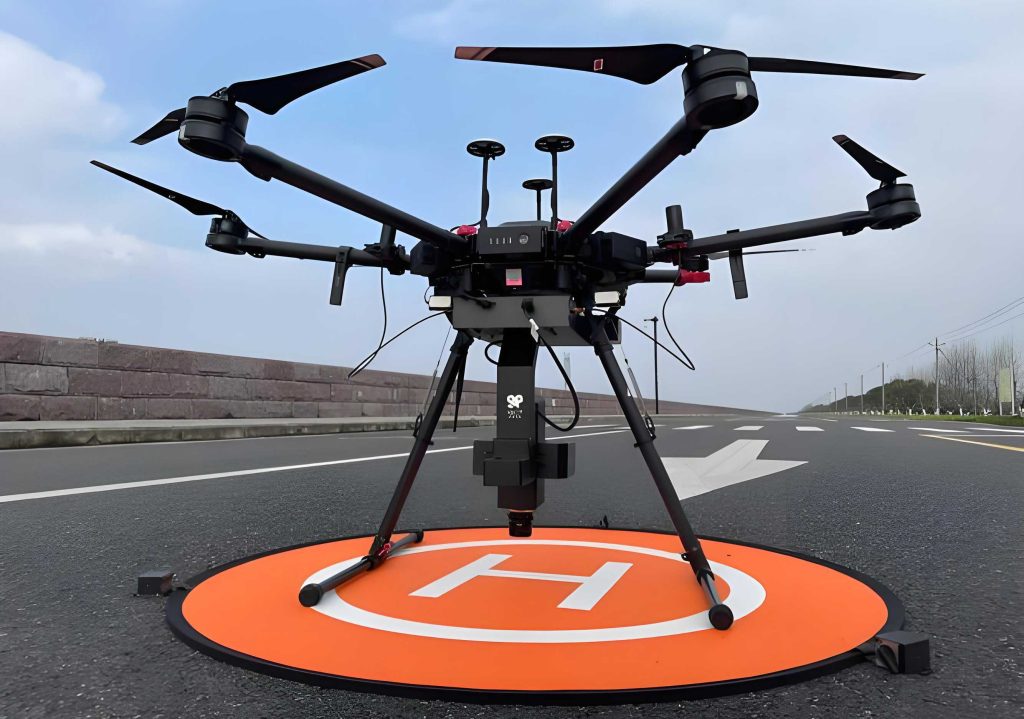
China UAV drone countermeasure systems designed for perimeter defense typically function by emitting disruptive radio signals. Two primary methods affect GNSS, with the first being overwhelmingly more common in practical incidents.
1. Suppression (Jamming) Interference
This is the most prevalent and direct method. The countermeasure device transmits a high-power noise signal across the GNSS frequency bands (e.g., centered on 1575 MHz). This malicious signal raises the noise floor at the victim GPS receiver’s antenna, overwhelming the extremely weak legitimate satellite signals. The receiver’s carrier-to-noise density ratio ($C/N_0$) falls below the tracking threshold, resulting in a loss of lock and no position solution. The technical simplicity and high effectiveness of this method make it a common feature in many commercial China UAV drone defense systems. The jammer’s effective isotropic radiated power (EIRP) directly determines its range of influence.
2. Spoofing Interference
A more sophisticated and insidious method, spoofing involves generating counterfeit GNSS signals that mimic authentic ones. These false signals can manipulate a receiver into calculating an incorrect position or time. While technically challenging to execute reliably, its potential to cause deliberate, misleading navigation errors poses a significant threat. Spoofing is less commonly observed in broad-coverage perimeter defense systems but represents a growing concern.
Case Analysis and Interference Range Modeling
Documented Interference Incidents
Two representative cases underscore the practical impact. In both instances, China UAV drone countermeasure systems installed at coastal industrial facilities were the identified source.
- Case A (Guangdong Port): Multiple vessels reported AIS positions displaying erroneously on land. Investigation traced the source to a UAV suppression system at a nearby petrochemical terminal, transmitting interference near 1575 MHz. AIS functionality normalized immediately after the system was powered down.
- Case B (Guangxi Port): Vessels at anchor were reported via AIS as moving at impossibly high speeds (e.g., 50 knots). The source was identified as a counter-drone system at a shore-based oil depot. Deactivation of the system resolved the anomaly.
These cases confirm a direct causal link and highlight the need for predictive modeling to understand the potential scope of such interference.
Mathematical Modeling of Interference Range
To quantify the impact, we model the scenario using standard radio wave propagation models. We define key parameters:
- Jammer: Transmit Power $P_t$ (W), Antenna Gain $G_t$ (dBi), Installation Height $h_j$ (m).
- Victim GPS Receiver: Acquisition Threshold (minimum $C/N_0$), Antenna Gain $G_r$ (dBi), Installation Height $h_v$ (m).
- Signal: GPS L1 Free-Space Signal Power at Receiver $P_{s}$ ≈ -130 dBm.
- Interference Criterion: Jamming-to-Signal Ratio ($J/S$) at the receiver must exceed a threshold (e.g., 24 dB for C/A code suppression) for effective interference.
The fundamental concept is the link budget. The received jamming power $P_{r,j}$ at a distance $d$ is given by:
$$ P_{r,j}(dBm) = P_t(dBm) + G_t(dBi) + G_r(dBi) – L_p(dB) $$
where $L_p$ is the path loss between the jammer and the victim receiver.
Free-Space Path Loss (FSPL) Model
The simplest model describes loss in an unobstructed line-of-sight (LoS) path:
$$ L_{fs}(dB) = 32.44 + 20\log_{10}(f_{MHz}) + 20\log_{10}(d_{km}) $$
For GPS L1 (1575.42 MHz), this simplifies to:
$$ L_{fs}(dB) = 32.44 + 20\log_{10}(1575.42) + 20\log_{10}(d_{km}) \approx 96.4 + 20\log_{10}(d_{km}) $$
The J/S ratio is then:
$$ J/S (dB) = P_{r,j} – P_{s} = [P_t + G_t + G_r – L_{fs}] – (-130) $$
Setting $J/S$ ≥ $J/S_{th}$ and solving for $d$ gives the theoretical interference range under ideal LoS conditions. However, maritime environments and Earth’s curvature impose critical constraints.
Incorporating Earth Curvature and LoS Limit
Radio waves travel in straight lines. The maximum LoS distance $d_{max}$ between two antennas at heights $h_j$ and $h_v$ (in meters) is determined by the effective Earth radius:
$$ d_{max}(km) \approx 4.12 \times \left( \sqrt{h_j(m)} + \sqrt{h_v(m)} \right) $$
This formula, incorporating a standard atmospheric refraction factor, defines the absolute geometric limit for interference, regardless of transmit power. An interfering signal cannot propagate beyond this radio horizon.
Practical Range Analysis Using an Empirical Model (ITU-R P.526)
For more realistic estimates over sea paths, empirical models like ITU-R P.526 for diffraction propagation are suitable. This model accounts for the sea surface as a spherical, diffracting edge. The path loss $L_{p526}$ is significantly higher than FSPL at distances approaching and beyond the LoS limit. Combining the interference criterion with this loss model allows us to generate realistic interference contours.
The following tables present calculated interference ranges for a typical scenario: a China UAV drone countermeasure system (with antenna gain $G_t = 3$ dBi) interfering with a shipboard GPS receiver ($G_r = 0$ dBi, $P_s = -130$ dBm, $J/S_{th} = 24$ dB). “Severe Radius” indicates where $J/S$ > 24 dB. “Maximum Radius” is the lesser of the distance where $J/S$ falls below threshold or the LoS limit $d_{max}$.
| Jammer Power (Pt) | Severe Interference Radius (km) | Maximum Influence Radius (LoS Limited) (km) | Dominating Factor |
|---|---|---|---|
| 100 W (50 dBm) | 25.8 | 29.7 | LoS Limit (~29.7 km) |
| 10 W (40 dBm) | 18.4 | 22.3 | LoS Limit |
| 1 W (30 dBm) | 12.1 | 14.9 | LoS Limit |
| 100 mW (20 dBm) | 6.0 | 9.6 | Power & Path Loss |
| 10 mW (10 dBm) | 1.9 | 3.3 | Power & Path Loss |
| 1 mW (0 dBm) | 0.6 | 1.0 | Power & Path Loss |
| Jammer Height hj (m) | Ship Antenna Height hv (m) | LoS Limit dmax (km) | Severe Interference Radius (km) | Notes |
|---|---|---|---|---|
| 30 | 10 | 34.1 | 18.4 (LoS Limited) | Higher jammer extends potential range. |
| 15 | 10 | 25.1 | 18.4 (Power Limited) | Range is power-limited, not geometry-limited. |
| 15 | 5 | 22.3 | 14.8 (Power Limited) | Lower victim height reduces effective range. |
| 5 | 10 | 18.1 | 9.5 (Power & LoS Limited) | Lowering jammer height is highly effective. |
The analysis yields critical, actionable insights:
- Power is Paramount at Close Range: For distances within a few kilometers, the jammer’s transmit power is the primary determinant of interference footprint. Reducing power from tens of watts to units of watts or less dramatically shrinks the affected area.
- Geometry is Destiny at Long Range: For powerful jammers, the ultimate interference boundary is the radio horizon ($d_{max}$), governed by the antenna heights. Lowering the jammer’s installation height is the most effective way to curtail its long-range impact.
- Vulnerability is Widespread: Even low-power devices (100 mW) can disrupt GPS for several kilometers, affecting a substantial port area.
Proposed Mitigation and Regulatory Measures
Balancing the security needs of China UAV drone defense with the safety imperative of maritime navigation requires a multi-faceted approach.
Technical Mitigation Strategies
- Strict Power Limitation: The transmit power of perimeter UAV countermeasure systems should be meticulously calibrated to the absolute minimum necessary for covering the protected asset, ideally not exceeding 100 mW for omnidirectional systems. Power should be dynamically adjustable.
- Optimized Antenna Deployment:
- Height Control: Installing jamming antennas at the lowest practical height significantly reduces the LoS range and confines interference.
- Directional Antennas: Replacing omnidirectional antennas with sectorized or directional antennas focused inward on the protected zone minimizes energy radiated over water.
- Advanced Signal Design: Encouraging the development and use of countermeasure systems that employ sophisticated, non-continuous wave signals or target specific UAV control links rather than broadcasting blanket, high-power noise across GNSS bands.
Management and Regulatory Coordination
- Inter-Departmental Coordination Framework: Establishing a permanent coordination mechanism among Maritime Safety, Industry and Information Technology (radio spectrum management), and Public Security authorities is essential. This ensures security needs are met without compromising navigational safety.
- Pre-Deployment Authorization and Modeling: Mandating that any installation of a China UAV drone countermeasure system near waterways undergoes a regulatory review. This review must include a predictive interference analysis (using models as shown above) to assess potential impact on maritime navigation and AIS infrastructure.
- Promotion of Resilient PNT (Positioning, Navigation, and Timing): Encouraging the maritime industry to adopt multi-constellation (GPS, Galileo, GLONASS, and crucially, China’s BeiDou) and multi-frequency GNSS receivers. BeiDou integration provides essential redundancy and can improve overall resilience for vessels operating in China UAV drone defense environments. Furthermore, the adoption of alternative or supplementary PNT sensors (e.g., inertial navigation systems, eLoran where available) should be promoted for critical vessels.
- Monitoring and Enforcement Regime: Implementing periodic spectrum monitoring campaigns in port areas to detect unauthorized or malconfigured emitters. Establishing clear penalties for systems causing harmful interference to safety-related services.
Conclusion
The conflict between terrestrial security and maritime safety, as embodied by China UAV drone countermeasure systems and vessel navigation, is a tangible and growing challenge. Through empirical case review and theoretical propagation modeling, this analysis demonstrates that the interference range of such systems is substantial and can easily extend across port approaches and anchorages. The key determinants are the jammer’s transmit power and its antenna height relative to the victim receiver. Mitigation is not only possible but necessary. A combination of stringent technical controls—specifically, drastic power reduction and lowered antenna deployment—coupled with robust inter-agency coordination and regulatory oversight, forms the cornerstone of a sustainable solution. By implementing these measures, China can effectively safeguard its critical coastal infrastructure from UAV threats while simultaneously ensuring the safety and efficiency of the vital maritime traffic upon which its economy and security equally depend. The path forward requires recognizing that the spectrum is a shared resource where the imperative of navigation safety must be diligently weighed against other security priorities.