
As a firefighting professional deeply involved in modern rescue operations, I have observed firsthand the escalating challenges posed by frequent fire incidents. These disasters not only threaten lives and property but also expose the limitations of traditional methods in hazardous environments. In this context, the integration of fire drone technology has emerged as a game-changer. This article delves into the application of fire drone systems in firefighting and rescue, exploring their capabilities, technical requirements, and future potential. My perspective is shaped by field experiences where these unmanned systems have proven indispensable, offering a blend of safety, efficiency, and data-driven decision-making that was previously unattainable.
The core of a fire drone lies in its compact design and advanced systems. Typically, a fire drone consists of an airframe, power supply, and a flight management and control system, which is the brain ensuring stable operation and real-time data transmission. Standard equipment includes GPS, miniaturized high-definition cameras, and navigation instruments. The advantages are manifold: low operational costs, simple maintenance, ease of operation, and minimal storage space. Crucially, fire drone units can execute missions in dangerous areas or adverse weather conditions, significantly enhancing the safety of rescue personnel. For instance, the ability to deploy a fire drone without risking human lives in volatile fire zones underscores its value. The following table summarizes key components and benefits of a typical fire drone system:
| Component | Description | Benefit in Firefighting |
|---|---|---|
| Flight Management System | Core control unit with processors and sensors | Ensures stable flight and accurate data relay |
| Power System | Battery or hybrid power source | Enables extended mission durations |
| Imaging Modules | HD cameras, thermal sensors, multispectral cameras | Provides real-time visual and thermal data |
| Communication Link | Wireless transmission systems (e.g., LTE, satellite) | Facilitates live streaming to command centers |
| Payload Adaptability | Mounts for additional instruments like gas detectors | Allows customization for specific hazards |
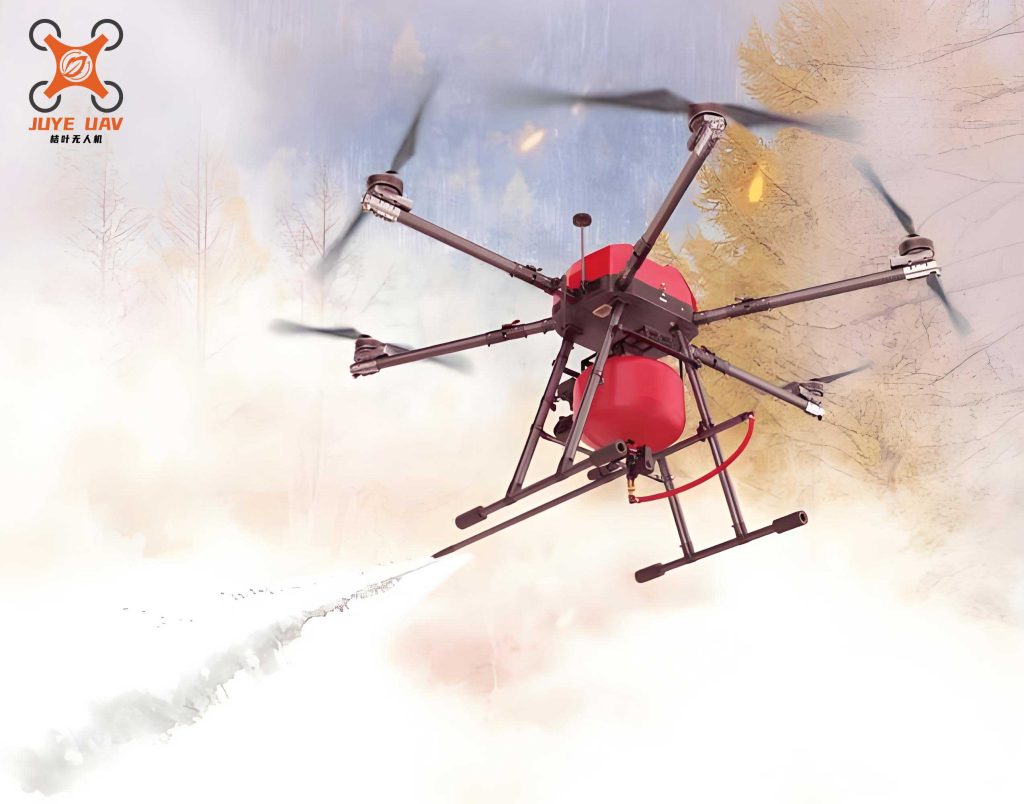
In fire scenarios, the deployment of a fire drone begins with situational awareness. When conditions are too perilous for human entry—such as in chemical fires or collapsing structures—the fire drone can swiftly navigate to the scene. Its agility and small size allow it to bypass obstacles, transmitting live video feeds that reveal fire spread, structural integrity, and potential victims. This capability is quantified through reconnaissance efficiency, which can be modeled using a formula for area coverage rate. For a fire drone flying at velocity \( v \) and equipped with a sensor of field-of-view angle \( \theta \), the area \( A \) scanned over time \( t \) at altitude \( h \) is given by:
$$A = v \cdot t \cdot 2h \cdot \tan\left(\frac{\theta}{2}\right)$$
This equation highlights how a fire drone optimizes侦查 efforts, providing commanders with critical data to plan interventions without endangering teams. Moreover, in specialized incidents like industrial fires, the fire drone can be outfitted with modules for detecting toxic gases or measuring temperature gradients, offering insights that guide hazardous material handling. The table below contrasts traditional scouting methods with fire drone-enhanced approaches:
| Aspect | Traditional Human Scouts | Fire Drone Reconnaissance |
|---|---|---|
| Entry Time | Slower due to safety protocols | Immediate deployment upon arrival |
| Risk Level | High, exposing personnel to dangers | Minimal, as drones operate remotely |
| Data Comprehensiveness | Limited by human perspective and endurance | Comprehensive via aerial views and sensors |
| Adaptability to Hazards | Restricted in toxic or high-heat zones | High, with specialized payloads for extreme conditions |
Beyond initial assessment, fire drone systems excel in continuous information gathering. By integrating various sensors—such as anemometers, thermographic cameras, and volatile organic compound detectors—the fire drone collects multidimensional data. This information is wirelessly transmitted to ground stations, where analysts process it into actionable intelligence. For example, in wildfire management, a fire drone can monitor flame fronts and wind patterns, enabling predictive modeling of fire behavior. The data fusion process can be expressed through a linear combination of sensor inputs \( S_i \) with weights \( w_i \) representing priority:
$$D_{\text{total}} = \sum_{i=1}^{n} w_i S_i$$
where \( D_{\text{total}} \) is the aggregated data value used for decision support. This approach ensures that commanders receive a holistic view of the emergency, facilitating resource allocation and strategic adjustments. In my experience, the real-time feedback from a fire drone has often prevented secondary disasters by identifying hidden hotspots or structural weaknesses before they escalate.
Command and control benefit immensely from fire drone integration. In large-scale incidents like urban fires or natural disasters, coordination is complex. The fire drone serves as an airborne command node, relaying live feeds to mobile command centers and even to individual firefighters via handheld devices. This enhances situational awareness across all levels, moving towards信息化 and modernized指挥. The effectiveness of such systems can be assessed through a reliability metric \( R \), defined as the probability of successful data transmission over mission duration \( T \), considering failure rates \( \lambda \) of components:
$$R(t) = e^{-\lambda t} \quad \text{for} \quad 0 \leq t \leq T$$
Ensuring high \( R(t) \) is crucial for maintaining uninterrupted oversight. Furthermore, fire drone networks can collaborate with other救援 systems, such as ground robots or aerial water-dropping units, creating a synergistic response. The table illustrates how fire drone capabilities enhance指挥调度 across different emergency phases:
| Emergency Phase | Role of Fire Drone | Outcome Enhancement |
|---|---|---|
| Initial Response | Rapid aerial assessment and hazard mapping | Faster deployment of appropriate resources |
| Ongoing Operations | Continuous monitoring of fire dynamics and rescue progress | Real-time战术 adjustments and risk mitigation |
| Post-Incident Analysis | Data logging for forensic investigation and training | Improved preparedness for future events |
To fully harness the potential of fire drone technology, specific technical requirements must be met. These criteria ensure that the drones perform reliably under the strenuous conditions of firefighting. First, reliability is paramount. A fire drone must operate seamlessly alongside other救援 equipment, forming an integrated system. This involves rigorous testing against environmental stressors like high temperatures and electromagnetic interference. The overall system reliability \( R_s \) for a fire drone with \( n \) independent components can be modeled as:
$$R_s = \prod_{i=1}^{n} R_i$$
where \( R_i \) is the reliability of each component. High \( R_s \) values indicate robust performance, essential for mission success. Second,操控性 must be intuitive. Complex controls can hinder operational efficiency, so user interfaces should be simplified without compromising functionality. This involves optimizing control algorithms to minimize latency and ensure precise maneuverability, even in turbulent air currents caused by fires.
Third, stability is critical. A fire drone must maintain flight integrity amid thermal updrafts, smoke, and wind gusts. This can be analyzed through aerodynamic stability coefficients, such as the static margin \( SM \), which influences pitch stability:
$$SM = \frac{x_{cg} – x_{ac}}{\bar{c}}$$
where \( x_{cg} \) is the center of gravity, \( x_{ac} \) is the aerodynamic center, and \( \bar{c} \) is the mean aerodynamic chord. Positive \( SM \) values contribute to inherent stability, allowing the fire drone to resist disturbances. Additionally, thermal protection systems are vital to prevent overheating of electronic components, ensuring continuous operation near flames. Fourth,集成兼容性 enables the fire drone to interface with existing command infrastructure. This includes standardized communication protocols (e.g., MAVLink) and data formats that allow seamless integration with GIS platforms and other救援 tools. The following table outlines key technical specifications for an optimal fire drone:
| Requirement | Technical指标 | Impact on Firefighting |
|---|---|---|
| Reliability | Mean Time Between Failures (MTBF) > 500 hours | Reduces downtime during extended operations |
| Controllability | Latency < 100 ms in control loops | Enables responsive piloting in dynamic environments |
| Stability | Wind resistance up to 15 m/s, operational temperature range of -10°C to 200°C | Ensures functionality in extreme fire conditions |
| Integration | Support for API interfaces with common C2 software | Facilitates data sharing and coordinated responses |
Looking ahead, the role of fire drone technology is expanding beyond firefighting to encompass broader rescue scenarios such as flood disasters, earthquake responses, and high-rise fire suppression. In my work, I have seen fire drone units deployed to assess structural damage after quakes or deliver emergency supplies to isolated areas. The versatility of these systems stems from their modular design, allowing quick reconfiguration for diverse missions. Future advancements may include swarm intelligence, where multiple fire drone units collaborate autonomously to cover vast areas or perform complex tasks like forming communication relays. The efficiency of such swarms can be described by a scaling law where total coverage \( C \) increases with the number of drones \( N \) and their individual capability \( \alpha \):
$$C = \alpha N^{\beta}$$
with \( \beta > 1 \) indicating superlinear benefits from coordination. Moreover, ongoing research into AI-powered analytics will enable fire drone systems to predict fire spread or identify victims through machine learning algorithms, further reducing response times.
In conclusion, the adoption of fire drone systems represents a significant leap forward in emergency response. From enhancing situational awareness to safeguarding personnel, these unmanned platforms have proven their worth in countless operations. As technology evolves, addressing current challenges like battery life and signal interference will unlock even greater potentials. For fire services worldwide, investing in fire drone capabilities is not merely an upgrade but a necessity to meet the growing complexities of modern disasters. Through continued innovation and integration, fire drone technology will undoubtedly become a cornerstone of resilient and effective rescue strategies, saving more lives and protecting communities with unprecedented precision.