
In recent years, the rapid advancement of UAV drone technology has led to its widespread adoption across various sectors such as agriculture, forestry, power grid inspection, mining, and logistics. The use of UAV drones for transportation tasks, in particular, has emerged as a promising application, offering potential efficiencies in delivery and resource movement. However, as UAV drone operations expand, significant challenges arise, especially in complex and dynamic environments. One critical issue is the optimization of transportation routes for medium-sized UAV drones, which must balance factors like flight time, energy consumption, and safety. Traditional route planning methods often fail to achieve optimal paths due to limitations in handling environmental uncertainties, such as airflow disturbances and obstacles. This can result in inefficient routes, increased transport durations, and even mission failures. To address these shortcomings, we propose a novel route planning method for medium-sized UAV drones based on an Improved Quantum Particle Swarm Optimization (IQPSO) algorithm. Our approach integrates real-time UAV drone positioning, sophisticated path encoding, and an enhanced optimization framework to generate shortest and safest routes. This article details our methodology, experimental validation, and results, demonstrating the effectiveness of our IQPSO-based planning in improving UAV drone transportation efficiency and reliability.
The core of our method lies in three interconnected components: UAV drone flight positioning, transportation path information encoding, and optimal route computation using IQPSO. We begin by establishing a precise real-time positioning system for the UAV drone. Consider a operational area of 100 m × 100 m, assumed to be flat and free of major terrain variations. We deploy a wireless sensor network with a node density of 10 to act as positioning anchors. Each sensor node has fixed coordinates, and the UAV drone, equipped with an onboard beacon, communicates with these nodes. The positioning model can be visualized as follows, where R denotes sensor node coordinates, H is the UAV drone flight altitude, r is the maximum communication range, and u and v represent the UAV drone’s heading and velocity, respectively. This setup allows us to treat UAV drone location determination as a discrete positioning problem, enabling continuous tracking during flight.
With the UAV drone positioning framework in place, we proceed to encode possible transportation paths. For a medium-sized UAV drone, a route can involve multiple waypoints, intersections, and delivery stops. We represent each possible path using a specific binary matrix encoding. For instance, a route for a single UAV drone can be encoded as a matrix where rows correspond to customer or node indices and columns represent the service sequence. A sample path matrix V is given by:
$$ V = \begin{bmatrix} 0 & 0 & 1 & 0 & 0 & 1 \\ 0 & 0 & 0 & 0 & 0 & 0 \\ 0 & 0 & 0 & 1 & 0 & 0 \\ 1 & 0 & 0 & 0 & 0 & 0 \\ 0 & 1 & 0 & 0 & 0 & 0 \\ 0 & 0 & 0 & 0 & 1 & 0 \end{bmatrix} $$
In this matrix, a ‘1’ indicates that a particular node is served at a specific order position. To enhance the search process, we incorporate quantum pheromone encoding for nodes that the UAV drone can fly over. This involves associating quantum-inspired information with each path segment, which gets updated based on performance. The pheromone update rule is defined as:
$$ f_i = f (1 – \beta) * \forall $$
Here, $f$ denotes the pheromone evaporation rate, $\beta$ represents the amount of pheromone on a path during optimization, and $\forall$ symbolizes the relative path length or quality. By applying this encoding, we generate an initial population of candidate paths for the UAV drone, each encoded as a quantum-enhanced solution vector. This population serves as the input for our optimization algorithm.
The next step is to compute the optimal route using our Improved Quantum Particle Swarm Optimization algorithm. We first define the objective function for UAV drone route planning. Based on typical UAV drone flight characteristics, we aim to minimize the total transportation time, which is closely related to path length and environmental factors. The objective function $T_r$ is formulated as:
$$ T_r = T \cdot \sum_{p} h*(u) \, d $$
where $T$ is the path width, $p$ represents the slope of ascent or descent along the path, $u$ is the average flight altitude of the UAV drone, $h$ denotes the road or flight direction, and $d$ is the distance component. This function encapsulates key constraints for medium-sized UAV drones, ensuring that routes are not only short but also feasible in terms of climb rates and altitude changes. To optimize this function, we employ IQPSO, which combines principles from quantum mechanics with particle swarm optimization to improve global search capability and convergence speed.
In standard PSO, particles update their positions based on personal and global bests. Our IQPSO introduces a quantum state-inspired update mechanism. The position update for particle $i$ in dimension $d$ at iteration $t+1$ is given by:
$$ x_{i,d}(t+1) = \begin{cases} q_{i,d}(t) – \beta \cdot | m_{i,d}(t) – x_{i,d}(t) | \cdot \ln\left(\frac{1}{u}\right), & \text{if } u > 0.5 \\ q_{i,d}(t) + \beta \cdot | m_{i,d}(t) – x_{i,d}(t) | \cdot \ln\left(\frac{1}{u}\right), & \text{if } u \leq 0.5 \end{cases} $$
Here, $m_{i,d}(t)$ is the particle’s dimension, $x_{i,d}(t)$ is the velocity vector, $q_{i,d}(t)$ is the local attractor or best position, and $u$ is a random number uniformly distributed in [0,1]. The parameter $\beta$, known as the contraction-expansion coefficient, is dynamically adjusted over iterations to balance exploration and exploitation:
$$ \beta = \beta_{max} – \frac{t}{T} (\beta_{max} – \beta_{min}) $$
where $\beta_{max}$ and $\beta_{min}$ are the maximum and minimum values of $\beta$, $t$ is the current iteration, and $T$ is the total number of iterations. This adjustment helps the UAV drone path search avoid local optima. Furthermore, we integrate a penalty coefficient into the objective function to handle constraints such as obstacle avoidance and maximum turning angles. The overall optimization workflow for UAV drone route planning is summarized in the following steps:
- Initialize the IQPSO parameters and generate an initial population of paths encoded as particles.
- Evaluate each particle’s fitness using the objective function $T_r$, incorporating penalties for constraint violations.
- Update personal and global best positions based on fitness.
- Apply the quantum-inspired position update formula to all particles.
- Adjust $\beta$ dynamically and repeat until convergence or maximum iterations.
- Select the global best solution as the optimal UAV drone transportation route.
To elaborate, during each iteration, a path is selected based on a probability derived from the quantum pheromone levels and fitness. The selection probability $m_f$ for a path segment is computed as:
$$ m_f = \frac{V_i}{T_j(g) * a * R_C} F_p F_j $$
where $V_i$ is the particle’s position after $i$ iterations, $T_j$ is an instability parameter, $g$ is a weight factor, $a$ is the set of unvisited nodes, $C$ is a velocity update factor, and $F_p$, $F_j$ are position update factors. This probabilistic selection ensures diversity in the search, allowing the UAV drone to explore various route configurations. The algorithm continues until an optimal or near-optimal path is found, minimizing transportation time and distance for the UAV drone.
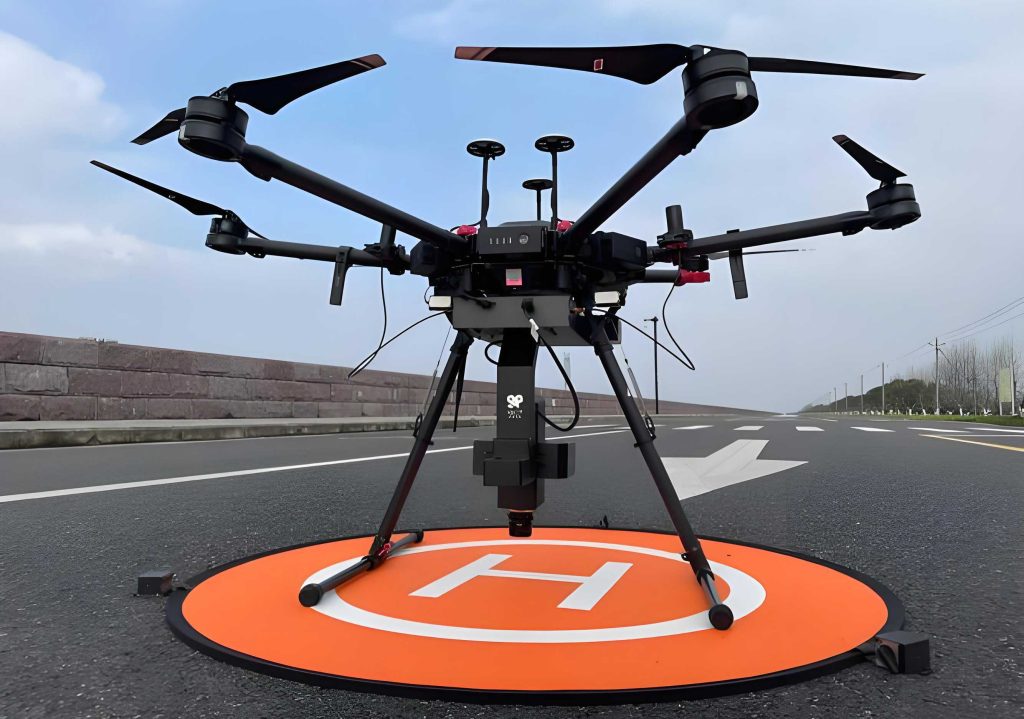
To validate our IQPSO-based UAV drone route planning method, we conducted extensive experiments simulating real-world conditions. The experimental setup involved a medium-sized UAV drone equipped with onboard processing units and ground sensor nodes. Key hardware included Raspberry Pi nodes acting as beacons and anchors, as shown in the image above. The UAV drone operated in AP mode, communicating with ground nodes at a frequency of 5 beacons per second to enable continuous positioning. We tested our method in two challenging environments: one with airflow disturbances and another with static obstacles. The parameters for the algorithm and UAV drone flight are listed in the table below.
| Parameter Category | Parameter | Value |
|---|---|---|
| Algorithm Parameters | Particle Population Size | 100 |
| Particle Dimension | 10 | |
| Maximum Iterations | 50 | |
| Contraction-Expansion Coefficient Upper Bound ($\beta_{max}$) | 0.5 | |
| Contraction-Expansion Coefficient Lower Bound ($\beta_{min}$) | 0.1 | |
| Fitness Function Weights | Weight $f_1$ (Distance) | 0.1 |
| Weight $f_2$ (Time) | 0.3 | |
| Weight $f_3$ (Safety) | 0.7 | |
| UAV Drone Flight Parameters | Path Segments | 20 |
| Maximum Yaw Angle | 30° | |
| Maximum Flight Speed | 3 m/s | |
| Maximum Flight Altitude | 80 m |
We compared our IQPSO method against two traditional approaches: a standard Particle Swarm Optimization (PSO) based method and a location-service based method. In the airflow disturbance environment, our IQPSO-planned route for the UAV drone demonstrated superior performance by effectively avoiding turbulent zones, maintaining stable velocity, and preventing yaw deviations. In contrast, the traditional methods produced paths that were susceptible to airflow, leading to speed reductions and significant yaw errors. This highlights the robustness of our IQPSO algorithm in dynamic conditions for UAV drone navigation.
In the obstacle-rich environment, we placed irregular static obstacles within the flight area. The paths generated by each method were analyzed for length and transportation time. The comparative results are presented in the table below, clearly showing that our IQPSO method achieves the shortest path and fastest transport time for the UAV drone.
| Planning Method | Transportation Time (seconds) | Total Flight Distance (meters) |
|---|---|---|
| Our IQPSO Method | 158 | 453 |
| Standard PSO-Based Method | 204 | 469 |
| Location-Service Based Method | 231 | 531 |
The data indicates that our method reduces transportation time by approximately 22% compared to standard PSO and 32% compared to the location-service method, while also shortening the flight distance. This efficiency gain stems from the IQPSO’s ability to integrate multiple constraints—such as obstacle avoidance and airflow resistance—through adaptive weighting in the fitness function. The UAV drone following our planned route not only avoids collisions but also optimizes speed profiles, resulting in minimal energy consumption and timely deliveries. These experiments confirm that our Improved Quantum Particle Swarm Optimization approach effectively addresses the limitations of traditional UAV drone route planning techniques.
In conclusion, we have developed and validated a novel route planning method for medium-sized UAV drones based on an Improved Quantum Particle Swarm Optimization algorithm. Our method encompasses precise UAV drone positioning, efficient path encoding with quantum pheromones, and a robust optimization process that minimizes transportation time and distance while ensuring safety. Experimental results under both airflow and obstacle environments demonstrate that our IQPSO-based planner generates shorter, faster, and more reliable routes compared to conventional methods, with no yaw deviations observed. This advancement contributes significantly to the field of UAV drone logistics, offering a scalable solution for complex transportation tasks. Future work will focus on enhancing the global search capability of the algorithm, accelerating convergence rates, and extending the method to multi-UAV drone coordination scenarios. We believe that continued refinement of such intelligent planning systems will unlock new potentials for UAV drone applications in delivery, surveillance, and emergency response, driving innovation in autonomous aerial transportation.