
As an enthusiast and practitioner in the field of unmanned aerial systems, I have always been fascinated by the mesmerizing spectacle of formation drone light shows. These shows rely on precise coordination and path planning to create stunning aerial displays, where dozens or even hundreds of drones move in synchrony to form intricate patterns and animations. The core challenge lies in ensuring that each drone follows a safe and efficient trajectory while maintaining tight formation shapes, especially in dynamic environments with obstacles. Traditional methods like the Artificial Potential Field (APF) have been widely used for path planning due to their simplicity and real-time capabilities, but they suffer from critical issues such as target unreachability, local minima, and oscillations—flaws that can disrupt the fluidity and safety of a formation drone light show. In this article, I will delve into an improved APF model that addresses these limitations, making it ideal for orchestrating complex formation drone light shows. Through detailed mathematical formulations, tables, and simulations, I will demonstrate how this approach enables robust path planning and formation control, ensuring that every drone in the show performs flawlessly.
The essence of a formation drone light show is to create visually cohesive patterns where drones act as pixels in the sky. This requires not only artistic design but also rigorous engineering to handle path planning, collision avoidance, and formation keeping. In such shows, drones often fly in tight clusters, mimicking shapes like logos, characters, or dynamic scenes, and any deviation can lead to collisions or broken formations. Thus, the path planning algorithm must account for multiple constraints: avoiding obstacles (e.g., buildings, trees, or other drones), adhering to drone mobility limits (like maximum turn angles), and maintaining relative positions within the formation. The traditional APF method, inspired by physics, uses attractive forces toward goals and repulsive forces from obstacles to guide drones. However, in the context of a formation drone light show, its shortcomings become pronounced. For instance, when a drone approaches a goal near an obstacle, repulsive forces may overpower attraction, preventing the drone from reaching its target—a disaster for a synchronized show. Similarly, local minima can trap drones in dead ends, causing delays or failures, while oscillations in narrow passages lead to erratic movements that ruin the visual harmony. To overcome these, I have developed an enhanced APF framework tailored for formation drone light shows, incorporating modifications that ensure smooth, reliable, and safe operations.
Let me begin by outlining the traditional APF model and its pitfalls. In APF, a drone at position \( q \) in a 2D or 3D space experiences an attractive potential \( U_{att}(q) \) pulling it toward the goal \( G \), and repulsive potentials \( U_{rep}(q) \) pushing it away from obstacles. Typically, these are defined as:
$$U_{att}(q) = \frac{1}{2} k \rho_G^2(q)$$
where \( k \) is a positive gain constant, and \( \rho_G(q) \) is the distance from \( q \) to the goal. The attractive force is the negative gradient:
$$F_{att}(q) = -\nabla U_{att}(q) = k \rho_G(q) \frac{\partial \rho_G(q)}{\partial q}$$
For repulsion, with \( \rho(q) \) as the distance to the nearest obstacle and \( \rho_0 \) as the obstacle’s influence radius, the repulsive potential is:
$$U_{rep}(q) = \begin{cases}
\frac{1}{2} m \left( \frac{1}{\rho(q)} – \frac{1}{\rho_0} \right)^2, & \text{if } \rho(q) \leq \rho_0 \\
0, & \text{if } \rho(q) > \rho_0
\end{cases}$$
where \( m \) is a repulsive gain. The repulsive force is \( F_{rep}(q) = -\nabla U_{rep}(q) \). The total force \( F_{total}(q) = F_{att}(q) + \sum F_{rep}(q) \) guides the drone. However, this model fails in formation drone light shows when goals are close to obstacles, as \( F_{rep} \) can dominate near the goal, making it unreachable. Also, equilibrium points where \( F_{total} = 0 \) but not at the goal create local minima, and oscillations occur in confined spaces. These issues are summarized in Table 1.
| Issue | Description | Impact on Formation Drone Light Show |
|---|---|---|
| Target Unreachability | Repulsive forces near goals prevent drones from reaching target positions. | Disrupts formation patterns, causing gaps or misalignments in the light show. |
| Local Minima | Drones get stuck at points where attractive and repulsive forces balance. | Leads to drones freezing mid-air, breaking the show’s continuity and timing. |
| Oscillations | Drones vibrate in narrow passages due to force imbalances. | Causes shaky movements, reducing visual quality and increasing collision risk. |
To address these, I propose an improved APF model with three key enhancements: a modified repulsive potential field, a random fluctuation method, and an obstacle linking technique. These are specifically designed for the high-precision demands of formation drone light shows.
First, the modified repulsive potential incorporates the distance to the goal \( \rho_G(q) \), ensuring that the goal remains the global minimum of the total potential field. This solves target unreachability. The new repulsive potential is:
$$U_{rep}(q) = \begin{cases}
\frac{1}{2} m \left( \frac{1}{\rho(q)} – \frac{1}{\rho_0} \right)^2 (\rho_G(q))^n, & \text{if } \rho(q) \leq \rho_0 \\
0, & \text{if } \rho(q) > \rho_0
\end{cases}$$
where \( n \) is a positive real number (typically \( n=2 \)). The repulsive force becomes:
$$F_{rep}(q) = -\nabla U_{rep}(q) = F_{rep1}(q) + F_{rep2}(q)$$
with components:
$$F_{rep1}(q) = m \left( \frac{1}{\rho(q)} – \frac{1}{\rho_0} \right) \frac{1}{\rho^2(q)} (\rho_G(q))^n \frac{\partial \rho(q)}{\partial q}$$
and
$$F_{rep2}(q) = -\frac{n}{2} m \left( \frac{1}{\rho(q)} – \frac{1}{\rho_0} \right)^2 (\rho_G(q))^{n-1} \frac{\partial \rho_G(q)}{\partial q}$$
Here, \( F_{rep1} \) points away from the obstacle, and \( F_{rep2} \) points toward the goal, canceling repulsion at the goal. This is crucial for formation drone light shows, where drones must reach exact positions to form shapes, even near stage boundaries or other drones acting as dynamic obstacles.
Second, the random fluctuation method tackles local minima. When a drone’s total force nears zero but it hasn’t reached the goal—common in complex formations—I introduce a small perturbing force \( F_{help} \). Its magnitude is \( w \| F_{att} \| \), with \( w \) as a coefficient, and direction perpendicular to the drone-goal line (following the right-hand rule). This nudges the drone out of stagnant points, allowing it to resume its path. In a formation drone light show, this ensures that no drone gets trapped, maintaining the overall synchronization.
Third, the obstacle linking method resolves oscillations. When drones navigate through tight spaces between obstacles—like in dense formation transitions—they may oscillate due to alternating forces. By linking nearby obstacles into a single enlarged obstacle, I simplify the environment, smoothing the path. For example, in a formation drone light show with many drones close together, treating clusters as linked obstacles reduces computational complexity and prevents jittery motions.
Now, let’s apply this improved APF to formation drone light show path planning. I assume drones fly at constant altitude and speed during the show, with known obstacle positions (e.g., lighting equipment, audience zones). The planning involves two layers: leader path planning and follower formation control, using a leader-follower strategy. For the leader drone, the path is computed step-by-step. Starting from an initial point, it moves under the total force, with checks for maximum turn angle constraints. The step-by-step algorithm is:
- Pre-plan the path and apply obstacle linking to areas prone to oscillations.
- Set up the potential field with gains \( k \), \( m \), influence distance \( \rho_0 \), step length, and start position.
- Compute total force \( F_{total} = F_{att} + \sum F_{rep} \).
- If \( F_{total} = 0 \) but not at goal, add random fluctuation force \( F_{help} \).
- Move to next point \( X_j \) along force direction.
- If turn angle between segments exceeds maximum \( \theta_0 \), adjust \( X_j \) using a smoothing vector.
- Repeat until goal is reached.
The turn angle constraint is vital for formation drone light shows, as drones have limited agility. If the angle between consecutive segments \( a = X_j – X_i \) and \( b = X_k – X_j \) is too large, the midpoint is adjusted to ensure smooth curves. Mathematically, if \( \arccos\left( \frac{a \cdot b}{|a||b|} \right) > \theta_0 \), then:
$$X_j = X_i + l \cdot e$$
where \( e = \frac{X_j + X_k – 2X_i}{|X_j + X_k – 2X_i|} \) is the unit vector toward the centroid, and \( l \) is a step length. This keeps movements fluid, essential for aesthetic formation drone light shows.
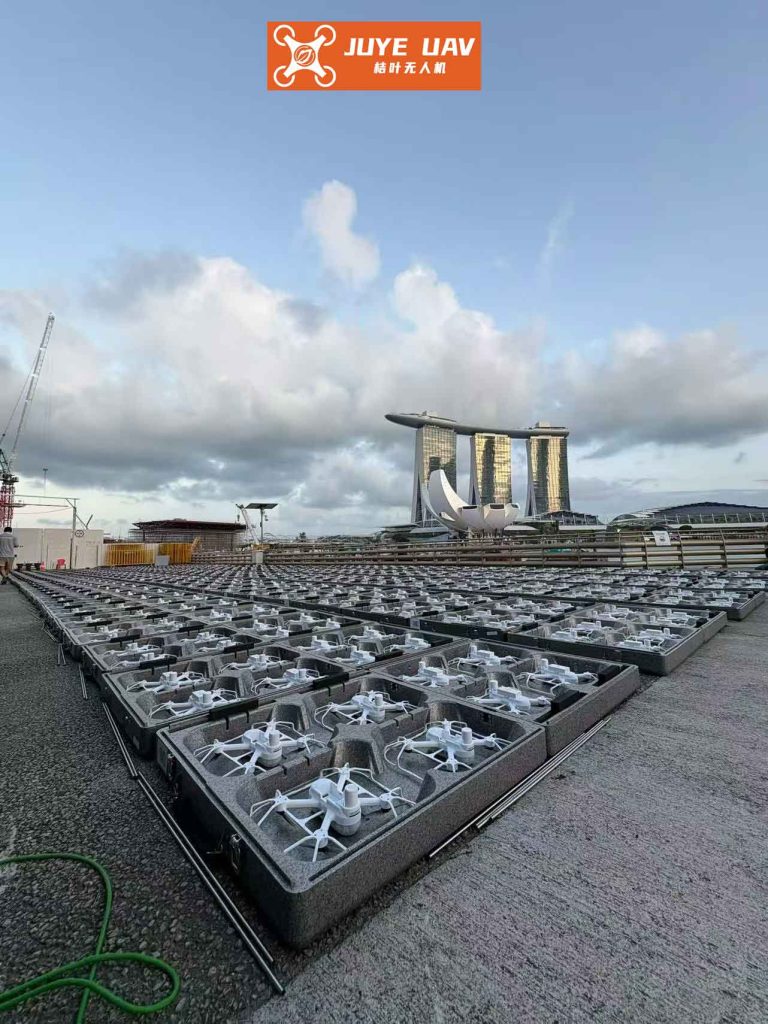
For follower drones in the formation drone light show, I use APF-based formation control. Each follower has a desired position relative to the leader, defined by distance \( l \) and angle \( \phi \). The formation potential \( U_i \) for follower \( i \) at position \( p_i \) with desired position \( p^G_i \) is:
$$U_i = \frac{1}{2} k_f \| p_i – p^G_i \|^2$$
where \( k_f \) is a formation gain. The formation force \( F_i = -\nabla U_i = -k_f (p_i – p^G_i) \) pulls the follower toward its slot. This force is added to the obstacle avoidance forces, ensuring cohesive movement. In a formation drone light show, this allows drones to maintain shapes like grids or circles while avoiding collisions. For multiple followers, interactions are modeled to keep internal spacing: if a drone drifts inside the formation, it’s pushed out, and if outside, it’s pulled in. This dynamic adjustment is key for adaptive shows where formations morph smoothly.
To handle obstacle avoidance in tight formations, I employ an obstacle expansion technique. Since drones in a formation drone light show fly close together, the entire group must avoid obstacles as a unit. I expand obstacles by a radius \( r \) equal to the maximum distance from the leader to any follower, effectively treating the formation as a single entity. This simplifies path planning to a point-mass problem, guaranteeing safe clearance. The expansion is computed as:
$$\rho_{exp}(q) = \rho(q) – r$$
where \( \rho(q) \) is the distance to the obstacle’s original boundary. The modified repulsive potential uses this expanded distance, ensuring all drones stay clear. This is especially useful in urban formation drone light shows where buildings or trees pose risks.
I have tested this improved APF in simulations mimicking formation drone light shows. The environment is a 100 km × 100 km area with artificial obstacles representing typical show hazards. Parameters are tuned for realism: \( k = 1 \), \( m = 1 \), \( \rho_0 = \text{obstacle radius}/2 \), \( w = 1 \), maximum turn angle \( \theta_0 = 45^\circ \), minimum step length \( 0.1 \) km, and formation distances \( l_1 = 2 \) km, \( \phi_1 = 45^\circ \) for follower 1, and \( l_2 = 1 \) km, \( \phi_2 = 30^\circ \) for follower 2. Obstacles are placed at coordinates with radii, as listed in Table 2.
| Obstacle ID | Center (km) | Radius (km) |
|---|---|---|
| 1 | (25, 25) | 7 |
| 2 | (48, 22) | 5 |
| 3 | (50, 29) | 10 |
| 4 | (45, 52) | 8 |
| 5 | (57, 53) | 6 |
| 6 | (80, 65) | 4 |
| 7 | (70, 70) | 5 |
| 8 | (93, 97) | 5 |
The leader’s path, plotted with the improved APF, shows smooth avoidance of all obstacles, even when goals are near obstacles (e.g., obstacle 8). The random fluctuation method prevents local minima, and obstacle linking eliminates oscillations in narrow gaps between obstacles 6 and 7. With turn angle constraints, the path is feasible for real drones, critical for a seamless formation drone light show. Follower drones successfully maintain formation, adjusting positions dynamically around obstacles. After obstacle expansion, the entire formation avoids collisions, as seen in trajectories where followers skirt expanded boundaries without entering danger zones. These results affirm that the improved APF can manage complex scenarios typical in formation drone light shows.
In practice, this approach scales for large formation drone light shows with hundreds of drones. The computational efficiency of APF allows real-time updates, essential for live shows where conditions may change. For instance, if a drone fails or wind disrupts paths, the forces can be recalculated on-the-fly to adapt formations. The mathematical framework is summarized in Table 3, highlighting how each component enhances the formation drone light show.
| Component | Mathematical Formulation | Benefit for Formation Drone Light Show |
|---|---|---|
| Modified Repulsive Potential | $$U_{rep}(q) = \frac{1}{2} m \left( \frac{1}{\rho(q)} – \frac{1}{\rho_0} \right)^2 (\rho_G(q))^n$$ | Ensures drones reach exact target positions for precise pattern formation. |
| Random Fluctuation Method | $$F_{help} = w \| F_{att} \| \text{ (perpendicular direction)}$$ | Prevents drones from stalling, maintaining show continuity. |
| Obstacle Linking | Merge nearby obstacles into single entities. | Reduces oscillations in dense formations for smoother visual effects. |
| Formation Control Potential | $$U_i = \frac{1}{2} k_f \| p_i – p^G_i \|^2$$ | Keeps drones in tight formations, enabling complex shapes and transitions. |
| Obstacle Expansion | $$\rho_{exp}(q) = \rho(q) – r$$ | Guarantees safe clearance for entire drone groups, avoiding collisions. |
The improved APF model also integrates well with show design software. Choreographers can input desired patterns, and the algorithm generates optimal paths for each drone, considering obstacles and dynamics. For example, in a formation drone light show that spells out words or creates animations, the drones’ target positions change rapidly; the modified repulsive potential ensures they hit each waypoint accurately, while formation forces keep the overall shape intact. This synergy between art and technology is what makes modern formation drone light shows so captivating.
Looking ahead, further enhancements could include 3D potential fields for altitude variations in formation drone light shows, or machine learning to predict obstacle movements in outdoor shows. The core principles, however, remain rooted in this improved APF framework. By addressing traditional APF flaws, I have created a robust tool that elevates the reliability and creativity of formation drone light shows, allowing for more ambitious displays in crowded skies.
In conclusion, the improved Artificial Potential Field method presented here offers a comprehensive solution for path planning in formation drone light shows. Through modified repulsive potentials, random fluctuations, and obstacle linking, it overcomes target unreachability, local minima, and oscillations—key issues that can mar a show. Combined with formation control and obstacle expansion, it ensures drones move safely and synchronously, forming intricate patterns without collision. Simulations validate its effectiveness, demonstrating smooth trajectories and adaptive formations. As formation drone light shows grow in popularity and complexity, such advanced algorithms become indispensable for turning artistic visions into aerial realities. I believe this approach will empower show designers to push boundaries, creating ever more stunning formation drone light shows that dazzle audiences worldwide.