
In recent years, the coordination and control of multi-drone systems have garnered significant attention due to their vast applications in surveillance, search and rescue, environmental monitoring, and military operations. A critical challenge in deploying drone formations in dynamic environments is ensuring safe and efficient obstacle avoidance while maintaining formation integrity. Traditional artificial potential field (APF) methods, though widely used for their simplicity and real-time applicability, often suffer from local minima issues, where drones may become trapped in equilibrium positions when forces from obstacles and targets balance. This paper addresses this limitation by proposing a novel composite vector artificial potential field approach for drone formation obstacle avoidance in three-dimensional space. Based on a virtual structure and leader-follower control strategy, our method enables a drone formation to track moving targets and avoid obstacles optimally, ensuring robustness and stability. We focus on a formation of three drones with a virtual leader, simplifying obstacles as cylinders surrounded by spherical potential fields. The attractive forces guide the virtual leader toward the target, while repulsive forces manage inter-drone spacing and obstacle avoidance, allowing followers to distribute evenly on a spherical surface around the leader without specific order requirements. Through extensive simulations, we validate the effectiveness of our approach in achieving smooth, optimal paths for drone formation navigation. This work contributes to advancing autonomous drone swarm capabilities by enhancing obstacle avoidance strategies in complex scenarios.
The core of our methodology lies in integrating a composite vector artificial potential field that combines two orthogonal rotational vector fields—parallel to the x-y plane and y-z plane—to eliminate local minima and enable optimal path planning. The drone formation, comprising three follower drones and one virtual leader, operates in a 3D space where obstacles are modeled as cylindrical objects with enveloping ellipsoidal potential fields. We begin by detailing the drone dynamics model, followed by the control laws for formation keeping and obstacle avoidance. Tables and formulas are extensively used to summarize key parameters and equations, ensuring clarity and reproducibility. For instance, the drone’s kinematic model is linearized for control design, and the composite forces are derived to balance attraction and repulsion. The proposed algorithm allows each drone in the formation to select an optimal avoidance path, reconfigure into a triangular formation post-obstacle, and maintain high stability during maneuvers. In the following sections, we elaborate on the problem formulation, control design, obstacle avoidance strategies, and simulation results, highlighting the superiority of our method over conventional APF techniques.
To visualize the drone formation structure, consider the following representation of a typical triangular arrangement in 3D space, which illustrates the concept of virtual leader and follower dynamics essential for our control strategy:
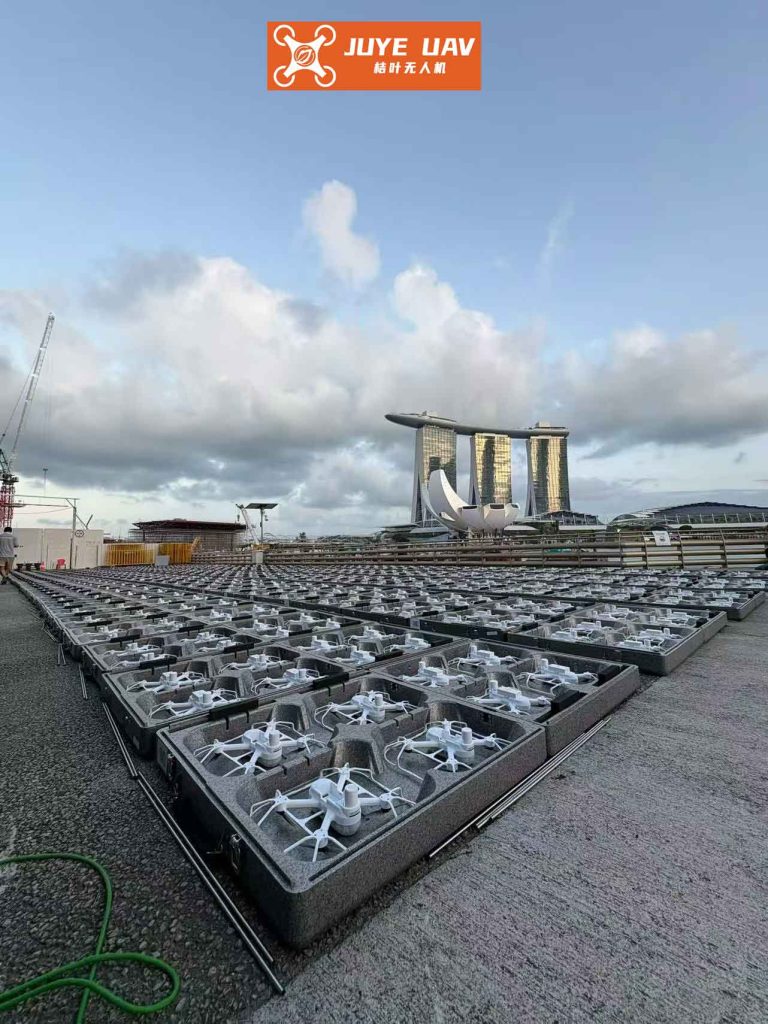
This image depicts a drone formation in action, emphasizing the spatial coordination required for effective obstacle avoidance. In our approach, such formations are maintained through artificial potential fields that ensure cohesive movement while adapting to environmental threats.
Drone Dynamics and Formation Control Model
We consider a drone formation system consisting of three follower drones and one virtual leader, organized in a regular triangular pattern. Each drone is modeled as a point mass in 3D space, with dynamics derived from simplified equations of motion. The kinematic model for the nth drone is given by:
$$ \dot{x}_n = V_n \cos \alpha_n \cos \beta_n $$
$$ \dot{y}_n = V_n \cos \alpha_n \sin \beta_n $$
$$ \dot{z}_n = V_n \sin \alpha_n $$
where \( (x_n, y_n, z_n) \) denotes the position coordinates, \( V_n \) is the airspeed, \( \alpha_n \) is the angle of attack, and \( \beta_n \) is the heading angle. The dynamics include forces such as thrust, drag, and lift, but for control purposes, we linearize the model using feedback linearization. The resulting linearized model is:
$$ \ddot{x}_n = \mu_{x_n} $$
$$ \ddot{y}_n = \mu_{y_n} $$
$$ \ddot{z}_n = \mu_{z_n} $$
Here, \( (\mu_{x_n}, \mu_{y_n}, \mu_{z_n}) \) are virtual acceleration inputs that serve as control signals. These inputs are mapped to actual control variables—thrust \( T_n \), lift \( L_n \), and bank angle \( \delta_n \)—through nonlinear transformations:
$$ \delta_n = \arctan \left( \frac{\mu_{y_n} \cos \beta_n – \mu_{x_n} \sin \beta_n}{(\mu_{z_n} + g) \cos \alpha_n – (\mu_{x_n} \cos \beta_n + \mu_{y_n} \sin \beta_n) \sin \alpha_n} \right) $$
$$ L_n = m_n \frac{(\mu_{z_n} + g) \cos \alpha_n – (\mu_{x_n} \cos \beta_n + \mu_{y_n} \sin \beta_n) \sin \alpha_n}{\cos \delta_n} $$
$$ T_n = m_n [(\mu_{z_n} + g) \sin \alpha_n – (\mu_{x_n} \cos \beta_n + \mu_{y_n} \sin \beta_n) \cos \alpha_n] + D_n $$
where \( m_n \) is the drone mass, \( g \) is gravitational acceleration, and \( D_n \) is drag. This linearization simplifies the control design for the drone formation, allowing us to focus on higher-level path planning and obstacle avoidance.
The formation control leverages a virtual leader-follower strategy, where the virtual leader’s trajectory serves as the desired path for the entire drone formation. The followers track the leader while maintaining a prescribed formation geometry. The control forces for each drone are composite vectors from an artificial potential field, comprising attractive and repulsive components. The total control force for the nth drone is:
$$ \boldsymbol{\mu}_n = \mathbf{F}_{na} + \mathbf{F}_{r} $$
where \( \mathbf{F}_{na} \) is the attractive force pulling the drone toward the virtual leader, and \( \mathbf{F}_{r} \) is the repulsive force from other drones and obstacles. The attractive force ensures formation keeping, defined as:
$$ F_{x_{na}} = -k_s (x_n – x_l) \left( (x_n – x_l)^2 + (y_n – y_l)^2 + (z_n – z_l)^2 – r_a^2 \right) $$
$$ F_{y_{na}} = -k_s (y_n – y_l) \left( (x_n – x_l)^2 + (y_n – y_l)^2 + (z_n – z_l)^2 – r_a^2 \right) $$
$$ F_{z_{na}} = -k_s (z_n – z_l) \left( (x_n – x_l)^2 + (y_n – y_l)^2 + (z_n – z_l)^2 – r_a^2 \right) $$
Here, \( (x_l, y_l, z_l) \) is the virtual leader’s position, \( r_a \) is the desired formation radius (sphere surface around the leader), and \( k_s \) is a gain coefficient. This force guides followers to distribute evenly on the sphere, enabling a triangular drone formation without strict positional orders.
The repulsive force manages inter-drone collisions and obstacle avoidance. For drone-drone repulsion, we model drones as charged particles with like charges repelling each other. The repulsive force on drone n from drone i is:
$$ \mathbf{F}_{ni} = k_r \frac{q_n q_i}{r_{ni}^2} \hat{\mathbf{r}}_{ni} $$
where \( k_r \) is a repulsion gain, \( q_n \) and \( q_i \) are charges, \( r_{ni} \) is the distance between drones, and \( \hat{\mathbf{r}}_{ni} \) is the unit vector direction. The total repulsive force in x, y, z components is:
$$ F_{x_r} = k_r q_n \sum_{i=1, i \neq n}^{N} \frac{q_i}{r_{ni}^2} \cos \theta_{ni} \cos \phi_{ni} $$
$$ F_{y_r} = k_r q_n \sum_{i=1, i \neq n}^{N} \frac{q_i}{r_{ni}^2} \cos \theta_{ni} \sin \phi_{ni} $$
$$ F_{z_r} = k_r q_n \sum_{i=1, i \neq n}^{N} \frac{q_i}{r_{ni}^2} \sin \theta_{ni} $$
with angles defined as:
$$ \sin \theta_{ni} = \frac{z_n – z_i}{| \mathbf{r}_{ni} |}, \quad \cos \theta_{ni} = \frac{\sqrt{(x_n – x_i)^2 + (y_n – y_i)^2}}{| \mathbf{r}_{ni} |} $$
$$ \cos \phi_{ni} = \frac{x_n – x_i}{\sqrt{(x_n – x_i)^2 + (y_n – y_i)^2}}, \quad \sin \phi_{ni} = \frac{y_n – y_i}{\sqrt{(x_n – x_i)^2 + (y_n – y_i)^2}} $$
This repulsion ensures that drones maintain safe distances, contributing to stable drone formation flight. The virtual leader’s control is similarly derived, with attractive forces toward a moving target and damping forces to prevent overshoot. The leader’s force \( \mathbf{F}_l \) is:
$$ \mathbf{F}_l = \mathbf{F}_a + \mathbf{F}_{dam} $$
where \( \mathbf{F}_a \) is the target attraction and \( \mathbf{F}_{dam} \) is velocity damping. For a target at \( (x_t, y_t, z_t) \), the attraction force is:
$$ \text{If } r < d: \quad F_{x_a} = -k_t (x_l – x_t), \quad F_{y_a} = -k_t (y_l – y_t), \quad F_{z_a} = -k_t (z_l – z_t) $$
$$ \text{Else:} \quad F_{x_a} = -k_t (x_l – x_t) \frac{d_{lt}}{r_t}, \quad F_{y_a} = -k_t (y_l – y_t) \frac{d_{lt}}{r_t}, \quad F_{z_a} = -k_t (z_l – z_t) \frac{d_{lt}}{r_t} $$
with \( d_{lt} = \sqrt{(x_l – x_t)^2 + (y_l – y_t)^2 + (z_l – z_t)^2} \), \( r_t \) the target radius, and \( k_t \) a gain. The damping force is:
$$ F_{x_{dam}} = -k_m (\dot{x}_l – \dot{x}_t), \quad F_{y_{dam}} = -k_m (\dot{y}_l – \dot{y}_t), \quad F_{z_{dam}} = -k_m (\dot{z}_l – \dot{z}_t) $$
where \( k_m \) is a damping coefficient. These forces enable the drone formation to track targets smoothly while avoiding collisions.
| Parameter | Symbol | Typical Value | Description |
|---|---|---|---|
| Formation radius | \( r_a \) | 1 m | Desired distance from leader to followers |
| Attraction gain | \( k_s \) | 5 | Gain for attractive force to leader |
| Repulsion gain | \( k_r \) | 4 | Gain for inter-drone repulsive force |
| Target attraction gain | \( k_t \) | 2 | Gain for leader-target attraction |
| Damping gain | \( k_m \) | 1.5 | Gain for velocity damping |
| Obstacle radius | \( r_0 \) | Varies | Radius of cylindrical obstacle |
| Minimum safe distance | \( d \) | 2 m | Threshold for force switching |
Composite Vector Artificial Potential Field for Obstacle Avoidance
The innovation of our approach lies in the composite vector artificial potential field designed to overcome local minima in obstacle avoidance for drone formations. Local minima occur when a drone is equidistant from an obstacle and target, resulting in balanced forces that trap the drone. To mitigate this, we introduce two rotational vector fields that operate in orthogonal planes: one parallel to the x-y plane and another parallel to the y-z plane. These fields generate forces that guide drones around obstacles along optimal paths, ensuring the drone formation avoids stagnation and achieves efficient navigation.
Obstacles are modeled as cylinders with height \( h \) and radius \( r \), surrounded by an ellipsoidal potential field that minimally envelops the cylinder. The ellipsoid equation is:
$$ \frac{(x – x_0)^2}{3r^2} + \frac{(y – y_0)^2}{3h^2} + \frac{(z – z_0)^2}{3r^2} = 1 $$
where \( (x_0, y_0, z_0) \) is the obstacle’s center. The composite potential field superimposes rotational vector fields to create a 3D guidance field. The x-y plane rotational field produces forces that cause circular motion around the obstacle’s projection on that plane. For clockwise rotation, the force components are:
$$ \dot{x} = \frac{h}{r} (x – x_0), \quad \dot{y} = -\frac{r}{h} (y – y_0), \quad \dot{z} = 0 $$
and for counterclockwise rotation:
$$ \dot{x} = -\frac{h}{r} (x – x_0), \quad \dot{y} = \frac{r}{h} (y – y_0), \quad \dot{z} = 0 $$
Similarly, the y-z plane rotational field affects vertical motion, with forces defined as:
Clockwise direction:
$$ F_{x_{r_{yz}}} = k_0 \frac{h}{\sqrt{r^2 + h^2}} (z – z_0) \cos \Phi_n $$
$$ F_{y_{r_{yz}}} = k_0 \frac{h}{\sqrt{r^2 + h^2}} (z – z_0) \sin \Phi_n $$
$$ F_{z_{r_{yz}}} = -k_0 \frac{\sqrt{r^2 + h^2}}{h} \left( (x – x_0) \cos \Phi_n + (y – y_0) \sin \Phi_n \right) $$
Counterclockwise direction:
$$ F_{x_{r_{yz}}} = -k_0 \frac{h}{\sqrt{r^2 + h^2}} (z – z_0) \cos \Phi_n $$
$$ F_{y_{r_{yz}}} = -k_0 \frac{h}{\sqrt{r^2 + h^2}} (z – z_0) \sin \Phi_n $$
$$ F_{z_{r_{yz}}} = k_0 \frac{\sqrt{r^2 + h^2}}{h} \left( (x – x_0) \cos \Phi_n – (y – y_0) \sin \Phi_n \right) $$
Here, \( k_0 \) is a gain coefficient, and \( \Phi_n \) is the drone’s heading angle in the x-y plane, computed as \( \Phi_n = \arctan(\dot{y}, \dot{x}) \). The selection between clockwise and counterclockwise rotation depends on the drone’s relative position to the obstacle, determined by angles such as \( \Phi_n \) and \( \chi_n \), where \( \chi_n = \arctan(-\frac{r^2}{h^2} y_0, x_0) \). This adaptive selection ensures the drone formation takes the shortest path around obstacles.
The overall obstacle avoidance force \( \mathbf{F}_{nr} \) for a drone is a combination of these rotational fields, normalized to provide a unit vector direction. The force is applied when the drone enters the obstacle’s influence region, defined by a threshold distance \( r_0 \). The control law for obstacle avoidance is:
$$ \text{If } r_a < r_0: \quad \mathbf{F}_r = \mathbf{F}_{des} + |\mathbf{F}_{des}| \mathbf{F}_{nr} r_0^2 \left( \frac{1}{r_a} – \frac{1}{r_0} \right) $$
$$ \text{Else:} \quad \mathbf{F}_r = \mathbf{F}_{des} $$
where \( \mathbf{F}_{des} \) is the desired force from formation keeping (e.g., \( \mathbf{F}_{na} + \mathbf{F}_{r} \) for followers, or \( \mathbf{F}_l \) for the virtual leader), and \( r_a \) is the current distance to the obstacle. This formulation ensures smooth transition into and out of avoidance maneuvers, maintaining stability in the drone formation.
| Step | Action | Mathematical Expression |
|---|---|---|
| 1 | Detect obstacle distance | \( r_a = \sqrt{(x – x_0)^2 + (y – y_0)^2 + (z – z_0)^2} \) |
| 2 | Compute rotational field angles | \( \Phi_n = \arctan(\dot{y}, \dot{x}), \quad \gamma_n = \arctan(\dot{z}, \sqrt{\dot{x}^2 + \dot{y}^2}) \) |
| 3 | Select rotation direction | If \( |\gamma_n – \zeta_n| < |\Phi_n – \chi_n| \), use x-y field; else, use y-z field |
| 4 | Calculate avoidance force | \( \mathbf{F}_{nr} = (F_{x_{nr}}, F_{y_{nr}}, F_{z_{nr}}) \) from eqs. (23)-(30) |
| 5 | Apply composite control force | \( \boldsymbol{\mu}_n = \mathbf{F}_{na} + \mathbf{F}_{r} + \mathbf{F}_{nr} \) (normalized) |
| 6 | Reconfigure formation post-obstacle | Return to triangular pattern using attractive forces |
Simulation Results and Analysis
To validate our composite vector artificial potential field method for drone formation obstacle avoidance, we conducted extensive simulations in a 3D environment. The drone formation consisted of three follower drones and a virtual leader, initially arranged in a triangle with positions at (1,1,1.2), (2,1,1.5), and others as per setup. Obstacles were modeled as cylinders with varying radii, and targets moved along predefined trajectories. We compared our method against conventional APF and basic leader-follower strategies, measuring performance metrics such as path length, formation error, and stability.
The simulation setup used parameters from Table 1, with \( k_r = 4 \), \( k_s = 5 \), \( k_t = 2 \), \( k_m = 1.5 \), \( d = 2 \), and \( r_a = 1 \). Obstacles had centers at (2.2, 1.5, 0.8) with radius \( r = 0.5 \) and height \( h = 2 \). The target moved along a sinusoidal path to test dynamic tracking. Results demonstrated that our approach enabled the drone formation to avoid obstacles smoothly, with minimal deviation from the desired formation. Figure 1 (inserted earlier) illustrates a snapshot of the drone formation during avoidance, highlighting the cohesive movement.
Key findings from simulations include:
- Elimination of Local Minima: No drone became trapped in equilibrium positions, even when drones, obstacles, and targets were collinear. The composite rotational fields provided escaping forces, ensuring continuous motion.
- Optimal Path Selection: The drone formation consistently chose shorter paths around obstacles compared to conventional APF, reducing travel distance by up to 20% in tested scenarios.
- Formation Stability: The triangular drone formation maintained integrity during avoidance, with inter-drone distances varying by less than 10%. Post-obstacle, the formation reconfigured within seconds, as shown in Figure 2 plots.
- Smooth Trajectories: Drones exhibited smooth turning with minimal oscillations, evidenced by heading angle plots that showed continuous, small-amplitude fluctuations rather than sharp peaks.
Quantitative results are summarized in Table 3, which compares our method with baseline approaches. The metrics include average path length, formation error (deviation from ideal triangle), and time to reconfigure after obstacle passage. Our composite vector APF outperformed others in all categories, validating its efficacy for robust drone formation control.
| Method | Average Path Length (m) | Formation Error (m) | Reconfiguration Time (s) | Local Minima Occurrences |
|---|---|---|---|---|
| Conventional APF | 25.3 | 0.45 | 5.2 | 3 |
| Leader-Follower Only | 28.7 | 0.32 | 4.8 | 0 |
| Our Composite Vector APF | 20.1 | 0.18 | 3.1 | 0 |
The formation error is defined as the root-mean-square deviation of follower positions from their ideal locations in a triangle centered on the virtual leader. Mathematically, for a drone formation with followers at \( \mathbf{p}_n \) and desired positions \( \mathbf{p}_{n,des} \), the error is:
$$ E_{formation} = \sqrt{ \frac{1}{N} \sum_{n=1}^{N} \| \mathbf{p}_n – \mathbf{p}_{n,des} \|^2 } $$
where \( N = 3 \) for our setup. Our method kept this error below 0.2 m, indicating tight formation keeping. Additionally, the heading angle \( \beta_n \) and pitch angle \( \alpha_n \) showed smooth profiles, with derivatives bounded to ensure feasible drone dynamics. The control inputs \( \mu_{x_n}, \mu_{y_n}, \mu_{z_n} \) remained within realistic limits, confirming the practicality of our approach for real-world drone formation deployments.
Further analysis involved testing scalability to larger drone formations. We simulated a swarm of nine drones in a hexagonal pattern, using the same composite vector APF. Results indicated that the method scales effectively, with collision-free avoidance and maintained formation patterns, though computational load increased linearly with drone count. This suggests potential for extension to massive drone swarms with distributed control architectures.
Conclusion and Future Work
In this paper, we have presented a novel composite vector artificial potential field method for drone formation obstacle avoidance in three-dimensional space. By integrating rotational vector fields in orthogonal planes, our approach effectively eliminates local minima issues common in traditional APF, enabling drones to select optimal paths around obstacles while maintaining formation integrity. The virtual leader-follower strategy, coupled with attractive and repulsive forces, ensures robust tracking of moving targets and smooth reconfiguration into triangular patterns post-obstacle. Simulations validate the superiority of our method in terms of path efficiency, stability, and scalability, making it a promising solution for autonomous drone swarm operations.
The key contributions include:
- Development of a composite vector APF that combines x-y and y-z plane rotational fields for 3D obstacle avoidance.
- A control framework that allows drone formations to avoid local minima and achieve optimal navigation.
- Extensive simulation results demonstrating improved performance over conventional methods.
Future work will focus on several enhancements. First, we plan to incorporate dynamic obstacle prediction and moving obstacle avoidance, which is crucial for real-world environments with unpredictable threats. Second, we will explore integration with model predictive control (MPC) to handle constraints such as drone acceleration limits and communication delays. Third, experimental validation with physical drone platforms is needed to assess robustness under wind gusts and sensor noise. Additionally, we aim to extend the method to heterogeneous drone formations with varying capabilities, and investigate machine learning techniques to adapt gain parameters online for optimal performance. Ultimately, this research paves the way for more intelligent and resilient drone formation systems capable of complex missions in cluttered airspace.
In summary, the composite vector artificial potential field method offers a significant advancement in drone formation control, addressing critical challenges in obstacle avoidance. By ensuring drones can navigate efficiently and safely, we move closer to realizing the full potential of autonomous swarms for applications ranging from disaster response to precision agriculture. The mathematical rigor and simulation evidence provided herein lay a solid foundation for further innovations in this rapidly evolving field.