
In the evolving landscape of autonomous systems, multi-drone, or drone formation, operations have transitioned from a technological novelty to a critical capability. The ability to coordinate multiple Unmanned Aerial Vehicles (UAVs) as a cohesive unit unlocks unprecedented potential in sectors ranging from precision agriculture and infrastructure inspection to disaster response and tactical surveillance. A drone formation leverages the strengths of individual UAVs—agility, perspective, and sensor diversity—while mitigating their primary weaknesses, such as limited endurance and payload capacity. By working in concert, a formation can cover vast areas, execute complex, multi-stage missions, and provide redundant, fault-tolerant systems. However, the efficacy of a drone formation is not merely a function of the number of vehicles deployed; it is fundamentally constrained by the intelligent orchestration of their actions and the efficient utilization of the resources that bind them together, most notably the electromagnetic spectrum.
The core challenge in drone formation management lies in the inherent coupling between mission execution and resource allocation. Traditional approaches often treat task planning (deciding which drone does what, and in what order) and communication resource management (allocating bandwidth, power, and channels) as sequential or separate optimization problems. This decoupling leads to suboptimal system performance. For instance, a task plan that maximizes geographical coverage might inadvertently position all drones in areas with poor communication links to the base station, creating a data bottleneck. Conversely, a spectrum allocation plan designed for minimal interference might restrict the formation’s ability to execute tasks concurrently, serializing operations and extending mission time. Therefore, the true potential of a drone formation is only realized through a joint optimization framework that simultaneously considers the physical mission objectives and the cyber-physical constraints of the communication network. This paper addresses this intricate problem, proposing a holistic methodology for the concurrent optimization of drone formation task planning and spectrum resource allocation, with a focus on scenarios involving multiple launch points—a more realistic and flexible model for large-scale operations.
System Modeling and Problem Formulation
We consider a scenario where a set of heterogeneous tasks must be performed across a wide operational area. These tasks, denoted by the set $\mathcal{K} = {1, 2, …, K}$, could involve surveillance of specific points, data collection from sensors, or delivery of payloads. Each task $k \in \mathcal{K}$ is characterized by a tuple of attributes: a value or priority $V_k$, a required data payload size $C_k$ (e.g., high-resolution imagery), a fixed execution time on-site $T_k^{exec}$, and a geographical location $\mathbf{q}_k = (x_k, y_k)$. To execute these tasks, we have a fleet of $M$ UAVs. Crucially, these UAVs are organized into $N$ distinct drone formations, each launched from a different base station or airport. The set of formations is $\mathcal{N} = {1, 2, …, N}$, with each formation $n$ operating from a known home base at location $\mathbf{q}_n^b = (x_n^b, y_n^b)$. The number of UAVs assigned to formation $n$ is $|\mathcal{A}_n|$, such that $\sum_{n=1}^{N} |\mathcal{A}_n| = M$.
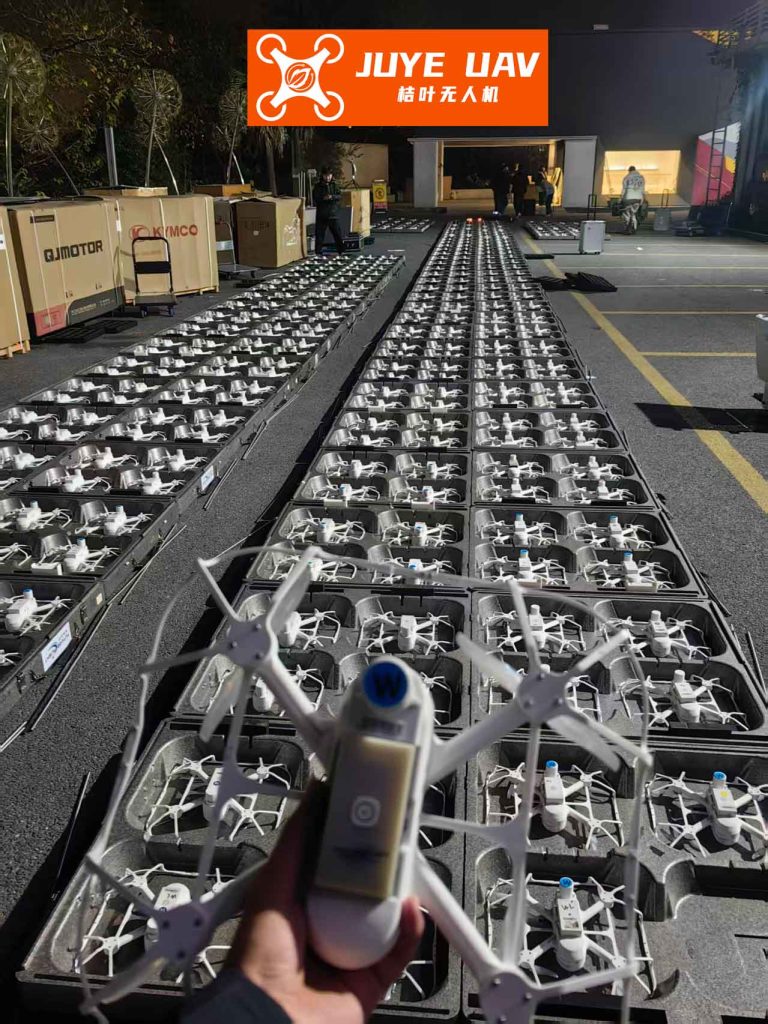
The operational model for a drone formation involves two primary phases at each assigned task location: task execution (e.g., loitering and sensing) and data communication. After flying to a task location, the formation hovers for a duration $T_k^{exec}$ to complete the physical task. Subsequently, it must transmit the acquired data (of size $C_k$) back to its home base. The success of the task and the efficiency of the communication are influenced by the formation’s size and the allocated bandwidth.
Task Success and Reward Model
The probability of a single UAV successfully completing task $k$ is $p_k$, which accounts for environmental difficulties. For a drone formation $\mathcal{A}_n$ with $|\mathcal{A}_n|$ UAVs collaborating on the same task, the combined probability of success is significantly higher due to redundancy and collaborative sensing. We model this as the probability that at least one UAV in the formation succeeds:
$$ p(\mathcal{A}_n, k) = 1 – (1 – p_k)^{|\mathcal{A}_n|}. $$
Thus, the effective reward garnered from task $k$ when assigned to formation $n$ is its intrinsic value scaled by this success probability:
$$ R_k^n = p(\mathcal{A}_n, k) \cdot V_k. $$
Energy Consumption Model
A UAV’s energy expenditure is dominated by two components: propulsion for movement and power for communication. The communication energy is typically orders of magnitude smaller than propulsion energy and is often neglected in trajectory planning. The propulsion power $P(v)$ for a rotary-wing UAV flying at a constant speed $v$ is well-approximated by:
$$ P(v) = P_0 \left(1 + \frac{3v^2}{U_{tip}^2}\right) + P_i \left( \sqrt{1 + \frac{v^4}{4v_0^4}} – \frac{v^2}{2v_0^2} \right)^{1/2} + \frac{1}{2} d_0 \rho s A v^3. $$
Here, $P_0$ and $P_i$ are blade profile and induced powers in hover, $U_{tip}$ is the tip speed, $v_0$ is the mean rotor-induced velocity, $d_0$ is the fuselage drag ratio, $\rho$ is air density, $s$ is rotor solidity, and $A$ is rotor disc area.
For a drone formation executing a sequence of tasks, the total propulsion energy is the sum of the energy consumed during flight between tasks and during hover at task locations. If formation $n$ executes a sequence of tasks $\pi_n = [\pi_n(0), \pi_n(1), …, \pi_n(L_n)]$, where $\pi_n(0)$ and $\pi_n(L_n)$ represent the home base, the total flight distance $S_n$ is:
$$ S_n = \sum_{l=0}^{L_n-1} \| \mathbf{q}_{\pi_n(l)} – \mathbf{q}_{\pi_n(l+1)} \|, $$
assuming $\mathbf{q}_{\pi_n(0)} = \mathbf{q}_{\pi_n(L_n)} = \mathbf{q}_n^b$. The flight time at a constant cruise speed $v_{cruise}$ is $T_n^{fly} = S_n / v_{cruise}$, and the corresponding flight energy is $E_n^{fly} = P(v_{cruise}) \cdot T_n^{fly} \cdot |\mathcal{A}_n|$ (summed across all UAVs in the formation).
The hover energy at task $k$ includes the fixed task execution time and the data transmission time:
$$ E_k^{hover} = P(0) \cdot (T_k^{exec} + T_k^{comm}) \cdot |\mathcal{A}_n|, $$
where $P(0)$ is the power consumption in hover ($v=0$).
Communication and Spectrum Model
The data transmission time $T_k^{comm}$ is the critical link between task planning and resource allocation. We assume the total available system bandwidth $W_{total}$ is partitioned into $N$ orthogonal sub-channels, one allocated to each drone formation to avoid inter-formation interference. Within a formation, UAVs share their assigned bandwidth $W_n$ using time-division multiple access (TDMA).
Thanks to the UAV’s aerial position, the air-to-ground channel is predominantly line-of-sight. The channel power gain from a UAV at task location $k$ to its home base $n$ is modeled as:
$$ h_{k,n} = \beta_0 \cdot d_{k,n}^{-2}, $$
where $\beta_0$ is the gain at a reference distance of 1 meter, and $d_{k,n} = \|\mathbf{q}_k – \mathbf{q}_n^b\|$ is the distance.
The achievable data rate for a single UAV transmitting with power $P_{tx}$ over bandwidth $W_n$ is given by the Shannon capacity:
$$ r_{k,n} = W_n \log_2\left(1 + \frac{P_{tx} h_{k,n}}{W_n N_0}\right), $$
where $N_0$ is the noise power spectral density. To transmit the total data $C_k$ collected by the formation, the aggregate time required, assuming sequential transmission by the $|\mathcal{A}_n|$ UAVs, is:
$$ T_k^{comm} = \frac{|\mathcal{A}_n| \cdot C_k}{r_{k,n}} = \frac{|\mathcal{A}_n| \cdot C_k}{W_n \log_2\left(1 + \frac{P_{tx} \beta_0 d_{k,n}^{-2}}{W_n N_0}\right)}. $$
This equation reveals the coupling: a larger formation ($|\mathcal{A}_n|$) collects data faster on-site but requires more communication time, which is alleviated by allocating more bandwidth ($W_n$).
Joint Optimization Problem Formulation
Our objective is to maximize the overall system utility, defined as the total task reward minus the total energy cost, weighted by appropriate factors to balance the units. The decision variables are:
- Task Assignment & Sequencing ($X, \pi$): Binary variable $X_{k,n}=1$ if task $k$ is assigned to formation $n$, else $0$. For each formation, the execution order $\pi_n$ is a permutation of its assigned tasks.
- Formation Sizing ($|\mathcal{A}_n|$): The integer number of UAVs in each drone formation.
- Bandwidth Allocation ($W_n$): The continuous amount of bandwidth allotted to each formation.
The resulting Mixed-Integer Non-Linear Programming (MINLP) problem is:
$$ \max_{X, \pi, |\mathcal{A}_n|, W_n} \sum_{n=1}^{N} \sum_{k=1}^{K} X_{k,n} \left[ R_k^n – \lambda E_k^{hover} \right] – \zeta \sum_{n=1}^{N} E_n^{fly} $$
subject to:
$$
\begin{aligned}
&\text{(C1) } \sum_{n=1}^{N} X_{k,n} = 1, \quad \forall k \in \mathcal{K} & \text{(Each task assigned once)} \\
&\text{(C2) } \sum_{k=1}^{K} X_{k,n} \geq 1, \quad \forall n \in \mathcal{N} & \text{(Each formation gets a task)} \\
&\text{(C3) } \sum_{n=1}^{N} |\mathcal{A}_n| = M & \text{(All UAVs assigned)} \\
&\text{(C4) } |\mathcal{A}_n| \geq 1, \quad \forall n \in \mathcal{N} & \text{(Non-empty formations)} \\
&\text{(C5) } S_n \leq S_{max}, \quad \forall n \in \mathcal{N} & \text{(Maximum flight range)} \\
&\text{(C6) } \sum_{n=1}^{N} W_n = W_{total}, \quad W_n > 0 & \text{(Bandwidth allocation)} \\
\end{aligned}
$$
Here, $\lambda$ and $\zeta$ are weighting coefficients for hover and flight energy penalties, respectively.
Proposed Hybrid Solution Methodology
The formulated problem is NP-hard due to the combinatorial nature of task assignment and sequencing coupled with continuous resource optimization. A monolithic solution approach is intractable. We propose a decoupled, iterative optimization strategy that leverages the strengths of two complementary algorithms: a Genetic Algorithm (GA) for the discrete search space and a Gradient Projection Method (GPM) for the continuous convex subproblem.
1. Genetic Algorithm for Discrete Variable Optimization
Given a fixed bandwidth allocation $\{W_n\}$, the problem reduces to optimizing the discrete variables: task assignment, sequencing, and drone formation sizing. This subproblem is a complex, multi-depot Vehicle Routing Problem (VRP) with variable team sizes, ideal for metaheuristic approaches. We employ a GA with a tailored chromosome design and operators.
- Chromosome Encoding: A chromosome is composed of three segments.
- Task Sequence: A permutation list of all $K$ task IDs.
- Formation Assignment: A parallel list of length $K$, where the $i$-th element indicates the formation ID assigned to the $i$-th task in the Sequence segment.
- Formation Sizing: A list of length $N$, where the $n$-th element is the integer number of UAVs $|\mathcal{A}_n|$ for formation $n$.
- Fitness Evaluation: For a given chromosome, the task sequence and assignment are decoded to build the route $\pi_n$ for each formation. The fitness is the objective function value calculated with the current $\{|\mathcal{A}_n|\}$ and the fixed $\{W_n\}$, minus a penalty for any constraint violation (e.g., exceeding $S_{max}$).
- Genetic Operators:
- Selection: We use tournament selection combined with an elitism strategy to preserve the best solutions.
- Crossover: For the Task Sequence segment, we use Ordered Crossover (OX) to produce valid permutations. For the Formation Assignment segment, we use uniform crossover, followed by a repair mechanism to ensure each task is assigned to exactly one formation.
- Mutation: We apply several mutation strategies with adaptive probabilities:
- Swap/Inverse: Mutate the Task Sequence by swapping two tasks or inverting a subsequence.
- Re-assign: Randomly change the formation assignment for a few tasks.
- Resize Formation: Randomly adjust the UAV count among formations while keeping the total $M$ constant.
The GA explores the vast discrete solution space effectively, seeking high-quality configurations for the drone formation logistics.
2. Gradient Projection Method for Continuous Bandwidth Optimization
Given a fixed discrete configuration—defined by the task assignments $\{X_{k,n}\}$, sequences $\{\pi_n\}$, and drone formation sizes $\{|\mathcal{A}_n|\}$—the original problem simplifies significantly. The task rewards $R_k^n$ and flight energies $E_n^{fly}$ become constants. The remaining optimization over the bandwidth $\{W_n\}$ aims to minimize the total hover energy, which is dominated by the communication time. The subproblem becomes:
$$ \min_{W_n > 0} \sum_{n=1}^{N} \sum_{k \in \mathcal{K}_n} \frac{|\mathcal{A}_n| \cdot C_k}{W_n \log_2\left(1 + \frac{\gamma_{k,n}}{W_n}\right)} \quad \text{s.t.} \quad \sum_{n=1}^{N} W_n = W_{total}, $$
where $\mathcal{K}_n$ is the set of tasks assigned to formation $n$, and $\gamma_{k,n} = P_{tx} \beta_0 d_{k,n}^{-2} / N_0$.
It can be proven that the function $f(x) = a / [x \log(1 + b/x)]$ is convex for $x > 0$ (where $a, b > 0$). Since the objective is a sum of convex functions and the constraint is linear, this is a convex optimization problem. We solve it efficiently using the Gradient Projection Method (GPM). The algorithm iteratively updates the bandwidth vector in the direction of the negative gradient of the objective function and then projects it onto the simplex constraint $\sum W_n = W_{total}, W_n > 0$.
- Compute the gradient: $\nabla_{W_n} f = \frac{\partial}{\partial W_n} \sum_{k \in \mathcal{K}_n} \frac{|\mathcal{A}_n| C_k}{W_n \ln(1 + \gamma_{k,n}/W_n)}$ (using the natural log for convenience).
- Update: $W_n^{new} = W_n – \alpha \cdot \nabla_{W_n} f$, where $\alpha$ is a step size.
- Project onto the feasible set: This involves shifting and scaling $W^{new}$ to satisfy the sum constraint while clamping any negative values to a small positive epsilon.
The GPM converges quickly to the optimal bandwidth allocation for the given drone formation task plan.
3. Integrated Iterative Algorithm
The complete joint optimization algorithm alternates between the GA and the GPM in a block coordinate descent fashion, as summarized below. This iterative process continues until the improvement in the overall utility falls below a threshold $\epsilon$.
| Algorithm: Joint Drone Formation & Spectrum Optimization |
|---|
|
Input: Task set $\mathcal{K}$, UAV count $M$, base locations $\mathbf{q}_n^b$, total bandwidth $W_{total}$. Output: Optimal task assignment $X^*$, sequences $\pi^*$, formation sizes $|\mathcal{A}_n|^*$, bandwidth $W_n^*$. 1: Initialize $r=0$. Randomly generate initial bandwidth $W_n^{(0)}$ satisfying C6. 2: repeat 3: Discrete Optimization: Given $W_n^{(r)}$, run the GA to obtain optimized discrete variables $X^{(r+1)}, \pi^{(r+1)}, |\mathcal{A}_n|^{(r+1)}$. 4: Continuous Optimization: Given the discrete solution from step 3, run the GPM to obtain optimized bandwidth $W_n^{(r+1)}$. 5: Calculate the total system utility $U^{(r+1)}$. 6: $r \leftarrow r + 1$. 7: until $|U^{(r)} – U^{(r-1)}| < \epsilon$ or maximum iterations reached. 8: return $(X^{(r)}, \pi^{(r)}, |\mathcal{A}_n|^{(r)}, W_n^{(r)})$. |
This hybrid approach is globally convergent to a local optimum because each step (GA or GPM) improves or maintains the objective function value, which is bounded above. The multi-start capability of the GA, exploring from various initial populations, enhances the chance of finding a near-global optimum for the overall drone formation management problem.
Performance Evaluation and Discussion
We evaluate the proposed hybrid Genetic-Gradient Projection (G-GP) algorithm through numerical simulations and compare it against benchmark strategies. The baseline algorithms are:
- Benchmark 1 (ACO-GP): Uses an Ant Colony Optimization (ACO) algorithm for the discrete part instead of GA, paired with the same GPM.
- Benchmark 2 (GA-PSO): Uses the same GA for the discrete part but replaces GPM with a Particle Swarm Optimization (PSO) algorithm for bandwidth allocation.
Common simulation parameters are listed in the table below.
| Parameter | Value |
|---|---|
| Number of Tasks ($K$) | 4 – 20 |
| Task Data Payload $C_k$ | 50 – 100 Mb |
| Task Value $V_k$ | 10 – 14 Units |
| UAV Transmit Power $P_{tx}$ | 1 W |
| Total Bandwidth $W_{total}$ | 10 MHz |
| Noise PSD $N_0$ | -169 dBm/Hz |
| Channel Gain at 1m $\beta_0$ | -60 dB |
| UAV Cruise Speed $v_{cruise}$ | 15 m/s |
| Max Formation Range $S_{max}$ | 3000 m |
| Energy Weights $\lambda, \zeta$ | 5e-5, 5e-4 |
Analysis of Optimization Results
The proposed algorithm effectively balances task rewards against energy costs. For instance, in a scenario with $K=10$ tasks, $M=10$ UAVs, and $N=3$ bases, the G-GP algorithm does not simply assign the most tasks to the largest drone formation. It strategically allocates UAVs to formations and tasks to minimize the total flight distance while ensuring efficient communication through tailored bandwidth allocation. A formation with a longer travel route may be assigned fewer but higher-value tasks, and compensated with slightly more bandwidth to reduce hover time, maximizing the net utility.
The convergence and superiority of the G-GP algorithm are evident in Figure X (conceptual). The algorithm consistently achieves a higher final system utility compared to both benchmarks. While ACO-GP can get trapped in local optima due to the pheromone-based search, and GA-PSO exhibits slower and less stable convergence in optimizing the convex bandwidth subproblem, the G-GP method combines the robust global search of GA with the fast, precise convergence of GPM. This synergy is particularly beneficial for managing complex drone formation operations.
Impact of Formation Size and Energy Weights
The utility as a function of the total number of UAVs $M$ reveals an important trade-off. As $M$ increases from a small number, the utility rises due to the benefits of collaboration within the drone formation: higher task success probability $p(\mathcal{A}_n, k)$ and parallel data collection. However, beyond an optimal point, the utility declines. The increasing energy cost, proportional to $|\mathcal{A}_n|$, begins to outweigh the diminishing marginal gains in task reward. The optimal fleet size is sensitive to the energy weighting coefficients $\lambda$ and $\zeta$. Higher weights, representing missions where energy efficiency is paramount (e.g., long-endurance surveillance), lead to a smaller optimal drone formation size. Conversely, for high-priority, reward-driven missions, the optimal size is larger. The G-GP algorithm dynamically finds this balance, whereas static allocation strategies are suboptimal across different scenarios.
| Algorithm | Total Utility (Avg.) | Convergence Time (s) | Task Reward Captured (%) | Energy Cost (Relative) |
|---|---|---|---|---|
| Proposed G-GP | 152.3 | 24.7 | 94.2 | 1.00 |
| Benchmark 1 (ACO-GP) | 138.1 | 31.5 | 91.5 | 1.12 |
| Benchmark 2 (GA-PSO) | 145.6 | 41.8 | 93.1 | 1.08 |
Scalability and Complexity
The computational complexity of the G-GP algorithm is dominated by the GA, which is $O(G \cdot P \cdot (K \log K + N))$ per major iteration, where $G$ is generations, $P$ is population size. The GPM has a complexity of $O(I_{GPM} \cdot N)$, which is very efficient. While the runtime increases with problem size, it remains feasible for pre-mission planning of drone formation operations. The decoupled approach offers a scalable framework for larger problems, where more sophisticated GA techniques or decomposition methods could be integrated.
Conclusion
This paper has presented a comprehensive framework for the joint optimization of task planning and spectrum resource allocation in multi-base drone formation systems. By formulating a holistic MINLP model that captures the intricate coupling between collaborative task execution, UAV team sizing, trajectory-based energy consumption, and communication latency, we address a critical gap in drone formation coordination. The proposed hybrid algorithm, synergizing a Genetic Algorithm for combinatorial optimization and a Gradient Projection Method for convex resource allocation, provides an effective and efficient solution mechanism. Simulation results validate its superior performance over traditional decoupled or less-synergistic methods in terms of overall system utility, convergence speed, and adaptability to different mission profiles (reward vs. energy focused). The ability to optimally size drone formations and allocate communication resources from multiple launch points makes this approach highly relevant for practical, large-scale UAV deployments in complex environments. Future work will focus on integrating dynamic elements, such as moving targets or uncertain channel conditions, and exploring distributed versions of the algorithm for fully autonomous drone formation operations.