
The cultivation of tea, Camellia sinensis, is a cornerstone of agriculture in many mountainous regions across Asia. These ecosystems, while ideal for producing high-quality tea leaves, present significant challenges for crop protection. The terrain is often steep and difficult to access, making traditional pest management methods labor-intensive, inefficient, and sometimes hazardous. Among the most persistent and economically damaging pests in these plantations is the tea green leafhopper (Empoasca onukii). This piercing-sucking insect feeds on the tender shoots, causing leaf chlorosis, curling, and stunted growth, which directly translates to reduced yield and compromised quality of both green and black teas. For decades, control has relied heavily on chemical pesticides applied via backpack sprayers. However, this approach faces a dual crisis: the development of pest resistance to commonly used insecticides and an acute shortage of skilled agricultural labor willing to undertake the arduous task of spraying on slopes.
This convergence of challenges has catalyzed the exploration of innovative precision agriculture technologies. The adoption of agricultural UAV (Unmanned Aerial Vehicle), or drone, technology represents a paradigm shift. Agricultural UAV systems offer the potential for rapid, uniform, and safe application of crop protection agents. Their ability to operate over complex topography independent of ground contact addresses the core logistical problem of mountainous tea farming. Previous studies have yielded promising but sometimes contradictory results regarding the efficacy and residue profiles of drone-applied pesticides compared to conventional methods. Differences in agricultural UAV models, nozzle types, flight parameters (altitude, speed), and the physicochemical properties of the pesticides themselves can significantly influence droplet deposition, coverage, and ultimately, biological and environmental outcomes. Therefore, it is not sufficient to state that drones “work”; systematic evaluation under defined operational parameters for specific crop-pest systems is essential.
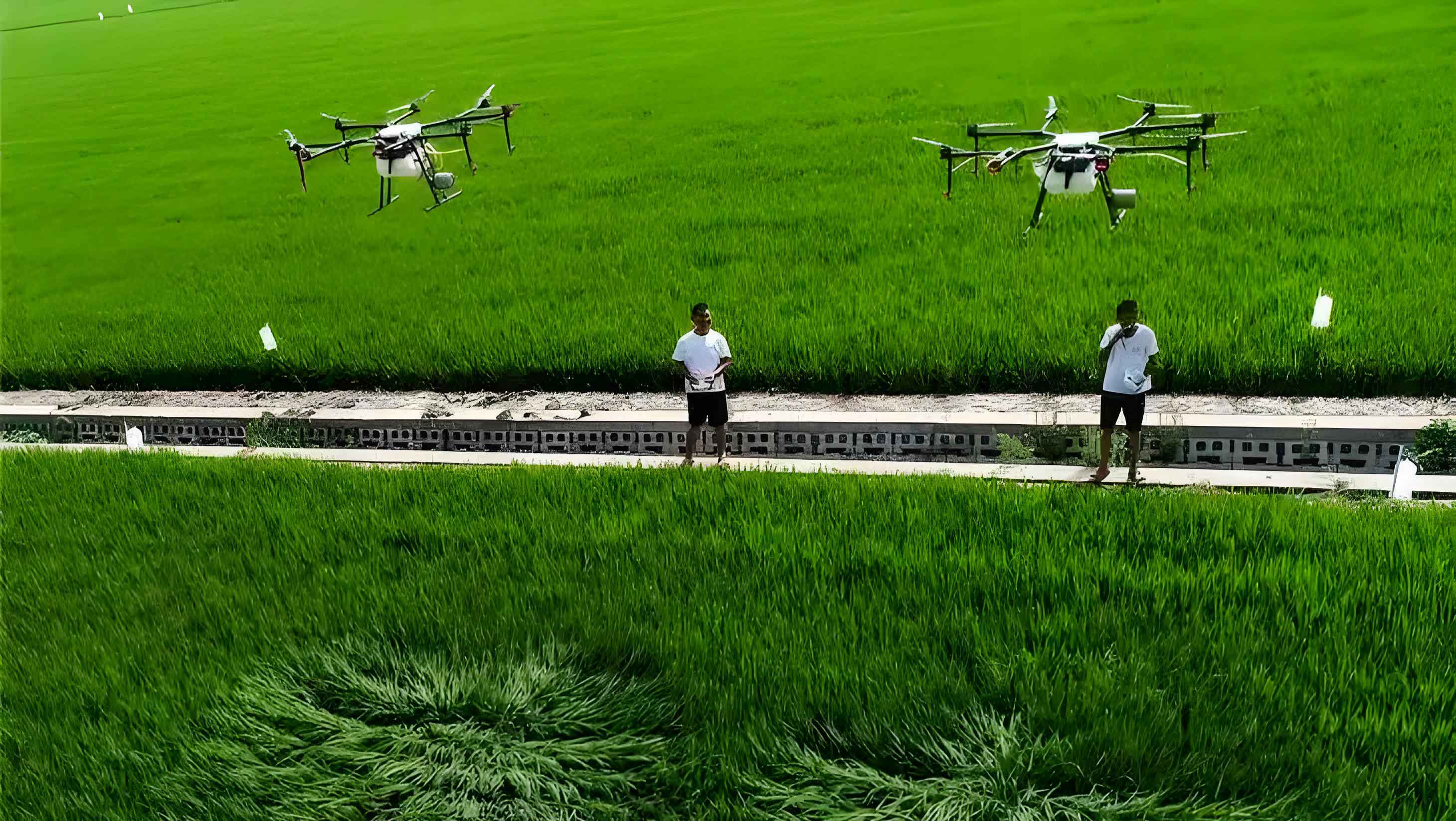
The present work is framed within this context of necessary validation. It aims to provide a rigorous, data-driven assessment of a modern agricultural UAV system deployed for tea green leafhopper management. The evaluation hinges on two critical pillars: biological efficacy and product safety. Specifically, the study investigates the field performance of three distinct insecticides with novel modes of action—selected for their lower solubility and potential to manage resistance—when applied via a DJI T70 agricultural UAV. Their control efficacy is compared directly with standard backpack spraying. Concurrently, the levels of pesticide residues in processed tea leaves are quantified to ensure compliance with food safety standards. Finally, an integrated analysis of operational efficiency and cost is presented. By synthesizing these elements, this article seeks to establish a robust technical reference for the scalable and sustainable integration of agricultural UAV technology into integrated pest management (IPM) programs for mountainous tea cultivation.
1. Research Methodology and Experimental Design
The field trial was conducted in a typical mountainous tea plantation with a slope of approximately 35°. The tea bushes (Camellia sinensis cv. Fuding Dahaocha) were four years old, with uniform growth and canopy structure. The experimental design was a randomized block to compare application technologies and chemical agents.
1.1. Chemical Agents and Application Equipment
Three insecticides with differing modes of action were selected:
- Afidopyropen (50 g/L SC): A novel biological-derived compound that disrupts insect chordotonal organs, affecting coordination and feeding.
- Chlorfenapyr (240 g/L SC): A pro-insecticide activated to a compound that uncouples oxidative phosphorylation in mitochondria, disrupting energy production.
- Tolfenpyrad (15% SC): A mitochondrial electron transport inhibitor (METI) that halts cellular respiration.
The application equipment comprised:
- Treatment Technology: DJI T70 agricultural UAV.
- Control Technology: 3WBD-20 electric backpack sprayer.
1.2. Treatment Parameters and Plot Layout
Optimized parameters for the agricultural UAV were established based on preliminary tests to ensure adequate canopy penetration in the mountainous setting. Key operational parameters are summarized below.
| Treatment Technology | Chemical Treatment | Dosage (AI g/ha) | Spray Volume (L/ha) | Key Operational Parameters |
|---|---|---|---|---|
| Agricultural UAV (DJI T70) | Afidopyropen 50 g/L SC | 19.0 | 75.0 | Flight Altitude: 3 m Flight Speed: 3 m/s Swath Width: 3 m Droplet Size (VMD): ~100 μm |
| Agricultural UAV (DJI T70) | Chlorfenapyr 240 g/L SC | 108.0 | ||
| Agricultural UAV (DJI T70) | Tolfenpyrad 15% SC | 67.5 | ||
| Backpack Sprayer | Chlorfenapyr 240 g/L SC | 108.0 | 675.0 | Conventional high-volume spray |
| Backpack Sprayer | Water Control | 0 | 675.0 | – |
Each treatment plot was isolated by a 10-row buffer zone to prevent spray drift contamination. For the agricultural UAV plots, a central area was demarcated for sampling. For backpack sprayer plots, the middle rows were used as sampling rows with edge rows as buffers.
1.3. Efficacy Assessment and Residue Analysis
Tea green leafhopper nymph populations were assessed on 100 tender leaves (below the bud) per replicate plot before application and at 1, 3, and 7 days after treatment (DAT). The control efficacy was calculated using Abbott’s formula, accounting for population change in the untreated control plot.
The formulae for calculation are as follows:
Population Reduction Rate (PRR) for a treatment:
$$ PRR_t (\%) = \frac{N_{pre} – N_{post}}{N_{pre}} \times 100 $$
where $N_{pre}$ is the mean pre-treatment pest count and $N_{post}$ is the count post-treatment.
Corrected Control Efficacy (CE):
$$ CE (\%) = \frac{PRR_t – PRR_c}{100 – PRR_c} \times 100 $$
where $PRR_c$ is the population reduction rate in the control plot (often negative due to population increase).
For residue analysis, fresh tea leaves (one bud and three leaves) were harvested 12 days after application—simulating a common safe harvesting interval in the region. Samples were processed into dry tea (green tea style) and analyzed for pesticide residues using established chromatographic methods (UPLC-MS/MS, GC-MS). The detected levels were compared against China’s maximum residue limits (MRLs).
2. Results: Efficacy, Residue, and Operational Analysis
2.1. Field Control Efficacy Against Tea Green Leafhopper
The initial pest pressure was uniform across all plots. The untreated control plot showed a consistent increase in nymph population over the 7-day assessment period, confirming active pest pressure. The results for control efficacy are consolidated in the table below.
| Treatment | Application Method | Corrected Control Efficacy (%) | |||
|---|---|---|---|---|---|
| 1 DAT | 3 DAT | 7 DAT | Mean Efficacy (1-7 DAT) | ||
| Chlorfenapyr | Backpack Sprayer | 93.0 ± 1.1 b | 100.0 ± 0.0 a | 89.0 ± 1.8 a | 94.0 |
| Chlorfenapyr | Agricultural UAV | 95.8 ± 2.1 ab | 95.0 ± 3.8 a | 86.5 ± 2.2 a | 92.4 |
| Tolfenpyrad | Agricultural UAV | 95.8 ± 1.6 ab | 100.0 ± 0.0 a | 85.0 ± 3.2 a | 93.6 |
| Afidopyropen | Agricultural UAV | 100.0 ± 0.0 a | 98.5 ± 1.5 a | 86.0 ± 4.8 a | 94.8 |
| Water Control | Backpack Sprayer | – | – | – | – |
Note: Values are mean ± SE. Different letters within a column indicate significant difference (P < 0.05, Duncan’s test).
The data reveals several key findings. First, all insecticide treatments, regardless of application method, provided excellent and rapid control, with efficacies exceeding 90% at 1 and 3 DAT. Second, there was no statistically significant difference in efficacy between the agricultural UAV and the backpack sprayer when applying chlorfenapyr at the same active ingredient dosage at any assessment interval. This demonstrates that the low-volume application (75 L/ha) via the optimized agricultural UAV parameters achieved biological performance equivalent to high-volume (675 L/ha) conventional spraying. Third, all three chemicals applied via agricultural UAV showed comparable high efficacy, with afidopyropen showing 100% control at 1 DAT. By 7 DAT, efficacies for all treatments remained above 85%, indicating satisfactory persistence under the field conditions.
2.2. Pesticide Residues in Processed Tea
The residue data collected 12 days after application is critical for consumer safety and regulatory compliance. The results are summarized below.
| Pesticide | Application Method | Dosage (AI g/ha) | Residue in Dry Tea (mg/kg) | MRL (GB 2763) (mg/kg) | Safety Ratio (Residue/MRL) |
|---|---|---|---|---|---|
| Chlorfenapyr | Backpack Sprayer | 108.0 | 0.51 | 20 | 0.026 |
| Chlorfenapyr | Agricultural UAV | 108.0 | 0.52 | ||
| Tolfenpyrad | Agricultural UAV | 67.5 | 0.10 | 20 | 0.005 |
| Afidopyropen | Agricultural UAV | 19.0 | ND (< 0.01)* | 50** | < 0.0002 |
* ND: Not Detected at the method’s limit of detection.
** MRL referenced from Codex Alimentarius or other established standards, as a national MRL was under development.
The residue analysis delivers a clear and positive message regarding the safety of agricultural UAV applications. First, for chlorfenapyr, the residue level resulting from agricultural UAV application was virtually identical to that from backpack spraying (0.52 vs. 0.51 mg/kg), confirming that the reduced spray volume does not inherently lead to higher residue concentrations. Second, and more importantly, all detected residues were drastically lower than their respective Maximum Residue Limits (MRLs). The safety ratios (Residue/MRL) were 0.026 for chlorfenapyr, 0.005 for tolfenpyrad, and exceedingly low for afidopyropen. This indicates a wide safety margin for consumer health. The low water solubility of these pesticides contributes to their limited translocation into the tea infusion, further mitigating dietary risk.
2.3. Comparative Efficiency and Cost-Benefit Analysis
Beyond efficacy and safety, the operational advantages of the agricultural UAV are transformative. A comparative analysis highlights the stark contrasts.
| Performance Metric | Agricultural UAV Spraying | Traditional Manual Spraying |
|---|---|---|
| Spray Volume (L/ha) | 75 | 675 |
| Theoretical Field Capacity (ha/day) | 15 – 20 | 1.0 – 1.5 |
| Labor Requirement | 1 pilot + 1 ground crew | 2-3 sprayers |
| Operational Safety | High (operator distanced from chemical and terrain) | Low (direct chemical exposure, slip/fall risk on slopes) |
| Application Window | Day or night operation possible | Typically daylight hours only |
| Water Resource Efficiency | Excellent (~89% savings) | Poor |
| Canopy Penetration & Coverage | Good (enhanced by downwash airflow) | Variable (dependent on operator skill) |
| Estimated Service Cost (USD/ha) | 25 – 30 | 30 – 40 |
The efficiency equation is compelling. An agricultural UAV can cover an area in one hour that would take a manual crew a full day. This rapid response capability is crucial for managing pest outbreaks before they reach economically damaging thresholds. The 90% reduction in water usage is a significant environmental and logistical benefit, especially in areas with limited water access. While the direct service cost per hectare is slightly lower or comparable, the true economic benefit arises from the enormous saving in labor costs and the opportunity cost of time, allowing farm managers to deploy human resources to other critical tasks. The enhanced safety profile, eliminating operator exposure to chemicals and dangerous terrain, is an invaluable non-economic benefit.
3. Discussion and Implications for Integrated Pest Management
This study provides robust evidence that modern agricultural UAV technology, when operated with optimized parameters, can deliver pest control efficacy equivalent to traditional methods while maintaining exemplary food safety standards. The success hinges on several interconnected factors. The selection of effective insecticides with novel modes of action (afidopyropen, chlorfenapyr, tolfenpyrad) is strategic for resistance management. Their inherent physicochemical properties, particularly lower water solubility, make them suitable candidates for low-volume application, as they are less prone to runoff and more likely to remain on the leaf surface where the pest feeds.
The optimized flight parameters for the agricultural UAV—a 3-meter altitude, 3 m/s speed, and a resulting droplet spectrum centered around 100 µm VMD—were critical. This configuration likely generated a downwash airflow that facilitated droplet penetration into the dense tea canopy and improved deposition on the abaxial (lower) leaf surfaces where tea green leafhoppers often reside. The formula for determining the theoretical deposition pattern can be influenced by these parameters, often modeled via computational fluid dynamics (CFD), but the empirical result here—equivalent efficacy to high-volume spray—validates the parameter set. The relationship can be conceptually simplified as finding an optimum where droplet size is small enough for good coverage but large enough to minimize drift, and flight speed is fast for efficiency but slow enough to allow canopy interaction: $$ Efficacy = f(Droplet Size, Flight Speed, Altitude, Wind, Canopy Density) $$ Our results empirically define a successful operational point in this multi-variable function for mountainous tea.
The non-significant difference in chlorfenapyr residues between application methods is a pivotal finding. It dispels the concern that lower spray volumes necessarily concentrate residues. The residue level is a function of application rate (g AI/ha) and the degradation/dissipation rate of the chemical, not solely of the carrier volume. The high efficiency of the agricultural UAV in delivering the chemical to the target ensures the intended dose is applied without wasteful runoff, which can actually lead to more predictable and potentially lower residual loads.
The integration of agricultural UAV into tea IPM programs offers profound advantages. It enables timely and precise application, which is a core principle of IPM. It reduces the environmental footprint through extreme water savings and potentially reduced chemical usage due to higher application accuracy. It dramatically improves working conditions and safety. For the sustainable future of mountainous tea cultivation, facing labor scarcity and increasing consumer demand for safe, high-quality produce, the agricultural UAV is not merely a convenient tool but a necessary technological evolution.
4. Conclusion
In conclusion, this comprehensive evaluation substantiates the role of agricultural UAV spraying as a highly effective, safe, and efficient strategy for controlling tea green leafhopper in challenging mountainous terrain. The DJI T70 agricultural UAV, operating at a spray volume of 75 L/ha with defined flight parameters, achieved control efficacies statistically on par with conventional high-volume backpack spraying for multiple insecticides. Critically, the residues of chlorfenapyr, tolfenpyrad, and afidopyropen in processed tea leaves were minimal and well within the safest margins of international food safety standards, with no significant difference found between application technologies for chlorfenapyr. When coupled with the dramatic improvements in operational capacity, water use efficiency, and operator safety, the case for adoption is compelling. Future work should focus on refining decision-support systems that link remote pest monitoring to automated agricultural UAV deployment protocols, further advancing the precision and sustainability of mountain tea agriculture.