
The evolution of modern warfare is inextricably linked to the proliferation and sophistication of unmanned aerial systems. As a student and analyst of contemporary military technology, I observe that the integration of artificial intelligence with air combat algorithms has precipitated a revolutionary shift towards intelligent weaponry. Unmanned Aerial Vehicles (UAVs), or drones, equipped with advanced AI, are redefining the battlespace. They possess an enhanced capacity to comprehend complex environments, plan intricate mission routes, and execute tactical decisions autonomously or semi-autonomously. Their roles have expanded far beyond traditional reconnaissance, surveillance, and intelligence gathering (ISR) to encompass precision strikes against land and sea targets, becoming a cornerstone of modern military conflict.
Recent conflicts underscore this transformation. The simulated victory of an AI pilot in a third-generation fighter against a human-flown fourth-generation jet, the targeted killing of a high-profile commander via a drone strike, the devastating effectiveness of drone-carried munitions in regional wars, and the successful swarm saturation attack against a naval vessel all signal a new era. In the ongoing war in Eastern Europe, both sides extensively leverage various UAV models for surveillance, strike, and harassment missions. These systems, often equipped with high-performance sensors, navigation, and communication suites, enable precise perception, rapid decision-making, and efficient action. Consequently, researching and developing robust countermeasures—anti-drone technologies and tactics—has become a critical imperative for modern defense forces.
Operational Employment of UAVs and Drone Swarms
Modern UAVs fulfill diverse roles tailored to specific mission requirements, forming a multi-layered threat spectrum. Their characteristics—powerful penetration capability, varied attack profiles, high autonomy, and relatively low cost—make them formidable adversaries. Their primary operational functions can be categorized as follows:
1. Intelligence, Surveillance, Reconnaissance (ISR), and Communications Relay
ISR-dedicated UAVs are typically outfitted with electro-optical/infrared (EO/IR) sensors, high-resolution Synthetic Aperture Radar (SAR), data links, and specialized software. Their advantages of small size, high speed, stealth, long endurance, and all-weather capability allow them to form a seamless, persistent surveillance network alongside satellites and manned aircraft. In a naval context, ships can deploy various UAVs to forward areas, creating a distributed sensor web. Using computer vision and image recognition, they can identify potential threats, capture comprehensive battlefield imagery, and relay this data in real-time to command centers on aircraft carriers or other platforms. This significantly extends the observational range and situational awareness of a surface action group, providing precise, real-time intelligence. Furthermore, UAVs can act as aerial communication relays, utilizing low-power, long-range wireless technologies to enhance data transmission speed and quality, ensuring the integrity and security of the command and control (C2)链路.
2. Kinetic Strike and Swarm Warfare
Armed UAVs and loitering munitions, integrated into multi-domain kill chains, have become pivotal links for delivering precise fires. In future maritime conflicts, where large-scale engagements may be tempered by strategic deterrence, UAVs are poised to become the primary aerial combatants. Low-cost, functionally simple drone swarms present a unique challenge. Their minimal optical and radar cross-section, combined with low infrared signatures, make detection exceptionally difficult. Operating over vast areas, these swarms use intelligent, cooperative wireless networking to analyze the battlespace, allocate tasks, and coordinate with other remote weapon systems and manned-unmanned teams (MUM-T). They can saturate enemy defenses, overwhelm point-defense systems through distributed attacks, and conduct battle damage assessment (BDA).
3. Electronic Warfare and Deception
Against mature air defense systems, UAVs excel as decoys. They can mimic the radar and infrared signatures of various manned aircraft, cooperating with other electronic warfare assets to create false aerial pictures and deceptive situational awareness. This forces enemy air defenses to react, revealing their positions, capabilities, and operational patterns while depleting valuable interceptor missiles. Beyond deception, UAV swarms can be equipped with GPS jammers, electronic countermeasure (ECM) pods, and cyber-attack modules. Deployed in a target airspace, they can conduct low-altitude, loitering electronic attacks, jamming signals and disrupting the coordination between enemy land, sea, and air units, thereby degrading their multi-domain joint operations capability.
The integration of these roles was exemplified in a coordinated attack on a naval base, where UAVs conducted feints to draw air defense fire, allowing unmanned surface vessels to strike, with a high-altitude ISR drone managing C2, targeting, and BDA—a textbook case of integrated drone swarm operations.
Anti-Drone Tactics, Techniques, and Procedures: A Layered Defense Approach
To counter the multi-faceted threat posed by UAVs and swarms, a comprehensive, layered anti-drone defense system is essential. This system must address the UAV’s operational lifecycle: long-range launch, mid-course transit, terminal approach/penetration, endgame engagement, and recovery. Accordingly, anti-drone operations can be segmented into four key phases, each employing distinct technologies.
The overarching framework of key anti-drone technologies is visualized below, encompassing the core pillars of Detection, Deception, Soft-Kill, and Hard-Kill measures.
Phase 1: Long-Range Detection, Tracking, and Early Warning
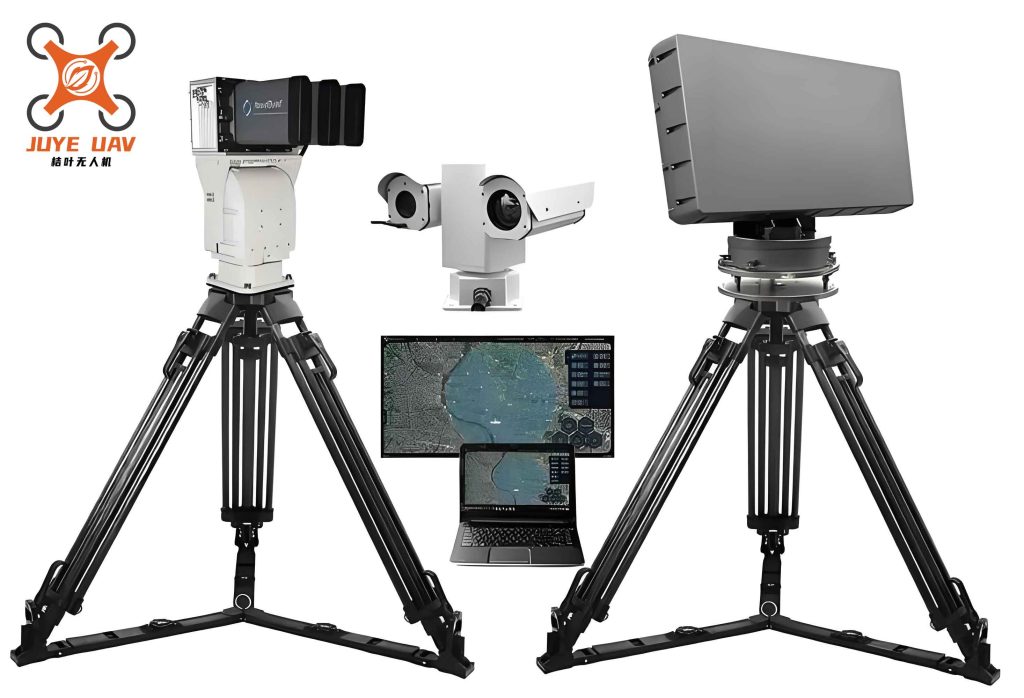
The first layer of any anti-drone system is reliable detection. Given the “low, slow, and small” (LSS) profile of many UAVs, no single sensor is sufficient. A fused, multi-spectral approach is necessary. The primary detection modalities are compared in Table 1.
| Technology | Principle | Advantages | Disadvantages |
|---|---|---|---|
| Radar | Emits RF waves and analyzes returns. | Long range, accurate tracking, all-weather. | Clutter issues for LSS targets, possible blind zones, stealth materials. |
| Electro-Optical/Infrared (EO/IR) | Captures visual or thermal imagery. | Good for identification, passive operation (IR). | Limited range (EO), weather-dependent, high false alarms. |
| Radio Frequency (RF) Sensing | Passively listens for drone C2/telemetry signals (e.g., 2.4 GHz, 5.8 GHz). | Passive, long range, can identify model via RF fingerprinting. | Ineffective against pre-programmed/autonomous drones; complex signal environment. |
| Acoustic Sensing | Detects and classifies unique acoustic signatures of drone motors/propellers. | Passive, low cost, good for perimeter defense. | Very short range, highly susceptible to ambient noise. |
Table 1: Comparison of Primary UAV Detection Technologies.
A robust detection network integrates data from ground-based radars, ship-based sensors, airborne early warning platforms, and even satellite cues. Sensor fusion algorithms are critical to correlating tracks, reducing false alarms, and providing a coherent air picture. The maximum detection range ($R_{max}$) for a radar can be estimated using the radar range equation, simplified for search:
$$R_{max} = \sqrt[4]{\frac{P_t G_t A_e \sigma}{(4\pi)^2 S_{min}}}$$
where $P_t$ is transmit power, $G_t$ is antenna gain, $A_e$ is effective aperture, $\sigma$ is target’s Radar Cross-Section (RCS), and $S_{min}$ is the minimum detectable signal. The small $\sigma$ of drones directly challenges $R_{max}$.
Phase 2: Mid-Course Disruption, Deception, and Soft-Kill
Once detected, the next layer aims to disrupt the UAV’s mission before it reaches its target. This “soft-kill” phase targets the drone’s reliance on navigation and communication links. Key anti-drone soft-kill methods are categorized below.
| Method | Mechanism | Effect | Considerations |
|---|---|---|---|
| GNSS Jamming | Broadcasts high-power noise on GPS/Galileo/GLONASS/BeiDou frequencies. | Denies positioning, causing navigation drift or hover/follow-home activation. | Broadcast, may affect friendly systems; less effective on drones with inertial navigation. |
| GNSS Spoofing | Broadcasts forged, but realistic, navigation signals. | Deceives drone into believing it is elsewhere, allowing controlled diversion. | Requires sophisticated technique; simultaneous jamming negates spoofing. |
| C2 Link Jamming | Jams the specific frequencies used for remote control and telemetry. | Severs pilot control, typically triggering failsafe (e.g., hover, return, land). | Requires knowledge of drone’s communication protocol; directional jamming is preferred. |
| Protocol Exploitation & Hijacking | Decrypts and replicates C2 protocols to send malicious commands. | Can take full control of drone, land it, or redirect it. Highly effective vs. commercial drones. | Requires extensive pre-mission analysis and preparation; specific to model/protocol. |
| Directional High-Power Microwave (HPM) | Focused RF pulses inducing high voltages in electronic circuits. | Fries internal electronics, causing permanent disablement (a soft-kill with hard effects). | Line-of-sight required; range depends on power output and focusing; potential collateral. |
Table 2: Categories of Anti-Drone Soft-Kill (Disruption/Deception) Technologies.
The effectiveness of jamming depends on the jamming-to-signal ratio (J/S). To successfully jam a C2 link, the power of the jamming signal ($P_j$) at the drone’s receiver must overcome the legitimate signal power ($P_s$). A simplified power balance considers the path loss ($L$):
$$J/S = \frac{P_j G_j G_{r}( \theta_j ) / L_j}{P_s G_t G_{r}( \theta_s ) / L_s} > M$$
where $G_j$ is jammer antenna gain, $G_{r}( \theta )$ is the drone receiver gain in the direction of the jammer or satellite, and $M$ is the required margin for successful jamming. Directional jammers maximize $G_j$ and $G_{r}( \theta_j )$ toward the target drone.
Phase 3 & 4: Terminal Hard-Kill and Point Defense
When disruption fails, physical destruction or capture is necessary. This terminal defense layer must be rapid, effective, and cost-efficient, especially against swarms. Options range from traditional kinetic systems to advanced directed-energy weapons (DEWs).
| Mechanism | Advantages | ||
|---|---|---|---|
| Kinetic Effectors (Guns, Missiles) | Physical impact/fragmentation. | High proven lethality, long range (missiles). | High cost-per-kill for cheap drones, magazine depth limited vs. swarms, collateral risk. |
| Net Guns / Capture Drones | Fires a net or uses a drone to entangle target. | Minimal collateral, allows for drone recovery/intel. | Very short range, requires precision, single target engagement. |
| High-Energy Laser (HEL) | Focused laser beam heats target to failure. | Light-speed engagement, deep magazine (limited by power), low cost-per-shot. | Atmospheric attenuation (rain, fog), line-of-sight, requires high power and tracking. |
| High-Power Microwave (HPM) | Broad-area or focused RF pulse. | Can engage multiple drones in cone, effective against electronics. | Shorter range than lasers, potential for friendly system damage. |
Table 3: Comparison of Terminal Anti-Drone Hard-Kill Measures.
The engagement timeline against a swarm is critical. A system’s maximum engagement rate ($E_{max}$) and the time to defeat a swarm ($T_{defeat}$) are key metrics. For a layered system with $n$ layers, each with its own probability of kill ($P_k$) and engagement rate, the overall effectiveness must be modeled. For a laser, the time to cause critical damage ($t_{damage}$) depends on laser power ($P_{laser}$), beam quality, target reflectivity ($\alpha$), and the specific energy required to defeat the material ($Q_{thresh}$):
$$ t_{damage} \approx \frac{Q_{thresh}}{\eta \cdot P_{laser} \cdot (1 – \alpha)} $$
where $\eta$ accounts for atmospheric transmission and beam focus. This highlights the need for high power and precise tracking for effective laser-based anti-drone defense.
Integrated Point Defense and Passive Measures
Finally, passive and active point defense for high-value assets is crucial. This includes:
Active Protection Systems (APS): Similar to tank APS, using interceptors or DEWs for last-second engagement.
Passive Protection: Physical barriers (nets, cages over sensitive areas), camouflage, decoys, and smoke screens to obscure targeting.
Electronic Hardening: Shielding critical communications and navigation systems from HPM effects.
An integrated air defense system must weave all these layers—detection, soft-kill, hard-kill, and passive defense—into a cohesive network. Command and control systems must process data in real-time, assign threats to appropriate effectors, and adapt to evolving swarm behaviors using AI-driven battle management.
Conclusion: The Imperative for an Adaptive Anti-Drone Ecosystem
The trajectory of warfare points towards increasingly autonomous, intelligent, and swarm-based unmanned systems. The operational advantages they confer in ISR, strike, and electronic warfare are undeniable. Therefore, the development of a resilient, multi-layered anti-drone defense system is not merely an option but a strategic necessity. From my analysis, success in this domain hinges on sensor fusion to overcome detection challenges, a blend of electronic attack and cyber exploitation for mid-course disruption, and a mix of cost-effective kinetic and novel directed-energy solutions for terminal defense. No single “silver bullet” exists; rather, victory will belong to forces that can best integrate these technologies into a responsive, adaptive, and networked anti-drone ecosystem. Future research must focus on AI-powered threat recognition, autonomous C2 for counter-swarm operations, and scalable effectors to ensure defense remains affordable and effective against the rising tide of intelligent aerial threats.