
The evolving threat landscape of modern maritime warfare is increasingly defined by the coordinated saturation attacks of unmanned aerial vehicle (UAV) swarms alongside traditional anti-ship missiles. This paradigm shift necessitates a fundamental re-evaluation of naval point defense strategies. Relying solely on conventional kinetic interceptors, such as missiles and guns, against low-cost, numerous drones presents severe challenges in terms of cost-effectiveness and magazine depth. Consequently, the integration of new physical principle weapons, specifically High-Energy Laser (HEL) and High-Power Microwave (HPM) systems, into the layered shipboard defense suite has become a critical research and operational focus. My analysis centers on the complex problem of firepower assignment for a single warship facing such a composite threat. The core challenge lies in optimally coordinating the use of these heterogeneous weapons—each with distinct engagement constraints and damage mechanisms—to maximize the probability of negating the incoming raid.
Effective anti-drone operations aboard naval platforms must account for diverse attack profiles. Typically, a carrier aircraft, which could be a manned platform or a large UAV, releases a swarm of smaller drones. These drones can be deployed either within or outside the ship’s primary defense zone. In a within-zone release scenario, the carrier penetrates close to the ship before deploying micro-drones intended to saturate sensors, provide terminal guidance, or clear a path for following missiles. The defensive response must prioritize engaging the carrier with long-range missiles, followed by a layered defense against the drone swarm using HPM for area defense and HEL/CIWS for precise point defense. Conversely, in a beyond-zone release, the carrier stays at a safe distance, launching medium-sized drones that fly at very low altitudes to coordinate a multi-axis attack with anti-ship missiles. Here, the defense may involve electronic countermeasures, followed by a dynamic mix of missile, laser, gun, and microwave engagements against both drones and missiles, capitalizing on the synergistic effects between different weapon types. A conceptual depiction of such a coordinated defensive engagement is provided below.
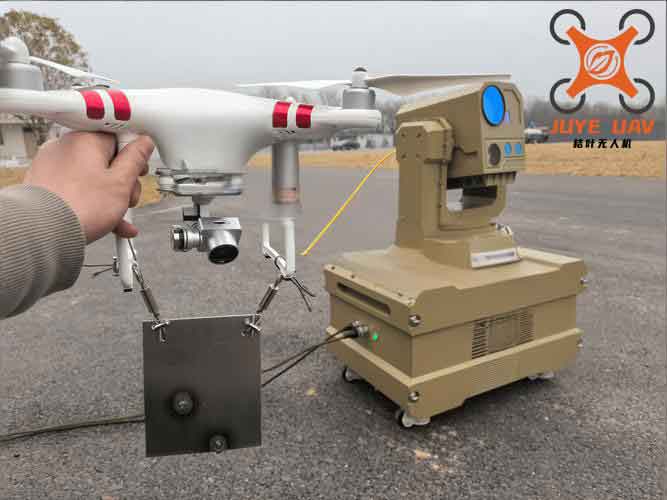
Operational Characteristics of Directed Energy Anti-Drone Weapons
The integration of HEL and HPM into fleet defense requires a deep understanding of their unique engagement physics and constraints, which differ markedly from kinetic weapons.
High-Energy Laser (HEL) Engagement
HEL systems inflict damage through the focused delivery of coherent optical energy onto a target, causing thermal ablation, structural failure, or ignition. Its advantages include speed-of-light engagement, low cost-per-shot, and deep magazines. However, its effectiveness is critically dependent on maintaining precise beam focus and dwell time on a specific aimpoint. The power density delivered to the target surface, a key determinant of damage, is given by:
$$ S_r^{(\text{HEL})} = \frac{P_0 \cdot D^2}{\pi \cdot (1.222 \cdot \beta \cdot \lambda \cdot R)^2} $$
where \( P_0 \) is laser power, \( D \) is transmitter aperture diameter, \( \beta \) is beam quality factor, \( \lambda \) is wavelength, and \( R \) is range to target. Damage is cumulative; achieving a given effect requires the delivered energy density (\( S_r \times \text{time} \)) to exceed the target’s damage threshold. Thresholds for typical UAV components are summarized below.
| Energy Density (J/cm²) | Critical Component | Damage Effect |
|---|---|---|
| ~700 | Electro-optical Sensors | Temporary dazzle or permanent damage |
| ~1,200 | Optical Windows/Lenses | Melting or cracking |
| ~1,800 | Fuel Tank / Hydraulic Lines | Ignition or rupture |
| ~3,200 | Composite Airframe (e.g., CFRP) | Penetration or structural failure |
High-Power Microwave (HPM) Engagement
HPM weapons deliver high-intensity electromagnetic pulses to disrupt, degrade, or destroy a target’s electronic systems. They offer a potent area-defense capability against drone swarms, with engagement speed at the speed of light and simple fire control. The primary kill mechanism is “front-door” coupling through the target’s own antennas, though “back-door” coupling through seams or cables is also possible. The power density incident on the target is:
$$ S^{(\text{HPM})} = \frac{P_t \cdot G_t}{4 \pi R^2} $$
where \( P_t \) is peak transmit power and \( G_t \) is transmit antenna gain. The power actually coupled into the target’s electronics depends on the receiving antenna’s effective area \( A_{\text{eff}} \) and gain \( G_r \):
$$ S_r^{(\text{HPM})} = S^{(\text{HPM})} \cdot G_r = \frac{P_t \cdot G_t \cdot A_{\text{eff}}}{(\lambda R)^2} $$
HPM effects range from temporary upset to permanent burnout, with approximate thresholds as follows.
| Power Density (W/cm²) | Effect on Electronics |
|---|---|
| 10⁻⁵ – 10⁻³ | Temporary upset (bit-flips, system resets) |
| 10⁻² – 10⁻¹ | Latent damage or performance degradation |
| 10¹ – 10² | Permanent damage (component burnout) |
| ≥ 10³ | Catastrophic failure (ignition of ordnance/fuel) |
Modeling Damage Probability with an Energy Relaxation Coefficient
A significant challenge in anti-drone planning with directed energy weapons is the inherent uncertainty in predicting hard-kill probability. Material responses under extreme thermal or electromagnetic stress are nonlinear and target-specific parameters are often unknown. To address this, I propose the concept of an Energy Damage Relaxation Coefficient, K. This coefficient acts as a safety or uncertainty margin. It posits that to achieve a desired damage level with high confidence, the delivered energy density should be a multiple \( K \) of the nominal material threshold \( \theta \). \( K = 1 \) implies perfect knowledge of the target; higher \( K \) values represent greater operational uncertainty. The effective damage probability \( P_{\text{eff}} \) for a given delivered energy \( E_{\text{del}} \) (where \( E_{\text{del}} = S_r \times t \) for HEL and \( E_{\text{del}} = S_r \) for HPM) is modeled using a parabolic function to reflect the nonlinear increase in kill likelihood as energy surpasses the required threshold:
$$ P_{\text{eff}} = \left( \frac{E_{\text{del}}}{K \cdot \theta} \right)^2 \quad \text{for } 0 \leq E_{\text{del}} \leq K \cdot \theta $$
$$ P_{\text{eff}} = 1 \quad \text{for } E_{\text{del}} > K \cdot \theta $$
This model captures the idea that simply meeting the threshold does not guarantee a kill, but exceeding it significantly increases the probability.
Furthermore, the effectiveness of HEL and HPM in a coordinated sequence is highly dependent on the target’s condition from prior engagements. This is modeled through conditional modifiers.
For HEL, the critical factor is the quality of fine tracking (\( P_{\text{track}} \)). If a prior engagement (e.g., HPM blast or gunfire) damages the UAV, its flight path and imagery may become erratic, hindering the HEL’s ability to acquire and hold aimpoint. This is modeled with a piecewise function dependent on the prior kill probability \( p_{\text{dm}} \) and the time interval \( t_{\text{Inv}} \) since that engagement relative to the HEL’s required fine-track time \( t_{\text{ftr}} \):
$$ P_{\text{track}}(p_{\text{dm}}, t_{\text{Inv}}, t_{\text{ftr}}) =
\begin{cases}
1, & p_{\text{dm}} = 0 \\
\min\left(\frac{t_{\text{Inv}}}{t_{\text{ftr}}}, 1\right), & 0 < p_{\text{dm}} \leq p_1 \\
0.1, & p_{\text{dm}} \geq p_2 \\
\min\left(\frac{t_{\text{Inv}}}{2 \cdot t_{\text{ftr}}}, 1\right), & \text{otherwise}
\end{cases} $$
Here, \( p_1 \) and \( p_2 \) (\( p_2 > p_1 \)) are thresholds representing minor and major target degradation, respectively.
For HPM, the key factor is the probability of coupling into the target’s electronics (\( P_{\text{enter}} \)). This increases if the target has no electromagnetic shielding or if a prior engagement (e.g., HEL or gun) has physically compromised the airframe, creating “back-door” entry points. Let \( df_{\text{tar}} \in \{0,1\} \) indicate the presence (1) or absence (0) of EM hardening, and \( p_{\text{en}} \) be the base front-door coupling probability for a hardened target.
$$ P_{\text{enter}}(df_{\text{tar}}, p_{\text{en}}, p_{\text{dm}}) =
\begin{cases}
df_{\text{tar}} \cdot p_{\text{en}} + (1-df_{\text{tar}})\cdot(1-p_{\text{en}}), & p_{\text{dm}} = 0 \\
\min\left( df_{\text{tar}} \cdot p_{\text{en}} + (1-df_{\text{tar}})\cdot(1-p_{\text{en}}) + p_{\text{dm}}, 1 \right), & \text{otherwise}
\end{cases} $$
The final kill probability for each weapon in a sequence is then:
$$ P_k^{(\text{HEL})} = P_{\text{track}} \cdot P_{\text{eff}}^{(\text{HEL})} $$
$$ P_k^{(\text{HPM})} = P_{\text{enter}} \cdot P_{\text{eff}}^{(\text{HPM})} $$
For kinetic weapons (missiles, guns), a fixed single-shot kill probability (SSPK) is typically used.
A Coordinated Firepower Assignment Model for Ship-Based Anti-Drone Defense
Integrating these concepts, I formulate a single-ship firepower assignment optimization model. The goal is to assign available weapon systems to incoming threats (UAVs and missiles) over time, minimizing the total weighted threat leakage.
Sets and Parameters:
– \( J \): Set of incoming threats, \( j = 1…N_J \), each with threat value \( V_j \).
– \( W \): Set of available weapon systems, \( w = 1…N_W \), each with type \( \text{typ}_w \), total inventory (or magazine) \( \text{NBu}_w \), and for HPM, an effective area coverage.
– \( Y_{wj} \in \{0,1\} \): Decision variable, 1 if weapon \( w \) is assigned to threat \( j \).
– \( [\text{wtf}_{wj}, \text{wtn}_{wj}] \): The assigned firing time window for weapon \( w \) against threat \( j \).
– \( [\text{wdf}_{wj}, \text{wdn}_{wj}] \): The allowable engagement range window.
– \( \text{num}_{wj} \): The amount of resource consumed (e.g., 1 interceptor, 1 time unit of dwell).
– \( P_{kj}(X) \): The cumulative kill probability on threat \( j \) given an ordered sequence of weapon assignments \( X = (X_1, X_2, …, X_n) \). This is computed recursively using the coordinated engagement model:
$$ P_{kj}(X_1,…,X_i) = 1 – \prod_{m=1}^{i} \left( 1 – P_k \left( P_{kj}(X_1,…,X_{m-1}) \, | \, X_m \right) \right) $$
where \( P_k(\cdot | X_m) \) is the conditional kill probability of weapon \( X_m \) given the target state resulting from previous engagements.
Optimization Model:
Objective: Minimize the Cumulative Threat Elimination Failure Rate.
$$ \text{Minimize: } \quad \frac{\sum_{j=1}^{N_J} V_j \cdot (1 – P_{kj})}{\sum_{j=1}^{N_J} V_j} $$
Subject to:
- Resource Constraints: Total consumption per weapon cannot exceed its inventory.
$$ \sum_{j=1}^{N_J} \text{num}_{wj} \leq \text{NBu}_w, \quad \forall w \in W $$ - Engagement Feasibility: A weapon can only engage a target within its feasible time and range windows.
$$ Y_{wj}=1 \Rightarrow \left( \text{wtf}_{wj}, \text{wtn}_{wj} \right) \subseteq \text{FeasibleTime}_{wj} \land \left( \text{wdf}_{wj}, \text{wdn}_{wj} \right) \subseteq \text{FeasibleRange}_{wj} $$ - Weapon Non-Simultaneity (for non-HPM): A weapon that cannot engage multiple targets simultaneously (e.g., HEL, gun, missile launcher) must have non-overlapping firing time windows.
$$ Y_{wj} \cdot Y_{wh} = 1 \Rightarrow \left( \text{wtf}_{wj}, \text{wtn}_{wj} \right) \cap \left( \text{wtf}_{wh}, \text{wtn}_{wh} \right) = \emptyset, \quad \forall j \neq h, \, \forall w | \text{typ}_w \notin \{\text{HPM}\} $$ - Logical Consistency: Weapons are assigned in a temporally logical order for each target (e.g., longer-range weapons fire first).
This model encapsulates the core decision problem in complex anti-drone defense: optimally scheduling and sequencing a mix of weapons with differing physics and constraints to defeat a coordinated raid.
Simulation Analysis & Intelligent Algorithm Performance
The formulated Firepower Assignment Problem (FAP) is a complex NP-hard combinatorial optimization problem, especially with the nonlinear, sequential kill probability calculations. I evaluated the performance of three distinct intelligent algorithms to solve it: Artificial Fish Swarm Algorithm (AFSA) representing parallel local search, Particle Swarm Optimization (PSO) representing social learning, and Differential Evolution Whale Optimization (DEWO) combining differential evolution with whale optimization strategies.
A scenario simulating a drone swarm coordinating with two anti-ship missiles was constructed. The algorithms were tasked with allocating a ship’s weapons (including missiles, a close-in weapon system (CIWS), a HEL, and an HPM system) against these threats to minimize the cumulative failure rate. Each algorithm was run for 200 independent trials. The convergence behavior and solution quality were analyzed.
The results clearly indicated that DEWO achieved the best overall performance. It consistently found solutions with the lowest failure rate (highest threat elimination), converged rapidly, and showed stable results across runs. PSO was fast but exhibited less stability, sometimes converging to suboptimal solutions. AFSA, while effective, was slower and generally found less optimal plans than DEWO. The average convergence times (in seconds) were: AFSA: 28.6, PSO: 10.5, DEWO: 19.5. This suggests that the differential evolution mechanism in DEWO provides a robust balance between exploration and exploitation, making it particularly suitable for this complex anti-drone FAP.
Sensitivity Analysis: Impact of the Energy Relaxation Coefficient (K)
A crucial aspect of this modeling approach is the sensitivity of the optimized fire plan to the uncertainty parameter \( K \). Using the DEWO and PSO algorithms, I conducted a sensitivity analysis by varying \( K \) from 1.2 to 6.0. For each value, 100 optimization runs were performed, and the characteristic convergence curves were compared.
The analysis yielded several key insights for anti-drone planning:
- Direct Correlation: As \( K \) increases, the optimized cumulative threat elimination failure rate also increases. This is intuitive: a higher required energy margin makes it harder for the directed energy weapons to achieve confident kills, reducing overall scheme effectiveness.
- Critical Range: The value of \( K \) has a pronounced impact on the optimization outcome within a specific range, approximately \( K \in [1.2, 2.2] \). Within this interval, the spread of achievable failure rates across different runs was large (spanning about 1.6 units on the normalized metric), indicating that the assumed uncertainty level significantly influences the “best” plan.
- Saturation Effect: For \( K > 2.2 \), up to 6.0, the variation in optimized failure rates between runs became much smaller (spanning about 1.0 unit). This suggests that beyond a certain point, increased uncertainty does not drastically alter the relative ranking or feasibility of different weapon-target pairings; the problem becomes consistently harder, and the solution space flattens.
- Algorithm Response: Interestingly, while \( K \) did not significantly affect DEWO’s convergence speed, a higher \( K \) value tended to accelerate the convergence of the PSO algorithm. This may be due to the smoother or more constrained solution landscape under high uncertainty, allowing the social learning mechanism to find a stable region faster.
This sensitivity analysis underscores the importance of empirically calibrating the \( K \) parameter through testing and intelligence. It provides commanders with a quantitative understanding of how confidence in weapon performance estimates translates to expected defensive outcomes.
Conclusion
This exploration into ship-based anti-drone firepower coordination presents a modeling framework that explicitly addresses the unique characteristics and synergies of next-generation directed energy weapons alongside traditional kinetic systems. By introducing the Energy Damage Relaxation Coefficient (K) and conditional probability modifiers for sequential engagements, the model captures critical operational uncertainties and interdependencies often overlooked in conventional fire assignment models. The formulation of the optimization problem to minimize cumulative threat leakage provides a militarily relevant objective function.
The comparative analysis of intelligent algorithms demonstrates that hybrid metaheuristics like Differential Evolution Whale Optimization are particularly effective at solving this complex, nonlinear assignment problem, offering a good compromise between solution quality, speed, and robustness. Furthermore, the sensitivity analysis reveals that the assumed level of uncertainty in weapon effectiveness (parameterized by K) is a major driver of planning outcomes, but its influence is most acute within a bounded range. This work provides a foundation for decision-support tools that can dynamically generate coordinated fire plans, enabling warships to more effectively counter the evolving threat of coordinated drone and missile swarms. Future work will focus on large-scale simulation to empirically bound realistic K values for various threat types and on developing dynamic rescheduling algorithms to handle rapidly changing tactical situations.