
The paradigm of naval aviation, centered on the aircraft carrier and its embarked air wing, has for decades defined power projection and sea control. From their humble beginnings as scouts for the battle fleet to becoming the primary strike arm of modern carrier strike groups (CSGs), carrier-based aircraft have undergone a revolutionary transformation. My analysis focuses on the most significant shift on the horizon: the inexorable integration and eventual dominance of unmanned systems within the carrier air wing. While traditional manned platforms like fighters, electronic warfare aircraft, and early warning planes remain crucial, the future vector points decisively toward advanced military UAV systems. This transition is driven by operational necessity, technological advancement, and the relentless pursuit of tactical advantage in increasingly contested maritime environments.
1. Historical Evolution and the Inevitability of Unmanned Systems
The genesis of carrier aviation dates to the early 20th century, a testament to human ingenuity in adapting flight for naval warfare. The progression from modified cruisers with wooden platforms to dedicated floating airfields was rapid. World War II cemented the carrier’s status, demonstrating that naval engagements would be decided beyond the horizon by aircraft, not by the range of naval guns. The post-war introduction of jet propulsion, angled decks, steam catapults, and optical landing systems represented a quantum leap, enabling higher-performance aircraft to operate from the rolling deck of a ship.
This historical trajectory reveals a constant theme: the carrier air wing evolves to maximize the reach, persistence, and survivability of its combat power. Manned aircraft pushed against physical limits of human endurance, platform size, and risk. The emergence of the military UAV is the logical next step in this evolution. Unmanned systems liberate design from human physiological constraints (allowing for higher-g maneuvers and extreme endurance), reduce risk to human life in high-threat environments, and offer a potentially more cost-effective force structure. The development history is thus not merely a chronicle of aircraft but a prelude to an autonomous future.
2. Deconstructing the Modern Carrier Air Wing: A Taxonomy
To understand where military UAV platforms will integrate, one must first comprehend the composition and function of a contemporary carrier air wing. It is a complex ecosystem of interdependent specialists. The table below categorizes these platforms, their primary missions, and identifies which roles are most susceptible to augmentation or replacement by unmanned systems.
| Category | Primary Mission | Key Characteristics | UAV Integration Potential |
|---|---|---|---|
| Fighter/Attack (e.g., F/A-18, F-35C) | Air Superiority, Strike, Interdiction | High performance, multi-role, manned. | High. Loyal wingman concepts; penetrating ISR/strike. |
| Airborne Early Warning & Control (e.g., E-2D) | Battle Management, Surveillance, C2 | Long endurance, large radar, manned crew. | Medium-High. Persistent radar node; risk reduction for AEW mission. |
| Electronic Warfare (e.g., EA-18G) | Electronic Attack, SEAD/DEAD | Specialized jamming, manned. | High. Stand-in/jamming platform; electromagnetic spectrum dominance. |
| Rotary Wing (Helicopters) | Anti-Submarine Warfare, Utility, Search & Rescue | Vertical take-off/landing, lower speed. | Medium. Already evolving (MQ-8B/C); extended ASW loiter. |
This taxonomy highlights that nearly every function has a potential unmanned counterpart. The driving equation for this shift can be framed in terms of cost-benefit and risk. Let us consider a simplified metric for mission effectiveness \(E\):
$$E = \frac{P_s \times C \times T}{R_c + R_h}$$
where:
- \(P_s\) = Probability of mission success
- \(C\) = Coverage area or capability density
- \(T\) = Time on station (endurance)
- \(R_c\) = Platform cost (acquisition, maintenance)
- \(R_h\) = Risk to human operators (a qualitative or weighted factor)
For many missions, a well-designed military UAV can significantly increase \(T\) (through endurance) and dramatically reduce \(R_h\) to near-zero, thereby increasing the overall effectiveness metric \(E\) even if \(P_s\) or \(C\) are initially slightly lower than a manned equivalent. This fundamental calculus is accelerating their adoption.
3. The Unique Crucible: Carrier Operating Environment
Operating from an aircraft carrier is arguably the most demanding discipline in aviation. Any discussion of carrier-based military UAV systems must be grounded in these harsh realities. The challenges are not merely scaled versions of land-based problems but are qualitatively different.
3.1 The Dynamic, Constrained Base: A carrier is a six-degree-of-freedom moving base (surge, sway, heave, roll, pitch, yaw) with a flight deck less than 1/10th the length of a typical land-based runway. This imposes severe constraints on launch and recovery systems. The classic equations of motion for an aircraft must be modified to account for the moving reference frame of the carrier at the moment of touchdown or catapult launch. The relative velocity and position are critical. For a recovery, the UAV must solve for a moving target point \(P_{carrier}(t)\) in 3D space, defined by:
$$P_{carrier}(t) = P_{carrier}(0) + \int_0^t V_{carrier}(t) \, dt + \delta_{oscillations}(t)$$
where \(\delta_{oscillations}(t)\) represents the complex, wind-and-sea-state-dependent deck motion. Autonomous landing systems for a military UAV must be vastly more precise and robust than any commercial autopilot.
3.2 The Corrosive Environment: Continuous exposure to salt spray, high humidity, and microbial growth accelerates corrosion. The corrosion rate \(R_{corr}\) for metals in a marine atmosphere is not linear and is often modeled as a function of time of wetness (\(TOW\)), chloride deposition rate (\(Cl^-\)), and temperature (\(T\)):
$$R_{corr} \propto f(TOW, [Cl^-], T)$$
UAV airframes and, more critically, their sensitive sensors (radar apertures, electro-optical windows) and propulsion systems require materials and coatings with far greater resistance than typical land-based systems, directly impacting design and lifecycle cost.
3.3 The Complex Air Wake: The aerodynamic environment behind a carrier is notoriously turbulent. The “burble” or “rooster tail” effect—a combination of steady-state and periodic disturbances—creates a hazardous zone for recovery. A military UAV must have a flight control system capable of rejecting these high-frequency disturbances without pilot input, requiring advanced adaptive control algorithms that can adjust in real-time to the measured flow field.
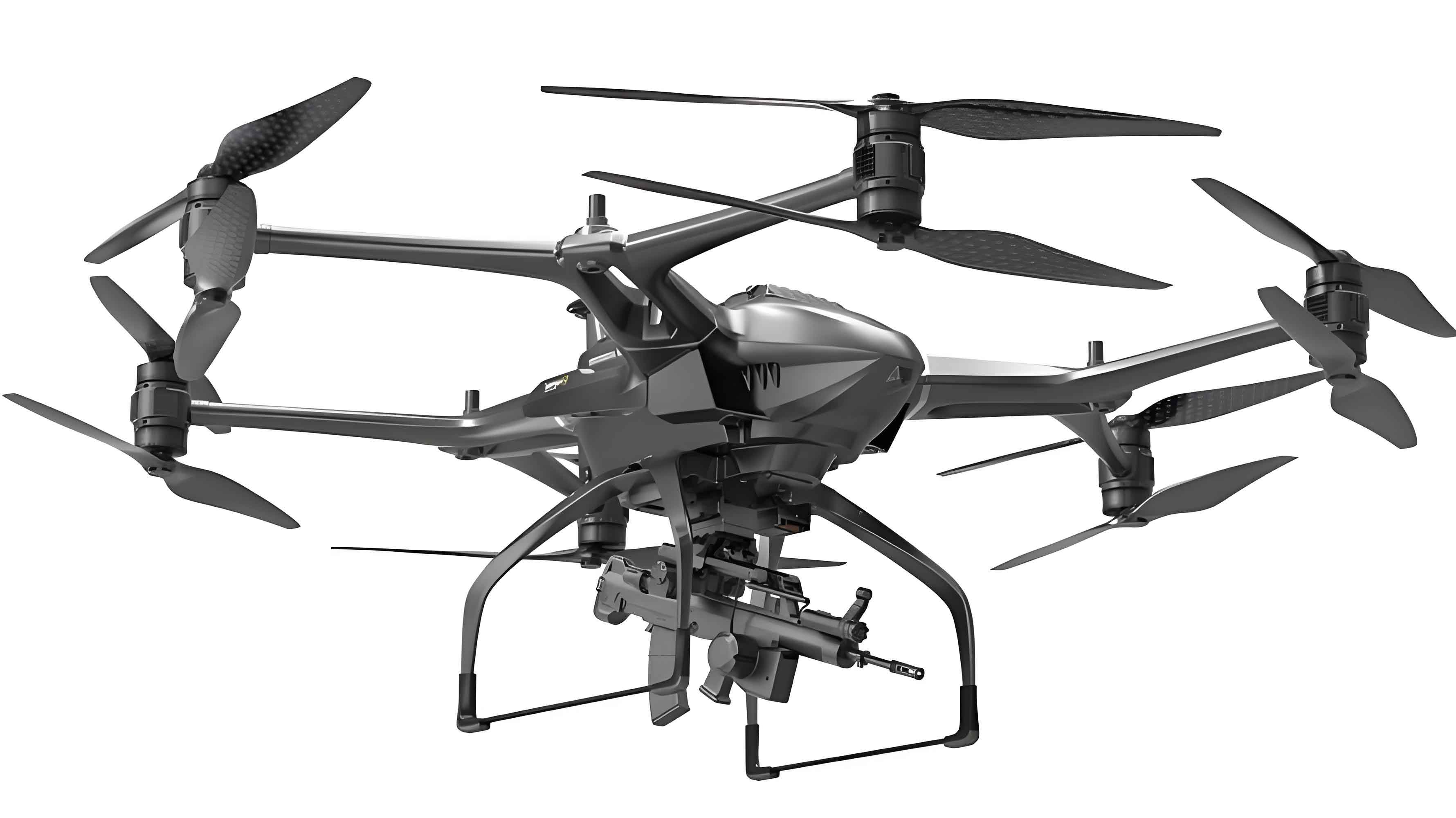
The image above starkly contrasts the traditional view of naval aviation with its future. It depicts a modern, stealthy military UAV, a system inherently suited to overcoming the environmental and tactical challenges just described. Its sleek, tailless design suggests low observability, critical for survivability in contested airspace, while its apparent compatibility with a naval setting hints at the core of this analysis: the seamless integration of unmanned systems into the fabric of carrier operations.
4. Technical Trends and Developmental Vectors for Carrier-Based Military UAVs
The future carrier air wing will be a “mosaic” force—a blend of manned and unmanned systems working in concert. The development of the carrier-based military UAV is focused on several key technological and operational vectors.
4.1 The Penetrating ISR/Strike Node: This is the role most famously prototyped by systems like the Northrop Grumman X-47B. The primary value proposition is persistence and survivability in denied environments. A stealthy, unmanned system can loiter for extended periods inside threat envelopes, conducting intelligence, surveillance, and reconnaissance (ISR) or delivering precision ordnance. Its effectiveness is not just in its payload, but in the decision-time compression it imposes on an adversary. Key technologies here include:
- Low-Observable (LO) Design: Minimizing radar cross-section (RCS) and infrared signature.
- Autonomous Aerial Refueling (AAR): Essential for extending range and endurance. This involves precise probe-and-drogue or boom-receptacle docking in turbulence.
- Advanced Comms and Data Links: Resilient, low-probability-of-intercept/low-probability-of-detection (LPI/LPD) links for command and control and data exfiltration.
4.2 The “Loyal Wingman” or Collaborative Combat Aircraft (CCA): This concept envisions lower-cost, attritable unmanned systems operating in teams with a manned “quarterback” aircraft (like an F-35). The manned aircraft provides high-level direction and leverages its superior sensors, while the UAVs act as sensor nodes, weapons magazines, or jammers. The tactical advantage is a force multiplier effect. If we model a formation’s combat potential \(P_{combat}\), a simple representation with \(n\) CCAs could be:
$$P_{combat} \approx P_{manned} + \sum_{i=1}^{n} (k_i \cdot P_{UAV_i})$$
where \(k_i\) is a synergy factor (often >1) representing the networked enhancement provided by the manned commander. The cost of losing one or more \(P_{UAV_i}\) is acceptable, protecting the high-value manned asset.
4.3 The Enabler and Suppressor: This category includes dedicated electronic warfare (EW) and early warning UAVs. An unmanned EW platform, derived from a stealthy airframe, can penetrate closer to enemy air defenses to suppress them, acting as a stand-in jammer. Similarly, a fixed-wing military UAV with an advanced AESA radar could provide a persistent, forward-based early warning and tracking capability, extending the sensor grid of the CSG. The technical demands mirror those of strike UAVs but emphasize payload power generation and thermal management for high-energy sensors and jammers.
4.4 The Organic Logistics and Mobility Platform: Beyond combat, UAVs offer transformative potential for carrier logistics. Vertical Take-Off and Landing (VTOL) or catapult-launched UAVs could conduct autonomous cargo and critical part transfer (COD missions) from supply ships to the carrier, or between ships in the strike group, reducing the burden on manned helicopters and increasing throughput.
5. Comparative Analysis: Manned vs. Unmanned for Carrier Operations
The following table synthesizes the core comparative advantages and challenges of integrating advanced military UAV systems versus continuing with traditional manned platforms.
| Aspect | Traditional Manned Aircraft | Advanced Military UAV (Carrier-Based) | Implication for Carrier Air Wing |
|---|---|---|---|
| Endurance | Limited by crew fatigue (8-10 hrs typical). | Limited by fuel/mechanical factors (24+ hrs possible). | UAVs enable persistent ISR and combat air patrols. |
| Survivability & Risk | High risk to pilot in contested airspace. Loss is political/human tragedy. | No risk to onboard crew. Loss is a material and intelligence cost. | Enables missions in high-threat areas deemed too risky for manned platforms. |
| G-Limits & Maneuverability | Limited by human physiology (~9 G). | Limited by airframe (potentially 15-20 G+). | UAVs can have superior kinematic performance for threat avoidance. |
| Size & Weight | Cockpit, life support systems add significant size/weight. | Can be more volumetrically efficient for fuel and payload. | Potentially smaller deck footprint or greater range/payload for same size. |
| Cognitive Load & Situational Awareness | Pilot in the loop for complex reasoning, adaptability in dynamic environments. | Dependent on AI/ML autonomy and off-board C2. Limited by sensor fusion and algorithm maturity. | Manned aircraft remain essential for command and complex decision-making; UAVs excel at predefined or supervised tasks. |
| Launch & Recovery | Mature procedures (catapult/arrestment or STOVL). Pilot skill intensive. | Requires new, highly reliable autonomous systems for same cycle. Failure modes are critical. | High development hurdle. Success (as with X-47B) proves feasibility but requires massive software assurance. |
| Lifecycle Cost | Very high acquisition, training, and sustainment costs. | Potentially lower per-unit acquisition and no pilot training cost. High R&D and software update costs. | Promise of a more affordable, larger force structure, but dependent on production scale and autonomy development. |
6. The Path Forward: Integration, Autonomy, and the Mosaic Force
The ultimate trend is not the wholesale replacement of manned aircraft but the creation of a integrated “mosaic” force. The carrier deck of 2040 will likely host a mix of 6th-generation manned fighters, loyal wingman CCAs, large penetrating ISR-strike military UAV systems, and specialized support UAVs. The core technological challenge is no longer just building a UAV that can land on a carrier—that has been proven—but rather building the command, control, communications, and computing (C4) architecture and the trusted autonomy to manage them effectively at the speed of relevance.
Key focus areas for the future include:
- Advanced Mission-Level Autonomy: Moving beyond waypoint navigation to systems that can dynamically re-task themselves within commander’s intent, collaborate with other UAVs (swarming), and handle contingencies like lost communications.
- Resilient Networking: Developing agile, mesh-based data links that can withstand electronic attack and ensure the flow of information between the CSG’s combat cloud and the dispersed military UAV fleet.
- Rapid Air Wing Reconfiguration: Software-defined payloads and modular designs will allow a single military UAV type to switch between ISR, EW, or strike roles based on mission needs, maximizing operational flexibility from the limited deck space.
- Human-Machine Teaming Interfaces: Developing intuitive control systems for air wing commanders and maintainers to manage a heterogeneous fleet of manned and unmanned assets without being overwhelmed by data or complexity.
The integration of military UAV systems into carrier aviation is the most significant evolution since the advent of the jet age. It responds directly to the operational environment’s constraints and the evolving threat. By combining the cognitive strength of the human warfighter with the endurance, risk tolerance, and potential cost-profile of unmanned systems, future carrier air wings will achieve a level of reach, flexibility, and power projection that redefines maritime dominance. The trajectory is clear: the unmanned system is not merely an adjunct to the carrier air wing; it is becoming its central nervous system and its leading edge.