
The evolution of unmanned aerial vehicles (UAVs) has profoundly impacted modern policing, offering unprecedented capabilities in surveillance, reconnaissance, and emergency response. While single-unit operations have become commonplace, a paradigm shift is underway towards coordinated fleets—police drone swarms. These swarms represent a transformative technology where multiple drones operate as a cohesive, intelligent unit, promising a quantum leap in policing efficacy. The core of this capability lies not merely in the number of drones but in the sophisticated command network that orchestrates them. This network transforms individual police drones from isolated tools into nodes of a distributed sensory and operational system.
The advantages of a police drone swarm over a single drone are substantial and address critical operational gaps. First, swarms can establish resilient communication relays. In remote or disaster-stricken areas where cellular networks are unavailable, a swarm can autonomously position its members to form a multi-hop communication bridge, extending command range and enabling real-time video feed from deep within the operational zone. Second, they provide expansive, multi-persistent surveillance. For large-scale public events or perimeter security, a swarm can blanket a vast area with overlapping fields of view, eliminating blind spots and enabling comprehensive situational awareness. Third, they enable rapid parallel search and tracking. A swarm can systematically canvass a large area for suspects, missing persons, or evidence far more quickly than a single unit or sequential searches by multiple independent drones. This collaborative intelligence allows for the dynamic tracking of multiple moving targets. Therefore, mastering the architecture and application of police drone swarm command networks is essential for law enforcement agencies to leverage this force multiplier effectively.
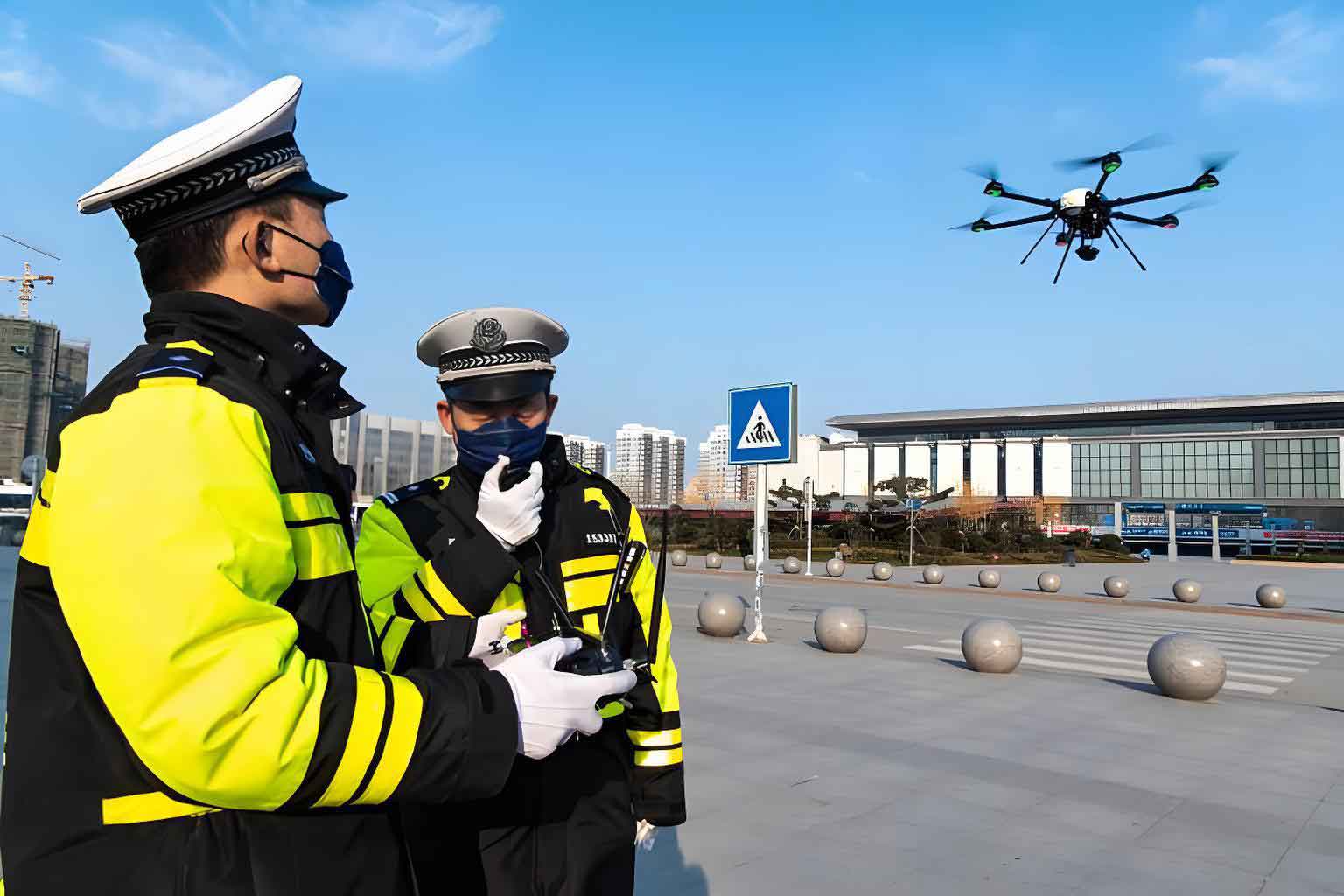
Constructing a robust and efficient command network for a police drone swarm requires the integration of several foundational technologies: a decentralized networking paradigm, a standardized communication protocol, a distributed operating system, and intelligent task allocation algorithms. This paper delves into each of these pillars, presents a layered architecture for the command network, and outlines application workflows for core policing tasks like search, tracking, and video dissemination.
1. Foundational Technologies for the Police Drone Swarm Network
The operational integrity of a police drone swarm hinges on its ability to maintain communication and coordination in dynamic, often unpredictable environments. The technologies outlined below form the bedrock of this capability.
1.1 Swarm Networking: The Ad-Hoc Paradigm
Network formation is fundamentally about efficient data transmission via electromagnetic waves. Traditional wireless networks like WiFi or 4G/5G rely on a star topology with fixed infrastructure (routers, cell towers) acting as central hubs. This model is ill-suited for a police drone swarm where all units are peers, and the network topology must be fluid to accommodate drones joining, leaving, or failing. The solution is the Mobile Ad-Hoc Network (MANET), specifically the IEEE 802.11 (WiFi) implementation in an ad-hoc mode.
The police drone swarm network employs this Ad-Hoc technology, creating a decentralized, peer-to-peer mesh topology. In this network, each police drone acts simultaneously as a communication endpoint and a router. When two drones are within direct wireless range, they communicate peer-to-peer. For drones beyond this range, data is relayed through intermediate drones in a multi-hop fashion. This dynamic routing capability ensures network resilience and extended operational range without relying on pre-existing infrastructure. The communication range between two drones can be modeled considering free-space path loss:
$$P_r = P_t + G_t + G_r – 20 \log_{10}(d) – 20 \log_{10}(f) – 147.55$$
where $P_r$ is received power (dBm), $P_t$ is transmitted power (dBm), $G_t$ and $G_r$ are antenna gains (dBi), $d$ is distance (meters), and $f$ is frequency (Hz). The Ad-Hoc network self-organizes to find paths that maintain $P_r$ above the receiver sensitivity threshold across multiple hops.
| Topology | Infrastructure Dependence | Scalability in Swarm | Fault Tolerance | Suitability for Police Swarm |
|---|---|---|---|---|
| Star (WiFi/4G/5G) | High (Fixed Hub) | Low (Hub Bottleneck) | Low (Single Point of Failure) | Poor |
| Mesh (Ad-Hoc) | None (Decentralized) | High (Distributed Routing) | High (Dynamic Re-routing) | Excellent |
1.2 Swarm Communication: The MAVLink Protocol
While the Ad-Hoc network handles the physical and network layers (L1 & L2 of TCP/IP), a common language is needed for drones to understand each other and the command center. This is the role of the communication protocol, governing the transport and application layers (L4 & L7). The de facto standard for lightweight UAVs, including typical police drones, is the Micro Air Vehicle Link (MAVLink) protocol (v2.3). It operates over UDP for reduced overhead, which is suitable for real-time command and telemetry streams.
MAVLink defines a precise packet structure that encapsulates messages. Each packet contains fields for start sign, length, sequence number, system/component IDs (identifying the source police drone and its internal parts), a message ID, payload data, and a checksum. This structure allows any node in the swarm—be it a ground control station (GCS) or another police drone—to parse and understand the incoming data unambiguously. The packet integrity is secured via a CRC-16 checksum ($C_{CRC}$) calculated over the payload and header:
$$C_{CRC} = \text{CRC16-CCITT-FALSE}([STX, LEN, SEQ, SYS, COMP, MSG, PAYLOAD])$$
where the polynomial is $0x1021$. Advanced packets also include a signature field for authentication, preventing spoofing of commands within the police drone network.
| Field | Size (Bytes) | Description | Purpose in Police Drone Swarm |
|---|---|---|---|
| STX | 1 | Start of Text (0xFD) | Packet delimiter |
| LEN | 1 | Payload Length (0-255) | Indicates how much data follows |
| SYS / COMP | 1 / 1 | System & Component ID | Uniquely identifies the source police drone and its subsystem (e.g., autopilot, camera) |
| MSG | 3 | Message ID | Identifies the message type (e.g., heartbeat, position, command) |
| PAYLOAD | LEN | Message Data | Contains the actual command or telemetry data |
| CKA, CKB | 2 | CRC-16 Checksum | Ensures data integrity during transmission |
1.3 Swarm Operating System: A Distributed Intelligence Framework
The police drone swarm operating system is a distributed software layer built atop the MAVLink communication fabric. It is the “brain” that manages resources, executes tasks, and maintains swarm cohesion. This system follows a multi-agent system (MAS) philosophy, where each police drone is an intelligent agent with both autonomy and a mandate for cooperation. The system is instantiated in two parts: the Master System at the Ground Control Center (GCC) and the Guardian System on each individual police drone.
The architecture can be conceptualized in two primary layers:
1. The System Layer (Master/Guardian): This layer is responsible for high-level task decomposition (at the Master) and local task execution monitoring (at the Guardian). The Master receives a global mission (e.g., “search area X for a red vehicle”), decomposes it into atomic sub-tasks, and allocates them. Atomic tasks are indivisible units relative to the swarm’s current capability and size. For instance, patrolling a specific sub-sector or streaming video from a given point is an atomic task.
2. The Self-Organization Layer: This layer, residing within the swarm, manages the dynamic inter-drone relationships via the Ad-Hoc network. Its key function is swarm reconfiguration—adapting the network and task distribution in response to triggers like mission change, drone failure, or environmental shifts. Reconfiguration can be proactive or reactive, and local or global.
The operational flow is a continuous loop: The Master System decomposes a mission and allocates atomic tasks via an allocation algorithm. The Guardian Systems execute tasks and feed status back. The Master monitors overall progress and swarm state, triggering reconfiguration in the Self-Organization layer when needed to maintain efficiency. This cycle ensures the police drone swarm remains adaptive and robust.
| Layer | Location | Primary Function | Key Processes |
|---|---|---|---|
| Master System Layer | Ground Control Center | Global Mission Management | Mission Decomposition, Static Task Allocation, Health Monitoring |
| Guardian System Layer | Individual Police Drone | Local Task Execution | Atomic Task Execution, Status Reporting, Dynamic Task Re-allocation |
| Self-Organization Layer | Distributed across Swarm | Network & Role Adaptation | Ad-Hoc Routing, Swarm Reconfiguration (Trigger: Fault, Environment, Mission) |
1.4 Swarm Task Allocation: From Static Optimization to Dynamic Contracts
Efficiently distributing work among police drones is critical. This process is divided into static (initial) and dynamic (runtime) allocation.
1.4.1 Static Task Allocation
This is performed by the Master System during mission planning. It is fundamentally a constrained multi-objective optimization problem. Given a set of $n$ atomic tasks $T = \{t_1, t_2, …, t_n\}$ and a swarm of $m$ police drones $D = \{d_1, d_2, …, d_m\}$, the goal is to find an assignment mapping $A: T \rightarrow D$ that optimizes objectives like total mission time, energy consumption, and resource utilization balance. The search space size is $m^n$. An optimization algorithm (e.g., based on decomposition like MOEA/D) evaluates potential assignments against a cost function $C(A)$:
$$C(A) = \alpha \cdot T_{\text{total}}(A) + \beta \cdot E_{\text{total}}(A) + \gamma \cdot U_{\text{imbalance}}(A)$$
where $T_{\text{total}}$ is estimated mission makespan, $E_{\text{total}}$ is total energy consumed, $U_{\text{imbalance}}$ is a measure of uneven resource use (computation, bandwidth), and $\alpha, \beta, \gamma$ are weighting coefficients. The Master selects the allocation $A^*$ that minimizes $C(A)$.
1.4.2 Dynamic Task Allocation
During operation, a police drone may become overloaded, fail, or move out of optimal position due to reconfiguration. The Guardian System on the affected drone uses a market-based approach, typically the Contract Net Protocol (CNP), to reallocate its tasks. The drone becomes a manager. It creates a Task Announcement for the task $t_x$ it wishes to offload and broadcasts it to neighbor drones (contractors). Each contractor $d_i$ evaluates its own capability and current load, then calculates a bid $B_i$ representing the cost (e.g., time, energy) to execute $t_x$:
$$B_i = f(\text{CPU}_i^{\text{avail}}, \text{Mem}_i^{\text{avail}}, \text{Batt}_i, \text{dist}(d_i, \text{loc}(t_x)))$$
The manager collects bids and awards the contract to the drone with the most favorable bid (e.g., lowest cost), transferring the task via MAVLink. This decentralized mechanism allows the police drone swarm to self-heal and optimize continuously.
2. Architecture of the Police Drone Swarm Command Network
Integrating the aforementioned technologies yields a three-tiered architecture for the command network, comprising the Network, System, and Application layers. The physical hardware consists of the Ground Control Center (GCC) and the police drone swarm itself.
Network Layer: This corresponds to the lower layers of the communication stack. It utilizes Ad-Hoc (distributed MAC & Network layer) and MAVLink over UDP (Transport & Application layer) to provide a resilient, standardized communication fabric for the entire system.
System Layer: This is the intelligence core. At the GCC, it houses the Master System and the Static Task Allocator. In the swarm, each police drone runs a Guardian System with a Dynamic Task Allocator module. This layer is responsible for translating application-layer commands into executable actions across the swarm, managing resources, and ensuring coordinated behavior.
Application Layer: This resides at the GCC and interfaces with the police operator. It is where high-level mission commands are generated—for example, defining a search geofence, selecting a target template, or initiating tracking. This layer can be integrated into existing Police Information Systems via secure VPN tunnels.
The data flow is streamlined: An operator defines a mission at the Application Layer. The System Layer’s Master component decomposes and allocates it. Commands and data flow through the Network Layer’s MAVLink/Ad-Hoc stack to the designated police drones. Telemetry and results flow back through the same path, creating a closed-loop command and control system.
3. Application Workflows for Core Policing Tasks
The true value of the police drone swarm command network is realized in concrete operational workflows. Two fundamental and interconnected workflows are target search/tracking and live video feed acquisition.
3.1 Police Target Search and Tracking
3.1.1 Search Workflow: The objective is to efficiently locate a target (person, vehicle, object) within a defined area.
- Mission Initiation: An operator at the GCC defines a search polygon and provides target descriptors (e.g., visual features, thermal signature) via the Application Layer.
- Task Decomposition: The Master System acquires the number $n$ of available police drones via MAVLink heartbeat signals. It then partitions the search area into $n$ sub-areas, creating $n$ atomic “sector search” tasks $\{s_1, s_2, …, s_n\}$.
- Static Allocation: The Static Task Allocator solves the optimization $A^*: \{s_j\} \rightarrow \{d_i\}$ based on drone position, battery, and sensor capability. The Master sends the tasks to the assigned drones.
- Parallel Execution: Each police drone executes its sector search pattern (e.g., lawnmower). Its Guardian System runs perception algorithms on sensor data. Upon detection, it packages the target’s geolocation $\mathbf{p}_t = (lat, lon, alt)$ into a MAVLink message and sends it to the GCC. A null result is also reported.
- Result Fusion: The GCC aggregates all reports, providing the operator with a unified search result picture.
3.1.2 Tracking Workflow: Once a target is located, the swarm must maintain contact.
- Track Initiation: The operator selects a located target from the GCC interface to track.
- Target State Query: The GCC issues a continuous MAVLink command to the swarm, effectively asking: “Which drone can see the target now, and what is its updated position $\mathbf{p}_t^{‘}$?” The swarm self-organizes, with the drone best positioned to observe the target (the “tracker drone”) responding.
- State Update & Network Optimization Check: The GCC updates the target’s state. It also evaluates if the current swarm formation provides a strong enough communication link ($P_r$ from tracker to GCC) for the expected data stream. A link margin $L_m$ is calculated:
$$L_m = P_r^{\text{min hop}} – P_{\text{rx,sens}}$$
If $L_m < L_{\text{threshold}}$, network optimization is needed. - Swarm Reconfiguration: A reconfiguration trigger is sent via the Master System. The Self-Organization layer executes, potentially repositioning drones to strengthen the communication chain from the tracker drone back to the GCC, all while maintaining the track. The loop returns to Step 2.
3.2 Live Video Feed from Police Target
For decision-making, real-time visual intelligence is paramount. This workflow integrates with tracking, controlling the gimbal and camera of the tracker drone.
- The operator requests a live video feed for a tracked target.
- The target’s coordinates $\mathbf{p}_t$ are fed to both the Tracking Workflow and the video application module.
- The application module sends MAVLink Camera Protocol messages (e.g., `MAV_CMD_REQUEST_VIDEO_STREAM_INFORMATION`) to the current tracker drone, initiating a video stream.
- The Master System fuses the incoming video stream with the updated target coordinates from the tracker. It assesses whether the target is centered in the video frame. A misalignment vector $\Delta \mathbf{\theta}$ is computed from the image plane coordinates.
- If $\|\Delta \mathbf{\theta}\| > \epsilon$, a MAVLink Gimbal Protocol command (`COMMAND_DO_GIMBAL_CONTROL`) is sent to the tracker drone to adjust its gimbal yaw and pitch by $\Delta \mathbf{\theta}$, ensuring the target remains in view.
- The updated drone position (after any movement for tracking) is fed back into the Tracking Workflow, closing the loop. This creates a continuous cycle of track-update-gimbal-adjust to maintain a stable video feed on the moving police target.
4. Conclusion
The transition from single police drone operations to coordinated swarm deployments marks a significant advancement in law enforcement technology. The efficacy of such a swarm is not inherent in the drones themselves but is engineered through a sophisticated command network. This network, built on the pillars of Ad-Hoc mesh networking, the MAVLink communication protocol, a distributed operating system, and intelligent task allocation algorithms, creates a resilient, adaptive, and intelligent system. The proposed three-tiered architecture—Network, System, Application—provides a clear framework for implementation. Finally, the defined workflows for search, tracking, and video acquisition translate this technical architecture into tangible operational procedures, enabling police drone swarms to provide unparalleled situational awareness, rapid response, and effective area denial. As this technology matures, it will become an indispensable tool for public safety, enhancing the ability of law enforcement to protect communities with greater efficiency and reduced risk. The future of aerial policing lies in the collaborative intelligence of the swarm.