
As a radio frequency engineering specialist, I have observed with great interest the transformative shifts in radio management policies and their practical applications in emerging technologies. The recent regulatory updates, particularly those facilitating amateur radio access for minors and ensuring robust无线电安全保障 for large-scale drone light shows, mark a significant leap toward harmonizing with international standards and fostering innovation. In this comprehensive analysis, I will explore these developments from a first-person perspective, delving into technical details, regulatory frameworks, and future implications. The convergence of radio technology and spectacular displays like drone light shows underscores the importance of adaptive spectrum management in the modern era.
The revision of amateur radio regulations, which now allows minors to set up and operate certain业余无线电台, represents a progressive step. Previously, restrictions limited such activities to adults, but the new rules align with global practices, promoting scientific literacy and youth involvement in radio communications. This change is encapsulated in the updated管理办法, which specifies parameters for未成年 operators. For instance, the permissible frequency range and power limits are clearly defined. To summarize the key changes, consider the following table comparing the old and new provisions:
| Aspect | Old Regulations (Pre-2024) | New Regulations (Effective March 1, 2024) |
|---|---|---|
| Age Requirement | Must be 18 years or older for transmitting stations | Minors permitted under specific conditions |
| Frequency Range | No specific restriction for minors (as they were barred) | 30–3000 MHz for minors |
| Maximum Transmit Power | Varies by license class | ≤ 25 watts for minors |
| International Alignment | Limited | Enhanced, following ITU recommendations |
This regulatory shift can be analyzed through the lens of radio wave propagation theory. The allowed frequency range for minors, 30–3000 MHz, encompasses VHF and UHF bands, which are known for their relatively stable propagation characteristics in urban and suburban environments. The power limit of 25 watts ensures minimal interference while enabling meaningful communication. The received power \(P_r\) at a distance \(d\) from a transmitter can be estimated using the Friis transmission equation:
$$P_r = P_t G_t G_r \left( \frac{\lambda}{4\pi d} \right)^2$$
Here, \(P_t\) is the transmitted power (capped at 25 W for minors), \(G_t\) and \(G_r\) are the antenna gains of the transmitter and receiver, respectively, and \(\lambda\) is the wavelength. For a typical scenario at 144 MHz (within the 30–3000 MHz range), with \(\lambda \approx 2.08\) meters, and assuming isotropic antennas (\(G_t = G_r = 1\)), the received power at 1 km distance would be:
$$P_r = 25 \times 1 \times 1 \times \left( \frac{2.08}{4\pi \times 1000} \right)^2 \approx 6.7 \times 10^{-7} \, \text{W}$$
This low power level minimizes interference risks, aligning with the regulatory intent to facilitate safe youth participation. Moreover, the signal-to-interference-plus-noise ratio (SINR) for such systems can be expressed as:
$$\text{SINR} = \frac{P_s}{P_n + \sum_{i=1}^{N} P_i}$$
where \(P_s\) is the desired signal power, \(P_n\) is the noise power, and \(P_i\) represents interference from other sources. By restricting power and frequencies, regulators effectively reduce \(\sum P_i\), enhancing overall spectrum efficiency. This foundation in amateur radio sets the stage for more complex applications, such as drone light shows, which rely heavily on precise radio control.
Turning to drone light shows, these performances have become increasingly popular worldwide, combining artistry with advanced technology. A drone light show involves hundreds or thousands of unmanned aerial vehicles (UAVs) equipped with LEDs, synchronized via radio commands to form dynamic patterns in the sky. The无线电安全保障 for such events is paramount, as any interference could lead to malfunctions or accidents. In a recent large-scale drone light show—featuring over 1,400 UAVs—meticulous radio management ensured a seamless spectacle. The success of this drone light show hinged on comprehensive planning and real-time monitoring, which I will detail through technical analyses and tables.
The electromagnetic environment for a drone light show is complex, with multiple systems operating simultaneously. Key components include the command-and-control links, telemetry data streams, and sometimes supplemental navigation signals. To illustrate, here is a table summarizing typical radio parameters for a large drone light show:
| System Component | Frequency Range | Power Level | Modulation Type | Purpose |
|---|---|---|---|---|
| Command & Control | 2.4 GHz or 5.8 GHz ISM bands | < 1 W per drone | FHSS or DSSS | Send flight commands |
| Telemetry | 433 MHz or 915 MHz | < 100 mW | FSK | Transmit drone status |
| Synchronization Beacon | Specific licensed bands | ~ 5 W | OFDM | Coordinate timing across fleet |
| Spectator Links | FM broadcast bands | ~ 10 W | FM | Audio accompaniment |
In practice, the drone light show coordination requires a detailed保障方案 to mitigate interference. For the aforementioned event, authorities deployed mobile monitoring vehicles and fixed stations to scan the spectrum continuously. The probability of interference \(P_{\text{int}}\) can be modeled based on the density of emitters and their power levels. If we consider \(N\) drones in a show, each with a transmit power \(P_t\) and bandwidth \(B\), the aggregate interference power \(I_{\text{agg}}\) in a given channel is:
$$I_{\text{agg}} = \sum_{j=1}^{N} P_{t,j} \cdot L_j \cdot \chi_j$$
where \(L_j\) is the path loss for drone \(j\), and \(\chi_j\) represents fading effects. For a drone light show in an urban area, path loss often follows a log-distance model:
$$L(d) = L_0 + 10 \cdot n \cdot \log_{10}\left(\frac{d}{d_0}\right) + X_\sigma$$
Here, \(L_0\) is the reference loss at distance \(d_0\), \(n\) is the path loss exponent (typically 2–4 for urban environments), and \(X_\sigma\) is a Gaussian random variable for shadowing. By conducting pre-event surveys and using such models, engineers can predict and mitigate hotspots of interference. The drone light show’s success relied on this proactive approach, ensuring that the signal-to-noise ratio (SNR) for critical links remained above a threshold, say 20 dB, defined as:
$$\text{SNR} = 10 \log_{10}\left(\frac{P_s}{P_n}\right)$$
During the event, real-time spectrum monitoring tracked parameters like occupancy and power spectral density. The following table outlines the monitoring metrics used for the drone light show安全保障:
| Monitoring Metric | Target Value | Measurement Tool | Action Trigger |
|---|---|---|---|
| Channel Occupancy | < 60% in command bands | Spectrum analyzer | Switch to backup frequency |
| Peak Power Density | < -50 dBm/Hz in control links | Mobile monitoring vehicle | Identify and locate interferers |
| Bit Error Rate (BER) | < 10^{-6} for telemetry | Software-defined radio | Adjust modulation scheme |
| Latency | < 100 ms for commands | Network analyzers | Optimize routing protocols |
The visual grandeur of a drone light show is breathtaking, and it hinges on flawless radio communication.
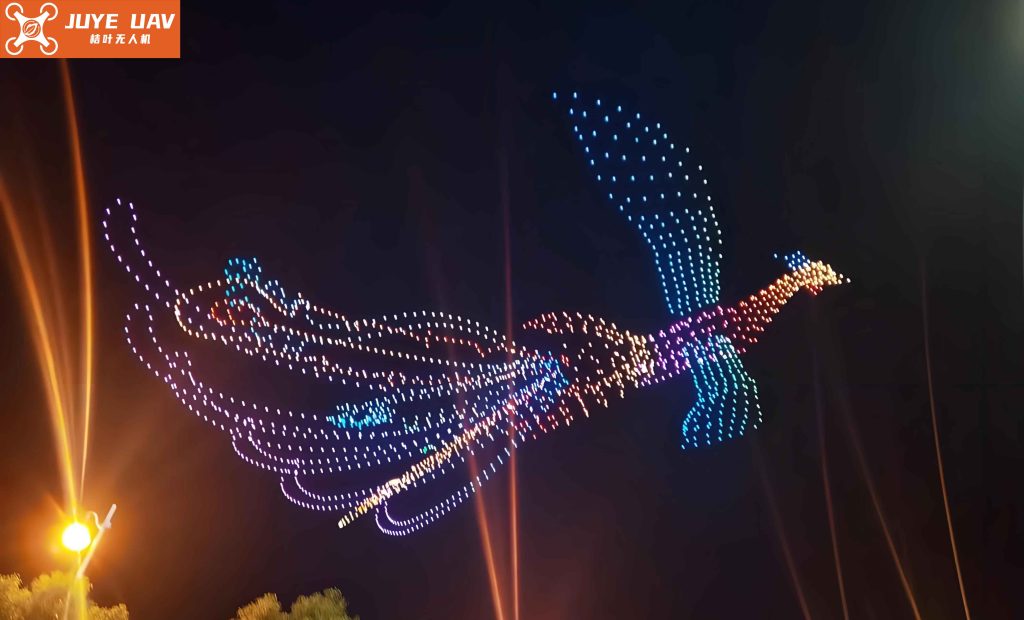
This image captures the essence of such a performance, where each drone acts as a pixel in a sky-bound display. From my experience, the synchronization精度 required for a drone light show is achieved through time-division multiple access (TDMA) schemes, where each drone is allotted a specific time slot for commands. The timing error \(\Delta t\) must be minimal to avoid misalignment; it can be expressed as:
$$\Delta t = \frac{\Delta f}{f_0} \cdot T + \tau_{\text{prop}}$$
where \(\Delta f\) is the frequency offset, \(f_0\) is the nominal clock frequency, \(T\) is the frame duration, and \(\tau_{\text{prop}}\) is the propagation delay. For a drone light show with 1,411 drones, if each command frame lasts 10 ms and propagation delays are under 1 μs (given short ranges), the aggregate timing budget is tightly managed. This precision is why radio保障 is so critical; even minor interference can distort \(\Delta f\) via phase noise, degrading the show’s quality.
Beyond the spectacle, the principles applied in drone light show无线电安全保障 extend to broader low-altitude economy initiatives, such as drone-based logistics and infrastructure inspection. The same radio management techniques—frequency coordination, interference analysis, and real-time monitoring—are essential for scaling these applications. For instance, in drone logistics, where UAVs deliver packages, reliable command links are vital for safety. The capacity \(C\) of such a radio link, based on Shannon’s theorem, is:
$$C = B \log_2\left(1 + \text{SINR}\right)$$
where \(B\) is the bandwidth. By ensuring high SINR through effective management, we can support data-intensive operations like real-time video feeds from drones. This synergy between entertainment and practical applications demonstrates the versatility of modern radio systems.
Furthermore, the regulatory evolution supporting youth amateur radio intersects with drone technology education. Minors learning radio basics through hands-on experience may later contribute to advancing drone light show technologies. The permitted frequency range of 30–3000 MHz includes bands used for drone telemetry, offering a practical training ground. For example, a teenager building a low-power业余无线电台 could experiment with antenna design to optimize gain \(G\), which is given by:
$$G = \frac{4\pi A_e}{\lambda^2}$$
where \(A_e\) is the effective aperture. Such skills are transferable to designing robust links for drone light shows. Additionally, the power limit of 25 watts aligns with typical drone transmitter powers, fostering an understanding of interference mitigation from an early age.
In conclusion, the recent advancements in radio management, from inclusive amateur licensing to rigorous drone light show安全保障, reflect a forward-thinking approach that balances innovation with safety. As someone involved in this field, I anticipate that these trends will accelerate the growth of low-altitude economies and democratize radio technology access. The mathematical models and tables presented here underscore the technical rigor behind these efforts. Future developments may see even more integrated systems, where drone light shows incorporate adaptive radio protocols based on real-time spectrum sensing, further enhancing their resilience and spectacular impact. By continuing to refine regulations and leveraging engineering insights, we can ensure that the radio spectrum remains a vibrant enabler of both artistic expression and technological progress.