
The proliferation of unmanned aerial vehicles (UAVs), or drones, has ushered in an era of both immense opportunity and significant security challenges. While drones are invaluable tools for applications ranging from aerial photography to logistics and infrastructure inspection, their potential for malicious use—such as unauthorized surveillance, contraband delivery, espionage, or even coordinated attacks—poses a grave threat to critical infrastructure, public safety, and national security. Traditional anti-drone systems, which primarily rely on radar, radio frequency (RF) scanners, and electro-optical/infrared (EO/IR) sensors, are increasingly struggling to meet the demands of modern asymmetric threats. These legacy systems often suffer from high false alarm rates, difficulty in detecting low-altitude, low-speed, small radar cross-section (RCS) drones, and a lack of real-time, automated response capabilities, especially in complex urban or cluttered environments.
The integration of Artificial Intelligence (AI), and specifically Deep Learning (DL), presents a paradigm shift in counter-unmanned aerial systems (C-UAS). This article explores the design and implementation of a next-generation anti-drone system centered on AI-assisted recognition. We propose a comprehensive framework that leverages deep neural networks for robust target detection, classification, and tracking, enabling intelligent threat assessment and automated, layered defensive responses. By moving beyond simple detection to contextual understanding and prediction, AI transforms passive sensor grids into active, intelligent anti-drone networks.
1. Analysis of AI-Assisted Recognition Technology for Anti-Drone Applications
The core limitation of traditional anti-drone methods lies in their reliance on pre-defined, often rigid, signal or signature libraries. Radar systems can be confused by ground clutter or bird flocks; RF detection fails against pre-programmed or autonomous drones not actively transmitting; and EO/IR systems require clear line-of-sight and can be overwhelmed by manually monitoring multiple video feeds. AI-assisted recognition addresses these shortcomings by learning the distinguishing features of drones directly from vast amounts of multi-modal sensor data.
The technological cornerstone of this approach is Deep Learning, particularly Convolutional Neural Networks (CNNs) for visual data and recurrent architectures for temporal sequence analysis. These models excel at extracting hierarchical features—from simple edges and textures to complex shapes and patterns—that define a “drone” amidst background noise. This capability is fundamental for reliable anti-drone operations. Key technological pillars include:
- Advanced Feature Extraction: Modern CNN architectures like EfficientNet or CSPDarknet can automatically learn discriminative features for drones of various sizes, shapes, and orientations, even under partial occlusion or poor lighting conditions.
- Multi-Sensor Data Fusion: AI provides the framework to synergistically combine data from disparate sources (Radar, RF, EO/IR, acoustic). A neural network can learn to correlate a radar track with a visual signature and a specific RF emission, creating a composite, high-confidence track that any single sensor could not achieve. This fusion is critical for reducing false positives and achieving positive identification.
- Real-Time Target Detection and Classification: Single-stage object detectors like the YOLO (You Only Look Once) family or anchor-free detectors are engineered for high-speed inference. They can process sensor feeds in real-time, drawing bounding boxes around potential drones and classifying them (e.g., multi-rotor vs. fixed-wing, specific model) simultaneously.
- Robust Multi-Object Tracking (MOT): Detection alone is insufficient for an effective anti-drone system. Tracking algorithms, enhanced by deep appearance descriptors, maintain the identity of each drone over time, predicting its trajectory and enabling behavioral analysis (e.g., loitering, approach vector).
The following table contrasts the capabilities of traditional methods versus AI-enhanced approaches in key dimensions relevant to anti-drone defense.
| Operational Dimension | Traditional Methods | AI-Assisted Recognition |
|---|---|---|
| Detection in Clutter | Poor; high false alarms from birds/background. | Excellent; CNN filters learn semantic drone features. |
| Classification Accuracy | Low; based on basic parameters (speed, size). | High; identifies specific drone models and types. |
| Adaptation to New Threats | Slow; requires manual signature updates. | Fast; can be retrained with new data on new drone models. |
| Behavioral Analysis | Minimal; limited to simple rule-based alerts. | Advanced; uses tracking and sequence models to identify hostile intent (e.g., swarm patterns). |
| System Autonomy | Low; heavy reliance on human operators. | High; enables automated detection-to-engagement workflows. |
2. Design of an AI-Centric Anti-Drone System
2.1 Overall System Architecture
A holistic AI-powered anti-drone system is built on a layered, distributed architecture that facilitates data flow from sensing to engagement. This design ensures scalability, resilience, and real-time performance. The four primary layers are:
- Perception Layer: This is the sensor grid comprising a heterogeneous mix of devices: 3D surveillance radars for long-range detection, pan-tilt-zoom (PTZ) EO/IR cameras for visual confirmation and tracking, RF spectrum analyzers to detect communication links, and sometimes acoustic arrays. Their fused data forms the raw input for the AI engine.
- Processing & AI Layer: The brain of the system. Edge computing nodes near sensors perform initial data preprocessing and lightweight inference (e.g., running a compact YOLO model on camera feed). A central AI server aggregates all sensor data for robust fusion, running sophisticated models for:
- Target Detection & Identification: Using CNNs to find and classify drones in imagery and radar plots.
- Multi-Sensor Fusion: Employing algorithms like Kalman Filters or Deep Neural Networks to correlate tracks from different sources into a single, accurate “system track.”
- Multi-Target Tracking: Maintaining track histories and predicting future states.
- Decision & Command Layer: This layer translates AI outputs into actionable intelligence. It performs dynamic threat assessment (discussed in Section 3.1) and, based on pre-defined rules of engagement (ROE), recommends or autonomously selects a countermeasure. It manages the overall defensive strategy, especially against drone swarms.
- Countermeasure (Effect) Layer: The “muscle” of the system. It consists of various neutralization technologies that can be deployed based on the decision layer’s command. These are often used in a layered defense strategy.
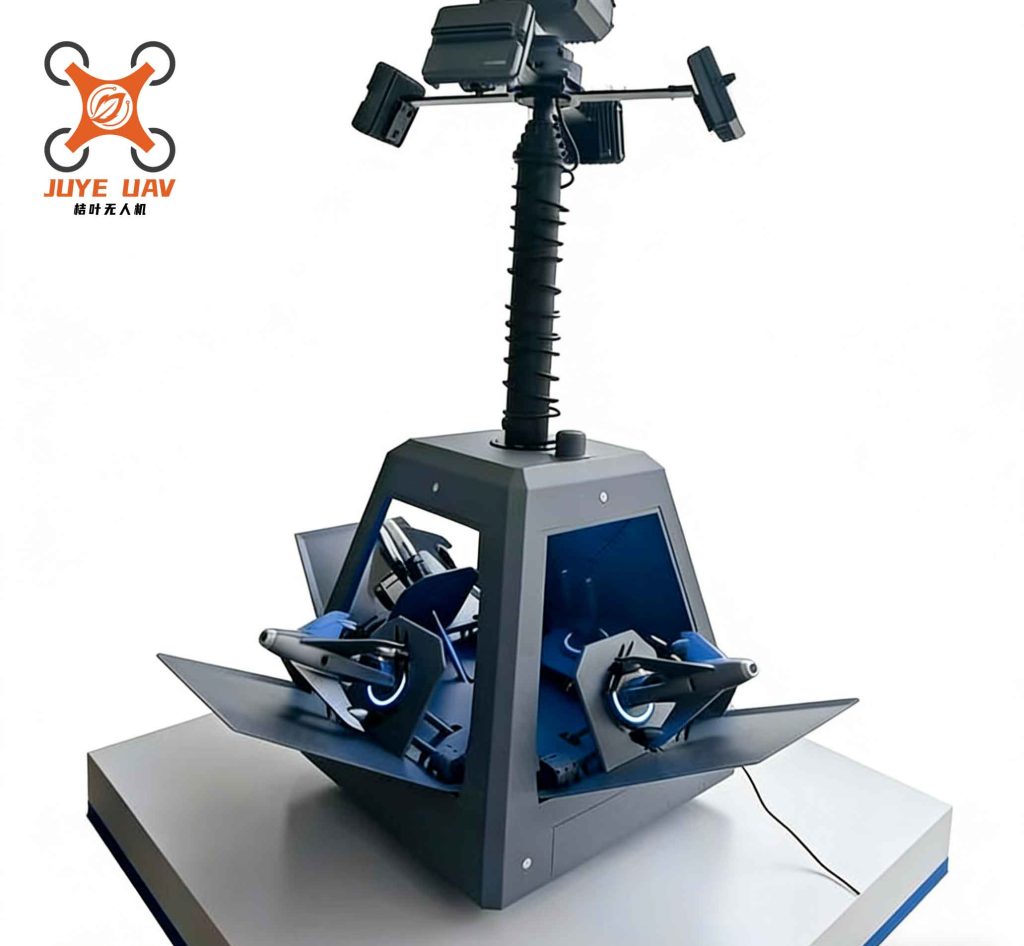
2.2 Design of the Intelligent Recognition Module
The intelligent recognition module is most commonly implemented using a state-of-the-art object detection network. Let’s consider an advanced model like YOLOv7 or a similar transformer-based detector (e.g., DETR). The challenge in anti-drone detection is the typically small size of the target in the image, especially at long ranges.
The model is trained on a large, curated dataset containing thousands of annotated images and video frames of drones in various environments (urban, rural, day, night, against cluttered backgrounds). Data augmentation techniques (rotation, scaling, changing brightness/contrast, adding noise) are critical to ensure robustness. The loss function the model optimizes during training is a multi-part function, crucial for accurate anti-drone performance:
$$
L_{total} = \lambda_{coord} L_{coord} + \lambda_{obj} L_{obj} + \lambda_{cls} L_{cls}
$$
Where:
- $L_{coord}$ is the bounding box regression loss (e.g., Complete-IoU loss), ensuring precise localization of the drone.
- $L_{obj}$ is the objectness loss, which measures the confidence that a bounding box contains an object. Techniques like Focal Loss can be used here to address the foreground-background class imbalance.
- $L_{cls}$ is the classification loss (e.g., cross-entropy), ensuring correct identification of the drone type.
- $\lambda_{coord}$, $\lambda_{obj}$, $\lambda_{cls}$ are weighting coefficients that balance the importance of each task.
The output of this module for each frame is a set of bounding boxes with associated class labels (e.g., “quadcopter,” “fixed-wing”) and confidence scores. This forms the primary input for the tracking and threat assessment subsystems.
2.3 Multi-Target Tracking Algorithm
Tracking is essential to understand drone behavior. A popular and effective paradigm is tracking-by-detection, where the detector’s output in each frame is associated with existing tracks. The DeepSORT algorithm is a classic example, enhanced for anti-drone purposes. Its core components are:
- Motion Prediction with Kalman Filter: For each active track, a Kalman Filter predicts its position in the next frame based on its current state (position, velocity).
- Appearance Feature Extraction: A small CNN (e.g., a lightweight ResNet) extracts a deep feature vector from the image patch inside each detection’s bounding box. This “appearance descriptor” is unique to the visual characteristics of that specific drone and is stored with the track.
- Data Association: This is the matching step. A cost matrix is computed that combines:
- Motion Affinity: The Mahalanobis distance between the predicted Kalman state and the new detections.
- Appearance Affinity: The cosine distance between the stored track appearance descriptor and the descriptors of new detections.
The final association metric $C_{i,j}$ for matching track $i$ with detection $j$ can be a weighted sum:
$$ C_{i,j} = \alpha \cdot d^{(1)}_{i,j} + (1-\alpha) \cdot d^{(2)}_{i,j} $$
where $d^{(1)}$ is the motion distance, $d^{(2)}$ is the appearance distance, and $\alpha$ is a tunable parameter. Hungarian algorithm is then used to find the optimal matching that minimizes the total cost. - Track Management: Logic handles the birth of new tracks (unmatched detections), confirmation of tentative tracks, and termination of lost tracks.
This algorithm allows the system to maintain the identity of multiple drones simultaneously, providing a continuous track history essential for trajectory analysis and intent prediction.
3. Anti-Drone Defense Strategy and Implementation
3.1 Threat Assessment Based on Recognition Outputs
AI recognition provides the raw data—”what is it and where is it going”—but translating this into a threat level requires a higher-level assessment module. This module takes the outputs from the detector and tracker (class, confidence, location, speed, trajectory history) and evaluates them against the protected site’s security policy. A multi-dimensional quantitative model can be employed. The overall threat score $T$ for a tracked drone can be computed as a weighted sum of factor scores:
$$
T = w_f \cdot S_f + w_b \cdot S_b + w_e \cdot S_e
$$
Where:
- $S_f$ is the Factor Score for Target Features (e.g., based on drone class/size/payload capacity). A large industrial drone scores higher than a hobbyist model.
- $S_b$ is the Factor Score for Observed Behavior (e.g., based on trajectory: direct approach vs. loitering vs. bypassing). Erratic movement or a direct heading towards a critical point increases the score.
- $S_e$ is the Factor Score for Environmental Context (e.g., proximity to no-fly zone, time of day, ongoing public event). Intrusion during a sensitive event raises the threat level.
- $w_f$, $w_b$, $w_e$ are the respective weights, summing to 1, reflecting the defense priority (e.g., a military base might weight $S_f$ more heavily, while an airport might weight $S_b$ more).
The following table exemplifies how different parameters can be quantified within this framework for an anti-drone system at an airport.
| Assessment Factor | Parameter / Observed State | Quantified Score (S) |
|---|---|---|
| Target Features (Sf) | Class: Large Commercial/Industrial Drone | 0.9 |
| Class: Consumer Hobbyist Drone | 0.4 | |
| Inferred Payload: Suspected package | +0.3 | |
| Behavior (Sb) | Trajectory: Direct ingress towards runway | 0.8 |
| Trajectory: Stationary loitering over perimeter | 0.6 | |
| Speed: High speed (> 20 m/s) approach | +0.2 | |
| Environment (Se) | Location: Inside inner restricted airspace | 0.9 |
| Time: During active takeoff/landing sequence | +0.5 | |
| Weather: Clear visibility (high intent assumption) | +0.1 |
3.2 Intelligent Defense Decision-Making
Once a threat level $T$ is calculated, the system must decide on a response. This can be modeled as a policy $\pi(s)$ that maps the system state $s$ (containing all track and threat data) to an action $a$ (a countermeasure). Modern approaches use Reinforcement Learning (RL) or rule-based expert systems informed by AI.
A simplified rule-based decision logic could be:
- If $T < \theta_{alert}$, continue monitoring. (Low threat)
- If $\theta_{alert} \leq T < \theta_{soft}$, initiate non-kinetic “soft-kill” measures. (Medium threat)
- Action: Deploy directional RF jamming to disrupt the drone’s control and navigation links.
- If $T \geq \theta_{hard}$, escalate to kinetic or capture measures. (High threat)
- Action: Activate a high-power microwave system to fry its electronics, or launch an interceptor net drone.
Where $\theta_{alert}$ and $\theta_{hard}$ are pre-configured threat thresholds. An RL-based system would learn the optimal policy $\pi^*(s)$ through simulation, maximizing a reward function $R$ that encourages threat neutralization while minimizing collateral damage and resource cost.
3.3 Design of a Cooperative Defense Mechanism
Effective anti-drone defense, especially against swarms, requires coordination. A cooperative defense network involves multiple, geographically distributed systems (nodes) communicating and acting in concert. Key aspects include:
- Shared Situational Awareness: All nodes share their local tracks and threat assessments via a secure data link, building a Common Operational Picture (COP).
- Resource Orchestration: A central or decentralized scheduler assigns defense tasks. For example, if Drone A is within range of both Node 1’s jammer and Node 2’s net launcher, the system decides which node responds based on effectiveness, probability of success, and cost.
- Swarm Defense Strategies: Against swarms, the AI can classify the swarm’s formation and behavior. The cooperative network can then execute complex tactics: one node uses broadband jamming to disrupt swarm communications, while others use spatially focused countermeasures to pick off key “leader” drones or create gaps in the swarm formation. The decision to engage individual drones or the swarm as a cohesive unit can be modeled as an optimization problem.
Let $E = \{e_1, e_2, …, e_m\}$ be the set of enemy drones in a swarm and $D = \{d_1, d_2, …, d_n\}$ be our defensive assets. The goal is to find an assignment matrix $X$ (where $x_{ij}=1$ if asset $d_i$ engages drone $e_j$) that maximizes the overall expected neutralization probability while respecting constraints (e.g., engagement time, resource depletion). A simplified objective could be:
$$
\max_X \sum_{i=1}^{n} \sum_{j=1}^{m} P_{ij}(x_{ij}) \cdot V_j
$$
subject to $\sum_{j} x_{ij} \leq 1$ (one asset engages one target at a time) and other constraints. Here, $P_{ij}$ is the probability of successful neutralization, and $V_j$ is the threat value of drone $e_j$.
4. System Experimental Validation and Performance Analysis
To validate the proposed AI-centric anti-drone framework, a prototype system was deployed and tested in a controlled environment simulating critical infrastructure protection. The test scenario included single drones and coordinated swarms of up to 5 UAVs (commercial quadcopters and custom fixed-wing models) performing various intrusion patterns.
Sensor Suite: A mid-range 3D radar, two PTZ EO/IR cameras, and an RF scanner were integrated.
AI Backend: A server with dual NVIDIA GPUs ran the YOLOv7-based detector (trained on a custom dataset of 15,000 drone images) and the DeepSORT tracker.
Countermeasures: A directional RF jammer and a net-capture UAV were integrated for response.
The system’s performance was measured against key anti-drone metrics. The results, averaged over 50 test runs, are summarized below:
| Performance Metric | Single Drone Scenario | Swarm (3-5 Drones) Scenario | Notes / Conditions |
|---|---|---|---|
| Detection Probability (Pd) | 98.7% | 95.1% | At ranges < 1.5 km, daytime, clear weather. Slight drop in swarm due to occlusion. |
| False Alarm Rate (per hour) | 0.3 | 1.2 | Mainly caused by large birds at extreme range. Higher in swarm due to increased sensor activity. |
| Mean Time to Accurate Classification | 1.2 seconds | 2.5 seconds | Time from first detection to class ID with >90% confidence. |
| Tracking Accuracy (ID F1 Score) | 0.96 | 0.87 | Measures ability to maintain correct drone identity over time. Lower in dense swarms. |
| End-to-End System Latency | 2.8 seconds | 4.1 seconds | Time from drone entering detection zone to threat assessment & countermeasure command. |
| Successful Neutralization Rate* | 94% | 81% (breakup) | *When countermeasure was triggered. Swarm strategy focused on disrupting coordination. |
The experiments demonstrated the clear superiority of the AI-assisted system over a baseline configuration using traditional signal-processing detection and manual tracking. The AI system reduced the operator’s workload by over 70% by automating detection and initial classification. The threat assessment model successfully categorized threats, preventing unnecessary escalation in 85% of benign intrusion scenarios (e.g., a lost hobbyist drone). The cooperative logic effectively managed the two countermeasures, choosing jamming first in 88% of medium-threat cases and escalating to net capture only when jamming proved ineffective or the threat score crossed the hard threshold.
The primary challenges observed were the degradation of visual detection performance at dusk/dawn and the increased computational load during swarm engagements, suggesting the need for further optimization and potentially dedicated swarm detection neural networks.
5. Conclusion and Future Outlook
The integration of Artificial Intelligence into anti-drone systems marks a fundamental leap from reactive sensing to proactive, intelligent defense. As demonstrated, AI-assisted recognition solves core deficiencies of traditional systems: it dramatically improves detection and classification accuracy in complex environments, enables robust tracking and behavioral analysis, and provides the decision-support foundation for automated, layered countermeasures. The proposed architecture—combining a multi-sensor perception layer, a central AI processing brain, an intelligent decision layer, and a coordinated countermeasure layer—forms a scalable blueprint for modern C-UAS solutions.
The future of AI in anti-drone defense lies in several promising directions. First, the development of lightweight yet powerful neural networks for deployment on edge sensors will reduce latency and improve system resilience. Second, advanced AI techniques like Meta-Learning could enable systems to adapt to novel drone models with minimal new training data. Third, the use of more sophisticated Multi-Agent Reinforcement Learning (MARL) will enhance the autonomous coordination of distributed anti-drone networks against intelligent, adaptive swarms. Finally, the fusion of AI with emerging directed-energy weapons and cyber-takeover capabilities will create more nuanced and scalable defeat mechanisms. As drone technology continues to evolve, so too must our defenses; AI-powered recognition and response stand as the most potent and adaptable shield in this ongoing technological contest.