
As a safety engineer specializing in emergency response, I have long been concerned with the limitations of traditional methods in hazardous chemical warehouse fire incidents. These environments pose severe risks, including toxic gas leaks, explosions, and rapid fire spread, which often hinder rescue personnel from accessing the site safely. The inability to gather real-time data compromises decision-making and increases the potential for secondary disasters. In recent years, I have explored the integration of fifth-generation (5G) mobile communication technology with unmanned aerial vehicles (UAVs), specifically fire UAVs, as a transformative approach. This combination addresses critical gaps in surveillance, monitoring, and intervention, offering a robust framework for enhancing emergency rescue operations. In this article, I will delve into the technical aspects, applications, and future prospects of 5G-enabled fire UAVs, employing tables and formulas to summarize key concepts and ensure clarity.
The advent of 5G technology marks a significant leap in wireless communications, characterized by unprecedented speed, low latency, and massive connectivity. These attributes are crucial for real-time emergency response. To quantify 5G performance, consider the following parameters often cited in research:
| Parameter | 5G Specification | Impact on Fire UAV Operations |
|---|---|---|
| Peak Data Rate | Up to 10 Gbps | Enables ultra-high-definition video streaming (e.g., 4K/8K) from fire UAVs. |
| Latency | As low as 1 ms | Facilitates real-time remote control and immediate feedback for rescue commands. |
| Connection Density | 1 million devices/km² | Supports extensive IoT sensor networks and multiple fire UAVs in a coordinated fleet. |
| Bandwidth | Wide spectrum (e.g., mmWave) | Allows for large data volumes from various payloads like thermal cameras and gas detectors. |
These features can be modeled mathematically. For instance, the data rate \( R \) in a 5G network can be approximated using the Shannon-Hartley theorem:
$$ R = B \log_2(1 + \text{SNR}) $$
where \( B \) is the bandwidth and SNR is the signal-to-noise ratio. In emergency scenarios, high \( R \) ensures that video feeds from a fire UAV are transmitted without compression loss, crucial for accurate situational awareness. Similarly, latency \( L \) is critical for control loops; it can be expressed as:
$$ L = t_{\text{propagation}} + t_{\text{transmission}} + t_{\text{processing}} $$
With 5G, \( L \) is minimized to milliseconds, enabling precise maneuvering of fire UAVs in dynamic fire environments. This low latency is vital for tasks like avoiding obstacles or targeting灭火剂 delivery.
Fire UAVs, or drones tailored for firefighting, have evolved from simple recreational devices to sophisticated tools. Their design incorporates features that make them ideal for hazardous chemical incidents. I summarize the core characteristics in the table below:
| Characteristic | Description | Advantage in Hazardous Chemical Fires |
|---|---|---|
| Mobility and Flexibility | Lightweight, portable, and capable of vertical take-off and landing. | Rapid deployment without reliance on ground infrastructure; accesses confined or dangerous areas. |
| Cost-Effectiveness | Lower acquisition and operational costs compared to helicopters or specialized vehicles. | Reduces financial burden on rescue departments; allows for scalable deployment of multiple fire UAVs. |
| Comprehensive Surveillance | Equipped with high-resolution cameras, infrared sensors, and wide-angle lenses. | Provides aerial views for global assessment of fire spread, gas plumes, and structural integrity. |
| Payload Versatility | Modular design allowing attachment of various instruments (e.g., gas detectors, loudspeakers). | Adapts to specific incident needs, such as detecting toxic gases or delivering emergency supplies. |
| Autonomy and AI Integration | Capable of pre-programmed flights or AI-driven decision-making. | Enhances efficiency in repetitive tasks like patrols or search missions, reducing human error. |
The effectiveness of a fire UAV in surveillance can be quantified by its coverage area \( A \) over time \( t \), given by:
$$ A(t) = v \times w \times t $$
where \( v \) is the velocity and \( w \) is the sweep width of its sensors. For instance, a fire UAV flying at 10 m/s with a sensor width of 50 m can cover 500 m² per second, vastly outperforming ground teams. Furthermore, the payload capacity \( P_{\text{max}} \) dictates the types of equipment it can carry, such as灭火剂 tanks or communication relays, following the relation:
$$ P_{\text{max}} = m_{\text{UAV}} \times g \times \text{thrust-to-weight ratio} $$
where \( m_{\text{UAV}} \) is the mass of the fire UAV and \( g \) is gravitational acceleration. Advanced fire UAVs are engineered to maximize \( P_{\text{max}} \) for robust rescue operations.
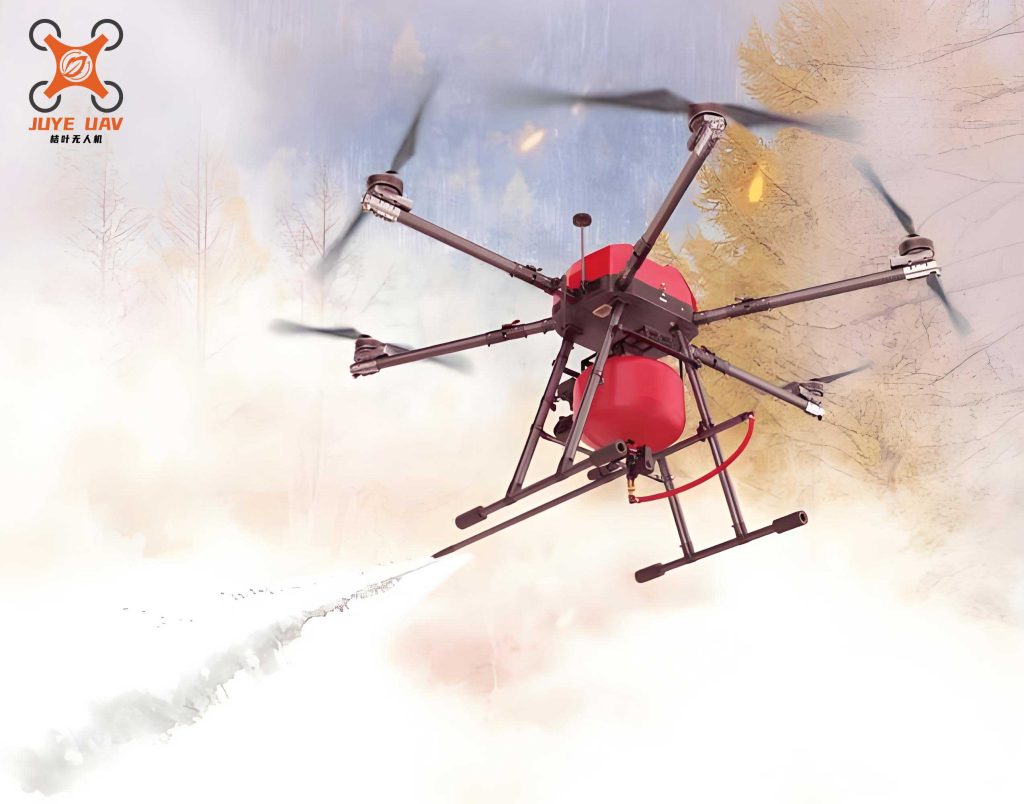
Integrating 5G with fire UAVs unlocks synergistic applications that transcend traditional limitations. The high bandwidth and low latency of 5G networks enable real-time data transmission and remote control, transforming fire UAVs into intelligent nodes in an emergency response ecosystem. Key applications include omnidirectional monitoring, live command coordination, high-definition直播, and automated inspections. For example, in a hazardous chemical warehouse fire, multiple fire UAVs can be deployed simultaneously, each streaming 4K video to a command center. The data rate required for such streams can be calculated as:
$$ R_{\text{video}} = \text{resolution} \times \text{frame rate} \times \text{color depth} \times \text{compression factor} $$
Assuming 4K resolution (3840 × 2160 pixels), 30 fps, 24-bit color, and moderate compression, \( R_{\text{video}} \) approximates 50 Mbps, well within 5G capabilities. This allows commanders to view live feeds without lag, making informed decisions swiftly. Moreover, 5G facilitates network slicing, where dedicated virtual networks prioritize fire UAV communications over other traffic, ensuring reliability. The table below contrasts traditional methods with 5G-enhanced fire UAV approaches:
| Aspect | Traditional Methods | 5G-Enhanced Fire UAV |
|---|---|---|
| Reconnaissance | Manual scouts or ground robots; slow and risky. | Aerial fire UAVs with real-time 4K/IR feeds; fast and safe. |
| Data Transmission | Reliant on limited 4G or satellite; high latency. | 5G networks with <10 ms latency; instantaneous updates. |
| Multi-Agent Coordination | Challenging due to communication gaps. | Seamless fleet control via 5G; synchronized missions. |
| Environmental Sensing | Point measurements by handheld devices. | Continuous 3D mapping and gas dispersion modeling by fire UAVs. |
The control loop for a remotely operated fire UAV via 5G involves several stages: sensor data acquisition, transmission to the cloud, processing at the command center, and command回传. The total time delay \( T_{\text{total}} \) must satisfy:
$$ T_{\text{total}} = 2 \times T_{\text{propagation}} + T_{\text{processing}} \leq T_{\text{critical}} $$
where \( T_{\text{critical}} \) is the maximum allowable delay for stable control (e.g., 100 ms for precise maneuvers). With 5G, \( T_{\text{propagation}} \) is negligible, enabling real-time teleoperation even over long distances. This is crucial for tasks like navigating through smoke or deploying灭火剂 accurately.
In hazardous chemical warehouse fire emergencies, 5G-enabled fire UAVs serve multifaceted roles. I categorize these into accident detection and inspection, real-time monitoring, auxiliary firefighting, and emergency communication and rescue. Each application leverages the unique capabilities of fire UAVs, enhanced by 5G connectivity.
Accident Detection and Inspection: Upon incident onset, fire UAVs are dispatched to perform initial assessments. Equipped with specialized payloads like multi-gas detectors or spectrometers, they can identify hazardous substances without endangering personnel. The concentration of a toxic gas \( C(x,y,z,t) \) detected by a fire UAV can be modeled using diffusion equations:
$$ \frac{\partial C}{\partial t} = D \nabla^2 C – \mathbf{v} \cdot \nabla C + S $$
where \( D \) is the diffusion coefficient, \( \mathbf{v} \) is wind velocity, and \( S \) is the source term. Fire UAVs provide spatial data points to solve this equation numerically, predicting plume spread. A fleet of fire UAVs can perform coordinated inspections, covering large areas efficiently. The inspection efficiency \( \eta \) is given by:
$$ \eta = \frac{N_{\text{detections}}}{N_{\text{total targets}}} \times 100\% $$
With 5G, \( \eta \) approaches 100% due to real-time data fusion and AI analysis. For instance, fire UAVs can use machine learning algorithms to recognize chemical containers or leak patterns from aerial imagery, transmitting findings instantly to responders.
Real-Time Monitoring: Continuous surveillance of fire dynamics is essential for adaptive response. Fire UAVs with thermal cameras capture temperature distributions \( T(x,y,t) \), which can be analyzed to identify hotspots or structural weaknesses. The heat flux \( q \) from a fire source observed by a fire UAV follows Stefan-Boltzmann law:
$$ q = \epsilon \sigma T^4 $$
where \( \epsilon \) is emissivity and \( \sigma \) is the Stefan-Boltzmann constant. By monitoring \( q \) over time, commanders assess fire intensity and prioritize interventions. Additionally, 5G enables live streaming of 360-degree VR footage, providing immersive views of the site. This requires high data throughput, achievable with 5G’s multi-gigabit speeds. The table below summarizes monitoring parameters and their significance:
| Parameter Monitored by Fire UAV | Measurement Tool | Utility in Emergency Response |
|---|---|---|
| Gas Concentrations (e.g., CO, H₂S) | Electrochemical sensors | Determines evacuation zones and detects explosion risks. |
| Temperature Profiles | Infrared thermography | Identifies fire cores and predicts flashover events. |
| Structural Deformations | LiDAR or photogrammetry | Assesses building stability to prevent collapses. |
| Meteorological Data (wind speed/direction) | Anemometers | Models pollutant dispersion and fire spread direction. |
Auxiliary Firefighting: Beyond surveillance, fire UAVs can actively participate in suppression efforts. They can carry and discharge灭火剂, such as foam or dry powder, targeting inaccessible areas. The discharge rate \( Q \) of a fire UAV’s灭火剂 system is critical:
$$ Q = A_{\text{nozzle}} \times v_{\text{ejection}} $$
where \( A_{\text{nozzle}} \) is the nozzle area and \( v_{\text{ejection}} \) is the ejection velocity. Optimizing \( Q \) maximizes灭火 efficiency. For example, a fire UAV hovering above a chemical tank can apply灭火剂 directly onto the flame, cooling the surface and inhibiting vapor release. Moreover, fire UAVs can deploy ignition devices for controlled burns of flammable gases, reducing explosion hazards. The effectiveness of such interventions depends on precise targeting, enabled by 5G’s low-latency control. In some designs, fire UAVs operate in swarms, where协同灭火 is coordinated via 5G mesh networks. The total灭火剂 delivered \( V_{\text{total}} \) by \( n \) fire UAVs over time \( t \) is:
$$ V_{\text{total}} = \sum_{i=1}^{n} Q_i t_i $$
where \( Q_i \) and \( t_i \) are individual discharge rates and operation times. This collective action can significantly contain fires before ground crews arrive.
Emergency Communication and Rescue: In disaster scenarios, communication infrastructure may be damaged. Fire UAVs equipped with 5G基站 can act as aerial relays, restoring connectivity for rescue teams and trapped victims. The coverage radius \( R_{\text{coverage}} \) of a fire UAV-borne基站 is approximated by:
$$ R_{\text{coverage}} = \sqrt{h^2 + d^2} $$
where \( h \) is the altitude and \( d \) is the line-of-sight distance. By positioning fire UAVs strategically, a temporary network can be established, facilitating coordination and distress signal reception. Additionally, fire UAVs can locate victims using thermal imaging or AI-based visual recognition, then drop survival kits or guide rescuers. The probability of victim detection \( P_{\text{detect}} \) increases with the number of fire UAVs \( N \) and their sensor accuracy \( \alpha \):
$$ P_{\text{detect}} = 1 – (1 – \alpha)^N $$
With 5G, real-time data sharing among fire UAVs enhances \( \alpha \) through sensor fusion, improving rescue outcomes. For instance, a fire UAV might identify a trapped individual via heat signature, transmit coordinates to other units, and relay audio instructions through a loudspeaker payload.
Looking ahead, the convergence of 5G, AI, and IoT will further revolutionize fire UAV applications in hazardous chemical emergencies. I anticipate several advancements: autonomous fire UAV fleets capable of self-organizing based on real-time fire dynamics; edge computing on fire UAVs for immediate data analysis, reducing reliance on cloud servers; and enhanced human-UAV interaction through augmented reality interfaces. For example, firefighters might wear AR glasses receiving live feeds from fire UAVs, overlaying hazard maps or structural data onto their field of view. The integration of blockchain could secure data transmission from fire UAVs, ensuring integrity in critical decisions. Moreover, advancements in battery technology and hydrogen fuel cells will extend the endurance of fire UAVs, allowing longer missions. The future operational model may involve a hierarchical system: micro fire UAVs for indoor inspections, larger fire UAVs for outdoor monitoring, and heavy-lift fire UAVs for灭火剂 delivery, all synchronized via 5G networks.
In conclusion, the fusion of 5G technology and fire UAVs represents a paradigm shift in hazardous chemical warehouse fire emergency rescue. From my perspective, this synergy addresses longstanding challenges in reconnaissance, monitoring, and active intervention, ultimately saving lives and reducing property damage. By leveraging high-speed data transmission, low-latency control, and versatile payloads, fire UAVs become force multipliers in rescue operations. As 5G infrastructure expands and drone technology matures, I envision widespread adoption of these systems, leading to smarter, safer emergency response frameworks. Continuous research into AI algorithms, sensor miniaturization, and network resilience will further optimize the performance of fire UAVs, making them indispensable tools in the fight against industrial fires.