
Abstract
As a new type of military equipment, the fixed-wing drone has a wide range of operational applications, including target tracking, intelligence reconnaissance, aerial refueling, and precision strikes. The path tracking performance and anti-jamming capability are essential for the drone to complete flight missions safely. With the increasing complexity of modern warfare environments, fixed-wing drones face greater challenges, especially from lateral wind disturbances. This paper presents a path tracking method with enhanced wind resistance designed for fixed-wing drones. The method employs a nonlinear guidance law to track the desired path and eliminates static deviations caused by constant wind disturbances through the introduction of integral feedback. Simulation results demonstrate the feasibility and effectiveness of the proposed approach. We also summarize key parameters and formulas in tables to facilitate understanding.
1. Introduction
In recent years, with the rapid development of national defense and unmanned aerial vehicle technology, fixed-wing drones have been widely used in various combat scenarios. The ability to accurately follow a predefined path is critical for mission success. However, environmental disturbances, particularly lateral winds, significantly degrade tracking accuracy. Lateral wind fields consist of constant winds and turbulence. While turbulence can be quickly suppressed by inner-loop stability augmentation control, constant wind imposes a steady lateral force on the fixed-wing drone, affecting its long-period motion. Therefore, research on wind resistance during path tracking mainly focuses on constant wind disturbances.
Many algorithms have been proposed for fixed-wing drone path tracking, such as proportional guidance, field-of-view guidance, PID control, and vector field methods. Most of these algorithms were simulated under windless conditions and did not consider lateral wind interference. In flight control systems, the common strategies for flying in crosswind are crabbing and sideslipping. Crabbing adjusts the heading angle to compensate for wind, ensuring the ground velocity aligns with the desired path. Sideslipping uses a roll angle to balance lateral forces but is unsuitable for long-duration flight under strong winds. Some studies have combined guidance methods to reduce wind-induced deviation, but they often neglect the force effect of wind on the drone body.
To address these issues, we propose a path tracking algorithm based on the nonlinear guidance principle for fixed-wing drones. The algorithm achieves stable path tracking under crosswind conditions and further improves accuracy by eliminating static errors. The contributions of this work are: (1) establishing a motion model of the fixed-wing drone in wind fields; (2) designing a nonlinear guidance law for path tracking; (3) analyzing the wind resistance of the basic algorithm and introducing integral feedback to eliminate steady-state deviations; (4) verifying the method through simulations and comparing results with and without wind.
2. Fixed-Wing Drone Model in Wind Field
2.1 Motion Model with Wind
We consider a fixed-wing drone operating in a two-dimensional horizontal plane. The motion is described by the following kinematic equations. Let v be the airspeed vector, vw the wind speed vector, and vg the ground speed vector. The relationship is:
$$ \mathbf{v}_g = \mathbf{v}_w + \mathbf{v} $$
When a crosswind acts, the ground speed vector rotates relative to the airspeed vector by an equivalent sideslip angle βw, approximated as:
$$ \beta_w \approx – \frac{|\mathbf{v}_w|}{|\mathbf{v}|} $$
The heading angle Ψs (ground track angle) and the yaw angle Ψ (body orientation) satisfy:
$$ \Psi_s = \Psi + \beta + \beta_w $$
where β is the sideslip angle due to aircraft motion (usually small in coordinated turns). Assuming the drone maintains level flight (pitch angle θ = 0), the inertial position dynamics are:
$$ \dot{x} = v_g \cos \Psi_s, \quad \dot{y} = v_g \sin \Psi_s $$
Resolving wind components along x and y axes, we get:
$$ \dot{x} = v \cos(\Psi + \beta) + v_{wx}, \quad \dot{y} = v \sin(\Psi + \beta) + v_{wy} $$
2.2 Path Tracking Control System
The path tracking system of a fixed-wing drone typically consists of an outer navigation loop and an inner attitude control loop. The outer loop computes the required roll angle command based on the current position and desired path, while the inner loop achieves attitude control. The structure is summarized in Table 1.
| Loop | Input | Output | Function |
|---|---|---|---|
| Outer navigation loop | Position, path | Roll angle command φ | Generate guidance law to align with path |
| Inner attitude loop | Roll angle command | Control surfaces (elevator, aileron, rudder) | Execute turn and maintain stability |
We focus on designing the outer loop to be wind-resistant.
3. Path Tracking Control Algorithm
3.1 Principle of Nonlinear Guidance Law
The nonlinear guidance method is illustrated conceptually. A virtual target point is selected on the desired path at a constant look-ahead distance l from the fixed-wing drone. The drone is guided toward this point, causing convergence to the path. The lateral acceleration required is derived from circular motion geometry:
$$ a = \frac{v_g^2}{r}, \quad r = \frac{l}{2 \sin \eta} $$
where η is the angle between the ground velocity vector vg and the line connecting the drone to the virtual target. Thus:
$$ a = \frac{2 v_g^2 \sin \eta}{l} $$
The direction of acceleration is determined by the sign of η. When the drone is on the path, η = 0 and a = 0.
3.2 Roll Angle Command Calculation
For a fixed-wing drone executing a coordinated turn, the lateral acceleration is related to roll angle φ by:
$$ \tan \phi = \frac{a}{g} $$
where g is gravity. Substituting a yields the roll command:
$$ \phi = \arctan\left( \frac{2 v_g^2 \sin \eta}{g l} \right) $$
The look-ahead distance l should be adjusted for different speeds to maintain consistent tracking performance:
$$ l’ = l + k_l (v_g’ – v_g) $$
where k_l is a proportional coefficient, and (v_g, l) are reference values. The angle η is computed as:
$$ \eta = \arccos\left( \frac{\mathbf{v}_g \cdot \mathbf{l}}{|\mathbf{v}_g|\, |\mathbf{l}|} \right) $$
Table 2 summarizes key parameters and their roles.
| Symbol | Meaning | Role |
|---|---|---|
| l | Look-ahead distance | Determines convergence rate and overshoot |
| η | Angle between v_g and line to target | Drives lateral acceleration direction |
| v_g | Ground speed | Affects acceleration magnitude |
| φ | Roll angle command | Outer loop output for attitude control |
4. Wind Resistance Analysis and Improvement
4.1 Wind Resistance of Basic Algorithm
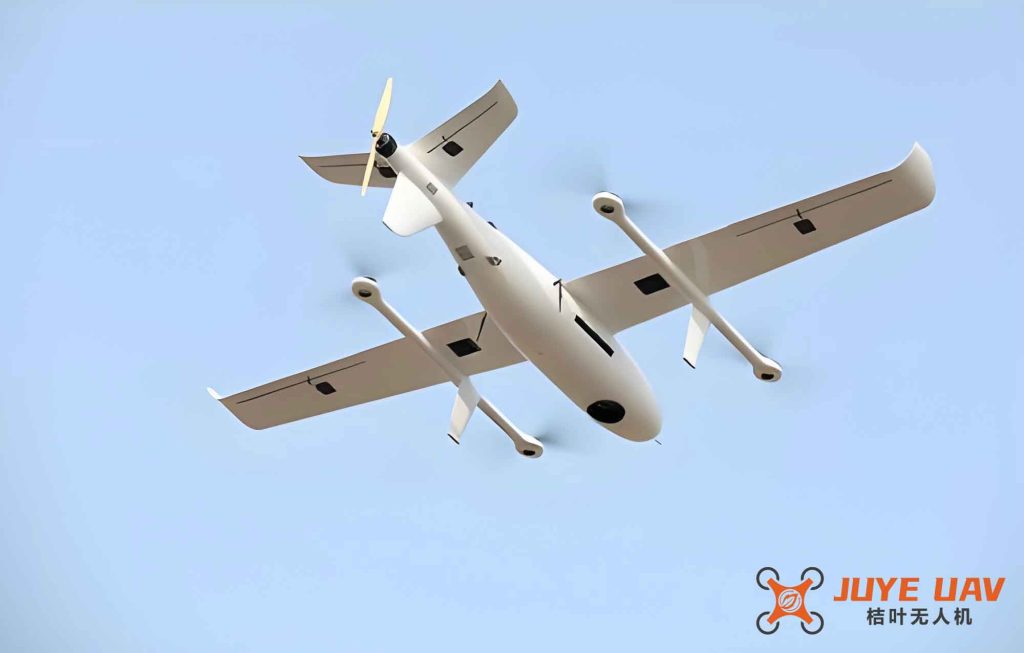
The basic nonlinear guidance law inherently adapts to wind because vg already incorporates wind. The roll command φ changes as vg changes, so the method can partially compensate for wind effects. However, wind also exerts a lateral force on the drone body, causing sideslip and a steady-state offset from the desired path. Figure 1 illustrates a fixed-wing drone in windy conditions.
To quantify this offset, consider a constant crosswind from east. The drone will drift off trajectory, especially on north-south segments. The steady-state deviation remains non-zero because the roll command alone cannot counteract the continuous lateral force.
4.2 Integral Feedback for Elimination of Static Error
We introduce an integral term of the path deviation Δd into the lateral acceleration command:
$$ a = \frac{2 v_g^2 \sin \eta}{l} + k \int \Delta d \, dt $$
where k is a proportional gain. The corresponding roll command becomes:
$$ \phi = \arctan\left( \frac{2 v_g^2 \sin \eta}{g l} + \frac{k}{g} \int \Delta d \, dt \right) $$
This integral feedback forces the aircraft to eliminate any residual steady-state error under constant wind. The design parameters are summarized in Table 3.
| Parameter | Description | Effect on performance |
|---|---|---|
| l | Look-ahead distance | Controls convergence speed and damping |
| k | Integral gain | Eliminates steady-state error; too high may cause oscillation |
| v_g | Ground speed | Impacts acceleration and roll command magnitude |
5. Simulation Verification
5.1 Simulation Setup
We simulate a fixed-wing drone with initial position (0,100) m, initial heading 0°, airspeed v = 40 m/s. The desired paths are a straight line of slope 1 and a square of side 1000 m. Wind is a constant eastward wind of 5 m/s. We compare three cases: (1) no wind, (2) wind with basic algorithm, (3) wind with improved algorithm. Simulation parameters are listed in Table 4.
| Parameter | Value |
|---|---|
| Initial position (x,y) | (0,100) m |
| Initial heading | 0° |
| Airspeed v | 40 m/s |
| Look-ahead distance l | 200 m |
| Integral gain k | 0.2 |
| Wind speed (east) | 5 m/s |
5.2 Results and Analysis
Case 1: No wind. The drone converges to the line path with negligible overshoot and zero steady-state error. Path deviation versus flight distance is shown in Table 5.
| Flight distance (m) | Deviation (m) |
|---|---|
| 0 | 70.7 |
| 200 | 15.2 |
| 400 | 2.1 |
| 600 | 0.3 |
| 800 | 0.05 |
| 1000 | 0.01 |
Case 2: Wind with basic algorithm. On the square path, the drone exhibits a static offset on north-south segments. The lateral deviation is approximately 15 m in the wind-affected direction.
Case 3: Wind with improved algorithm. The integral feedback eliminates the steady-state offset. Table 6 compares the maximum deviation on the north-south leg between the two algorithms under wind.
| Algorithm | Maximum deviation (m) |
|---|---|
| Basic nonlinear guidance | 17.3 |
| Improved with integral feedback | 1.2 |
The improved algorithm reduces the error by over 93%. The convergence to the desired path is smooth, and no persistent oscillation is observed. The integral gain is tuned to balance responsiveness and stability.
6. Conclusion
This paper presented a wind-resistant path tracking method for fixed-wing drones. By combining a nonlinear guidance law with integral feedback of the path deviation, the algorithm can effectively compensate for constant lateral wind disturbances. The model incorporates the effect of wind on both the ground velocity and the lateral force. Simulation results demonstrate that the improved method achieves accurate path tracking even under strong crosswinds, eliminating the steady-state error that exists in the basic algorithm. The proposed approach is suitable for fixed-wing drone operations in complex outdoor environments.
Future work will focus on extending the method to time-varying winds and three-dimensional paths, as well as experimental validation on actual fixed-wing drones.