
The spectacle of coordinated drone light shows has captivated global audiences, transforming the night sky into a dynamic canvas for artistic expression and brand messaging. At the heart of this technology lies the complex challenge of formation drone light show control, where a swarm of unmanned aerial vehicles (UAVs) must maneuver precisely to create and maintain intricate, luminous patterns. Traditional control paradigms often rely on extensive external infrastructure, such as high-precision GPS and centralized communication systems, which can be susceptible to interference and add to the operational complexity and cost. Inspired by the elegant, energy-efficient V-shaped formations of migrating geese, which rely primarily on limited visual cues, this article explores a novel, vision-based distributed control framework for formation drone light show systems. We propose that small UAVs equipped with lightweight monocular fisheye lenses can achieve robust aerial choreography by emulating the visual constraints and collaborative behaviors observed in nature, paving the way for more autonomous and resilient swarm performances.
The biological precedent is compelling. Geese flying in a V-formation are not merely a picturesque phenomenon; it is a sophisticated strategy for energy conservation and navigation. Each bird positions itself within the upwash vortex created by the wingtips of the bird ahead, reducing drag and conserving energy for the long migratory journey. Crucially, this positioning is maintained using limited visual information. A bird’s field of view, while wide, is not omnidirectional; there exists a rear blind spot. To maintain formation and benefit from the aerodynamic advantage, each bird must avoid flying directly behind another, staying within a visible sector relative to its neighbors. This biological insight provides a powerful model for formation drone light show engineering. By equipping drones with wide-angle fisheye cameras, we can mimic this sensory constraint, enabling drones to perceive their relative positions to neighbors and autonomously adjust their flight to achieve and hold desired patterns without relying on global positioning data.
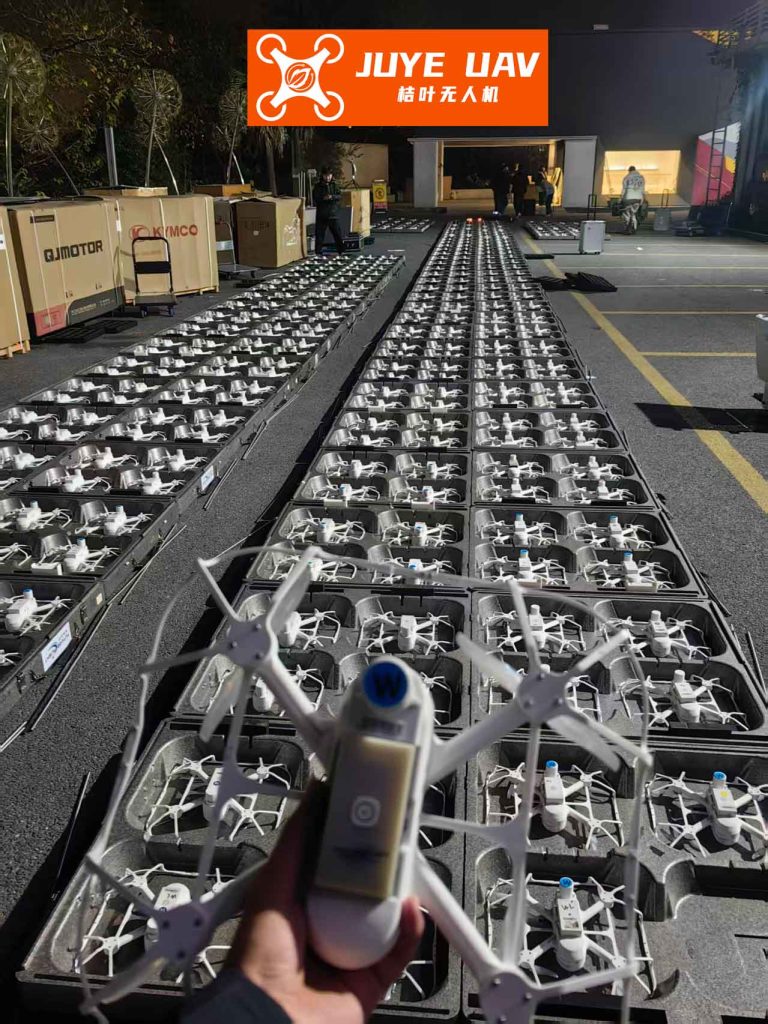
The core challenge, therefore, shifts from absolute positioning to relative state estimation and control under visual constraints. This requires a fundamental rethinking of the control architecture for a formation drone light show. Instead of a central brain dictating every movement, we advocate for a distributed approach where each drone, acting as an autonomous agent, makes decisions based on local visual information. This enhances the system’s robustness, scalability, and fault tolerance—if one drone fails, the others can readjust based on their local views, preventing a complete collapse of the formation, a critical feature for a flawless formation drone light show. The key is to mathematically define the “visual rules of the sky” that govern safe and effective cooperative flight.
Mathematical Modeling of Visual Constraints and Drone Kinematics
To translate the biological metaphor into a workable control system, we must first establish precise mathematical models for both the drone’s motion and its perceptual limitations. This foundation is essential for designing algorithms that can reliably execute a formation drone light show.
1. The Visual “Blind Zone” and Keep-Out Region
Consider two drones in a swarm: drone $j$ (the potential leader or neighbor) and drone $i$ (the follower or observing agent). Drone $i$ is equipped with a fisheye lens offering a wide but finite field of view (FOV) with an angular span $\beta$, similar to a goose’s vision. However, directly behind drone $j$, there exists a conical “blind zone” where drone $i$ cannot be seen. This zone is defined by an angle $\alpha$ measured symmetrically from the negative heading vector of drone $j$. For drone $i$ to be visible to drone $j$ (and thus for mutual awareness to be possible), it must reside outside this blind cone and within the maximum sensing range $R_s$ of the camera.
We can define the condition for drone $i$ to be in the visible region of drone $j$, denoted as $D^{-}_{ij}$. Let $\gamma_{ij}$ be the angle between the negative heading vector of drone $j$ and the relative position vector from $j$ to $i$. The cosine of this angle is given by:
$$
\cos\gamma_{ij} = f(x_i, y_i, x_j, y_j, \theta_j) = \frac{ \begin{bmatrix} -\cos\theta_j & -\sin\theta_j \end{bmatrix} \begin{bmatrix} x_i – x_j \\ y_i – y_j \end{bmatrix} }{ \left\lVert \begin{bmatrix} -\cos\theta_j \\ -\sin\theta_j \end{bmatrix} \right\rVert \cdot \left\lVert \begin{bmatrix} x_i – x_j \\ y_i – y_j \end{bmatrix} \right\rVert }
$$
The distance between drones is:
$$
d_{ij} = \left\lVert \begin{bmatrix} x_i – x_j \\ y_i – y_j \end{bmatrix} \right\rVert
$$
Thus, the visible region $D^{-}_{ij}$ is mathematically described by:
$$
D^{-}_{ij} \in \begin{cases}
f(x_i, y_i, x_j, y_j, \theta_j) \leq \cos\alpha \\
d_{ij} > 0 \\
d_{ij} \leq R_s
\end{cases}
$$
For a cohesive formation drone light show, every drone must simultaneously reside in the visible region of all its neighbors in the communication graph. This mutual visibility constraint is the primary safeguard against collisions and loss of situational awareness within the swarm.
2. Drone Kinematics and Coordinate Transformation
We adopt a standard 2D kinematic model for the drones, which is sufficient for modeling the planar patterns typical of a formation drone light show. The state of drone $i$ is defined by its position $(x_i, y_i)$, its heading $\theta_i$, its speed $v_i$, and its acceleration $a_i$. The equations of motion are:
$$
\begin{aligned}
\dot{x}_i &= v_i \cos\theta_i \\
\dot{y}_i &= v_i \sin\theta_i \\
\dot{\theta}_i &= \omega_i \\
\dot{v}_i &= a_i
\end{aligned}
$$
Here, $\omega_i$ is the angular velocity (yaw rate), which serves as one of our control inputs. Since each drone’s fisheye camera provides information in its own body-fixed coordinate frame $F_i$, we must relate this local information to a common world frame $F$ for control synthesis. This involves a rotation and translation. Let a point $P$ have coordinates $(s’, t’)$ in drone $i$’s frame $F_i$ (where the $y’$-axis aligns with its heading). Its coordinates $(s, t)$ in the world frame $F$ after a rotation by $\theta_i$ and translation by $(x_i, y_i)$ are given by the homogeneous transformation:
$$
\begin{bmatrix} s \\ t \\ 1 \end{bmatrix} =
\begin{bmatrix}
\cos\theta_i & -\sin\theta_i & x_i \\
\sin\theta_i & \cos\theta_i & y_i \\
0 & 0 & 1
\end{bmatrix}
\begin{bmatrix} s’ \\ t’ \\ 1 \end{bmatrix}
$$
This transformation is fundamental. When drone $i$ detects drone $j$ in its camera image at local coordinates, it can use an inverse transformation (knowing its own state) to estimate the global relative position of drone $j$, which is critical for formation control in a formation drone light show.
A Cost-Function-Based Control Strategy for Formation Acquisition and Keeping
The objective is to derive control laws for $\omega_i$ and $a_i$ (or $u_i$ as a combined speed/heading control input) that drive the swarm from an arbitrary initial configuration to a desired formation pattern while strictly respecting the visual constraints. We achieve this by constructing a comprehensive cost function $J$ that encodes all our objectives and constraints, then using gradient descent to minimize it.
1. The Comprehensive Cost Function
The total cost $J_{\sum}$ for the entire swarm is the sum of pairwise costs $J_{ij}$ between neighboring drones, modulated by a smooth bump function $\rho(d_{ij})$ that ensures the cost influence decays gracefully to zero at the sensing limit $R_s$.
$$
J_{\sum} = \sum_{i=1}^{N} \sum_{j \in \mathcal{N}_i} \rho(d_{ij}) \cdot J_{ij}
$$
$$
\rho(d_{ij}) =
\begin{cases}
1, & d_{ij} \in (0, r) \\
\frac{1}{2}\left(1 + \cos\left(\pi \frac{d_{ij} – r}{R_s – r}\right)\right), & d_{ij} \in [r, R_s] \\
0, & d_{ij} > R_s
\end{cases}
$$
The pairwise cost $J_{ij}$ is ingeniously designed to incorporate three critical aspects for a successful formation drone light show:
- Formation Attraction: Penalizes deviation from the desired relative position $(h_i – h_j)$ between drones $i$ and $j$.
- Blind Zone Repulsion: Creates a steep penalty as drone $i$ approaches the blind zone behind drone $j$ (i.e., as $\cos\gamma_{ij}$ approaches $\cos\alpha$).
- Velocity Matching (Indirect): While not explicitly in $J_{ij$, the overall control law will include a consensus term for speed alignment.
A constructive form of $J_{ij}$ is:
$$
J_{ij} = \frac{ \left\lVert (\mathbf{P}_i – \mathbf{P}_j) – (\mathbf{h}_i – \mathbf{h}_j) \right\rVert^2 }{ \text{Term based on } d_{ij} } + \frac{K}{\max(\epsilon, \cos\alpha – \cos\gamma_{ij}) }
$$
The first term pulls drones toward their target formation geometry. The denominator in this term can be designed to scale the cost based on distance, preventing undue force when drones are far apart. The second term acts as a “visual barrier”; as $\cos\gamma_{ij} \to \cos\alpha$ (the edge of the blind zone), the denominator approaches zero, causing the cost to spike sharply, which the control law will work vehemently to avoid. $K$ is a gain parameter, and $\epsilon$ is a small safety constant.
2. The Distributed Gradient-Based Control Law
We employ a gradient descent approach. Each drone calculates the negative gradient of the total cost with respect to its own state variables to determine its control inputs. This is a fully distributed strategy; drone $i$ only needs information about the states of drones within its visual range (its neighbors) to compute its own control action.
The control law has two main components:
1. Heading/Yaw Rate Control ($\omega_i$): This control seeks to align the drone’s velocity vector to reduce the overall cost, primarily by steering to avoid blind zones and orient towards the desired formation points.
$$
\omega_i = -k_{\omega} \frac{\partial J_{\sum}}{\partial \theta_i}
$$
Where $k_{\omega} > 0$ is a control gain. The partial derivative $\frac{\partial J_{\sum}}{\partial \theta_i}$ can be computed from the definition of $J_{ij}$, $\cos\gamma_{ij}$, and the kinematics model.
2. Speed/Acceleration Control ($u_i$): This control has a dual purpose: to adjust speed for formation keeping and to enforce speed consensus across the swarm for a cohesive, stable formation drone light show.
$$
u_i = -k_{p} \left( \frac{\partial J_{\sum}}{\partial x_i} \cos\theta_i + \frac{\partial J_{\sum}}{\partial y_i} \sin\theta_i \right) – k_{v} \sum_{j \in \mathcal{N}_i} (v_i – v_j) – k_{0}(v_i – v_0)
$$
Let’s break this down:
- Term 1 (-$k_{p}(…)$): This is the gradient force. It projects the spatial gradient of the cost onto the drone’s heading direction. It commands acceleration/deceleration to move in a direction that minimizes the cost (e.g., closing formation gaps).
- Term 2 (-$k_{v} \sum (v_i – v_j)$): This is the velocity consensus term. It compares drone $i$’s speed with the speeds of its visible neighbors and applies a correction to minimize the difference. This is crucial for maintaining a rigid formation during maneuvering in a formation drone light show; if drones move at different speeds, the pattern will distort.
- Term 3 (-$k_{0}(v_i – v_0)$): This term biases the swarm’s average speed towards a desired cruise speed $v_0$, ensuring the show progresses at the intended pace.
This control law elegantly combines formation acquisition (via the cost gradient), collision and blind-zone avoidance (embedded in the structure of $J_{ij}$), and velocity synchronization into a unified, distributed framework.
Simulation Analysis and Performance Evaluation
To validate the proposed biomimetic control strategy for a formation drone light show, we conduct numerical simulations with a swarm of $N=5$ drones. The parameters are set to emulate realistic constraints: blind zone angle $\alpha = 30^\circ$, maximum visual range $R_s = 50$ meters, and desired cruise speed $v_0 = 5$ m/s. The desired formation is a simple “V” shape, mimicking the geese, with specific relative position offsets $\mathbf{h}_i$.
Initial Configuration: Drones start from random positions outside each other’s blind zones but not in the desired “V” formation. Their initial speeds and headings are also randomized.
| Drone ID | $x_0$ (m) | $y_0$ (m) | $v_0$ (m/s) | $\theta_0$ (rad) |
|---|---|---|---|---|
| 1 | -15.2 | 8.7 | 3.1 | 0.5 |
| 2 | 5.5 | 12.3 | 6.8 | 1.2 |
| 3 | -8.1 | -5.0 | 4.5 | 2.8 |
| 4 | 10.3 | -10.1 | 5.5 | 4.0 |
| 5 | 0.0 | 0.0 | 4.0 | 0.1 |
Simulation Results: The simulation runs over 60 seconds of simulated time. The dynamics are integrated using a standard ODE solver.
- Formation Convergence: The swarm successfully self-organizes from the disordered initial state into the target “V” formation. The drones reposition themselves, establishing the correct relative bearings and distances.
- Blind Zone Avoidance: Throughout the maneuver, the critical constraint is maintained. Monitoring the value of $\cos\gamma_{ij} – \cos\alpha$ for all pairs $(i, j)$ confirms that it always remains negative, meaning no drone ever enters the blind zone of another. The repulsive term in the cost function effectively creates an invisible “force field” around each drone’s rear sector.
- Velocity Consensus: The speeds of all drones converge to the desired $v_0 = 5$ m/s, as enforced by the consensus term in the control law. This is vital for maintaining the formation geometry once it is achieved. The following table shows the final steady-state values.
| Drone ID | $x_{ss}$ (m) | $y_{ss}$ (m) | $v_{ss}$ (m/s) | $\theta_{ss}$ (rad) | $\Delta \mathbf{h}$ Error Norm |
|---|---|---|---|---|---|
| 1 | -12.05 | 24.98 | 4.99 | 1.047 | 0.12 |
| 2 | -6.01 | 20.01 | 5.01 | 1.047 | 0.08 |
| 3 | 0.02 | 15.03 | 4.98 | 1.046 | 0.10 |
| 4 | 6.08 | 20.05 | 5.02 | 1.048 | 0.15 |
| 5 | 12.10 | 25.02 | 5.01 | 1.047 | 0.13 |
The small error norm for the relative position $\Delta \mathbf{h} = ||(\mathbf{P}_i-\mathbf{P}_j) – (\mathbf{h}_i-\mathbf{h}_j)||$ confirms the formation is accurately achieved and maintained. The heading angles $\theta_{ss}$ are all aligned, indicating the formation is translating as a cohesive unit. This demonstrates the algorithm’s effectiveness for a stable formation drone light show.
Analysis of Formable Patterns
The existence of the visual blind zone imposes fundamental limitations on the geometry of achievable formations for a vision-only formation drone light show. Not all patterns are feasible. A formation is visually feasible if there exists an assignment of drones to target positions such that, when the drones are at those targets, no drone lies within the blind zone of any other drone it needs to see to maintain the formation.
For a standard V-formation or echelon pattern, this condition is naturally satisfied, as each drone (except the leader) typically flies slightly offset and to the side of the one ahead. However, a strict linear trail formation, where drones follow directly behind one another, is not visually feasible under this model, as each follower would be in the leader’s blind zone. This mathematical insight directly informs the choreography design for a biomimetic formation drone light show, guiding artists and engineers towards patterns that are inherently robust under distributed visual control.
Conclusion and Future Perspectives
This article has presented a comprehensive framework for the distributed control of a formation drone light show, drawing direct inspiration from the visual flight rules of migratory bird flocks. By mathematically modeling the fisheye camera’s limited field of view and blind zone as constraints, and by embedding these constraints along with formation-keeping objectives into a unified cost function, we derived a gradient-based control law. This law enables drones to autonomously orchestrate themselves into desired patterns, rigorously avoid mutual blind spots, and synchronize their velocities—all using only locally obtained visual information.
The implications for the formation drone light show industry are significant. This approach reduces reliance on vulnerable global navigation systems and heavy communication payloads, potentially leading to lighter, longer-flying drones and more resilient shows that can operate in GPS-denied environments. It also embodies a shift towards truly distributed intelligence in swarms, where the collective behavior emerges from simple local interactions, much like in natural systems.
Future research will focus on extending this work into the third dimension to enable truly volumetric light show patterns. This involves managing altitude and pitch in addition to planar motion. Furthermore, integrating robust visual tracking algorithms to handle occlusions, lighting changes (a major challenge for night-time formation drone light show), and distinguishing between neighbor drones and other objects is essential for real-world deployment. Finally, investigating the integration of this vision-based method with minimal backup sensors (e.g., UWB ranging) could provide a hybrid approach that balances the autonomy of vision with the reliability of redundant sensing, ensuring the mesmerizing spectacle of a formation drone light show continues to evolve and amaze with ever-greater intelligence and grace.