
In recent years, as global climate conditions shift and population density increases in many regions, natural disasters and large-scale fire incidents have become more frequent. We in the emergency response sector face severe challenges during fire and rescue operations, particularly when dealing with complex scenarios like floods, wildfires, and earthquakes. Efficiently gathering real-time intelligence at disaster sites and accurately deploying comprehensive rescue strategies have emerged as critical puzzles for fire departments worldwide. Therefore, we believe that studying the characteristics of unmanned aerial vehicles (UAVs) and leveraging their便捷救援方式 can significantly enhance the efficiency of消防应急 work, ultimately safeguarding public safety. This article delves into the properties of fire UAVs and explores their technical applications in消防应急救援, aiming to provide a robust framework for their integration.
To begin, let us define what a fire UAV entails. Essentially, a UAV refers to an unmanned aircraft system, with its core comprising the platform system, ground control system, and payload system. Initially, UAVs in our country were primarily deployed in military domains for national security. However, with advancements in living standards and the evolution of rescue technologies in fire departments, fire UAVs have gradually permeated civilian消防应急 fields. Typically, a fire UAV consists of the airframe, flight system, big data system, launch and recovery platform, and power system. These components work in tandem to ensure operational efficacy during emergencies.
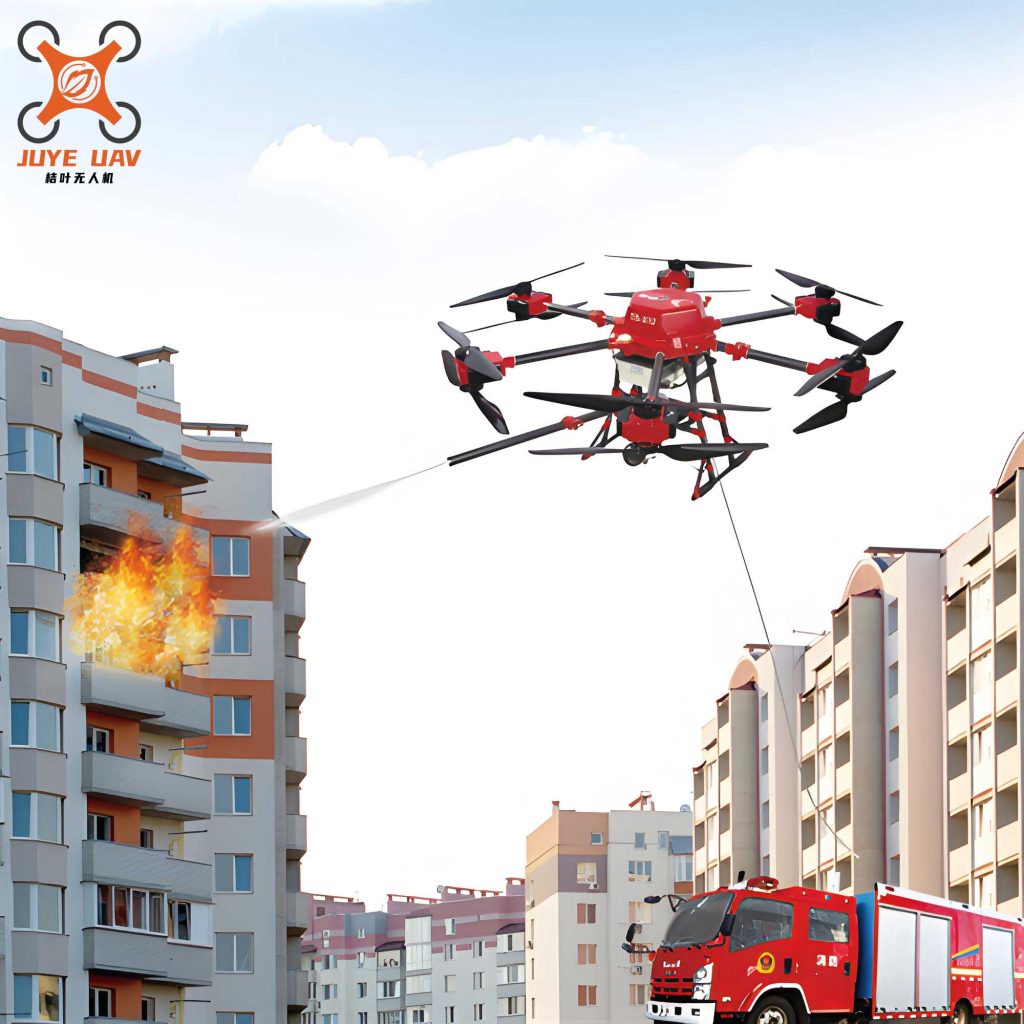
We have identified several key advantages of fire UAVs that make them indispensable in救援 operations. First, their high portability and flexibility stand out. Small fire UAVs, commonly used due to low manufacturing costs, are designed for rapid信息采集 in应急 modes. With simplified internal structures, operators can activate them using flight controls without繁琐流程, making them highly agile. Moreover, their lightweight nature facilitates easy maintenance and allows navigation through narrow or hazardous areas, thereby boosting rescue efficiency. Second, fire UAVs offer简单操作 with low usage restrictions. Unlike traditional aircraft, they feature automated systems;救援人员 can manage them via remote control or pre-set routes, enabling超视距 control through data链 systems for broader信息采集. This reduces the barriers to救援勘测. Third, fire UAVs possess强大的救援功能. They can quickly reach incident sites—such as earthquakes, floods, or forest fires—and relay real-time data via wireless devices to command centers, aiding in swift decision-making. Additionally, equipped with loudspeakers, lighting, and life-detection instruments, fire UAVs can broadcast information, assist in搜救, and deliver emergency supplies, thereby protecting lives.
To summarize these advantages quantitatively, we present the following table and formulas. The table outlines the core benefits of fire UAVs, while the formulas model their operational efficiency.
| Advantage Category | Description | Key Metrics |
|---|---|---|
| Portability & Flexibility | Small size, low cost, easy deployment in confined spaces | Weight (W), Deployment Time (T_d) |
| Ease of Operation | Automated systems, remote control, minimal training needed | Operation Complexity Score (C_op), Control Range (R_c) |
| Rescue Capability | Rapid response, real-time data transmission, multi-functional payloads | Response Time (T_r), Data Transmission Rate (D_t) |
We can express the overall effectiveness of a fire UAV using an efficiency formula that integrates these metrics. Let \( E_{UAV} \) represent the救援效率 of a fire UAV, defined as the ratio of area covered to time taken, adjusted for operational factors:
$$ E_{UAV} = \frac{A_{cover}}{T_{total}} \times \frac{1}{C_{op}} $$
where \( A_{cover} \) is the area covered during救援勘测 (in square meters), \( T_{total} \) is the total time from deployment to data transmission (in seconds), and \( C_{op} \) is the operation complexity factor (dimensionless, with lower values indicating simpler operation). For instance, a fire UAV with high portability might have \( C_{op} \approx 0.8 \), enhancing \( E_{UAV} \). Additionally, the cost-effectiveness of fire UAVs can be modeled as:
$$ CE_{UAV} = \frac{R_{speed}}{C_{operation}} $$
where \( R_{speed} \) is the response speed (in meters per second) and \( C_{operation} \) is the operational cost per hour (in monetary units). These formulas help us quantify why fire UAVs are superior in消防应急 scenarios.
Moving to the primary applications of fire UAVs in应急救援, we categorize them into three domains:辅助决策,形势管控, and紧急救援. First, in辅助决策, fire UAVs equip high-definition cameras to capture real-time footage, transmitted via 4G无线传输 to command centers. This enables快速救援部署 and战术预判. For example, during earthquakes, fire UAVs provide aerial views to guide rescue routes, overcoming obstacles like debris. Second, for形势管控, fire UAVs monitor human activities in forests, transmitting images to安保 centers for流量分析 and resource allocation, thus preventing incidents. Third, in紧急救援, fire UAVs autonomously reach sites like floods or landslides, deliver救生设备, and assist in生命迹象搜救. We encapsulate these applications in the table below, supplemented with formulas for performance evaluation.
| Application Area | Specific Use Case | Key Parameters |
|---|---|---|
| Decision Support | Aerial reconnaissance, data relay for指挥部 | Image Resolution (I_res), Transmission Latency (L_t) |
| Situation Control | Monitoring人流, preventive surveillance | Coverage Area per Flight (A_flight), Detection Accuracy (D_acc) |
| Emergency Rescue | Rapid deployment, supply delivery, life detection | Payload Capacity (P_cap), Search Efficiency (S_eff) |
To assess the decision-support capability, we define a情报质量 index \( Q_{intel} \) for fire UAVs:
$$ Q_{intel} = \frac{I_res \times D_acc}{L_t} $$
Higher \( Q_{intel} \) values indicate better real-time intelligence for救援部署. For emergency rescue, the search efficiency \( S_eff \) can be calculated as:
$$ S_eff = \frac{N_{detected}}{T_{search}} $$
where \( N_{detected} \) is the number of生命迹象 detected and \( T_{search} \) is the search time in minutes. These metrics underscore how fire UAVs enhance救援工作 through technology.
However, the effective use of fire UAVs requires attention to several注意事项. We outline these in three aspects:飞行事项,兼容事项, and操作人员培训. First, regarding飞行事项, fire UAVs must be launched away from crowds, with safety指挥人员 monitoring weather conditions like强对流 or浓雾 to plan safe routes. This minimizes risks of accidents. Second, for兼容事项, we must consider integration issues; payloads should adhere to weight limits, and多功能 compatibility—such as for毒气检测 or温度测量—needs rigorous testing to ensure功能有效运用. Third,操作人员技能培训 is crucial: pilots should hold民用无人机驾驶员证书, and departments must implement training regimes for飞行管理,保养修护, and技术考核. The table below summarizes these points with associated formulas for risk assessment.
| Consideration Category | Key Points | Risk Metrics |
|---|---|---|
| Flight Operations | Safe launch, weather adaptation, route planning | Weather Risk Factor (W_risk), Collision Probability (P_col) |
| System Compatibility | Payload weight, multi-function integration | Compatibility Score (C_score), Overload Risk (O_risk) |
| Personnel Training | Certification,模拟训练, maintenance protocols | Training Effectiveness (T_eff), Error Rate (E_rate) |
We can model the overall risk \( R_{total} \) during fire UAV operations as a weighted sum:
$$ R_{total} = \alpha \cdot W_risk + \beta \cdot O_risk + \gamma \cdot E_rate $$
where \( \alpha, \beta, \gamma \) are权重 coefficients based on operational context. By minimizing \( R_{total} \), we ensure safer use of fire UAVs. Additionally, the compatibility score \( C_score \) for multi-functional fire UAVs can be expressed as:
$$ C_score = \sum_{i=1}^{n} w_i \cdot F_i $$
where \( F_i \) represents the functionality score for feature i (e.g.,生命探测 or毒气检测), and \( w_i \) is its weight. This helps in optimizing fire UAV designs for消防应急救援.
In conclusion, fire UAVs have become integral to消防应急救援 due to their portability, ease of operation, and powerful capabilities. We observe that these systems not only supplement human efforts in hazardous environments but also accelerate搜救 through advanced sensors, thereby protecting lives and mitigating disaster impacts. As we continue to refine fire UAV technologies, their role in enhancing救援效率 will undoubtedly expand, offering a promising avenue for future应急工作 innovations. Through rigorous training and compatibility checks, we can harness the full potential of fire UAVs to address the evolving challenges in消防部门 globally.