
The concept of automatic control is not new; its rudimentary principles can be traced back millennia to ingenious creations like the “wooden horse carriage” and the “wooden ox and flowing horse.” The formal birth of modern control theory, however, catapulted these ideas into a new era, giving rise to sophisticated technologies such as robust control, fuzzy control, and computer control, now ubiquitous across military, industrial, managerial, and daily life domains. Among these technological marvels, the Unmanned Aerial Vehicle (UAV), or drone, stands out. Initially propelled by military applications, UAV technology has seen explosive growth over the past decade, seamlessly transitioning into the civilian sphere. Today, drones are versatile, controllable aircraft capable of executing a diverse array of missions, from military reconnaissance and disaster relief logistics to civilian applications like aerial photography, surveying, and, most spectacularly, synchronized entertainment displays known as formation drone light shows. This evolution prompts critical questions about future trajectories: What novel applications will emerge? How can research be directed to maximize societal benefit? This article, adopting a first-person perspective as a researcher in the field, delves into the core of multi-UAV operations: formation control and path planning. We will systematically explore the principles of formation assembly and obstacle avoidance, with a particular emphasis on the Artificial Potential Field (APF) method and its relevance to complex, dynamic applications like a formation drone light show.
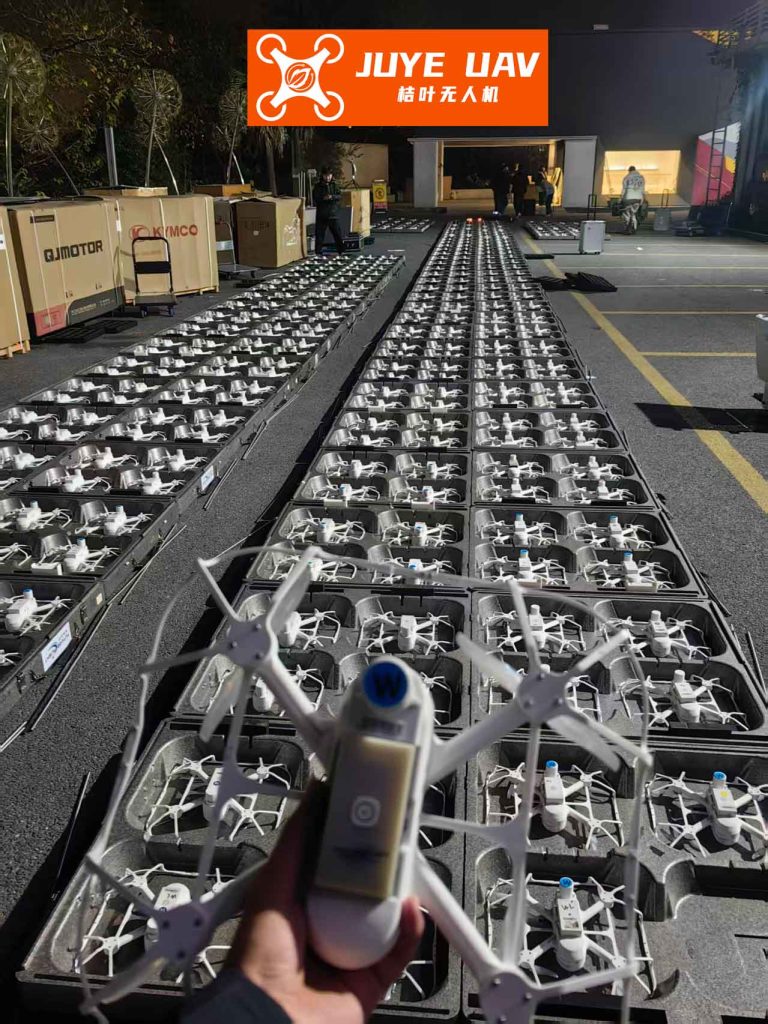
The significance of transitioning from single-UAV to multi-UAV systems cannot be overstated. While a single drone offers advantages like compact size and ease of operation, its limitations in payload, sensor perspective, and operational range due to energy constraints are significant. These constraints hinder its applicability in demanding scenarios. The fundamental solution is collaborative operation through UAV formations. A UAV formation involves multiple drones maintaining a specific spatial configuration during flight. The benefits are multifold: it enables multi-perspective data collection enhancing information fidelity, increases mission reliability through redundancy (if one drone fails, others continue), and overcomes payload limitations for tasks like cooperative transport. Executing a mesmerizing formation drone light show is a quintessential example that inherently requires precise, reliable formation control to create coherent aerial imagery and patterns.
Principles of Formation Assembly
Coordinating multiple drones into a stable formation requires specialized control strategies beyond single-agent control. Several established methodologies exist, each with distinct mechanisms and suitability for applications like a formation drone light show.
| Method | Core Principle | Advantages | Disadvantages | Suitability for Light Shows |
|---|---|---|---|---|
| Behavior-Based | Each drone is programmed with a set of basic behaviors (e.g., collision avoidance, goal seeking, formation keeping). The emergent global formation is the result of local interactions. | Highly flexible, robust to individual failures, adaptable to dynamic environments. | Global behavior can be unpredictable; rigorous stability analysis is challenging. | Moderate. Good for adaptive patterns but may lack the precision needed for highly choreographed, rigid shapes. |
| Virtual Structure | The entire formation is treated as a single, rigid virtual body. Each drone corresponds to a fixed point on this structure. The drones coordinate to move as this virtual entity moves. | Provides precise and rigid formation geometry, easy to specify and control overall formation motion. | Less flexible; the entire formation must maneuver as one, which can be inefficient for complex reconfigurations. | High. Excellent for maintaining precise geometric shapes and synchronized movements central to a formation drone light show. |
| Artificial Potential Field (APF) | Uses virtual attractive forces (to target/desired position) and repulsive forces (from obstacles/other drones) to guide each drone. The formation emerges from the equilibrium of these fields. | Conceptually simple, provides continuous guidance, inherently includes obstacle avoidance. | Can get trapped in local minima; oscillations may occur near equilibria; tuning force parameters is critical. | High, with modifications. Ideal for smooth transitions and dynamic obstacle avoidance within the show, though local minima must be addressed. |
| Graph Theory-Based | Formation is represented as a graph where nodes are drones and edges represent communication/control links. Stability is analyzed and controlled based on graph connectivity (e.g., Laplacian matrix). | Provides a strong theoretical foundation for stability analysis; can handle formations with only relative neighbor information. | Performance depends heavily on communication topology; absolute position knowledge may be lost. | Moderate to High. Useful for ensuring formation stability based on local neighbor interactions, which is scalable for large-scale formation drone light show fleets. |
| Leader-Follower | A designated leader drone traces the desired trajectory. Followers maintain specific relative positions/orientations with respect to the leader or another follower. | Simple structure, easy to implement and understand. | Single point of failure (if the leader fails); errors can propagate through the chain; stringent requirements on leader tracking. | Moderate. Commonly used but risky for large shows due to failure propagation. Often combined with other methods for robustness. |
Path Planning and Obstacle Avoidance for Formations
For a formation, especially one performing in cluttered or dynamic spaces, obstacle avoidance is paramount. Path planning algorithms must account for the entire formation’s footprint, not just individual drones.
| Method | Core Principle | Application in Formation Context |
|---|---|---|
| Visibility Graph | Constructs a graph connecting all vertices of polygonal obstacles and start/goal points. The shortest collision-free path is found along graph edges. | Can be applied by treating the formation as a single polygon with an inflated boundary. Computationally heavy for dynamic environments or many obstacles. |
| Free Space (Cell Decomposition) | Decomposes the free space into simple, contiguous cells (e.g., trapezoids). A path is planned by navigating from the cell containing the start to the cell containing the goal. | The formation’s configuration space must be considered, leading to complex cell decomposition. More suitable for offline planning of a formation drone light show in a known arena. |
| Grid-Based (Occupancy Grid) | The environment is discretized into a grid. Each cell is marked as free or occupied. Algorithms like A* or D* search for an optimal path on this grid. | Simple to implement. The formation can be represented by ensuring all cells it occupies are free. Resolution vs. computation trade-off is key. Can be used for real-time adjustments in a show. |
| Artificial Potential Field (APF) | As described for formation assembly, repulsive fields from obstacles are added. The net force on each drone (or the formation center) guides it away from obstacles while maintaining formation. | Very natural integration with formation control. Obstacles generate repulsive fields. This is a reactive, real-time method highly suitable for dynamic obstacle avoidance during a live formation drone light show. |
| Genetic Algorithm (GA) | A population of candidate paths evolves over generations. Paths are evaluated by a fitness function (shortness, safety, smoothness). Crossover and mutation operations generate new solutions. | Can optimize complex, global paths for the entire formation, considering multiple constraints (e.g., smooth turns for viewer appeal). Used for high-level, offline trajectory planning for a complex show sequence. |
In-Depth Analysis: The Artificial Potential Field (APF) Method
Given its dual role in both formation assembly and obstacle avoidance, the APF method warrants a detailed examination. Its intuitive physics-based model makes it a cornerstone for autonomous navigation in UAVs, including the precise choreography required for a formation drone light show.
The core idea is to construct a virtual scalar potential field $U_{\text{total}}(\vec{q})$ over the configuration space, where $\vec{q}$ represents the position of a drone (or a point of interest). This total potential is the sum of an attractive field pulling the drone toward its goal and repulsive fields pushing it away from obstacles and other drones.
1. Attractive Potential: Typically, a conical or quadratic well is used.
$$ U_{\text{att}}(\vec{q}) = \frac{1}{2} k_{\text{att}} \cdot d^2(\vec{q}, \vec{q}_{\text{goal}}) $$
where $k_{\text{att}} > 0$ is a positive gain constant, and $d(\vec{q}, \vec{q}_{\text{goal}})$ is the distance to the goal position $\vec{q}_{\text{goal}}$. The corresponding attractive force is the negative gradient:
$$ \vec{F}_{\text{att}}(\vec{q}) = -\nabla U_{\text{att}}(\vec{q}) = -k_{\text{att}} \cdot (\vec{q} – \vec{q}_{\text{goal}}) $$
This force linearly pulls the drone toward the goal.
2. Repulsive Potential (from Obstacles): This field is active only within a threshold distance $d_0$ from an obstacle.
$$ U_{\text{rep, obs}}(\vec{q}) = \begin{cases}
\frac{1}{2} k_{\text{rep}} \left( \frac{1}{d(\vec{q}, \vec{q}_{\text{obs}})} – \frac{1}{d_0} \right)^2, & \text{if } d(\vec{q}, \vec{q}_{\text{obs}}) \leq d_0 \\
0, & \text{if } d(\vec{q}, \vec{q}_{\text{obs}}) > d_0
\end{cases} $$
where $k_{\text{rep}} > 0$ is a repulsive gain, and $d(\vec{q}, \vec{q}_{\text{obs}})$ is the distance to the obstacle. The repulsive force is:
$$ \vec{F}_{\text{rep, obs}}(\vec{q}) = -\nabla U_{\text{rep, obs}}(\vec{q}) = \begin{cases}
k_{\text{rep}} \left( \frac{1}{d(\vec{q}, \vec{q}_{\text{obs}})} – \frac{1}{d_0} \right) \frac{1}{d^2(\vec{q}, \vec{q}_{\text{obs}})} \nabla d(\vec{q}, \vec{q}_{\text{obs}}), & \text{if } d \leq d_0 \\
0, & \text{if } d > d_0
\end{cases} $$
This force points away from the obstacle.
3. Inter-Agent Repulsive Potential (for Formation & Collision Avoidance): To maintain separation and avoid collisions within the formation, a similar repulsive field is applied between drones $i$ and $j$.
$$ U_{\text{rep, agent}}(\vec{q}_i, \vec{q}_j) = \begin{cases}
\frac{1}{2} k_{\text{agent}} \left( \frac{1}{d_{ij}} – \frac{1}{d_s} \right)^2, & \text{if } d_{ij} \leq d_s \\
0, & \text{if } d_{ij} > d_s
\end{cases} $$
where $d_{ij} = ||\vec{q}_i – \vec{q}_j||$, $d_s$ is the desired safe separation distance, and $k_{\text{agent}}$ is the inter-agent repulsive gain. The force on drone $i$ from drone $j$ is the negative gradient with respect to $\vec{q}_i$.
4. Total Force and Motion Control: For a drone $i$ in a formation, the total virtual force is the vector sum:
$$ \vec{F}_{\text{total}, i} = \vec{F}_{\text{att}, i} + \sum_{\text{obstacles}} \vec{F}_{\text{rep, obs}, i} + \sum_{j \neq i} \vec{F}_{\text{rep, agent}, ij} $$
This net force $\vec{F}_{\text{total}, i}$ dictates the desired direction of motion. In a typical velocity-based control model, the desired velocity $\vec{v}_{d,i}$ is proportional to this force:
$$ \vec{v}_{d,i} = K_v \cdot \vec{F}_{\text{total}, i} $$
where $K_v$ is a gain matrix. The drone’s low-level flight controller then tracks this desired velocity.
Application to Formation Drone Light Shows: Challenges and Enhancements
For a flawless formation drone light show, the standard APF requires enhancements:
- Local Minima: A drone can get stuck where attractive and repulsive forces balance (e.g., in a narrow passage). Solutions include adding a random-walk or “virtual vortex” term, or using navigation functions.
- Oscillations and Smoothness: Near equilibria or in tight formations, forces can cause jittery motion—unacceptable for a smooth visual display. Implementing force smoothing filters or using harmonic potential fields can mitigate this.
- Formation Geometry Integration: The attractive force for a follower drone $\vec{F}_{\text{att}, i}$ is not toward a global goal, but toward its desired position within the formation $\vec{q}_{\text{des}, i}(t)$, which is defined by the formation’s virtual structure or leader’s state. Thus:
$$ \vec{F}_{\text{att}, i}(\vec{q}_i) = -k_{\text{att}} \cdot (\vec{q}_i – \vec{q}_{\text{des}, i}(t)) $$
This seamlessly blends APF with the virtual structure or leader-follower approach. - Dynamic Goal for Maneuvers: In a formation drone light show, the goal for the entire formation is a time-varying trajectory. $\vec{q}_{\text{des}, i}(t)$ must be updated in real-time based on the show’s choreography, ensuring the formation morphs smoothly between shapes.
A simplified algorithmic overview for a single drone in a light show context is presented below.
| Step | Action (for Drone i at time t) |
|---|---|
| 1. | Get State: Obtain own position $\vec{q}_i$, and via communication, states of neighbors $\vec{q}_j$ and leader/virtual structure state. |
| 2. | Calculate Desired Position: Compute $\vec{q}_{\text{des}, i}(t)$ based on the current show choreography and formation pattern. |
| 3. | Compute Attractive Force: $\vec{F}_{\text{att}, i} = -k_{\text{att}} (\vec{q}_i – \vec{q}_{\text{des}, i}(t))$. |
| 4. | Compute Obstacle Repulsive Forces: For all sensed obstacles within range $d_0$, compute $\vec{F}_{\text{rep, obs}, i}$ using sensor data (e.g., LiDAR, UWB). |
| 5. | Compute Inter-Agent Repulsive Forces: For all neighboring drones $j$ within $d_s$, compute $\vec{F}_{\text{rep, agent}, ij}$. |
| 6. | Compute Total Force: $\vec{F}_{\text{total}, i} = \vec{F}_{\text{att}, i} + \sum \vec{F}_{\text{rep, obs}, i} + \sum \vec{F}_{\text{rep, agent}, ij}$. |
| 7. | Apply Smoothing & Minima Escape: Filter $\vec{F}_{\text{total}, i}$ (e.g., low-pass filter). If trapped (velocity ~0 but not at goal), apply a small perturbative force. |
| 8. | Generate Velocity Command: $\vec{v}_{d,i} = K_v \cdot \vec{F}_{\text{total}, i}$. Send $\vec{v}_{d,i}$ to the low-level flight controller. |
| 9. | Loop: Repeat from Step 1 for the next control cycle. |
Synthesis: Integrated Formation Control Architecture
A robust system for a formation drone light show typically integrates several methods hierarchically. A common architecture is:
- High-Level Planner (Genetic Algorithm / Grid-Based): Offline, this planner generates the overall sequence of formation shapes and the smooth trajectory for the formation’s center or virtual structure, optimizing for visual appeal and energy efficiency.
- Formation Controller (Virtual Structure / Graph Theory + APF): In real-time, the virtual structure defines $\vec{q}_{\text{des}, i}(t)$ for each drone. An enhanced APF controller, as described in Algorithm 1, is then used by each drone to track its desired position. The APF component actively handles local deviations, dynamic obstacle avoidance (e.g., a stray bird), and maintains safe inter-drone separation. Graph theory ensures the communication network maintains connectivity for stable coordination.
- Low-Level Flight Controller: Each drone’s onboard autopilot (using PID or more advanced controllers) stabilizes the aircraft and accurately tracks the velocity command $\vec{v}_{d,i}$ issued by the APF module.
This layered approach combines the global optimality of offline planning with the local reactivity and robustness of APF, making it highly suitable for the demanding environment of a large-scale, outdoor formation drone light show.
Conclusion and Future Trajectories
The exploration of UAV formation control reveals a rich tapestry of interdisciplinary techniques, from graph theory and classical control to biologically-inspired algorithms. The formation drone light show has emerged as a powerful civilian application that drives innovation in scalability, reliability, and real-time dynamic control. The Artificial Potential Field method, despite its known challenges like local minima, remains a cornerstone due to its intuitive fusion of path planning and reactive obstacle avoidance, making it exceptionally relevant for such dynamic performances.
Future research will likely focus on overcoming the limitations of individual methods through hybridization, such as combining APF with predictive control (MPC) for smoother trajectories or with machine learning to adapt force laws in real-time. Furthermore, the need for ultra-reliable, secure communication and swarm intelligence for autonomous recovery from failures will be paramount as shows involve thousands of drones. The quest for more sustainable and longer-lasting displays will also push advancements in energy-aware formation planning and wireless charging. Ultimately, the principles refined in the dazzling context of a formation drone light show will cascade into more critical applications like search and rescue, precision agriculture, and automated logistics, truly enabling this technology to better serve humanity.