
In my extensive analysis of modern warfare, I have observed that military UAVs (Unmanned Aerial Vehicles) are revolutionizing defense strategies globally. The proliferation of military UAVs has shifted paradigms, enabling non-contact warfare dominated by long-range, intelligent, and信息化 weaponry. From my perspective, the advantages of military UAVs over manned aircraft—such as compact size, cost-effectiveness, operational flexibility, minimal environmental requirements, and enhanced survivability—make them indispensable assets. As nations accelerate their development, I will delve into the key trends shaping the future of military UAVs, incorporating tables and formulas to summarize critical aspects. The evolution of military UAVs is not just incremental; it represents a transformative leap in aerial combat and reconnaissance.
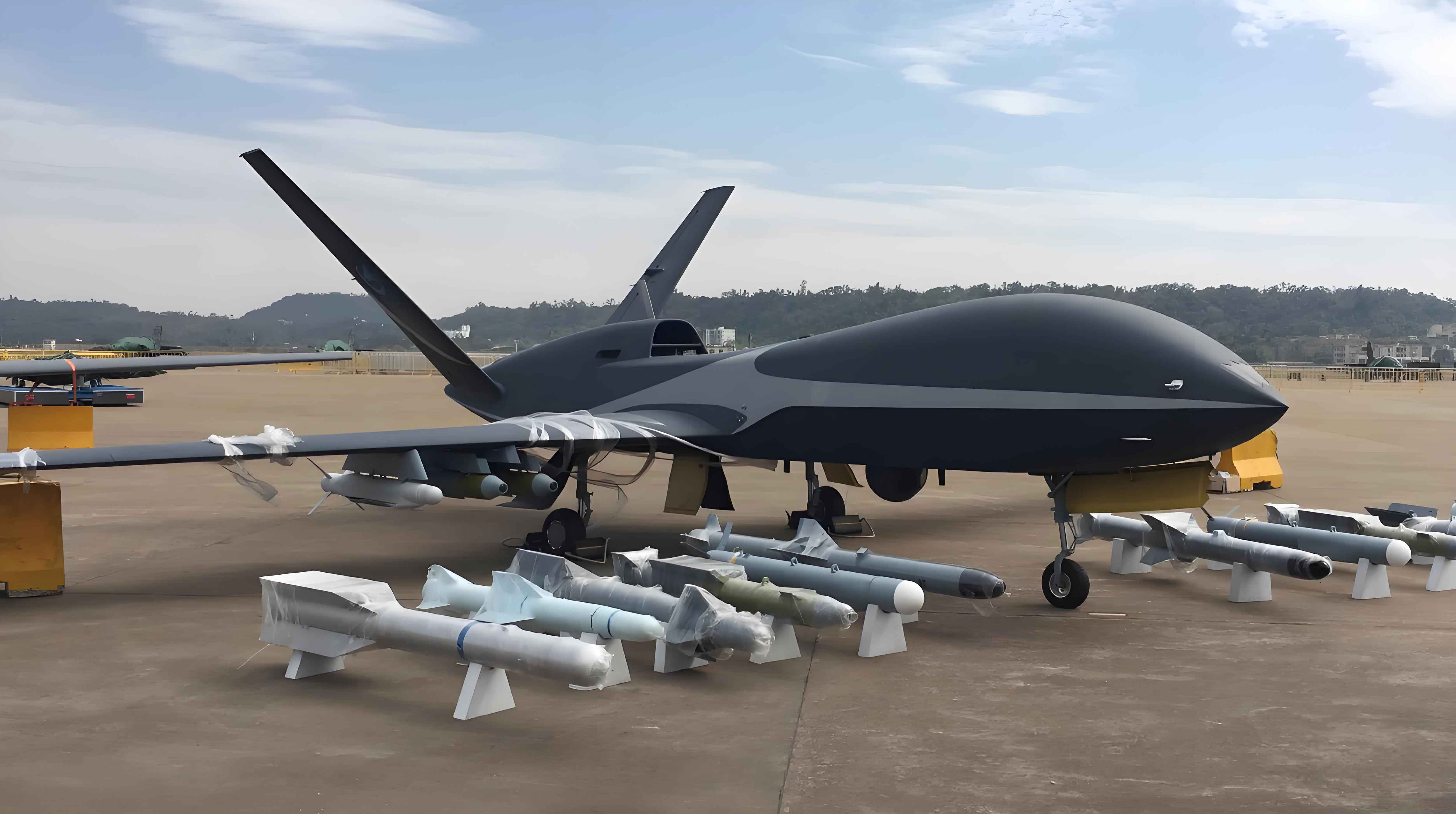
From my standpoint, the first major trend in military UAV development is the push for increased endurance and higher speeds. Military UAVs with extended loiter times can provide persistent surveillance and strike capabilities, which I believe are crucial for modern battlefields. For instance, high-altitude long-endurance (HALE) military UAVs, like the Global Hawk, operate above 20,000 meters, where they face fewer restrictions and can integrate into atmospheric surveillance networks. I often emphasize that endurance, denoted as $E$, can be modeled by the formula: $$ E = \int_{0}^{T} \frac{P_{\text{fuel}}}{C_{\text{fuel}}(v, h)} \, dt $$ where $P_{\text{fuel}}$ is fuel power, $C_{\text{fuel}}$ is fuel consumption rate as a function of velocity $v$ and altitude $h$, and $T$ is time. To enhance endurance, engineers are optimizing aerodynamic designs and propulsion systems, as shown in Table 1.
| Military UAV Model | Endurance (hours) | Max Speed (km/h) | Altitude (meters) |
|---|---|---|---|
| Global Hawk | 30+ | 650 | 18,000 |
| Predator B | 24 | 740 | 15,000 |
| Rotary-wing UAV | 24 | 740+ | 5,000 |
| Micro UAV | 1-2 | 50 | 100 |
In my view, speed is equally vital for military UAVs to evade anti-UAV systems. I predict that future military UAVs will achieve hypersonic speeds, reducing interception probabilities. The kinetic energy $K$ of a military UAV can be expressed as: $$ K = \frac{1}{2} m v^2 $$ where $m$ is mass and $v$ is velocity. As velocities exceed 740 km/h, designers must balance structural integrity with stealth features. I have noted that hybrid designs, combining rotary and fixed-wing capabilities, are emerging to enable both high speed and hover endurance, making military UAVs more versatile in complex environments.
Secondly, I consider stealth and miniaturization as critical trends for enhancing military UAV survivability. Military UAVs are being designed with reduced radar cross-section (RCS) and acoustic signatures to operate undetected. From my analysis, the RCS $\sigma$ for a military UAV can be approximated using the formula: $$ \sigma = \frac{4\pi A^2}{\lambda^2} $$ where $A$ is the effective scattering area and $\lambda$ is the radar wavelength. By using composite materials, radar-absorbent coatings, and low-noise engines, military UAVs like the Predator achieve an RCS as low as 0.1 m². I have compiled key stealth techniques in Table 2, which I often reference in discussions on military UAV advancements.
| Technology | Application in Military UAVs | Effect on Detectability |
|---|---|---|
| Composite Materials | Graphite-based structures | Reduces radar reflection |
| Infrared Suppression | Special paints and fuel additives | Lowers thermal signature |
| Seam Reduction | Integrated control surfaces | Minimizes RCS gaps |
| Charged Coatings | 24V-powered skin layers | Absorbs radar waves, adaptive coloration |
I am particularly fascinated by micro military UAVs, which are shrinking to insect-like dimensions for covert operations. These military UAVs, with lengths under 15 cm, leverage micro-electromechanical systems (MEMS) and weak-signal control for urban reconnaissance. The Reynolds number $Re$ for such military UAVs is low, given by: $$ Re = \frac{\rho v L}{\mu} $$ where $\rho$ is air density, $v$ is velocity, $L$ is characteristic length, and $\mu$ is dynamic viscosity. Designing for low $Re$ requires innovative aerodynamics, which I have seen in prototypes like the Black Widow. In my opinion, the proliferation of micro military UAVs will challenge traditional anti-reconnaissance measures, though their operational use remains limited due to power constraints.
Thirdly, I assert that intelligence and weaponization are transforming military UAVs into autonomous combat platforms. The shift from remote control to high autonomy involves advanced algorithms for real-time decision-making. I define UAV intelligence as the ability to process sensor data and react to threats autonomously, which can be modeled using artificial neural networks with weights $w_i$: $$ y = f\left(\sum_{i} w_i x_i + b\right) $$ where $x_i$ are input features, $b$ is bias, and $f$ is an activation function. Military UAVs like the unmanned combat aerial vehicle (UCAV) prototypes are being equipped with weapons such as Hellfire missiles and JDAMs, enhancing their attack capabilities. I have summarized this trend in Table 3, based on my observations of recent conflicts.
| Military UAV Type | Weapon Systems | Autonomy Level | Key Technologies |
|---|---|---|---|
| Predator B | GBU-38 JDAM, Hellfire | Semi-autonomous | GPS-guided targeting |
| Hunter UAV | Viper Strike missiles | Medium autonomy | Machine vision for target ID |
| Future UCAV | Air-to-air missiles | Fully autonomous | AI-based threat assessment |
From my perspective, the key challenge lies in developing reliable autonomous systems for military UAVs that can distinguish friend from foe in dynamic environments. I advocate for redundancy and virtual systems to improve reliability. For example, triple-redundant flight control systems in military UAVs use parallel processing to detect faults, with failure rates modeled by: $$ R(t) = e^{-\lambda t} $$ where $R(t)$ is reliability over time $t$, and $\lambda$ is failure rate. As military UAVs become more intelligent, I foresee them taking on roles traditionally held by manned aircraft, but ethical and technical hurdles remain.
Fourthly, I emphasize system integration and sensor fusion as trends that boost the versatility of military UAVs. Modern military UAVs incorporate multi-spectral sensors—such as electro-optical, infrared, and synthetic aperture radar (SAR)—to provide all-weather reconnaissance. In my analysis, sensor fusion can be represented by a Kalman filter equation: $$ \hat{x}_{k|k} = \hat{x}_{k|k-1} + K_k(z_k – H_k \hat{x}_{k|k-1}) $$ where $\hat{x}$ is state estimate, $z$ is measurement, $H$ is observation matrix, and $K$ is Kalman gain. This allows military UAVs to combine data streams for enhanced situational awareness. I have outlined common sensor suites in Table 4, which I consider essential for military UAV missions.
| Sensor Type | Function in Military UAVs | Performance Metrics |
|---|---|---|
| Electro-Optical (EO) | Daytime imaging | Resolution: <1 mrad |
| Infrared (IR) | Night/low-light observation | Thermal sensitivity: <50 mK |
| Synthetic Aperture Radar (SAR) | All-weather mapping | Range resolution: 0.3 m |
| Laser Rangefinder | Target distance measurement | Accuracy: ±5 m |
I also note that data transmission reliability is critical for military UAVs. They employ multiple links, like C-band for line-of-sight and Ku-band satellite for beyond-line-of-sight通信. The signal-to-noise ratio (SNR) for these links is given by: $$ \text{SNR} = \frac{P_t G_t G_r \lambda^2}{(4\pi R)^2 k T B} $$ where $P_t$ is transmit power, $G_t$ and $G_r$ are antenna gains, $R$ is range, $k$ is Boltzmann’s constant, $T$ is temperature, and $B$ is bandwidth. Modular design further enhances military UAV通用性, allowing quick reconfiguration for different roles. In my experience, this adaptability makes military UAVs cost-effective force multipliers.
Fifthly, I highlight electronic warfare (EW) and networked operations as emerging trends for military UAVs in information dominance. Military UAVs are being deployed as EW platforms to jam enemy radars or serve as decoys. For instance, anti-radiation military UAVs like the Harpy can loiter and attack radar emitters autonomously. I model the effectiveness of an EW military UAV using the jammer-to-signal ratio: $$ J/S = \frac{P_j G_j B_r}{P_t G_t B_j} \cdot \frac{4\pi R^2}{\sigma} $$ where $P_j$ is jammer power, $G_j$ is jammer antenna gain, $B_r$ is radar bandwidth, $B_j$ is jammer bandwidth, and $\sigma$ is target RCS. Table 5 categorizes EW roles for military UAVs, based on my research into contemporary tactics.
| EW Role | Military UAV Example | Primary Function |
|---|---|---|
| Anti-Radiation UAV | Harpy | Destroy radar systems |
| Decoy UAV | Quail | Simulate aircraft to draw fire |
| Jamming UAV | Modified Predator | Disrupt enemy communications |
| Signals Intelligence (SIGINT) | Global Hawk variant | Collect electronic emissions |
In my view, networked military UAVs will form swarms for coordinated attacks, leveraging mesh communications. The connectivity in such networks can be analyzed using graph theory, with nodes representing military UAVs and edges denoting links. As information warfare intensifies, I predict military UAVs will become key assets in cyber-electronic operations, though this requires robust encryption and anti-jamming features.
Lastly, I discuss dual-mode mechanisms and functional expansion as trends that broaden the utility of military UAVs. The development of optionally manned aircraft, like the Joint Strike Fighter无人化 variants, allows seamless transition between piloted and autonomous modes. I conceptualize this through a control parameter $\alpha$ where $\alpha=0$ for manual and $\alpha=1$ for autonomous operation: $$ \text{Control Output} = (1-\alpha) \cdot \text{Human Input} + \alpha \cdot \text{AI Decision} $$ This flexibility ensures mission continuity even if the pilot is incapacitated. Moreover, military UAVs are expanding into roles like logistics, chemical sensing, and combat rescue. I believe that multi-role military UAVs will dominate future inventories, as summarized in Table 6.
| Mission Area | Military UAV Applications | Key Requirements |
|---|---|---|
| Dull (持久监视) | Border patrol, persistent ISR | High endurance, sensor stability |
| Dirty (污染环境) | NBC reconnaissance | Hardened sensors, decontamination |
| Dangerous (高风险) | Suppression of enemy air defenses | Stealth, high speed, armament |
| Dual-Mode | Optionally manned strikes | Redundant controls, AI backup |
From my perspective, the optimization of military UAV performance involves trade-offs between speed, stealth, and payload. I often use Pareto optimization models: $$ \min_{x} \left[ f_1(x), f_2(x), \ldots, f_n(x) \right] $$ where $x$ represents design variables like wing area or engine type, and $f_i$ are objective functions for cost, RCS, etc. As military UAVs evolve, I anticipate他们 will increasingly integrate with space-based assets and AI clouds, forming a ubiquitous surveillance-strike continuum.
In conclusion, based on my analysis, military UAVs are advancing along multiple fronts: endurance and speed, stealth and miniaturization, intelligence and weaponization, system integration, electronic warfare, and dual-mode functionality. The relentless innovation in military UAV technology promises to reshape battlefield dynamics, offering asymmetric advantages. I urge stakeholders to invest in R&D for these trends, as military UAVs will undoubtedly play a pivotal role in future conflicts. The journey of military UAVs from simple reconnaissance tools to autonomous combatants is a testament to human ingenuity, and I look forward to witnessing their continued evolution.