
As a researcher deeply involved in the advancement of precision agriculture, I have dedicated significant effort to addressing the critical limitations of contemporary agricultural drones. These unmanned aerial vehicles (UAVs) are pivotal in modern farming, enabling efficient crop monitoring, spraying, and data collection. However, widespread adoption is hampered by persistent technical challenges, primarily motor overheating during prolonged operation and inefficient pesticide utilization due to sedimentation in tanks. In high-demand scenarios, such as in mountainous regions cultivating crops like peppers, agricultural drones often operate under continuous high load, leading to motor temperature spikes exceeding 70°C. Concurrently, pesticide sedimentation rates can reach 20–30%, representing substantial economic waste and environmental concern. Current solutions, including air-cooling systems and pesticide circulation methods, are inadequate; they either lose efficacy in hot environments or risk damaging components and altering chemical efficacy. Therefore, the development of an integrated, efficient thermal and fluid management system is paramount. In this article, I present a comprehensive study, based on proprietary patented technology, detailing the design, analysis, and validation of a novel agricultural drone system centered on a ring-shaped cold box structure. This system synergizes semiconductor-based cooling with intelligent pesticide mixing, offering a robust solution to enhance the reliability, efficiency, and sustainability of agricultural drone operations.
The core innovation lies in a holistic redesign of the agricultural drone’s architecture. The system employs a center-symmetric layout comprising five primary modules: the airframe, pesticide tank, cold box, motors, and nozzles. The pesticide tank is designed as a cylindrical structure that penetrates the central axis of the airframe, optimizing the center of gravity for superior flight stability. Encasing the upper portion of this tank is the ring-shaped cold box, forming a concentric “tank-in-box” assembly that saves over 30% of space compared to conventional disjointed layouts. Motors are symmetrically mounted at the ends of the arms, each coupled with a dedicated spraying nozzle for uniform coverage. Key structural innovations include an integrated circular cover plate that consolidates coolant and pesticide filling ports, a modular delivery system for ease of maintenance, and a bottom rib design to guide fluid dynamics for mixing.
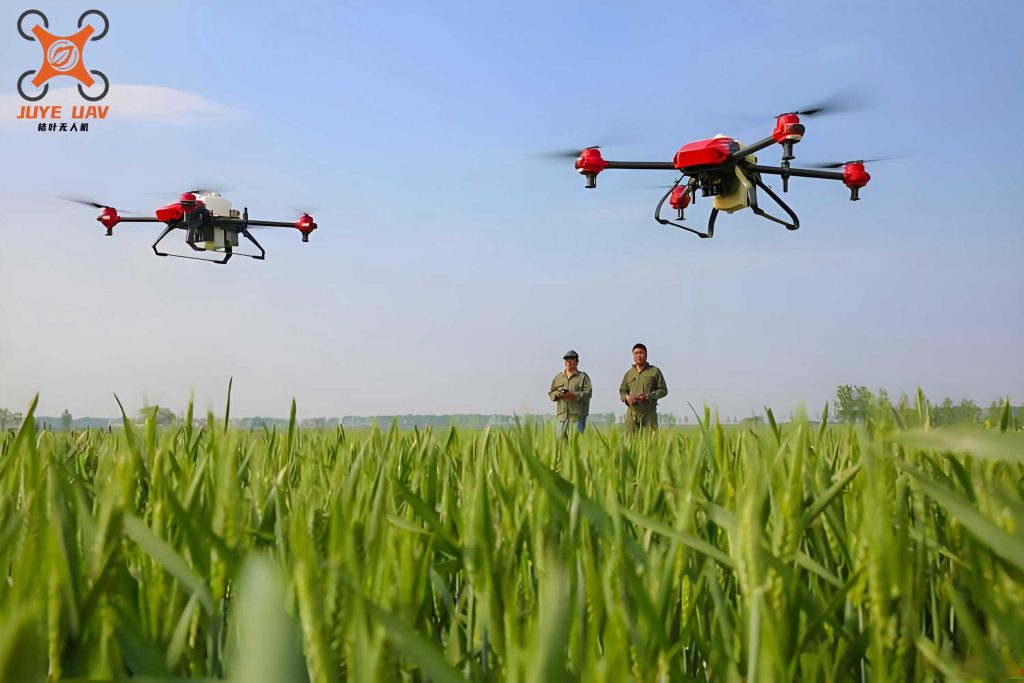
This configuration not only streamlines the agricultural drone’s form factor but also sets the foundation for an advanced thermal management network.
The thermal management system operates on a two-stage cooling architecture, forming a closed-loop circuit that includes the cold box, delivery pipelines, and motor heat dissipation cavities. A coolant medium—optimally a mixture of pure water and ethylene glycol—is circulated via a pump through ring-shaped conduits to each motor. Experimental data confirm that this system maintains motor operating temperatures at a stable $45 \pm 3^\circ\text{C}$, a reduction of more than $25^\circ\text{C}$ compared to traditional air-cooled agricultural drone systems. The process can be described by the following thermal energy balance for the motor cooling:
$$Q_{\text{motor}} = \dot{m} c_p (T_{\text{out}} – T_{\text{in}})$$
where $Q_{\text{motor}}$ is the heat dissipated from the motor (in watts), $\dot{m}$ is the mass flow rate of the coolant (in kg/s), $c_p$ is the specific heat capacity of the coolant (in J/(kg·K)), and $T_{\text{in}}$ and $T_{\text{out}}$ are the inlet and outlet coolant temperatures (in K), respectively. In typical operation, the coolant enters at $10$–$15^\circ\text{C}$ and exits at $25$–$30^\circ\text{C}$ after absorbing heat. The cold box itself is maintained at a low temperature of $12$–$18^\circ\text{C}$ using semiconductor cooling technology. Peltier elements (semiconductor thermoelectric coolers) are arranged in a ring, with their cold sides attached to the inner wall of the cold box and their hot sides connected to the pesticide tank wall. This design enables directional heat transfer, effectively moving waste heat from the cold box to the pesticide tank, which helps maintain the pesticide at an optimal temperature of $20 \pm 5^\circ\text{C}$ to prevent crystallization. The heat pump performance of a Peltier element can be approximated by:
$$Q_c = \alpha I T_c – \frac{1}{2} I^2 R – K (T_h – T_c)$$
where $Q_c$ is the heat absorbed at the cold junction, $\alpha$ is the Seebeck coefficient, $I$ is the current, $T_c$ and $T_h$ are the cold and hot junction temperatures, $R$ is the electrical resistance, and $K$ is the thermal conductance. This “active + passive” composite strategy ensures efficient cooling while recycling thermal energy.
A pivotal feature of this agricultural drone system is its intelligent pesticide mixing mechanism. When the pesticide tank level falls below a preset threshold or a timed spraying interval elapses, the control system activates an electro-valve, allowing a controlled amount of coolant to inject into the pesticide tank through bottom-connected orifices. The tank’s interior wall is equipped with triangular prismatic ribs that generate vortex shedding and centrifugal acceleration, promoting rapid and homogeneous mixing. The dynamics of this process can be modeled using the Navier-Stokes equations for an incompressible fluid:
$$\rho \left( \frac{\partial \mathbf{v}}{\partial t} + \mathbf{v} \cdot \nabla \mathbf{v} \right) = -\nabla p + \mu \nabla^2 \mathbf{v} + \mathbf{f}$$
where $\rho$ is fluid density, $\mathbf{v}$ is velocity, $p$ is pressure, $\mu$ is dynamic viscosity, and $\mathbf{f}$ represents body forces. In practice, coolant injection at $0.5\ \text{m/s}$ tangential velocity, combined with rib-induced accelerations of approximately $a = 0.8\ \text{m/s}^2$, creates a spiral downward flow field that achieves over 95% mixing uniformity within 15 seconds. This reduces pesticide sedimentation to less than 3%, a dramatic improvement over conventional systems.
The ring-shaped cold box is the cornerstone of this agricultural drone’s thermal system. Through finite element thermal analysis and optimization, its dimensional ratio and material composition were refined. The optimal diameter-to-height ratio was determined to be $3:1$, maximizing heat exchange surface area relative to volume. The box wall employs a double-layer stainless steel construction with polyurethane foam insulation, yielding an effective thermal conductivity as low as $k_{\text{eff}} = 0.023\ \text{W/(m·K)}$. Internal spiral baffles extend the coolant flow path by 40%, enhancing residence time and heat transfer efficiency. Key performance parameters of the cold box are summarized in the following table:
| Parameter | Value | Test Condition |
|---|---|---|
| Volume | 5 L | Standard configuration |
| Maximum Cooling Power | 300 W | Ambient temperature 25°C |
| Temperature Uniformity | ±1.5°C | Steady-state operation |
| Weight (including coolant) | 1.2 kg | – |
| Thermal Resistance | 0.05 K/W | At full load |
This design ensures that even under ambient temperatures of $35^\circ\text{C}$, the agricultural drone can operate continuously for over 120 minutes without thermal saturation, a critical advantage for extended missions.
The control system of the agricultural drone adopts a hierarchical architecture comprising sensor, decision, and execution layers. Multiple sensors—including liquid level, temperature, and flow sensors—sample data at 10 Hz. The decision layer employs a fuzzy logic algorithm to process inputs and generate control commands. For instance, coolant flow rate $\dot{V}$ is dynamically adjusted between $0.5$ and $2.0\ \text{L/min}$ based on real-time motor temperature $T_m$ and ambient temperature $T_a$, following a rule-based function:
$$\dot{V} = f(T_m, T_a, \dot{Q}_{\text{motor}})$$
where $\dot{Q}_{\text{motor}}$ is the estimated motor heat generation. The control system also manages the pesticide-coolant mixing ratio $R_{\text{mix}}$ according to pesticide viscosity and concentration, optimizing utilization. System response time is under 100 ms, enabling precise adaptation to varying operational conditions. Furthermore, the controller incorporates fault diagnostics and failsafe modes, enhancing the agricultural drone’s reliability. Historical data logs indicate that this intelligent control extends motor lifespan by 2–3 times and boosts pesticide utilization efficiency by more than 15%.
To validate the performance of this agricultural drone design, extensive field tests were conducted in mountainous pepper cultivation regions over two months. A comparative study pitted the prototype (experimental group) against a conventional air-cooled agricultural drone (control group). Both units performed daily pest control operations for 6 hours, covering a cumulative area of 3,000 mu (approximately 200 hectares). The results, encapsulated in the table below, demonstrate significant advantages:
| Performance Indicator | Experimental Group | Control Group |
|---|---|---|
| Motor Failure Rate (%) | 0 | 18 |
| Pesticide Sedimentation (%) | 2.7 | 23.5 |
| Operational Efficiency (mu/hour) | 45 | 38 |
| Pest Control Efficacy (%) | 92 | 85 |
| Continuous Operation Time in Heat (minutes) | 120+ | 45–60 |
The experimental agricultural drone maintained consistent performance even during peak temperature periods (11:00–14:00), whereas the control unit required frequent pauses for cooling. This translates to an 18.4% improvement in operational efficiency and a 7% boost in pest control efficacy, underscoring the system’s robustness in challenging environments.
Laboratory-based thermal performance tests were also performed under controlled environmental chamber conditions, simulating temperatures from $25^\circ\text{C}$ to $40^\circ\text{C}$, relative humidity from 30% to 70%, and workload levels from 50% to 100%. Infrared thermography captured temperature distributions across components. The data confirmed that motor temperatures remained within a safe limit of $50^\circ\text{C}$, pesticide temperature stayed in the optimal $18$–$22^\circ\text{C}$ range, and the system’s maximum heat dissipation capacity reached $400\ \text{W}$ at $35^\circ\text{C}$ ambient. The rate of coolant temperature rise was measured at less than $0.5^\circ\text{C}$ per minute, indicating stable thermal buffering. These results validate the agricultural drone’s ability to handle diverse and harsh operating scenarios.
An economic feasibility assessment was conducted using a full life-cycle cost analysis (LCCA) over a 5-year horizon. The analysis considered initial investment, annual maintenance, pesticide savings, and operational revenue. The comparative figures are presented below:
| Cost/Benefit Item | Experimental Agricultural Drone | Conventional Agricultural Drone | Difference |
|---|---|---|---|
| Initial Investment (USD thousands) | 4.8 | 4.2 | +0.6 |
| Annual Maintenance Cost (USD thousands) | 0.5 | 1.2 | -0.7 |
| Annual Pesticide Savings (USD thousands) | 0.8 | 0 | +0.8 |
| Annual Operational Revenue (USD thousands) | 6.5 | 5.0 | +1.5 |
| 5-Year Cumulative Net Benefit (USD thousands) | 9.0 | 4.0 | +5.0 |
The analysis reveals that although the advanced agricultural drone incurs a 15% higher upfront cost, the reductions in maintenance and pesticide waste, coupled with higher productivity, enable a payback period of under two years. Over five years, the net additional benefit amounts to $5,000, demonstrating strong economic viability for adoption in commercial farming.
The technological advantages of this agricultural drone design are multifaceted. Firstly, the integrated cooling system elevates heat dissipation efficiency by over 40% compared to traditional methods, directly enhancing reliability. Secondly, the smart mixing mechanism achieves pesticide utilization rates exceeding 97%, minimizing environmental impact and input costs. Thirdly, the modular and fault-tolerant architecture results in a mean time between failures (MTBF) greater than 500 hours, reducing downtime. These attributes make the agricultural drone particularly suitable for demanding applications: prolonged operations in hot climates, precision protection of high-value crops like fruits and vegetables, undulating terrains such as hills and mountains, and organic farms where chemical usage must be meticulously controlled.
Nevertheless, certain limitations were identified during testing. The additional mass of the cold box and associated components adds approximately 1.5 kg to the agricultural drone, which can reduce flight endurance by about 10–15%. Semiconductor cooling efficiency also diminishes slightly under extreme ambient temperatures above $40^\circ\text{C}$. Moreover, the initial system cost, though justifiable long-term, may pose a barrier to entry for small-scale farmers. To address these issues, future research will focus on several fronts: employing lightweight composite materials (e.g., carbon-fiber-reinforced polymers) to offset weight; integrating phase-change materials (PCMs) for supplemental passive cooling, governed by latent heat absorption $Q = m L_f$ where $m$ is PCM mass and $L_f$ is latent heat of fusion; streamlining manufacturing processes to lower production costs; and exploring hybrid power systems incorporating solar panels to extend mission time. These improvements aim to further optimize the agricultural drone for broader accessibility and performance.
Looking ahead, the evolution of thermal management in agricultural drones is poised to follow several trajectories. Intelligence will deepen through IoT connectivity and AI-driven predictive maintenance, allowing real-time system health monitoring and adaptive control. Multifunctionality will expand, with cooling systems possibly incorporating energy harvesting from waste heat to charge auxiliary batteries. Standardization efforts will emerge to establish industry-wide benchmarks for thermal performance and safety in agricultural drones. Sustainability will become a central theme, driving the development of eco-friendly, biodegradable coolant media and closed-loop fluid systems. These advancements will collectively propel the agricultural drone toward greater efficiency, reliability, and environmental stewardship, solidifying its role as a cornerstone of smart agriculture.
In conclusion, this research presents a groundbreaking approach to thermal and fluid management in agricultural drones. Through the innovative ring-shaped cold box design coupled with semiconductor cooling and intelligent mixing, the system achieves a motor temperature reduction exceeding $25^\circ\text{C}$, elevates pesticide utilization to 97%, and enhances operational efficiency by 18.4%. Field validations in mountainous pepper cultivation confirm superior pest control efficacy of 92% and remarkable reliability. Economic analysis affirms that the initial investment is recouped within two years, with substantial long-term benefits. This study not only provides a practical solution to extant challenges but also opens new avenues for optimizing agricultural drone performance. Future work will focus on weight reduction and cost optimization to accelerate the adoption of this technology, ultimately contributing to more sustainable and productive agricultural practices worldwide. The agricultural drone, empowered by advanced thermal management, stands ready to meet the growing demands of modern precision farming.