
In recent years, the rapid advancement of drone technology has led to its widespread adoption across various sectors. As a professional involved in emergency response training, I have observed the growing integration of drones, particularly fire drones, into the operations of national comprehensive fire and rescue teams. These unmanned aerial vehicles are revolutionizing how we approach “all-hazard, major emergency” scenarios, offering unprecedented capabilities in reconnaissance, monitoring, and direct intervention. However, the effectiveness of fire drones hinges on the skills of their operators. Currently, there is a pressing need for standardized training programs for fire drone operators within rescue services, as existing courses vary widely in content and applicability, often leaving graduates unprepared for field demands. In this article, I will analyze the application scenarios of fire drones in rescue work, outline the competency requirements for operators, and propose a detailed curriculum framework, emphasizing the use of tables and formulas to clarify key concepts. Throughout, the term ‘fire drone’ will be frequently highlighted to underscore its central role.
The deployment of fire drones in rescue operations spans numerous critical scenarios. First, in disaster site reconnaissance and surveillance, fire drones provide aerial views to assess situations, monitor progress, and search for targets. For instance, in building or underground facility fires, a fire drone can be sent ahead to scout for collapse risks or toxic leaks, enhancing responder safety. Real-time video feeds from fire drones can be transmitted via satellite, 5G, or wired networks to command centers, aiding decision-making. Second, environmental data collection is facilitated by fire drones equipped with sensors to measure temperature, humidity, wind, air quality, and toxic gases. This data informs safety protocols, such as evacuations or gear selection. Third, aerial photography and modeling involve fire drones with multi-lens or oblique cameras to capture images for creating 2D panoramas, 3D models, and before-after comparisons. These outputs support situational awareness and mapping for command purposes. Fourth, voice broadcasting allows fire drones to use onboard speakers to direct or calm victims and responders. Fifth, lighting and guidance are achieved with fire drones carrying illumination devices for night operations or low-light conditions. Sixth, aerial communication relay is a key function; fire drones can act as airborne repeaters to overcome signal blockages in mountainous, urban, or high-rise areas. The communication coverage radius can be calculated using the formula: $$ R = 3.57 \sqrt{H} $$ where \( R \) is the coverage radius in kilometers and \( H \) is the drone’s altitude in meters. The coverage area \( S \) is then given by $$ S = \pi R^2 $$. This enables extended control and video transmission ranges, especially when using tethered fire drones for prolonged missions. Seventh, material transport and airdrop involve fire drones delivering rescue ropes, life jackets, or supplies to inaccessible areas, such as islands in rapids or rugged terrain. Eighth, firefighting with drones entails using fire drones to carry extinguishing agents like dry powder or CO₂ to combat high-rise fires, or to deploy water hoses from ground sources. Looking ahead, direct victim evacuation via fire drones may become feasible. To summarize these scenarios, I present a table below.
| Scenario | Description | Key Fire Drone Capabilities |
|---|---|---|
| Reconnaissance and Surveillance | Aerial monitoring of disaster sites for real-time video and search operations. | High-resolution cameras, thermal imaging, live transmission. |
| Environmental Data Collection | Measuring temperature, gases, and weather conditions at the scene. | Sensor payloads (e.g., gas detectors, anemometers). |
| Aerial Photography and Modeling | Capturing images for 2D/3D maps and comparative analysis. | Multi-lens cameras, photogrammetry software integration. |
| Voice Broadcasting | Broadcasting instructions or alerts to people on the ground. | Loudspeakers, audio transmission systems. |
| Lighting and Guidance | Providing illumination for night rescues or signaling paths. | LED lights, spotlights with adjustable intensity. |
| Communication Relay | Extending wireless signal coverage in obstructed areas. | Radio repeaters, tethered systems for endurance. |
| Material Transport and Airdrop | Delivering supplies or rescue gear to isolated locations. | Cargo hooks, precision drop mechanisms. |
| Firefighting | Direct suppression of fires using onboard extinguishers or hoses. | Fire-resistant design, agent dispersal systems. |
To effectively utilize fire drones in these scenarios, operators must possess a diverse skill set. First, knowledge of laws and regulations is crucial. Operators should understand national aviation laws, airspace management rules, and local drone restrictions to ensure legal compliance. For example, in many jurisdictions, operating a fire drone requires prior airspace authorization. Second, flight control proficiency is essential. This includes abilities for takeoff, landing, and maneuvering in various conditions: outdoor visual line-of-sight (VLOS), outdoor beyond visual line-of-sight (BVLOS), indoor VLOS, and indoor BVLOS. Operators must achieve certifications like the AOPA Remote Pilot Certificate, with higher-level licenses for complex missions. Third, understanding wireless communication transmission characteristics is key. Fire drones rely on radio frequencies for control and data links; operators must configure channels, adjust antenna orientations, and even perform simple modifications to optimize signal strength. The path loss in wireless transmission can be modeled using the Friis transmission equation: $$ P_r = P_t G_t G_r \left( \frac{\lambda}{4 \pi d} \right)^2 $$ where \( P_r \) is received power, \( P_t \) is transmitted power, \( G_t \) and \( G_r \) are antenna gains, \( \lambda \) is wavelength, and \( d \) is distance. This knowledge helps in positioning and relay setups. Fourth, aerial photography skills are needed for capturing high-quality video and images. Operators should master camera settings, shot planning, and basic editing techniques. Fifth, mapping and annotation capabilities involve using software like ArcMap, DJI Terra, or ContextCapture to create panoramas, 3D models, and annotated maps for command decisions. Sixth, material handling skills enable precise cargo delivery and airdrop operations. Seventh, firefighting proficiency requires stable drone control during agent discharge. Eighth, maintenance and upkeep abilities ensure drone readiness, including assembly, cleaning, battery management, and minor repairs. For instance, battery capacity decay over time can be expressed as $$ C(t) = C_0 e^{-\alpha t} $$ where \( C(t) \) is capacity at time \( t \), \( C_0 \) is initial capacity, and \( \alpha \) is decay rate. Regular checks prevent failures. Below is a table summarizing these competency requirements.
| Competency Area | Specific Skills | Importance in Fire Drone Operations |
|---|---|---|
| Legal and Regulatory Knowledge | Understanding aviation laws, airspace申请, and local rules. | Ensures compliant and safe fire drone deployments. |
| Flight Control Proficiency | VLOS/BVLOS operations,模拟飞行, and certification. | Enables precise maneuvering in diverse rescue environments. |
| Wireless Communication Understanding | Radio frequency management, antenna tuning, relay setup. | Maintains reliable control and data links for fire drones. |
| Aerial Photography Skills | Camera operation, video editing, and搜寻 techniques. | Produces actionable visual intelligence from fire drones. |
| Mapping and Annotation Abilities | 2D/3D modeling, software use, and map标绘. | Supports decision-making with geospatial products. |
| Material Handling Proficiency | Payload calculation, airdrop accuracy, and safety protocols. | Facilitates efficient logistics via fire drones. |
| Firefighting Operation Skills | Stable flight during extinguisher use, agent management. | Directly enhances fire suppression capabilities of fire drones. |
| Maintenance and Upkeep | Battery care,故障排除, and component replacement. | Ensures fire drone longevity and readiness for emergencies. |
Based on these competencies, I propose a comprehensive training curriculum for fire drone operators. The curriculum should be modular, combining theory, simulation, and hands-on practice. Module 1: Regulations and Theory. This covers aviation laws, airspace rules, meteorology, drone anatomy, flight principles, and radio wave physics. For instance, the Bernoulli principle explains lift generation: $$ P + \frac{1}{2} \rho v^2 + \rho gh = \text{constant} $$ where \( P \) is pressure, \( \rho \) is air density, \( v \) is velocity, \( g \) is gravity, and \( h \) is height. Module 2: Flight Skills Training. It includes computer-based simulations and field exercises, progressing from basic controls to advanced maneuvers. Operators should aim for AOPA certifications, with regular refresher training. Module 3: Aerial Image Acquisition. Topics include photography basics, lens control,航拍技巧, and editing software. Module 4: Mapping and Annotation. Training on software for全景图, 3D modeling, and cluster computing setups for rapid processing. Module 5: Transport and Airdrop. Lessons on payload dynamics,例如, the force balance during airdrop: $$ F_{\text{net}} = mg – D $$ where \( F_{\text{net}} \) is net force, \( m \) is mass, \( g \) is gravity, and \( D \) is drag. Module 6: Maintenance. Covers assembly, cleaning, battery management (e.g., monitoring internal resistance \( R_{\text{bat}} \)), and troubleshooting. Module 7: Specialized Training. Tailored modules for specific roles, such as indoor flying for scouts or firefighting drills for suppression teams. The curriculum should emphasize practical scenarios where fire drones are deployed, such as in high-rise fire responses. For example, in a fire drill, operators might calculate the required extinguisher volume using $$ V = A \times h \times \rho_{\text{agent}} $$ where \( V \) is volume, \( A \) is fire area, \( h \) is suppression depth, and \( \rho_{\text{agent}} \) is agent density. Below is a table outlining the curriculum structure.
| Module | Content | Delivery Methods | Duration (Estimated Hours) |
|---|---|---|---|
| 1. Regulations and Theory | Laws, airspace management, drone physics, communication theory. | Lectures, online courses, quizzes. | 40 |
| 2. Flight Skills Training | Simulation, VLOS/BVLOS practice, certification prep. | Simulators, field exercises, assessments. | 60 |
| 3. Aerial Image Acquisition | Photography basics, camera control, video editing. | Hands-on flights, software labs. | 30 |
| 4. Mapping and Annotation | 2D/3D modeling software, map标绘, cluster setup. | Computer labs, project work. | 40 |
| 5. Transport and Airdrop | Payload计算, airdrop accuracy, safety protocols. | Field drills, weight simulations. | 25 |
| 6. Maintenance | Battery care, component replacement,故障排除. | Workshops, practical sessions. | 20 |
| 7. Specialized Training | Role-specific skills (e.g., firefighting, indoor search). | Scenario-based exercises, certifications. | 35 |
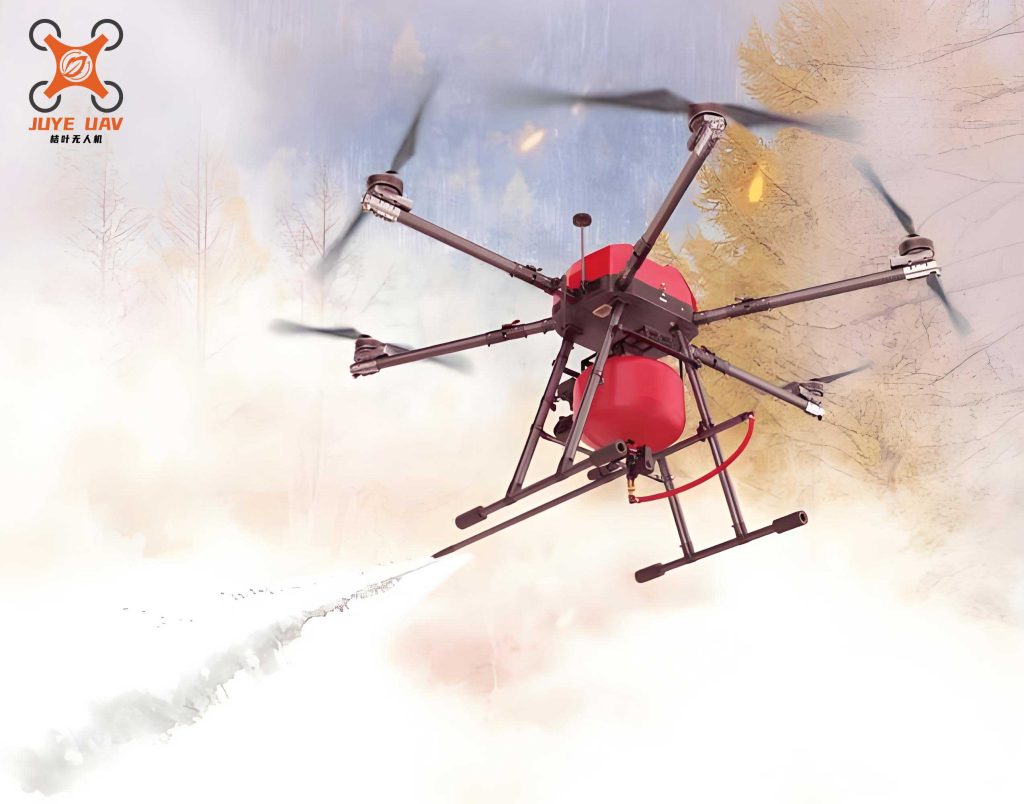
The integration of fire drones into rescue operations is not just a technological upgrade but a paradigm shift in emergency response. From my perspective, the effectiveness of a fire drone hinges on the operator’s expertise, making standardized training imperative. The curriculum I’ve outlined addresses core competencies through a blend of theory and practice, with tables and formulas used to clarify concepts like communication coverage and payload dynamics. For instance, in communication relay, the formula $$ R = 3.57 \sqrt{H} $$ helps operators plan aerial positions for optimal signal reach. Similarly, maintenance routines should account for battery degradation models to ensure fire drone reliability. As fire drone technology evolves, ongoing curriculum updates will be necessary, incorporating advancements in AI, autonomy, and new firefighting agents. Ultimately, a well-trained operator can maximize the potential of fire drones, enhancing safety and efficiency in rescue missions. This approach fosters a culture of proficiency where fire drones become indispensable tools in saving lives and mitigating disasters.
In conclusion, the demand for skilled fire drone operators in rescue services is growing, driven by the versatile applications of these unmanned systems. By implementing a structured curriculum that emphasizes legal knowledge, flight skills, communication understanding, and specialized capabilities, we can prepare operators to meet field challenges. The use of formulas, such as those for wireless transmission or force calculations, adds rigor to the training, while tables provide clear frameworks for learning. As I reflect on this, I believe that investing in such education will yield significant returns in operational effectiveness, making fire drones a cornerstone of modern rescue strategies. Future efforts should focus on validating this curriculum through pilot programs and adapting it to emerging technologies, ensuring that fire drone operators remain at the forefront of emergency response innovation.