
The night sky has found a new canvas. Across the globe, synchronized fleets of unmanned aerial vehicles (UAVs) paint ephemeral, luminous sculptures against the dark expanse, telling stories and branding experiences in a breathtaking spectacle known as a formation drone light show. This mesmerizing application transforms autonomous vehicles from tools of logistics or surveillance into artists’ pixels, requiring not just reliable individual flight but exquisite, coordinated choreography. The success of a formation drone light show hinges on the ability to control a large swarm—often hundreds or thousands of drones—to form and transition between complex, predefined three-dimensional shapes with millisecond precision, all while ensuring absolute safety and collision avoidance. This presents a formidable challenge in distributed nonlinear control.
Traditional control paradigms for multi-agent systems often rely on linearized models or complex optimization schemes that can struggle with the inherent nonlinearities of drone dynamics and the scalability demands of a large-scale formation drone light show. We often ask: can we find a control methodology that is inherently nonlinear, provides guaranteed stability, offers clear physical intuition, and scales elegantly with the size of the swarm? In this exploration, I delve into the application of Port-Hamiltonian System (PHS) theory and Interconnection and Damping Assignment Passivity-Based Control (IDA-PBC) to this very problem. This framework views the entire formation drone light show not just as a collection of independent agents, but as a cohesive, energy-driven system, allowing us to sculpt the swarm’s collective behavior by shaping its energy landscape.
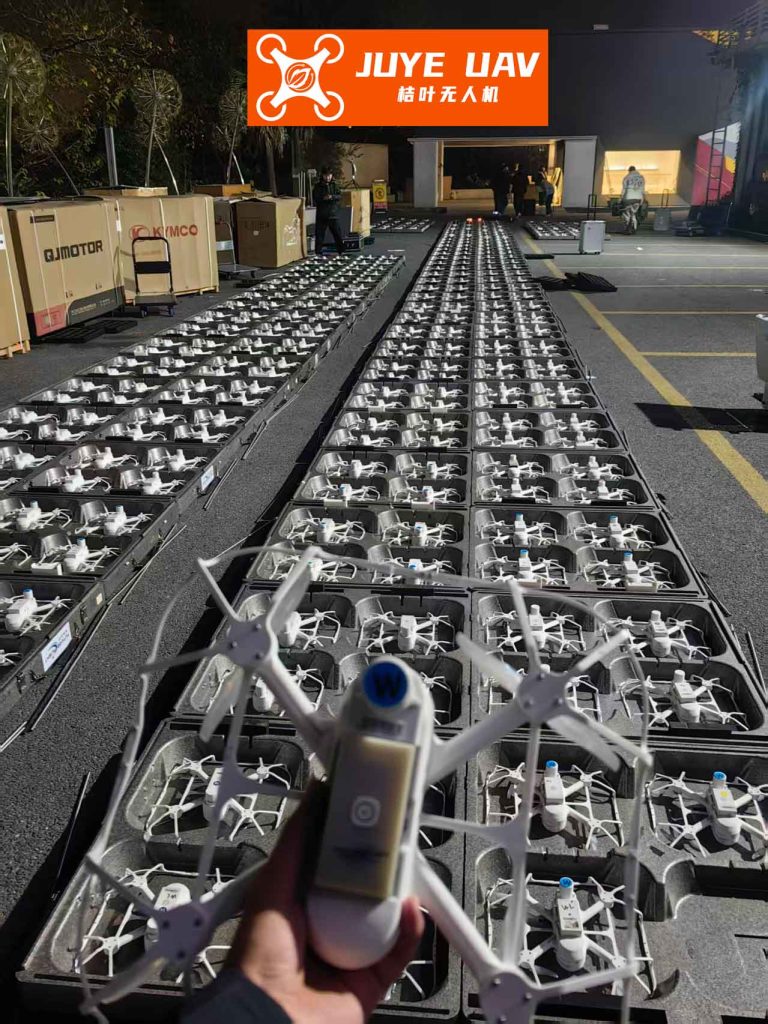
The core mathematical model for a single drone in a planar formation, which forms the basis for the 2D projection design of many formation drone light show patterns, combines kinematic and simplified autopilot dynamics. Let the state of drone \( i \) be \( \mathbf{x}_i = [x_i, y_i, \psi_i, V_i, \omega_i]^T \), representing its inertial position, heading angle, speed, and turning rate. The kinematics are:
$$
\begin{aligned}
\dot{x}_i &= V_i \cos(\psi_i) \\
\dot{y}_i &= V_i \sin(\psi_i) \\
\dot{\psi}_i &= \omega_i
\end{aligned}
$$
Coupled with a first-order autopilot model for speed and heading response:
$$
\begin{aligned}
\dot{V}_i &= k_V (V_i^c – V_i) \\
\dot{\omega}_i &= k_{\psi} (\psi_i^c – \psi_i) + k_{\omega} (\dot{\psi}_i^c – \omega_i)
\end{aligned}
$$
where \( u_i = [\psi_i^c, V_i^c]^T \) is the control input (command heading and speed), and \( k_V, k_{\psi}, k_{\omega} \) are time constants. This can be compactly written as a nonlinear system: \( \dot{\mathbf{x}}_i = \mathbf{f}(\mathbf{x}_i) + \mathbf{g}(\mathbf{x}_i) \mathbf{u}_i \).
For a swarm of \( N \) drones in a formation drone light show, the collective dynamics become:
$$
\dot{\mathbf{X}} = \mathbf{F}(\mathbf{X}) + \mathbf{G}(\mathbf{X}) \mathbf{U}
$$
where \( \mathbf{X} = [\mathbf{x}_1^T, \ldots, \mathbf{x}_N^T]^T \) and \( \mathbf{U} = [\mathbf{u}_1^T, \ldots, \mathbf{u}_N^T]^T \). The control objective is to drive each drone to a time-varying desired state \( \mathbf{x}_i^d(t) \), which defines its specific role in the evolving aerial image of the formation drone light show. The state error is \( \tilde{\mathbf{x}}_i = \mathbf{x}_i – \mathbf{x}_i^d \).
The Port-Hamiltonian Framework: An Energetic Perspective
Port-Hamiltonian Systems provide a powerful geometric framework for modeling and controlling complex physical systems. A PHS is described by:
$$
\begin{aligned}
\dot{\mathbf{x}} &= [\mathbf{J}(\mathbf{x}) – \mathbf{R}(\mathbf{x})] \frac{\partial H(\mathbf{x})}{\partial \mathbf{x}} + \mathbf{g}(\mathbf{x})\mathbf{u} \\
\mathbf{y} &= \mathbf{g}^T(\mathbf{x}) \frac{\partial H(\mathbf{x})}{\partial \mathbf{x}}
\end{aligned}
$$
Here, \( H(\mathbf{x}) \) is the Hamiltonian function representing the total stored energy. \( \mathbf{J}(\mathbf{x}) = -\mathbf{J}^T(\mathbf{x}) \) is the interconnection matrix describing how energy flows between different parts of the system, and \( \mathbf{R}(\mathbf{x}) = \mathbf{R}^T(\mathbf{x}) \geq 0 \) is the damping matrix representing energy dissipation. The passivity property (energy output \(\leq\) energy input) is inherent, making stability analysis natural through Lyapunov theory (\( \dot{H} \leq 0 \)).
The IDA-PBC methodology aims to reshape the system’s total energy and its interconnection/damping structure via feedback to achieve a desired closed-loop behavior. For a formation drone light show, we don’t just want each drone to be stable; we need the *formation* to be stable. We therefore define a *formation-wide* desired Hamiltonian \( H_d(\tilde{\mathbf{X}}) \) based on two key error types:
- Individual Tracking Error: The energy due to each drone’s deviation from its own trajectory (\( \frac{1}{2}\tilde{\mathbf{x}}_i^T \mathbf{M} \tilde{\mathbf{x}}_i \)).
- Relative Formation Error: The energy due to pairwise deviations from the desired formation geometry (\( \frac{1}{2} \sum_{j \in \mathcal{N}_i} \tilde{\mathbf{x}}_{ij}^T \mathbf{N} \tilde{\mathbf{x}}_{ij} \), where \( \tilde{\mathbf{x}}_{ij} = \tilde{\mathbf{x}}_i – \tilde{\mathbf{x}}_j \)).
Thus, for the entire formation drone light show swarm:
$$
H_d(\tilde{\mathbf{X}}) = \frac{1}{2} \sum_{i=1}^{N} \tilde{\mathbf{x}}_i^T \mathbf{M} \tilde{\mathbf{x}}_i + \frac{1}{2} \sum_{i=1}^{N} \sum_{j \in \mathcal{N}_i} \tilde{\mathbf{x}}_{ij}^T \mathbf{N} \tilde{\mathbf{x}}_{ij}
$$
This can be written compactly using the graph Laplacian matrix \( \mathbf{L} \) of the communication topology:
$$
H_d(\tilde{\mathbf{X}}) = \frac{1}{2} \tilde{\mathbf{X}}^T \left( \mathbf{I}_N \otimes \mathbf{M} + \mathbf{L} \otimes \mathbf{N} \right) \tilde{\mathbf{X}}
$$
The gradient is \( \frac{\partial H_d}{\partial \tilde{\mathbf{X}}} = \left( \mathbf{I}_N \otimes \mathbf{M} + \mathbf{L} \otimes \mathbf{N} \right) \tilde{\mathbf{X}} \). The matrices \( \mathbf{M} \) and \( \mathbf{N} \) are positive definite weighting matrices that allow the show designer to prioritize the precision of position, heading, or speed in the final formation drone light show pattern.
Designing the Controller for a Cooperative Choreography
Our goal is to find a distributed control law \( \mathbf{U} = \beta(\mathbf{X}) \) such that the closed-loop swarm dynamics mimic a desired PHS:
$$
\dot{\tilde{\mathbf{X}}} = [\mathbf{J}_d(\tilde{\mathbf{X}}) – \mathbf{R}_d(\tilde{\mathbf{X}})] \frac{\partial H_d(\tilde{\mathbf{X}})}{\partial \tilde{\mathbf{X}}}
$$
where \( \mathbf{J}_d \) and \( \mathbf{R}_d \) are the designer-chosen desired interconnection and damping matrices. This is achieved by solving the so-called matching condition. For the drone model, after careful selection of these matrices to satisfy the underlying structural conditions, we arrive at a distributed, computable control law for each drone \( i \) in the formation drone light show:
The control input for drone \( i \) is derived as:
$$
\mathbf{u}_i = \boldsymbol{\eta} \cdot \left[ \mathbf{C} \left( \tilde{\mathbf{x}}_i + \sum_{j \in \mathcal{N}_i} \mathbf{N} \tilde{\mathbf{x}}_{ij} \right) + \mathbf{D} (\dot{\mathbf{x}}_i^d – \mathbf{f}(\mathbf{x}_i)) \right]
$$
where \( \boldsymbol{\eta} = \text{diag}(1/k_V, 1/k_{\psi}) \), \( \mathbf{C} \) contains the interconnection gains derived from \( \mathbf{J}_d \), and \( \mathbf{D} \) is a selection matrix. This law has an intuitive structure:
- Formation Feedback: The term \( \mathbf{C} ( \tilde{\mathbf{x}}_i + \sum \mathbf{N} \tilde{\mathbf{x}}_{ij} ) \) ensures each drone corrects its own error while also cooperating with its neighbors to minimize relative errors, directly enforcing the cohesive geometry of the formation drone light show.
- Feedforward Compensation: The term \( \mathbf{D} (\dot{\mathbf{x}}_i^d – \mathbf{f}(\mathbf{x}_i)) \) accounts for the planned motion of the formation, helping the drone anticipate and track its dynamic target state.
Substituting this control law into the drone’s acceleration dynamics yields:
$$
\begin{bmatrix} \dot{V}_i \\ \dot{\omega}_i \end{bmatrix} = \mathbf{C} \left( \tilde{\mathbf{x}}_i + \sum_{j \in \mathcal{N}_i} \mathbf{N} \tilde{\mathbf{x}}_{ij} \right) + \begin{bmatrix} \dot{V}_i^d \\ \dot{\omega}_i^d \end{bmatrix}
$$
This clearly shows that the controller adjusts the drone’s accelerations based on the collective formation error, superimposed on the desired maneuver. The closed-loop system is guaranteed to be stable, with \( H_d(\tilde{\mathbf{X}}) \) acting as a Lyapunov function, ensuring all errors converge to zero for a well-designed formation drone light show sequence.
Simulation & Performance in a Virtual Light Show
To validate the approach for a formation drone light show, we simulate a swarm of 7 drones (1 leader, 6 followers) forming a rotating hexagon—a common and visually striking pattern. The desired formation is maintained relative to a virtual leader. The simulation parameters for a typical show drone are summarized below:
| Parameter | Symbol | Value |
|---|---|---|
| Speed Time Constant | \( k_V \) | 0.5 s\(^{-1}\) |
| Heading Time Constant | \( k_{\psi} \) | 0.5 s\(^{-2}\) |
| Angular Rate Time Constant | \( k_{\omega} \) | 0.3 s\(^{-1}\) |
| Min/Max Speed | \( V_{min}, V_{max} \) | 10 m/s, 50 m/s |
| Max Acceleration | \( a_{max} \) | 8 m/s\(^2\) |
| Interconnection Gain | \( k_1 \) | 0.08 |
| Damping (Speed) | \( r_V \) | 1 |
| Damping (Angular) | \( r_{\omega} \) | 2 |
The results are compelling. The swarm successfully achieves and maintains the precise hexagonal formation while executing both straight-line and circular collective motions. The state errors converge smoothly and rapidly to zero. A key advantage observed is the “energy-shaping” characteristic of the PHS approach: the transient response is notably smooth, without the aggressive oscillations or overshoot that can sometimes occur with high-gain error feedback, leading to a more stable and visually pleasing evolution of the formation drone light show pattern.
To quantify the performance, we compare the Port-Hamiltonian (PH) method against two other common approaches in a straight-line formation tracking scenario: a consensus-based linear method (CB) and a Distributed Model Predictive Control (DMPC). The key metrics for a high-quality formation drone light show are convergence time and control effort smoothness.
| Performance Metric | Port-Hamiltonian (PH-IDA-PBC) | Consensus-Based (CB) | Distributed MPC (DMPC) |
|---|---|---|---|
| Steady-State Position Error | < 0.1 m | < 0.15 m | < 0.1 m |
| Convergence Time (to 5% error) | ~12 s | ~18 s | ~15 s |
| Control Input Smoothness (Variance of \( \dot{V}_c \)) | Low | High | Medium |
| Computational Load per Drone | Very Low (explicit formula) | Low | Very High (online optimization) |
| Scalability to Large Swarms | Excellent | Good | Poor |
| Formation Cohesion During Transients | Excellent | Good | Good |
The table highlights the strengths of the PH approach for a formation drone light show. It offers fast and stable convergence with exceptionally smooth control signals, which translates to less wear on drone actuators and a more fluid visual presentation. Crucially, its computational simplicity (requiring only the evaluation of an explicit formula) and natural distributed structure make it supremely scalable. This is a decisive advantage for a large-scale formation drone light show involving hundreds of drones, where DMPC might become computationally intractable and simpler methods might lack smoothness or precision.
From Theory to the Night Sky: Practical Implementation
Translating this controller to a real-world formation drone light show requires addressing several practicalities. The PHS framework is robust to model inaccuracies due to its passivity-based foundation, but additional layers are needed:
- Robustness & Disturbance Rejection: While inherently stable, integrating an integral action or a sliding-mode observer within the PHS framework can enhance rejection of persistent wind gusts—a common challenge for outdoor formation drone light show performances.
- Collision Avoidance: The core formation controller assumes ideal conditions. A practical system must incorporate a reactive, higher-priority collision avoidance module, perhaps using artificial potential fields or velocity obstacles, that temporarily overrides the formation-keeping commands when a minimum separation distance is violated.
- 3D Extension: The presented model is planar. A full formation drone light show operates in 3D. The PHS/IDA-PBC methodology extends naturally to 3D dynamics (incorporating altitude, climb rate, pitch, and roll), with the Hamiltonian now penalizing errors in all six degrees of freedom. The desired interconnection matrix \( \mathbf{J}_d \) becomes more complex but retains its skew-symmetric structure.
- Communication Topology: The Laplacian \( \mathbf{L} \) in the controller must reflect the actual RF mesh network connecting the drones. The system’s stability is maintained as long as the communication graph is connected, making the formation drone light show robust to temporary, non-catastrophic link drops.
Conclusion
The Port-Hamiltonian system approach, combined with IDA-PBC, offers a profound and effective methodology for controlling a formation drone light show. It moves beyond merely driving state errors to zero and instead focuses on shaping the collective energy of the entire swarm. This energy-based perspective yields a controller that is not only provably stable and nonlinear but also provides remarkably smooth transient performance, low computational burden, and elegant scalability. These attributes are precisely what is demanded by the ambitious, large-scale aerial displays that define the modern formation drone light show. By viewing the swarm as an interconnected energetic system, we gain a powerful tool to choreograph the sky, transforming rigorous control theory into the magic of synchronized light and motion. The future of formation drone light show technology will undoubtedly involve more complex adaptive patterns and resilience; the Port-Hamiltonian framework provides a solid, extensible foundation upon which to build these next-generation capabilities.