
As an industrial designer deeply immersed in the intersection of technology, education, and child development, I have always been fascinated by how tangible objects can bridge abstract concepts. The journey of creating tools that not only entertain but also enlighten has led me to explore two remarkable innovations: a musical building block system that demystifies composition, and a bionic unmanned aerial vehicle that transforms the sky into a canvas of biological wonder. In this personal reflection, I delve into the principles, impacts, and future potentials of these designs, with a particular emphasis on the enchanting *flying butterfly drone*. Through this exploration, I aim to illustrate how design can cultivate creativity, scientific curiosity, and hands-on learning in children, using both analytical frameworks and poetic inspiration.
The core philosophy behind the musical building blocks is to translate the abstract language of music into a visual, tactile medium. Music theory, with its notes, rhythms, and harmonies, often appears daunting to young minds. By breaking it down into physical modules, we allow children to manipulate sound as if it were a set of colorful bricks. Each block represents a discrete musical element—melody, rhythm, instrument timbre, or volume. When connected, they form a coherent piece, much like assembling a puzzle. This approach aligns with constructivist learning theories, where knowledge is built through interaction with the environment. The system operates on two axes: horizontal arrangement dictates temporal sequence (rhythm and volume progression), while vertical stacking defines structural layers (different musical sections or harmonies). This spatial mapping can be represented through simple mathematical relations.
Consider the fundamental relationship between block placement and musical output. Let a block \( B_i \) be defined by a tuple of parameters: pitch \( p_i \), duration \( d_i \), intensity \( v_i \), and instrument type \( t_i \). When arranged horizontally in a sequence of \( n \) blocks, the resulting rhythm \( R \) and volume envelope \( V(t) \) can be modeled as:
$$ R = \sum_{i=1}^{n} d_i \cdot \delta(t – T_i) $$
$$ V(t) = \sum_{i=1}^{n} v_i \cdot \Pi\left(\frac{t – T_i}{d_i}\right) $$
where \( T_i \) is the cumulative time up to block \( i \), \( \delta \) is the Dirac delta function representing instantaneous note onset, and \( \Pi \) is the rectangular function defining the sustain period. Vertically, blocks stacked at position \( j \) create a harmonic layer \( H_j \), which is a superposition of pitches:
$$ H_j(t) = \sum_{k \in S_j} A_k \sin(2\pi f(p_k) t + \phi_k) $$
with \( S_j \) being the set of blocks in stack \( j \), \( A_k \) amplitude, \( f \) frequency mapping from pitch, and \( \phi_k \) phase. This formalism, though simplified, shows how spatial configuration translates to auditory experience. The technology enabling this is a fusion of radio-frequency identification (RFID) and flexible circuitry. Each block contains an RFID tag that encodes its musical identity. When placed on a baseboard embedded with readers, the system detects the arrangement and generates sound in real-time, offering an immersive, interactive loop. The table below summarizes the block types and their parameter mappings:
| Block Type | Parameter Symbol | Musical Equivalent | Range/Options |
|---|---|---|---|
| Melody | \( p_i \) | Pitch (Note) | C4 to G5 (12-tone equal temperament) |
| Rhythm | \( d_i \) | Duration | Whole, Half, Quarter, Eighth notes |
| Dynamics | \( v_i \) | Volume (Intensity) | pp, p, mp, mf, f, ff (0-100 dB SPL) |
| Instrument | \( t_i \) | Timbre | Piano, Violin, Flute, Drum, etc. |
| Structure | \( S_j \) | Harmonic Layer | Verse, Chorus, Bridge (stack height) |
The educational benefits are manifold. Children engage in algorithmic thinking as they sequence blocks, experiment with cause-effect relationships, and develop fine motor skills. Moreover, by making music composition tangible, we lower the barrier to artistic expression, fostering creativity and imagination. This design exemplifies how industrial design can serve as a mediator between complex systems and intuitive play.
Transitioning from the auditory to the aerial realm, the *flying butterfly drone* represents a leap in biomimetic design for educational toys. My fascination with this creation stems from its ability to merge nature’s elegance with technological prowess, creating a tool that inspires awe and inquiry. The *flying butterfly drone* is not merely a remote-controlled aircraft; it is a carefully crafted artifact that mimics the morphology and aesthetics of Lepidoptera, specifically butterflies. Designed for children aged eight and above, it serves as a gateway to biology, physics, and engineering.
The bionic design principles underlying the *flying butterfly drone* are rooted in the replication of natural flight mechanics and visual appearance. Butterflies exhibit complex flapping flight characterized by clap-and-fling mechanisms, which enhance lift. The drone emulates this through lightweight, flexible wings that undergo controlled deformation. The aerodynamic forces can be approximated using the Navier-Stokes equations simplified for low Reynolds number flow, typical for small-scale flapping flight:
$$ \rho \left( \frac{\partial \mathbf{u}}{\partial t} + \mathbf{u} \cdot \nabla \mathbf{u} \right) = -\nabla p + \mu \nabla^2 \mathbf{u} + \mathbf{f} $$
where \( \rho \) is air density, \( \mathbf{u} \) velocity field, \( p \) pressure, \( \mu \) dynamic viscosity, and \( \mathbf{f} \) body forces from wing beats. For design purposes, a more accessible model relates lift \( L \) to wing parameters:
$$ L = \frac{1}{2} \rho v^2 C_L A $$
with \( v \) as flapping velocity, \( C_L \) lift coefficient (dependent on wing shape and angle), and \( A \) wing area. The *flying butterfly drone* optimizes these variables to achieve stable, graceful motion. Beyond aerodynamics, the visual mimicry is achieved through smart material choices and integrated lighting. The wings incorporate iridescent films and LEDs that simulate the structural coloration found in butterfly scales, producing vibrant hues that change with viewing angle. This effect can be described by thin-film interference equations:
$$ 2n d \cos \theta = m \lambda $$
where \( n \) is refractive index, \( d \) film thickness, \( \theta \) angle of incidence, \( m \) order of interference, and \( \lambda \) wavelength of light. By tuning these parameters, the *flying butterfly drone* can replicate the shimmering colors of species like Morpho or Monarch, turning each flight into a dynamic light show.
The integration of such a *flying butterfly drone* into children’s play serves multiple pedagogical purposes. It sparks curiosity about entomology and ecology, encouraging kids to observe real butterflies more closely. The hands-on piloting experience teaches basics of drone control, navigation, and even programming if paired with coding interfaces. Moreover, the aesthetic appeal fosters an emotional connection to technology, blending art with science. To quantify its design attributes, consider the following specification table:
| Parameter | Value/Range | Design Significance |
|---|---|---|
| Wingspan | 20-25 cm | Mimics medium-sized butterflies, ensures indoor safety |
| Weight | 50-70 grams | Lightweight for efficient flapping, complies with toy regulations |
| Flight Time | 8-12 minutes | Balanced battery life for engagement without frustration |
| Control Range | 30 meters | Sufficient for backyard or classroom use |
| Lighting Modes | 6 pre-set, customizable via app | Enables color variation, educational on butterfly diversity |
| Material Composition | Polycarbonate frame, silicone wings, LED arrays | Durability, flexibility, and visual effects |
| Biomimetic Features | Flapping frequency: 5-8 Hz, wing curvature adjustable | Realistic flight pattern, study of biomechanics |
In practice, operating the *flying butterfly drone* is an immersive experience. Children can guide it through obstacle courses, simulate pollination scenarios, or simply enjoy its graceful dances. The inclusion of sensors for obstacle avoidance and stabilization algorithms ensures a user-friendly experience, reducing crashes and building confidence. This *flying butterfly drone* thus becomes a tool for STEM education, promoting skills in observation, hypothesis testing, and manual dexterity.
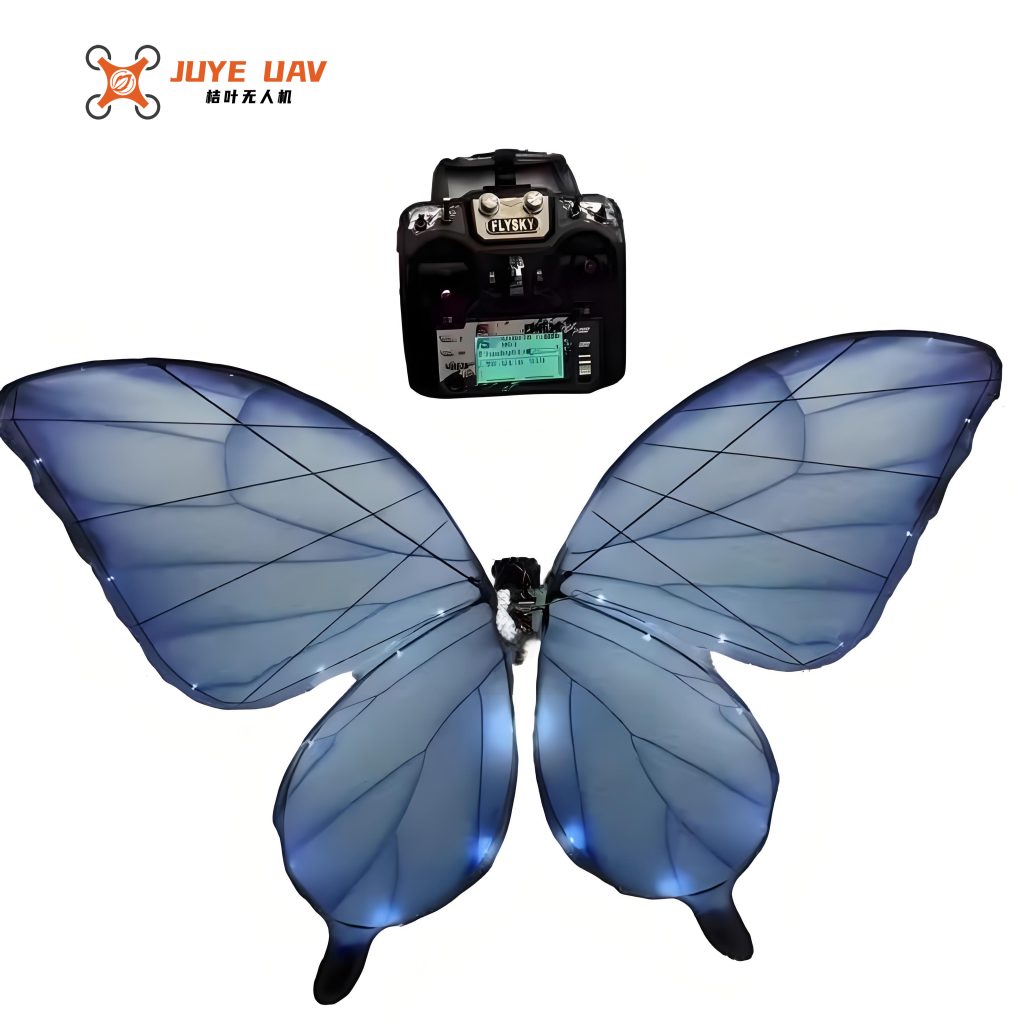
Seeing the *flying butterfly drone* in action, as captured in the image above, reinforces its magical quality. The delicate wings, aglow with ethereal colors, seem to defy the mechanical underpinnings, offering a glimpse into a future where technology harmonizes with nature. This visual representation is crucial for engaging children, as it taps into their innate wonder. The *flying butterfly drone* not only flies but tells a story of adaptation and beauty, inviting users to explore beyond the toy itself.
Comparing the two designs reveals a shared design ethos: making the complex accessible through physical interaction. Both the music blocks and the *flying butterfly drone* employ modularity and sensory feedback to teach abstract principles. However, they differ in sensory domains—auditory versus visual-kinesthetic—and in the cognitive skills they emphasize. The music blocks focus on sequential logic and pattern recognition, while the *flying butterfly drone* emphasizes spatial reasoning and real-time control. This complementary nature suggests that integrating such tools could create holistic learning environments. For instance, children might compose a soundtrack for the *flying butterfly drone*’s flight, blending music and motion into a multisensory performance.
From a technical perspective, both designs rely on embedded systems and wireless communication. The music blocks use RFID for passive identification, whereas the *flying butterfly drone* employs radio control or Wi-Fi for active maneuvering. The energy budgets also differ: the blocks draw minimal power from the baseboard, while the drone requires efficient batteries to sustain flight. These considerations highlight the importance of optimizing for usability and safety, especially for young users. The following formula estimates the power consumption \( P \) of the *flying butterfly drone*:
$$ P = P_{\text{prop}} + P_{\text{ctrl}} + P_{\text{light}} = \frac{1}{2} C_D \rho A v^3 + I V_{\text{circuit}} + N_{\text{LED}} \cdot I_{\text{LED}} V_{\text{LED}} $$
where \( P_{\text{prop}} \) is propulsion power (with \( C_D \) drag coefficient), \( P_{\text{ctrl}} \) for control electronics, and \( P_{\text{light}} \) for lighting. Minimizing \( P \) extends flight time, a key user satisfaction metric.
The educational impact of these designs can be framed through developmental psychology. According to Piaget’s stages, children aged 8-12 are in the concrete operational phase, benefiting from manipulatives that represent abstract ideas. Both products cater to this by providing concrete representations of music theory and aerodynamics. Vygotsky’s zone of proximal development is also relevant, as the tools scaffold learning: the music blocks offer guided composition, while the *flying butterfly drone* provides assisted flight modes before full manual control. Moreover, the *flying butterfly drone* encourages outdoor play and physical activity, countering sedentary screen time.
Looking ahead, the evolution of such designs could incorporate advanced technologies like artificial intelligence and augmented reality. Imagine a *flying butterfly drone* that adapts its flight pattern based on child’s skill level, or music blocks that suggest harmonies using machine learning. The integration of IoT could allow multiple *flying butterfly drones* to swarm, simulating collective behaviors seen in nature. These advancements would further blur the line between play and education, creating immersive learning ecosystems.
In my design practice, the principles gleaned from these projects inform a broader methodology. I advocate for human-centered design that prioritizes intuitive interaction, aesthetic appeal, and educational depth. The success of the *flying butterfly drone*, in particular, underscores the value of biomimicry—not just as a functional strategy but as a narrative tool that connects users to the natural world. Every time a child pilots the *flying butterfly drone*, they are not just controlling a device; they are engaging with a story of evolution, physics, and art.
To further elaborate on the technical nuances, let’s consider the control system of the *flying butterfly drone*. It typically uses a proportional-integral-derivative (PID) controller to maintain stability. The error \( e(t) \) between desired and actual orientation (pitch, roll, yaw) is minimized by adjusting motor outputs:
$$ u(t) = K_p e(t) + K_i \int_0^t e(\tau) d\tau + K_d \frac{de(t)}{dt} $$
where \( K_p, K_i, K_d \) are tuning gains. This ensures smooth flight even in mild winds, making the *flying butterfly drone* robust for outdoor use. Additionally, the *flying butterfly drone* might include gyroscopes and accelerometers for inertial measurement, feeding data to a microcontroller that executes control algorithms. This complexity is hidden behind a simple interface, often a smartphone app or a dedicated remote, embodying the design tenet of simplicity atop sophistication.
The manufacturing process for the *flying butterfly drone* involves considerations of scalability and sustainability. Lightweight materials like carbon fiber composites or advanced polymers are used to reduce weight while maintaining strength. The wings require precise molding to achieve the desired flexibility and optical properties. Assembly must balance cost with durability, as children’s products endure rough handling. Environmental impact is also crucial; using recyclable materials and efficient packaging reduces the ecological footprint of each *flying butterfly drone*.
From a market perspective, products like the *flying butterfly drone* and music blocks tap into growing trends in edutainment and STEAM (Science, Technology, Engineering, Arts, Mathematics) toys. Parents and educators seek tools that are both engaging and enriching, and these designs fit that niche. The *flying butterfly drone*, with its captivating appearance, has particular appeal for gift-giving and classroom demonstrations, often serving as a conversation starter about technology and nature.
In conclusion, the journey through these two design exemplars—the musical building blocks and the *flying butterfly drone*—reveals the transformative power of industrial design in childhood education. By making abstract concepts tangible, we empower children to explore, create, and discover. The *flying butterfly drone*, with its elegant biomimicry, stands as a testament to how technology can inspire wonder and curiosity. As I continue to explore new frontiers in design, I remain committed to creating experiences that blend play with learning, always remembering that the most effective tools are those that speak to the heart as well as the mind. The *flying butterfly drone* is more than a toy; it is a portal to a world where imagination takes flight, and every child can hold a piece of magic in their hands.
To quantify the interdisciplinary connections, here is a summary table linking design features to educational outcomes:
| Design Feature | Product | Educational Outcome | Cognitive Skill Enhanced |
|---|---|---|---|
| Spatial Arrangement of Blocks | Music Blocks | Understanding musical structure | Sequential logic, pattern recognition |
| RFID-Based Interaction | Music Blocks | Real-time feedback on composition | Cause-effect reasoning, auditory discrimination |
| Biomimetic Wing Design | Flying Butterfly Drone | Insight into aerodynamics and biology | Spatial reasoning, observational skills |
| Color-Changing Lighting | Flying Butterfly Drone | Awareness of optical phenomena and biodiversity | Visual perception, scientific inquiry |
| Modular Stacking (Vertical) | Music Blocks | Grasp of harmony and layering | System thinking, creativity |
| Stabilized Flight Control | Flying Butterfly Drone | Basics of robotics and control theory | Hand-eye coordination, problem-solving |
Ultimately, the legacy of such designs lies in their ability to inspire future generations. A child who composes a melody today might become a musician or programmer tomorrow; a child who pilots a *flying butterfly drone* might pursue a career in aerospace or ecology. By embedding learning into play, we plant seeds of curiosity that can grow into lifelong passions. The *flying butterfly drone*, in its delicate flight, carries not just technology but dreams, reminding us that design, at its best, is a bridge between the present and the possible.