
From a strategic studies perspective, the evolution of military technology is rarely a story of autonomous scientific progress. Instead, it is a narrative deeply intertwined with a state’s perception of threat, its overarching national security strategy, and its resulting military doctrine. The development and deployment of U.S. military drone systems offer a compelling case study of this dynamic. As a leading power in both military affairs and technological innovation, the trajectory of American military drone programs cannot be fully understood in isolation from the shifting priorities in Washington’s strategic outlook. This article argues that military drones function as strategic instruments, with their operational roles, technical specifications, and global deployment patterns being directly shaped by the prevailing U.S. strategic paradigm—from the Global War on Terror, through the Asia-Pacific Rebalance, to the current era of Great Power Competition.
Theoretical Framework: Military Technology as a Strategic Tool
In the complex giant system of international relations and military affairs, technological advancements serve primarily as “enablers.” The invention and refinement of weapon systems, from firearms to aircraft carriers to nuclear weapons, have historically been directed towards fulfilling specific strategic objectives. The direction of military research and development (R&D) is not neutral; it is a response to perceived threats and envisioned conflict scenarios. The development of military drone technology in the United States exemplifies this principle. Top-level strategic planning documents, such as the Department of Defense’s periodic Unmanned Systems Integrated Roadmaps, provide the blueprint, but the operational impetus comes from the strategic environment. We can model this relationship conceptually:
$$ S(t) \rightarrow P(T, D) \rightarrow M(drone) $$
Where \( S(t) \) represents the National Security Strategy at time \( t \), defining the primary threat. This strategy informs military Priorities \( P \), which are a function of perceived Threat type \( T \) and envisioned Conflict Domain \( D \). These priorities, in turn, dictate the Mission profile \( M \) and consequent development trajectory for military drone systems. The following table summarizes this linkage across recent strategic eras:
| Strategic Era | Primary Threat (T) | Conflict Domain (D) | Primary Military Drone Mission (M) | Key Military Drone Characteristics |
|---|---|---|---|---|
| Global War on Terror (c. 2001-2014) | Non-state actors (Terrorist Networks) | Permissive / Asymmetric (Middle East, South Asia) | Persistent ISR; Precision Strike (Counter-terrorism) | High-altitude, long-endurance (HALE); Armed platforms (e.g., MQ-1); Focus on cost-effectiveness and risk reduction. |
| Asia-Pacific Rebalance (c. 2012-2017) | Rise of a Peer Competitor (China) | Maritime / Contested Commons (Indo-Pacific) | Broad-area Maritime ISR; Situational Awareness | Maritime-optimized HALE (e.g., MQ-4C); Deployment to forward bases; Emphasis on interoperability with allies. |
| Great Power Competition (c. 2018-Present) | Near-peer state competition (China, Russia) | High-end, multi-domain warfare | ISR in denied areas; Stand-in attack; Force multiplier in networked systems | Attritable, low-cost systems; “Loyal Wingman” concepts; AI/ML integration; Swarm tactics; Counter-drone systems. |
Phase I: Military Drones in the Global War on Terror – Proof of Concept
Following the September 11 attacks, counter-terrorism became the central organizing principle of U.S. national security. The military drone transitioned from a developmental asset to a cornerstone of counter-insurgency (COIN) operations. The strategic environment was characterized by a massive power asymmetry. Adversaries like Al-Qaeda and the Taliban lacked integrated air defenses, electronic warfare capabilities, or sophisticated early warning systems. This created a permissive environment where the inherent vulnerabilities of early military drone systems—such as susceptibility to advanced air defenses—were not a limiting factor.
The primary mission set for military drones in this era was two-fold: persistent Intelligence, Surveillance, and Reconnaissance (ISR) and precision strike, often in the form of “targeted killings.” The value proposition was clear: a military drone like the MQ-1 Predator or MQ-9 Reaper could loiter over an area for over 24 hours, providing unparalleled persistent stare, and then deliver a Hellfire missile with precision, all while keeping U.S. personnel out of harm’s way. This tactical utility dovetailed perfectly with the strategic goal of applying relentless pressure on terrorist networks with minimal U.S. casualties and lower financial cost compared to traditional manned platforms.
A significant tactical innovation was the “signature strike,” where the targeting logic moved beyond specific high-value individuals to patterns of life and behavior. This represented an early fusion of military drone sensor data with rudimentary algorithmic processing. The operational loop could be simplified as:
$$ \text{Drone ISR Feed} \xrightarrow{\text{Pattern Recognition}} \text{Target Signature Match} \rightarrow \text{Kinetic Strike Authorization} $$
While effective in disrupting terrorist cells, this phase also revealed the strategic and ethical limitations of military drone warfare in counter-terrorism. Civilian casualties, though arguably lower than with conventional munitions, generated significant local backlash and complicated broader strategic objectives of stabilization and winning local support. The military drone proved to be a potent tactical tool against diffuse, low-tech adversaries, but its use also underscored that technological superiority alone does not resolve complex political conflicts.
Phase II: The Asia-Pacific Rebalance – Pivoting the ISR Platform
As the U.S. began drawing down from Iraq and Afghanistan, its strategic focus shifted towards the Indo-Pacific region, formalized in the Obama administration’s “Pivot” or “Rebalance.” The perceived threat evolved from non-state terrorism to the strategic rise of China, viewed as a “revisionist power.” The conflict domain shifted accordingly from permissive land environments to vast, contested maritime commons. In this context, the role of the military drone evolved from a hunter-killer in counter-terrorism to a vital sensor node in a great power competition characterized by peacetime rivalry and the need for domain awareness.
The deployment and export of military drone systems to the Asia-Pacific region became a key instrument of the Rebalance strategy. The U.S. forward-deployed ISR-optimized drones like the RQ-4 Global Hawk and the maritime-specific MQ-4C Triton to bases in Guam, Japan, and later, the Philippines. These systems were tailored for the mission: providing broad-area, persistent surveillance over the South and East China Seas, monitoring Chinese naval and coast guard activities, and enhancing the U.S. military’s maritime domain awareness.
Furthermore, the U.S. began exporting unarmed, ISR-focused military drones to key allies and partners in the region, such as Japan, South Korea, and Australia. This served multiple strategic purposes: it deepened military interoperability with allies, strengthened their independent surveillance capabilities (often in areas of territorial dispute with China), and integrated partner nations into a broader U.S.-led informational network. The drone was no longer just a weapon system; it was a tool for alliance management and building a shared operational picture to deter Chinese coercion. The strategic logic was one of peacetime competition and deterrence, where the military drone’s role was to enhance transparency, support freedom of navigation operations, and gather intelligence—all while minimizing the risk of direct escalation that might accompany frequent manned aircraft incursions.
Phase III: Great Power Competition – Gearing Up for High-End Warfare
The U.S. strategic documents from 2017-2018 crystallized a decisive shift. “Inter-state strategic competition,” not terrorism, was declared the primary concern of U.S. national security. The “pacing challenge” from China, in particular, framed a future conflict scenario not as an asymmetric struggle but as a “high-end conventional war” against a “near-peer” adversary with advanced anti-access/area denial (A2/AD) capabilities, integrated air defenses, cyber and electronic warfare tools, and its own sophisticated military drone fleet. This new paradigm demanded a radical rethinking of the military drone’s role and capabilities.
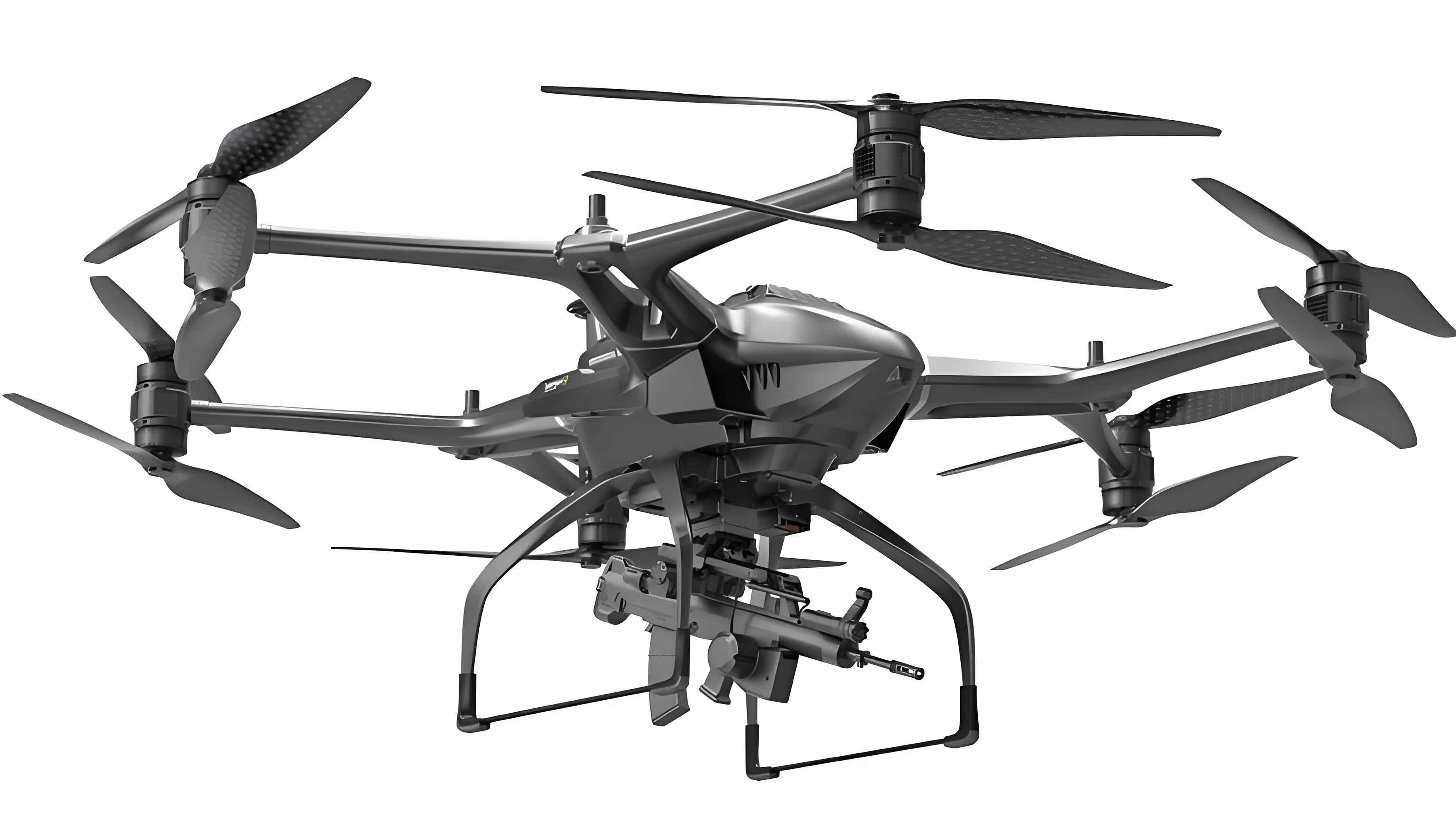
The military drone now had to be survivable and effective in contested, denied, and operationally limited environments. Simply put, the permissive conditions of the counter-terrorism era were gone. The U.S. response has been to drive military drone development along several interconnected vectors, all aimed at increasing lethality, resilience, and mass while reducing cost and risk to manned platforms. The following table outlines the key developmental thrusts:
| Development Thrust | Strategic Rationale | Examples / Concepts |
|---|---|---|
| Manned-Unmanned Teaming (MUM-T) | Preserve human decision-making in the loop while leveraging unmanned mass and sensor capabilities; penetrate contested airspace with attritable drones alongside high-value manned assets. | “Loyal Wingman” programs (e.g., Skyborg, XQ-58A Valkyrie); MQ-25 Stingray unmanned tanker to extend strike range of manned fighters. |
| Integration of AI & Machine Learning (AI/ML) | Process vast sensor data faster than adversaries; enable autonomous coordination in communications-denied environments; improve target recognition and reduce operator cognitive load. | Project Maven (computer vision for FMV analysis); algorithmic control for drone swarms; AI pilots for autonomous dogfighting. |
| Attritable, Low-Cost, & Swarming Systems | Overwhelm enemy defenses with mass; achieve favorable cost-exchange ratios; enable distributed operations central to new concepts like JADC2 (Joint All-Domain Command & Control). | OFFSET program (swarm tactics); LOCUST (Low-Cost UAV Swarming Technology); small, tube-launched drones. |
| Counter-Drone (C-UAS) Systems | Defend forces and homeland from adversary drone swarms and ISR platforms, which are now a ubiquitous threat. | Directed energy (lasers, HPM); electronic warfare; kinetic interceptors; DoD-wide C-UAS strategy. |
This phase also saw a significant policy shift regarding military drone exports. To counter China’s growing role as a leading exporter of armed drones and to bolster partners facing Chinese pressure, the Trump administration reinterpreted the Missile Technology Control Regime (MTCR) guidelines in 2020. This allowed the U.S. to more freely export Category I systems like the MQ-9B Sea Guardian, directly competing with Chinese models and strategically arming partners from India to Taiwan. The military drone thus became a tool not only for direct warfighting preparation but also for shaping the international security environment through arms transfers and alliance bolstering.
Future Trajectories and the Strategic Calculus
The current trajectory of U.S. military drone development is firmly set by the logic of great power competition and preparing for high-intensity conflict. Future systems will increasingly emphasize autonomy, networking, and integration into a larger “system of systems.” The vision is for swarms of low-cost, collaborative drones performing a variety of missions—from ISR and electronic attack to strike and air defense suppression—acting as force multipliers for manned platforms and making U.S. force posture more distributed and resilient.
A key conceptual model for future operations is the “kill web,” where a military drone is merely one node in a dynamic, resilient network of sensors and shooters. Its value is derived not solely from its onboard capabilities but from its connectivity. The formula for effectiveness in this paradigm shifts:
$$ \text{Drone Effectiveness}_{Future} = f(Autonomy, Connectivity, Mass, Cost) $$
Where:
\( Autonomy \) = Level of AI-enabled independent action within a commander’s intent.
\( Connectivity \) = Resilient data links within the JADC2 network (though with capacity for “offline” ops).
\( Mass \) = The number of deployable, attritable units.
\( Cost \) = Low enough to enable procurement of significant mass.
This stands in stark contrast to the earlier model of the military drone as a remotely piloted, standalone ISR-strike platform.
Conclusion: The Drone as a Mirror of Strategy
The history of the U.S. military drone is a history of adapting technology to strategic necessity. From its initial use as a niche tool for counter-terrorism in permissive skies, it has been recast as a central component of sea control and peacetime competition in the Pacific, and is now being radically redesigned as a networked, attritable asset for high-end warfighting. Each shift in U.S. strategic priorities—from a “Global War on Terror” to an “Asia-Pacific Rebalance” to “Great Power Competition”—has directly precipitated a corresponding shift in the mission set, deployment patterns, export policy, and technological focus of its military drone programs.
This analysis underscores that military drone systems, like all major weapon systems, are not merely products of technological determinism. They are policy instruments, shaped at the most fundamental level by a nation’s answer to the core strategic questions: Who is the adversary? Where might conflict occur? What type of conflict is it? As long as great power competition remains the defining framework of U.S. national security strategy, the development of American military drones will continue to be guided by the demanding requirements of survivability, lethality, and mass in a contested multi-domain battlespace. The evolution of the military drone from a tactical strike platform to a strategic instrument of competition and deterrence is a powerful testament to the enduring interplay between technology, military doctrine, and grand strategy.