
As an observer and researcher in the field of defense technology, I have witnessed the rapid proliferation of unmanned aerial vehicles (UAVs) and the ensuing security challenges. The global UAV market has been growing at an annual rate exceeding 20%, bringing economic benefits but also posing severe threats to civil aviation, military operations, and personal safety. In this context, the development of anti-UAV technologies has become a critical focus in international security. In this article, I will delve into the current landscape of anti-UAV systems, analyzing their technical architectures, limitations, and future directions, while emphasizing the importance of innovation in this domain. The term “anti-UAV” will be frequently referenced to underscore its centrality in modern defense strategies.
The rise of anti-UAV capabilities is driven by the increasing sophistication of UAV threats, including swarm attacks and autonomous operations. From my perspective, the evolution of anti-UAV technologies reflects a broader shift toward integrated, multi-layered defense systems. These systems are designed to detect, identify, and neutralize UAVs through a combination of sensors, electronic warfare, and kinetic or non-kinetic interceptors. In the following sections, I will explore key anti-UAV systems, their underlying technologies, and the mathematical principles that govern their performance, using tables and formulas to summarize complex concepts.
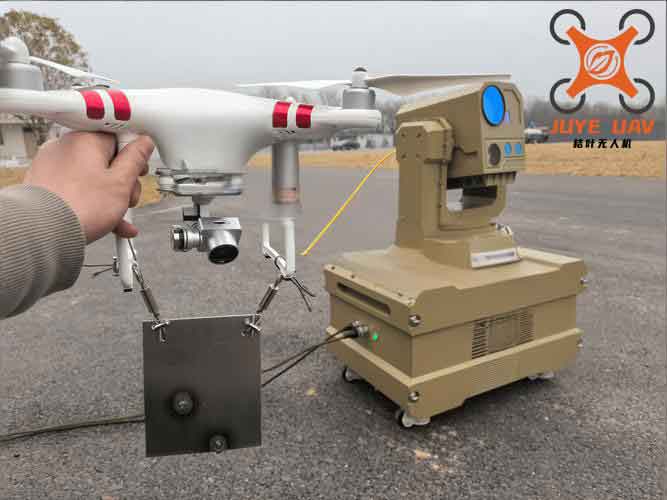
Anti-UAV systems can be categorized based on their core functions: detection and identification, electronic countermeasures, and physical interception. Each category employs distinct technologies, and their integration is essential for effective defense. For instance, detection often relies on multi-modal sensor fusion, where radio frequency (RF) sensors, radar, and electro-optical systems work in tandem. The effectiveness of these systems can be quantified using formulas such as the radar range equation for detection capabilities. Consider the following equation for radar detection range in anti-UAV applications:
$$ R = \sqrt[4]{\frac{P_t G_t G_r \lambda^2 \sigma}{(4\pi)^3 k T_s B F L}} $$
Here, \( R \) represents the detection range, \( P_t \) is the transmitted power, \( G_t \) and \( G_r \) are the antenna gains, \( \lambda \) is the wavelength, \( \sigma \) is the radar cross-section of the UAV, \( k \) is Boltzmann’s constant, \( T_s \) is the system noise temperature, \( B \) is the bandwidth, \( F \) is the noise figure, and \( L \) accounts for losses. This equation highlights how factors like UAV size and environmental conditions impact anti-UAV radar performance. For small UAVs with a radar cross-section of 0.01 m², systems like the KuRFS radar can achieve ranges up to 8 km, demonstrating the importance of optimized parameters in anti-UAV design.
To provide a comprehensive overview, I have compiled tables summarizing prominent anti-UAV systems. These tables categorize systems by their primary technology, range, advantages, disadvantages, and typical applications. The data is based on publicly available information and reflects the diversity of approaches in the anti-UAV domain. Table 1 focuses on detection and intelligent decision-making systems, which are crucial for early warning and situational awareness in anti-UAV operations.
| System Name | Core Technology | Operational Range | Advantages | Disadvantages | Typical Application Scenarios |
|---|---|---|---|---|---|
| Multi-Sensor Tracker | RF, Electro-Optical, and AI Fusion | ≤5 km | 98% identification accuracy, operator tracking capability | No interception ability, requires integration with other systems | Critical site monitoring, situational awareness |
| AI-Driven Sensor Network | Distributed sensors with AI analytics | ≤2 km | Real-time threat assessment, adaptive defense | Requires network support, high electromagnetic compatibility needs | Border patrol, base protection |
| Smart Fire Control System | AI-assisted targeting for small arms | ≤300 m | Increases hit probability to over 90% | Relies on human shooter, limited to low-speed targets | Infantry units, close-range defense |
Electronic countermeasures form another pillar of anti-UAV technology, often referred to as “soft kill” methods. These systems disrupt UAV communications or navigation without physical damage, allowing for capture and forensic analysis. Key techniques include RF jamming, GPS spoofing, and protocol hacking. The effectiveness of jamming can be modeled using signal-to-interference ratio (SIR) calculations. For an anti-UAV jammer, the SIR at the UAV receiver can be expressed as:
$$ \text{SIR} = \frac{P_r}{J + N} $$
where \( P_r \) is the received power from the legitimate controller, \( J \) is the jamming power, and \( N \) is the noise power. Successful anti-UAV jamming typically requires an SIR below a threshold, often around 0 dB for commercial UAVs. Systems like tactical electromagnetic guns can simultaneously jam multiple frequency bands (e.g., 433 MHz, 915 MHz, 2.4 GHz, 5.8 GHz), enhancing their versatility in anti-UAV scenarios. Table 2 outlines electronic countermeasure systems, emphasizing their role in non-destructive anti-UAV operations.
| System Name | Core Technology | Operational Range | Advantages | Disadvantages | Typical Application Scenarios |
|---|---|---|---|---|---|
| Tactical Electromagnetic Gun | Multi-band RF and GNSS interference | ≤2 km | Portable, non-destructive, forensic-friendly | Depends on UAV communication protocols | Urban security, critical site defense |
| Handheld RF Disruptor | Directional RF interference | ≤1 km | Lightweight, rapid response | Short range, limited frequency coverage | Close-range emergency response |
| Integrated Electronic Warfare System | Protocol cracking and electronic attack | ≤5 km | Can take over control, precise targeting | Effective only against known protocols, high technical barrier | High-end military engagements |
| Modular Defense System (Electronic Module) | Radar, electro-optical, and jamming integration | ≤3 km | Modular design, interception success rate up to 95% | Complex system, long deployment time | Critical infrastructure protection |
Physical interception, or “hard kill,” represents the final layer in anti-UAV defense, involving direct destruction or capture of UAVs. This category includes kinetic interceptors, energy weapons, and net-based systems. The lethality of kinetic interceptors can be assessed using impact energy formulas. For example, the kinetic energy \( E_k \) of an interceptor drone used in anti-UAV operations is given by:
$$ E_k = \frac{1}{2} m v^2 $$
where \( m \) is the mass and \( v \) is the velocity. With velocities exceeding 500 km/h, such interceptors can neutralize small UAVs effectively. Energy weapons, like high-energy lasers, rely on power density for damage. The power density \( I \) at the target for an anti-UAV laser system is:
$$ I = \frac{P}{A} $$
where \( P \) is the laser power and \( A \) is the spot area. Systems with 50 kW lasers can achieve power densities sufficient to burn through UAV components within seconds. Table 3 summarizes physical interception systems, highlighting their role in robust anti-UAV strategies.
| System Name | Core Technology | Operational Range | Advantages | Disadvantages | Typical Application Scenarios |
|---|---|---|---|---|---|
| High-Energy Laser Weapon System | Laser beam destruction | ≤5 km | Light-speed engagement, low per-shot cost | Affected by weather, high energy consumption | Military bases, field air defense |
| Net-Based Interceptor | Compressed air net launch | ≤100 m | Non-kinetic, allows forensic capture | Short range, requires line-of-sight | Airports, nuclear plants |
| Interceptor Drone | Collision or submunition release | ≤10 km | Low cost (~$15,000 per unit), reusable | Requires radar guidance, limited against high-maneuverability targets | Layered air defense, swarm countermeasures |
| Modular Loitering Munition System | Loitering and suicide attack | ≤70 km | Multi-mission capability, low cost (~$30,000 per unit) | Limited endurance, requires human confirmation | Frontline units, asymmetric warfare |
| Anti-Radiation Loitering Munition | Radar homing and explosive destruction | Area coverage | Intelligent radar identification, high explosive damage | Single-use, requires electromagnetic signal inducement | Suppression of enemy air defenses |
Looking ahead, future anti-UAV technologies are poised to leverage advancements in artificial intelligence, quantum communication, and cross-domain synergy. Systems under development aim to address current limitations, such as environmental adaptability and interoperability. For instance, AI algorithms can enhance detection accuracy in cluttered environments, while quantum encryption may secure anti-UAV networks. The performance of next-generation anti-UAV systems can be projected using scaling laws. For detection range improvements, a simplified model might be:
$$ R_{\text{future}} = R_{\text{current}} \times \left( \frac{P_{\text{future}}}{P_{\text{current}}} \right)^{1/4} $$
where \( R_{\text{future}} \) and \( P_{\text{future}} \) are the future range and power, respectively. With anticipated power increases, detection ranges could exceed 20 km by 2030, revolutionizing anti-UAV capabilities. Table 4 outlines emerging technologies focused on swarm and cross-domain anti-UAV challenges.
| System Name | Core Technology | Operational Range | Advantages | Disadvantages | Typical Application Scenarios |
|---|---|---|---|---|---|
| Autonomous Swarm System with EMP | Drone swarm and electromagnetic pulse | Area coverage | Effective against saturation attacks, intelligent task allocation | Technology not mature, energy management challenges | Future battlefield area denial |
| Multi-Domain Unmanned System Platform | Cross-domain unmanned system coordination | All domains | Seamless cross-domain response, autonomous operation | Requires quantum communication support, conceptual stage | Joint air, land, and sea operations |
Despite these advancements, current anti-UAV technologies face significant limitations. From my analysis, environmental adaptability remains a critical bottleneck. In urban settings, multipath effects and obstructions can increase false alarm rates to 30%, reducing the reliability of anti-UAV sensors. Weather conditions, such as rain or fog, degrade laser-based anti-UAV systems by over 60%, as atmospheric attenuation reduces beam coherence. This can be quantified using the attenuation coefficient \( \alpha \) in the Beer-Lambert law for laser propagation:
$$ I = I_0 e^{-\alpha d} $$
where \( I_0 \) is the initial intensity, \( I \) is the intensity at distance \( d \), and \( \alpha \) increases in poor visibility. For RF jamming, success rates drop to 75% against UAVs with anti-jamming designs, highlighting the need for adaptive anti-UAV electronic warfare.
System interoperability is another major challenge in anti-UAV networks. Data format incompatibility between vendors hinders information sharing, while response delays often exceed 200 ms, insufficient for high-speed UAV threats. The integration latency \( T_{\text{int}} \) in a multi-system anti-UAV setup can be modeled as:
$$ T_{\text{int}} = T_{\text{proc}} + T_{\text{comm}} + T_{\text{sync}} $$
where \( T_{\text{proc}} \) is processing time, \( T_{\text{comm}} \) is communication latency, and \( T_{\text{sync}} \) is synchronization overhead. Reducing \( T_{\text{int}} \) below 100 ms is essential for effective anti-UAV responses, necessitating standardized interfaces and optimized algorithms.
In conclusion, the evolution of anti-UAV technologies reflects a dynamic interplay between innovation and practical constraints. From detection to interception, anti-UAV systems have matured into a cohesive framework, yet gaps in environmental robustness and synergy persist. As AI and quantum technologies advance, future anti-UAV systems will likely become more autonomous, networked, and efficient, with detection ranges extending beyond 20 km and reaction times shrinking under one second. However, ethical and legal considerations must guide their deployment to ensure compliance with international norms. Through continued research and collaboration, the anti-UAV community can build more resilient defense architectures, safeguarding against emerging aerial threats. The journey toward next-generation anti-UAV capabilities is ongoing, and it is one that I believe will reshape modern warfare and security paradigms.